maintenance HONDA CIVIC COUPE 1998 User Guide
[x] Cancel search | Manufacturer: HONDA, Model Year: 1998, Model line: CIVIC COUPE, Model: HONDA CIVIC COUPE 1998Pages: 251, PDF Size: 2.04 MB
Page 114 of 251
Service Station Procedures
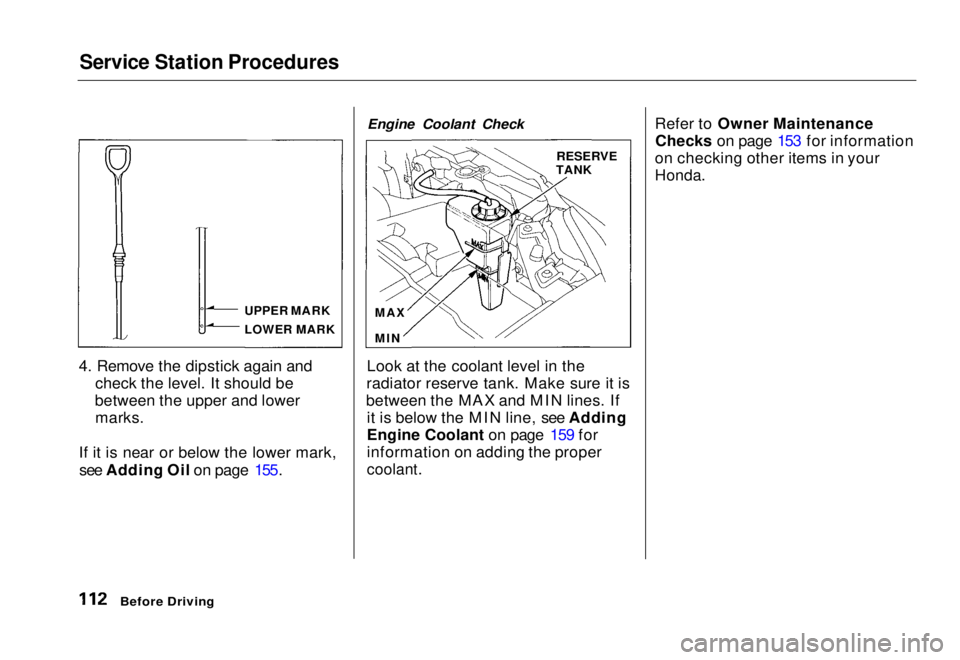
4. Remove the dipstick again and check the level. It should be
between the upper and lower marks.
If it is near or below the lower mark, see Adding Oil on page 155. Engine Coolant Check
Look at the coolant level in the
radiator reserve tank. Make sure it is
between the MAX and MIN lines. If it is below the MIN line, see Adding
Engine Coolant on page 159 for
information on adding the proper
coolant.
Refer to Owner Maintenance
Checks on page 153 for information
on checking other items in your
Honda.
Before Driving
UPPER MARK
LOWER MARK
RESERVE
TANK
MAX
MINMain Menu Table of Contents s t
Page 115 of 251
Fuel Economy
The condition of your vehicle and your driving habits are the two mostimportant things that affect the fuel
mileage you get.
Vehicle Condition Always maintain your vehicle accord- ing to the maintenance schedule.
This will keep it in top operating
condition.
An important part of that mainte- nance is the Owner Maintenance
Checks (see page 153). For
example, an underinflated tire
causes more "rolling resistance,"
which uses fuel. It also wears out
faster, so check the tire pressure at
least monthly.
In winter, the build-up of snow on
your vehicle's underside adds weight and rolling resistance. Frequent
cleaning helps your fuel mileage and
reduces the chance of corrosion. Driving Habits
You can improve fuel economy by driving moderately. Rapid acceler-
ation, abrupt cornering, and hard
braking use more fuel.
Always drive in the highest gear that allows the engine to run and acceler-ate smoothly.
Depending on traffic conditions, try
to maintain a constant speed. Every time you slow down and speed up,
your vehicle uses extra fuel. Use the cruise control, when appropriate, to
increase fuel economy. A cold engine uses more fuel than a
warm engine. It is not necessary to "warm-up" a cold engine by letting it
idle for a long time. You can drive
away in about a minute, no matter
how cold it is outside. The engine
will warm up faster, and you get better fuel economy. To cut down on
the number of "cold starts," try tocombine several short trips into one.
The air conditioning puts an extra load on the engine which makes ituse more fuel. Turn off the A/C to
cut down on air conditioning use.
Use the flow-through ventilation
when the outside air temperature is moderate.
Before DrivingMain Menu Table of Contents s t
Page 142 of 251
Maintenance
This section explains why it is important to keep your vehicle well
maintained and to follow basic
maintenance safety precautions.
This section also includes Maintenance Schedules for normaldriving and severe driving conditions,
a Maintenance Record, and instruc-
tions for simple maintenance tasks
you may want to take care of yourself.
If you have the skills and tools to per-
form more complex maintenance tasks on your Honda, you may want
to purchase the Service Manual. See
page 219 for information on how to obtain a copy, or see your Honda
dealer.
Maintenance Safety....................... 142
Important Safety Precautions.. 143
Maintenance Schedule.................. 144
Maintenance Record..................... 151
Owner Maintenance Checks........ 153
Fluid Locations............................... 154
Engine Oil....................................... 155 Adding Oil................................... 155Recommended Oil..................... 155Synthetic Oil............................... 156
Additives..................................... 156
Changing the Oil and Filter...... 157
Cooling System.............................. 159
Adding Engine Coolant............. 159Replacing Engine Coolant........ 161
Windshield Washers..................... 164
Transmission Fluid........................ 164
Automatic
Transmission.......................... 164
5-speed Manual
Transmission.......................... 166
Brake and Clutch Fluid................. 166
Brake System............................. 167Clutch System............................ 167
Power Steering............................... 168
Air Cleaner Element...................... 169 Spark Plugs..................................... 171
Replacement............................... 171
Specifications............................. 172
Battery............................................ 173
Wiper Blades.................................. 175
Air Conditioning System............... 177 Drive Belts...................................... 178
Timing Belt..................................... 178
Tires................................................ 179 Inflation....................................... 179
Recommended Tire Pressures
for Normal Driving............ 180
Inspection................................... 181
Maintenance............................... 181
Tire Rotation.............................. 182
Replacing Tires and Wheels ....
183
Wheels an d
Tires....................... 184
Winter Driving........................... 184 Snow Tires.............................. 184
Tire Chains............................. 185
Lights.............................................. 186 Headlight Aiming...................... 188
Replacing Bulbs......................... 189
Storing Your Vehicle..................... 197
MaintenanceMain Menu s t
Page 143 of 251
Maintenance Safety
Regularly maintaining your vehicle is
the best way to protect your
investment. Proper maintenance is essential to your safety and the
safety of your passengers. It will also
reward you with more economical,
trouble-free driving and help reduce
air pollution. This section includes instructions for
simple maintenance tasks, such as
checking and adding oil. Any service
items not detailed in this section should be performed by a Honda
technician or other qualified mechanic. Some of the most important safety
precautions are given here. However,
we cannot warn you of every conceivable hazard that can arise in
performing maintenance. Only youcan decide whether or not you
should perform a given task.
Maintenance
Improperly maintaining this
vehicle or failing to correct a problem before driving can
cause a crash in which you can be seriously hurt or killed.
Always follow the inspection and maintenancerecommendations and
schedules in this owner's manual. Failure to properly follow
maintenance instructions and
precautions can cause you to
be seriously hurt or killed.
Always follow the procedures and precautions in this owner'smanual.Main Menu Table of Contents s t
Page 144 of 251
Maintenance Safety
Important Safety Precautions Before you begin any maintenance,
make sure your vehicle is parked on
level ground and that the parking
brake is set. Also, be sure the engine is off. This will help to eliminate
several potential hazards:
Carbon monoxide poisoning
from engine exhaust. Be sure there is adequate ventilation
whenever you operate the engine.
Burns from hot parts. Let theengine and exhaust system cool
before touching any parts.
Injury from moving parts. Do
not run the engine unless in-
structed to do so. Read the instructions before you
begin, and make sure you have the
tools and skills required.
To reduce the possibility of fire or explosion, be careful when working
around gasoline or batteries. Use a
nonflammable solvent, not gasoline, to clean parts. Keep cigarettes,sparks, and flames away from the
battery and all fuel-related parts.
You should wear eye protection and protective clothing when working
near the battery or when usingcompressed air.
MaintenanceMain Menu Table of Contents s t
Page 145 of 251
Maintenance Schedule
The Maintenance Schedule specifies how often you should have your
vehicle serviced and what things
need attention. It is essential that
you have your vehicle serviced as scheduled to retain its high level of
safety, dependability, and emissions
control performance.
The services and time or distance
intervals shown in the maintenanceschedule assume you will use your
vehicle as normal transportation for passengers and their possessions.
You should also follow these
recommendations:
Avoid exceeding your vehicle'sload limit. This puts excess stresson the engine, brakes, and many
other parts of your vehicle. The
load limit is shown on the label on
the driver's doorjamb.
Operate your vehicle on
reasonable roads within the legal speed limit.
Drive your vehicle regularly over a
distance of several miles (kilometers). Always use unleaded gasoline with
the proper octane rating (see page
108).
Which Schedule to Follow:
Service your vehicle according to the
time and mileage periods on one of
the Maintenance Schedules on the
following pages. Select the schedule
for "Severe Conditions" if most of
your driving is done under one or more of the conditions listed on that
page. Otherwise, follow the schedule
for "Normal Conditions."
MaintenanceMain Menu Table of Contents s t
Page 146 of 251
Maintenance Schedule
Your authorized Honda dealer knows your vehicle best and can
provide competent, efficient service.However, service at a dealer is not
mandatory to keep your warranties in effect. Maintenance may be done
by any qualified service facility or
person who is skilled in this type of automotive service. Keep all the
receipts as proof of completion, and
have the person who does the work
fill out the Maintenance Record. Check your warranty booklet for
more information. We recommend the use of Genuine
Honda parts and fluids whenever you
have maintenance done. These are
manufactured to the same high- quality standards as the originalcomponents, so you can be confident
of their performance and durability.
U.S. Vehicles:
Maintenance, replacement or
repair of emission control devices
and systems may be done by any
automotive repair establishment or individual using parts that are
"certified" to EPA standards. According to state and federal
regulations, failure to perform
maintenance on the items marked
with # will not void your emissions
warranties. However, Honda recommends that all maintenance
services be performed at the
recommended time or mileage
period to ensure long-term reliability.
MaintenanceMain Menu Table of Contents s t
Page 147 of 251
Maintenance Schedule (Normal Conditions)
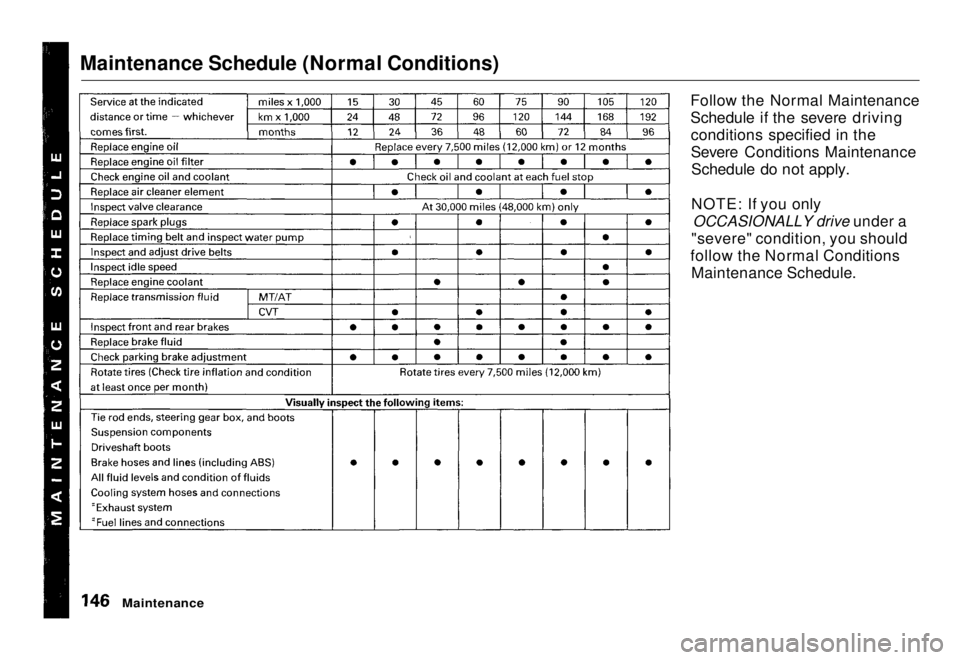
Follow the Normal Maintenance
Schedule if the severe drivingconditions specified in the
Severe Conditions MaintenanceSchedule do not apply.
NOTE: If you only
OCCASIONALLY drive under a
"severe" condition, you should
follow the Normal Conditions Maintenance Schedule.
MaintenanceMain Menu Table of Contents s t
Page 148 of 251
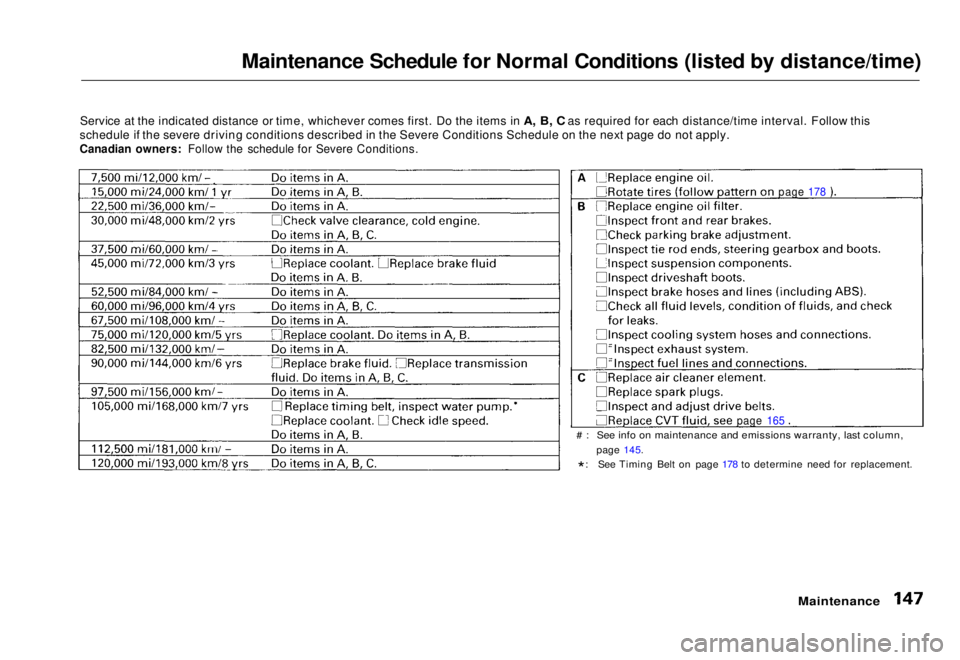
Maintenance Schedule for Normal Conditions (listed by distance/time)
Service at the indicated distance or time, whichever comes first. Do the items in A, B, C as required for each distance/time interval. Follow this
schedule if
the severe driving conditions described in the Severe Conditions Schedule on the next page do not apply.
Canadian owners: Follow the schedule for Severe Conditions.
Maintenance
page 178
page 165
# : See info on maintenance and emissions warranty, last column,
page 145.
* : See Timing Belt on page 178 to determine need for replacement.Main Menu Table of Contents s t
Page 149 of 251
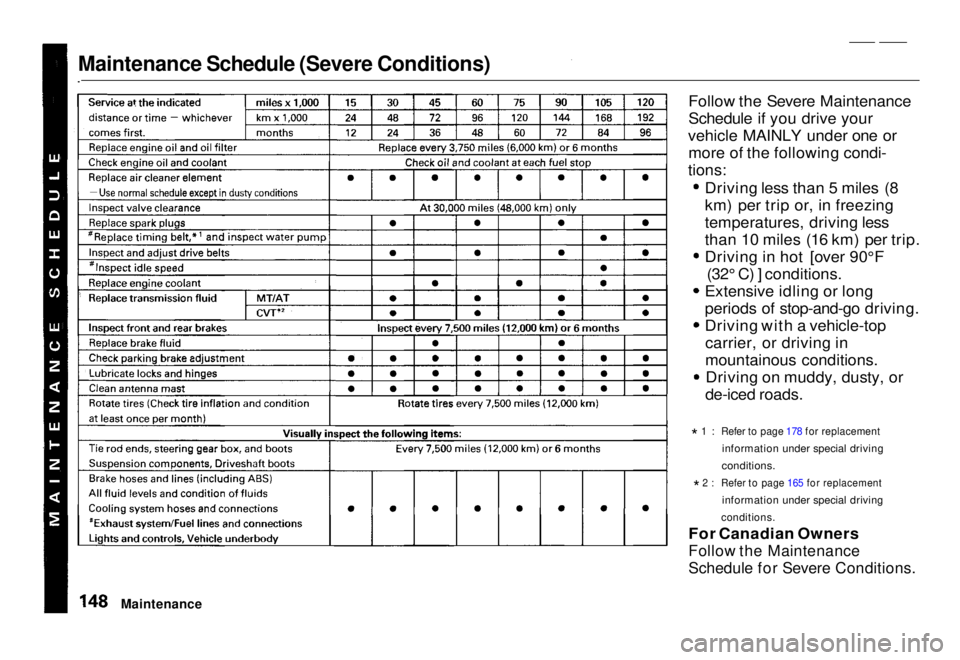
Maintenance Schedule (Severe Conditions)
Follow the Severe Maintenance
Schedule if you drive your
vehicle MAINLY under one or more of the following condi-
tions:
Driving less than 5 miles (8
km) per trip or, in freezing
temperatures, driving less
than 10 miles (16 km) per trip.
Driving in hot [over 90°F(32° C) ] conditions.
Extensive idling or long
periods of stop-and-go driving.
Driving with a vehicle-top carrier, or driving in
mountainous conditions.Driving on muddy, dusty, or
de-iced roads.
* 1 : Refer to page 178 for replacement
information under special driving
conditions.
* 2: Refer to page 165 for replacement
information under special driving
conditions.
For Canadian Owners
Follow the Maintenance
Schedule for Severe Conditions.
MaintenanceMain Menu Table of Contents s t