warning HONDA CIVIC COUPE 1998 User Guide
[x] Cancel search | Manufacturer: HONDA, Model Year: 1998, Model line: CIVIC COUPE, Model: HONDA CIVIC COUPE 1998Pages: 251, PDF Size: 2.04 MB
Page 207 of 251
Changing a Flat Tire
If you have a flat tire while driving, stop in a safe place to change it.
Stopping in traffic or on the shoulder
of a busy road is dangerous. Drive
slowly along the shoulder until you
get to an exit or an area to stop that is far away from the traffic lanes.
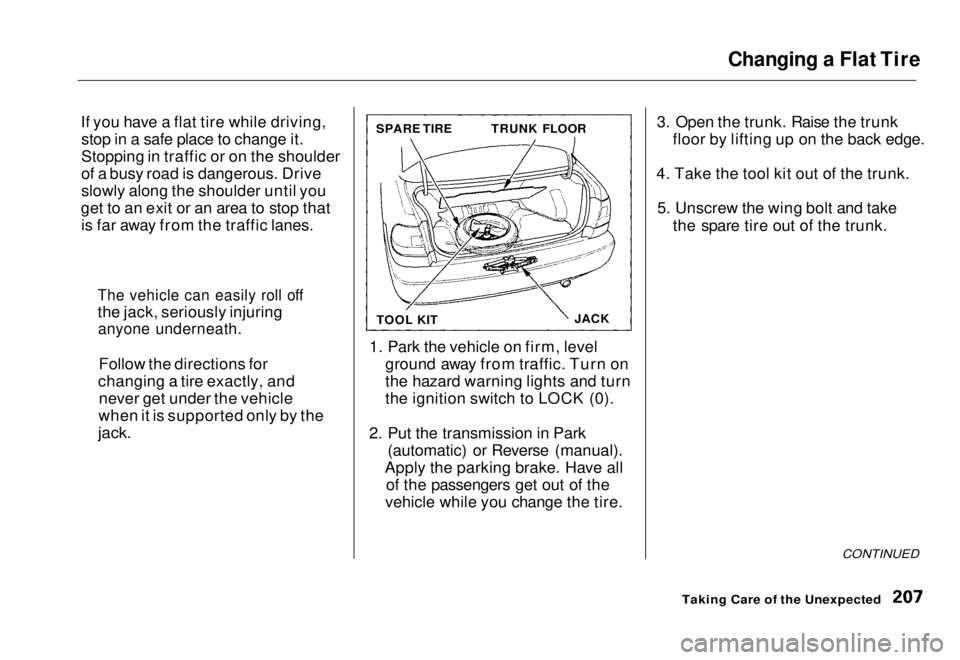
1. Park the vehicle on firm, levelground away from traffic. Turn on
the hazard warning lights and turn
the ignition switch to LOCK (0).
2. Put the transmission in Park (automatic) or Reverse (manual).
Apply the parking brake. Have all of the passengers get out of the
vehicle while you change the tire. 3. Open the trunk. Raise the trunk
floor by lifting up on the back edge.
4. Take the tool kit out of the trunk. 5. Unscrew the wing bolt and take the spare tire out of the trunk.
CONTINUED
Taking Care of the Unexpected
The vehicle can easily roll off
the jack, seriously injuring
anyone underneath.
Follow the directions for
changing a tire exactly, and never get under the vehicle
when it is supported only by the
jack.
SPARE TIRE
TRUNK FLOOR
TOOL KIT JACKMain Menu Table of Contents s t
Page 213 of 251
If Your Engine Won't Start, Jump Starting
The Starter Operates Normally In this case, the starter motor'sspeed sounds normal, or even faster
than normal, when you turn the ignition switch to START (III), but
the engine does not run.
Are you using the proper startingprocedure? Refer to Starting the
Engine on page 121.
Do you have fuel? Turn the
ignition switch to ON (II) for a
minute and watch the fuel gauge.
The low fuel level warning light may not be working, so you were
not reminded to fill the tank.
There may be an electrical problem, such as no power to the
fuel pump. Check all the fuses (see page 223).
If you find nothing wrong, you will
need a qualified technician to find
the problem. See Emergency Towing on page 227. Jump Starting
If your vehicle's battery has rundown, you may be able to start the
engine by using a booster battery.
Although this seems like a simple procedure, you should take several
precautions.
You cannot start a Honda with anautomatic transmission by pushing
or pulling it. To jump start your vehicle, follow
these directions closely:
1. Open the hood and check the physical condition of the battery(see page 150). In very cold
weather, check the condition of the electrolyte. If it seems slushyor like ice, do not try jump starting
until it thaws.
If a battery sits in extreme cold, the
electrolyte inside can freeze.
Attempting to jump start with a frozen
battery can cause it to rupture.
2. Turn off all the electrical acces- sories: heater, A/C, stereo system,
lights, etc.
Put the transmission in Neutral or
Park and set the parking brake.
CONTINUED
Taking Care of the Unexpected
A battery can explode if you do
not follow the correct procedure,
seriously injuring anyone nearby.
Keep all sparks, open flames,
and smoking materials away
from the battery.
NOTICEMain Menu Table of Contents s t
Page 215 of 251
If Your Engine Overheats
The pointer of your vehicle's temperature gauge should stay in
the midrange under most conditions.It may go higher if you are driving up
a long steep hill on a very hot day. If
it climbs to the red mark, you should
determine the reason.
Driving with the temperature gauge-
pointer at the red mark can cause serious damage to your engine. Your vehicle can overheat for several
reasons, such as lack of coolant or a
mechanical problem. The only
indication may be the temperature
gauge climbing to or above the red
mark. Or you may see steam or
spray coming from under the hood.
In either case, you should take
immediate action.
1. Safely pull to the side of the road.
Put the transmission in Neutral or
Park and set the parking brake.
Turn off the heating and cooling system and all other accessories.
Turn on the hazard warning
indicators.
2. If you see steam and/or spray coming from under the hood, turnoff the engine.
3. If you do not see steam or spray, leave the engine running and
watch the temperature gauge. If
the high heat is due to overloading (climbing a long, steep hill on a
hot day with the A/C running, for
example), the engine should start
to cool down almost immediately. If it does, wait until the tempera-
ture gauge comes down to the mid-
point then continue driving.
CONTINUED
Taking Care of the Unexpected
NOTICE
Steam and spray from an
overheated engine can
seriously scald you.Do not open the hood if steam
is coming out.Main Menu Table of Contents s t
Page 217 of 251
Low Oil Pressure Indicator
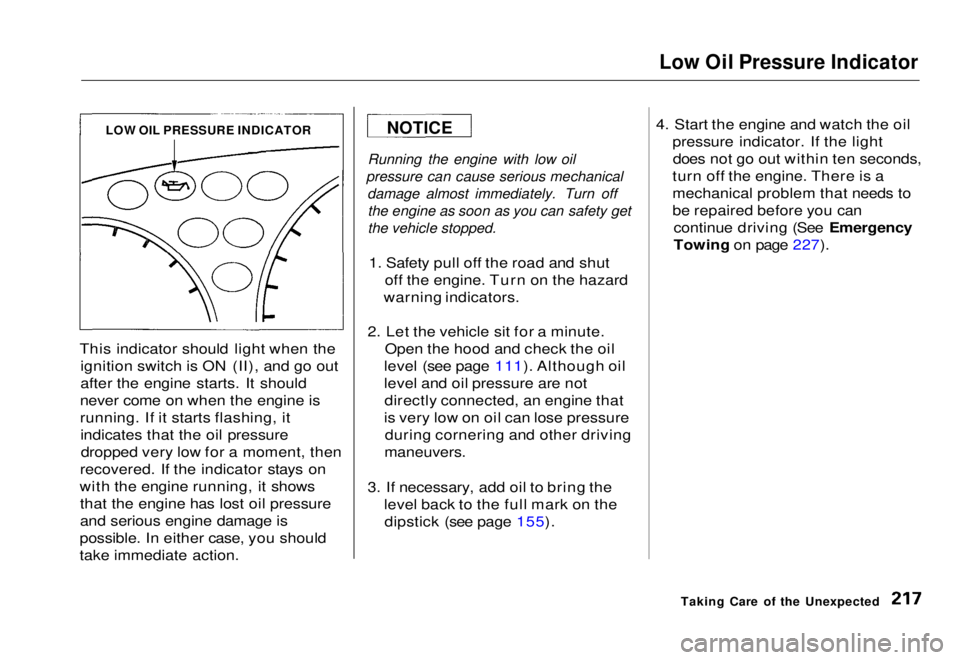
This indicator should light when the ignition switch is ON (II), and go out
after the engine starts. It should
never come on when the engine is
running. If it starts flashing, it indicates that the oil pressuredropped very low for a moment, then
recovered. If the indicator stays on
with the engine running, it shows that the engine has lost oil pressure
and serious engine damage is
possible. In either case, you should
take immediate action.
Running the engine with low oil
pressure can cause serious mechanical damage almost immediately. Turn offthe engine as soon as you can safety get
the vehicle stopped.
1. Safety pull off the road and shut off the engine. Turn on the hazard
warning indicators.
2. Let the vehicle sit for a minute. Open the hood and check the oil
level (see page 111). Although oil
level and oil pressure are not directly connected, an engine that
is very low on oil can lose pressure during cornering and other driving
maneuvers.
3. If necessary, add oil to bring the level back to the full mark on thedipstick (see page 155). 4. Start the engine and watch the oil
pressure indicator. If the lightdoes not go out within ten seconds,
turn off the engine. There is a
mechanical problem that needs to
be repaired before you can continue driving (See Emergency
Towing on page 227).
Taking Care of the Unexpected
LOW OIL PRESSURE INDICATOR
NOTICEMain Menu Table of Contents s t
Page 237 of 251

Tire Information
Traction
The traction grades, from highest to lowest, are A, B, and C, and they
represent the tire's ability to stop on
wet pavement as measured under controlled conditions on specified
government test surfaces of asphaltand concrete. A tire marked C may
have poor traction performance.
Warning: The traction grade as- signed to this tire is based on brak-
ing (straight ahead) traction tests
and does not include cornering (turning) traction.
Temperature
The temperature grades are A (the highest), B, and C, representing the
tire's resistance to the generation of
heat and its ability to dissipate heat
when tested under controlled conditions on a specified indoor
laboratory test wheel. Sustained high
temperature can cause the material of the tire to degenerate and reduce
tire life, and excessive temperature can lead to sudden tire failure. The
grade C corresponds to a level of
performance which all passenger car tires must meet under the Federal
Motor Vehicle Safety Standard No. 109. Grades B and A represent
higher levels of performance on the laboratory test wheel than the
minimum required by law. Warning: The temperature grade for
this tire is established for a tire that
is properly inflated and not over-
loaded. Excessive speed, underinfla- tion, or excessive loading eitherseparately or in combination, can
cause heat build-up and possible tire
failure.
Technical InformationMain Menu Table of Contents s t
Page 250 of 251
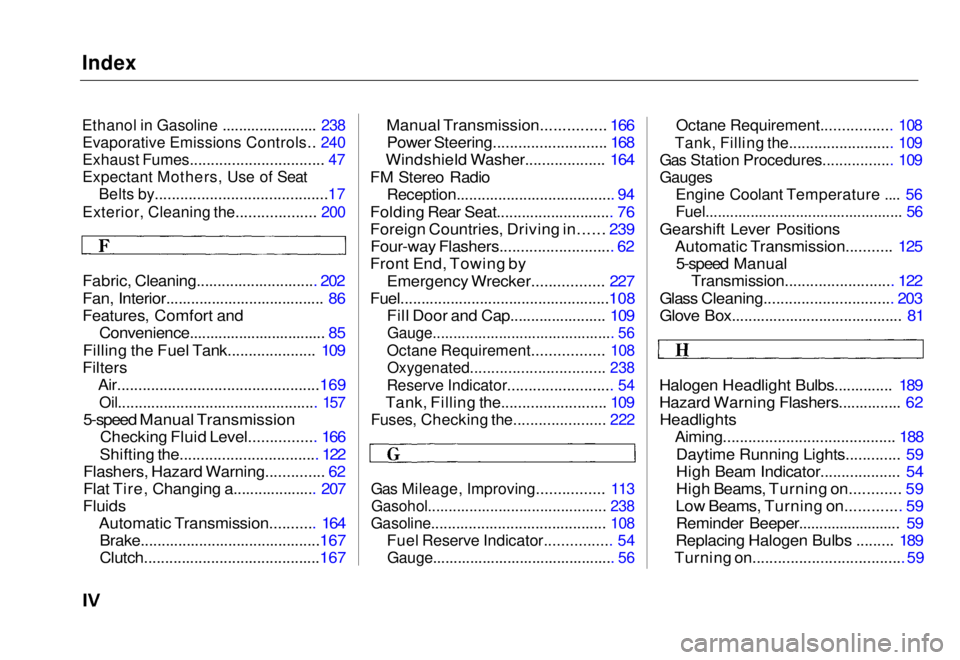
Index
Ethanol in Gasoline ....................... 238
Evaporative Emissions Controls.. 240
Exhaust Fumes................................ 47
Expectant Mothers, Use of Seat
Belts by.........................................17
Exterior, Cleaning the................... 200
Fabric, Cleaning............................. 202
Fan, Interior...................................... 86
Features, Comfort and Convenience................................. 85
Filling the Fuel Tank..................... 109
Filters
Air................................................169
Oil................................................ 157
5-speed Manual Transmission
Checking Fluid Level................ 166
Shifting the................................. 122
Flashers, Hazard Warning.............. 62
Flat Tire, Changing a.................... 207
Fluids
Automatic Transmission........... 164
Brake...........................................167
Clutch..........................................167
Manual Transmission............... 166
Power Steering........................... 168
Windshield Washer................... 164
FM Stereo Radio
Reception...................................... 94
Folding Rear Seat............................ 76
Foreign Countries, Driving in...... 239
Four-way Flashers........................... 62
Front End, Towing by
Emergency Wrecker................. 227
Fuel..................................................108
Fill Door and Cap....................... 109
Gauge............................................ 56
Octane Requirement................. 108
Oxygenated................................ 238
Reserve Indicator......................... 54
Tank, Filling the......................... 109
Fuses, Checking the...................... 222
Gas Mileage, Improving................ 113
Gasohol........................................... 238
Gasoline.......................................... 108
Fuel Reserve Indicator................ 54
Gauge............................................ 56
Octane Requirement................. 108
Tank, Filling the......................... 109
Gas Station Procedures................. 109
Gauges
Engine Coolant Temperature .... 56
Fuel................................................ 56
Gearshift Lever Positions Automatic Transmission........... 1255-speed Manual Transmission.......................... 122
Glass Cleaning............................... 203
Glove Box......................................... 8 1
Haloge n Headligh t
Bulbs.............. 189
Hazard Warning Flashers............... 62
Headlights
Aiming......................................... 188
Daytime Running Lights............. 59
High Beam Indicator................... 54
High Beams, Turning on............ 59
Low Beams, Turning on............. 59 Reminder Beeper......................... 59
Replacing Halogen Bulbs ......... 189
Turning on....................................
59Main Menu s t
Page 251 of 251
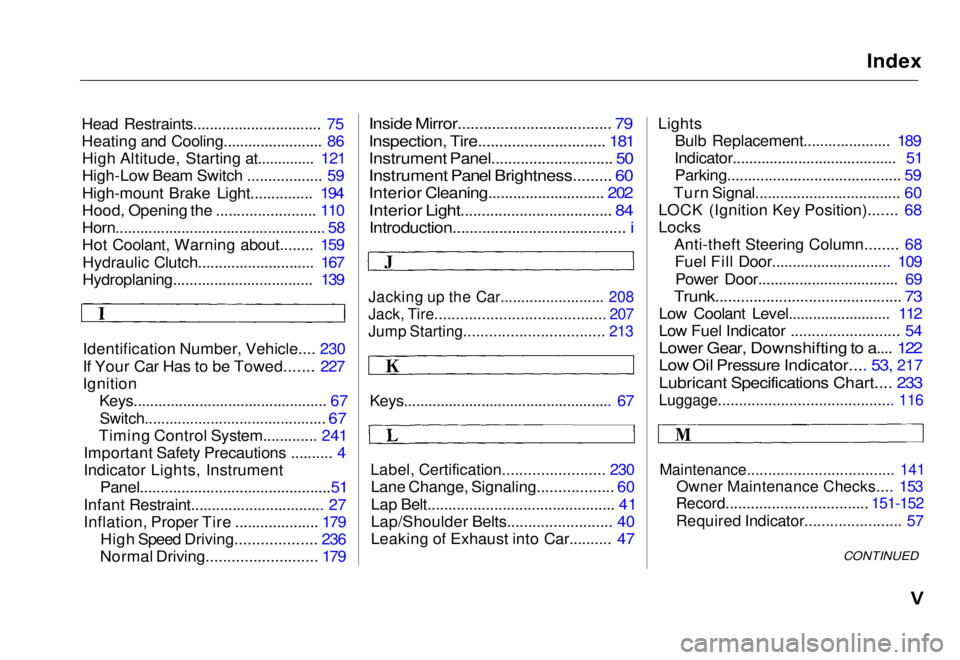
Index
Head Restraints............................... 75
Heating and Cooling........................ 86 High Altitude, Starting at.............. 121
High-Low Beam Switch .................. 59
High-mount Brake Light............... 194
Hood, Opening the ........................ 110
Horn................................................... 58
Hot Coolant, Warning about........ 159
Hydraulic Clutch............................ 167
Hydroplaning.................................. 139
Identification Number, Vehicle.... 230
If Your Car Has to be Towed....... 227
Ignition
Keys............................................... 67
Switch............................................ 67
Timing Contro l
System............. 241
Important Safety Precautions .......... 4
Indicator Lights, Instrument
Panel..............................................51
Infant Restraint................................ 27
Inflation, Proper Tire .................... 179 High Speed Driving................... 236
Normal Driving.......................... 179
Inside Mirror.................................... 79
Inspection, Tire.............................. 181
Instrument Panel............................. 50
Instrument Panel Brightness......... 60
Interior Cleaning............................ 202
Interior Light.................................... 84
Introduction......................................... i
Jacking up the Car......................... 208
Jack, Tire........................................ 207
Jump Starting................................. 213
Keys................................................... 67
Label, Certification........................ 230
Lane Change, Signaling.................. 60
Lap Belt............................................. 41
Lap/Shoulder Belts......................... 40
Leaking of Exhaust into Car.......... 47 Lights
Bulb Replacement..................... 189
Indicator........................................ 51 Parking.......................................... 59
Turn Signal................................... 60
LOCK (Ignition Key Position)....... 68
Locks
Anti-theft Steering Column........ 68Fuel Fill Door............................. 109
Power Door.................................. 69
Trunk............................................ 73
Low Coolant Level......................... 112
Low Fuel Indicator .......................... 54
Lower Gear, Downshifting to a.... 122
Low Oil Pressure Indicator.... 53,
217
Lubricant Specification s
Chart.... 233
Luggage.......................................... 116
Maintenance................................... 141
Owner Maintenance Checks.... 153
Record.................................. 151-152
Required Indicator....................... 57
CONTINUEDMain Menu s t