octane HONDA CIVIC COUPE 1998 Owners Manual
[x] Cancel search | Manufacturer: HONDA, Model Year: 1998, Model line: CIVIC COUPE, Model: HONDA CIVIC COUPE 1998Pages: 251, PDF Size: 2.04 MB
Page 110 of 251
Break-in Period, Gasoline
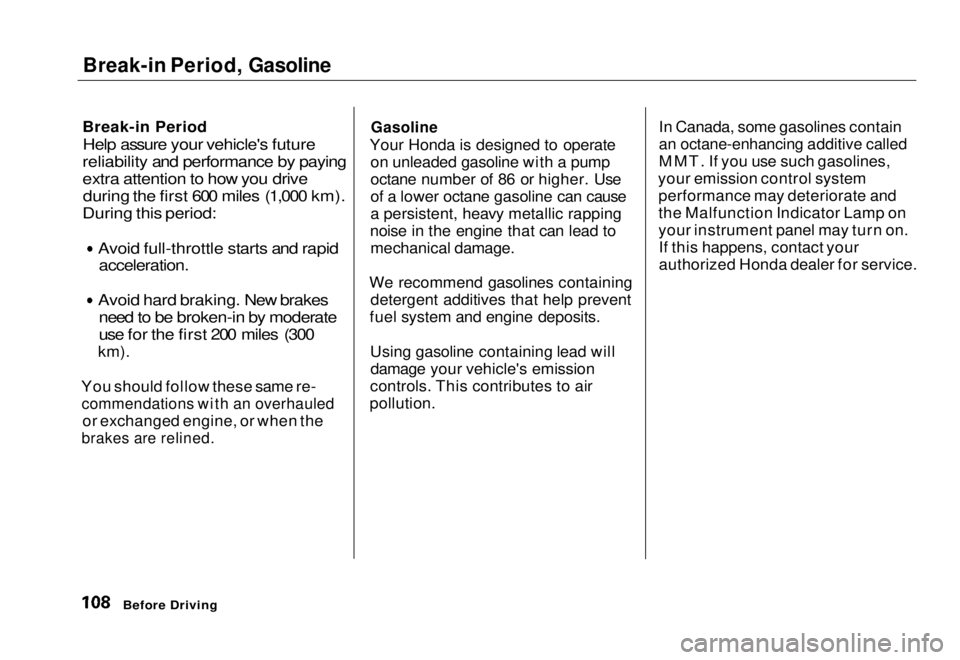
Break-in Period
Help assure your vehicle's future
reliability and performance by paying
extra attention to how you drive during the first 600 miles (1,000 km).
During this period:
Avoid full-throttle starts and rapid
acceleration.
Avoid hard braking. New brakes
need to be broken-in by moderate
use for the first 200 miles (300
km).
You should follow these same re-
commendations with an overhauled
or exchanged engine, or when the
brakes are relined.
Gasoline
Your Honda is designed to operate on unleaded gasoline with a pump
octane number of 86 or higher. Use
of a lower octane gasoline can cause
a persistent, heavy metallic rapping
noise in the engine that can lead to mechanical damage.
We recommend gasolines containing detergent additives that help prevent
fuel system and engine deposits.
Using gasoline containing lead willdamage your vehicle's emission
controls. This contributes to air
pollution.
In Canada, some gasolines contain
an octane-enhancing additive called
MMT. If you use such gasolines,
your emission control system performance may deteriorate and
the Malfunction Indicator Lamp on
your instrument panel may turn on.If this happens, contact your
authorized Honda dealer for service.
Before DrivingMain Menu Table of Contents s t
Page 145 of 251
Maintenance Schedule
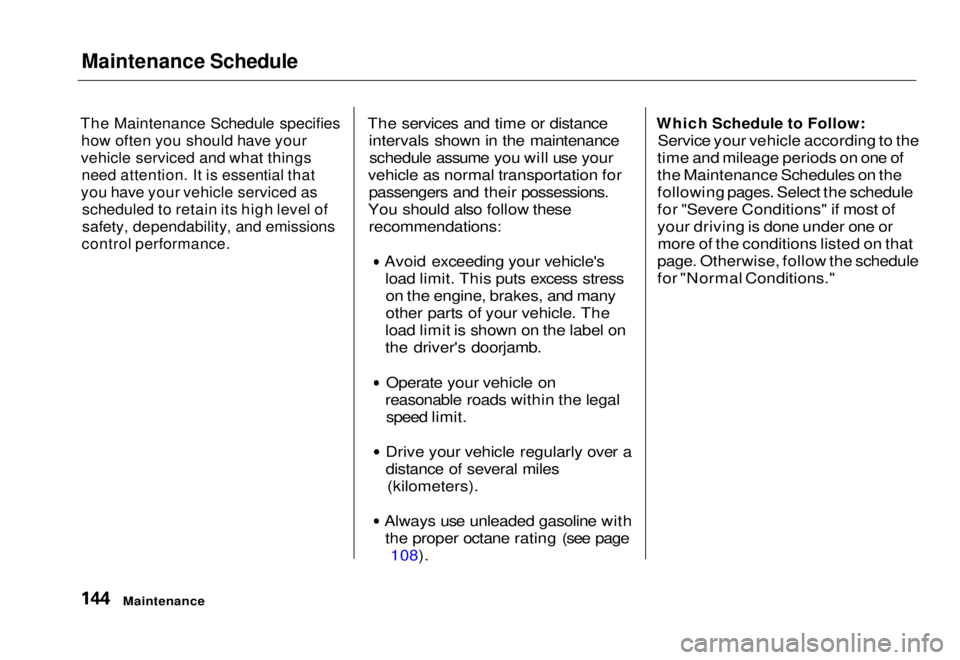
The Maintenance Schedule specifies how often you should have your
vehicle serviced and what things
need attention. It is essential that
you have your vehicle serviced as scheduled to retain its high level of
safety, dependability, and emissions
control performance.
The services and time or distance
intervals shown in the maintenanceschedule assume you will use your
vehicle as normal transportation for passengers and their possessions.
You should also follow these
recommendations:
Avoid exceeding your vehicle'sload limit. This puts excess stresson the engine, brakes, and many
other parts of your vehicle. The
load limit is shown on the label on
the driver's doorjamb.
Operate your vehicle on
reasonable roads within the legal speed limit.
Drive your vehicle regularly over a
distance of several miles (kilometers). Always use unleaded gasoline with
the proper octane rating (see page
108).
Which Schedule to Follow:
Service your vehicle according to the
time and mileage periods on one of
the Maintenance Schedules on the
following pages. Select the schedule
for "Severe Conditions" if most of
your driving is done under one or more of the conditions listed on that
page. Otherwise, follow the schedule
for "Normal Conditions."
MaintenanceMain Menu Table of Contents s t
Page 238 of 251
Oxygenated Fuels
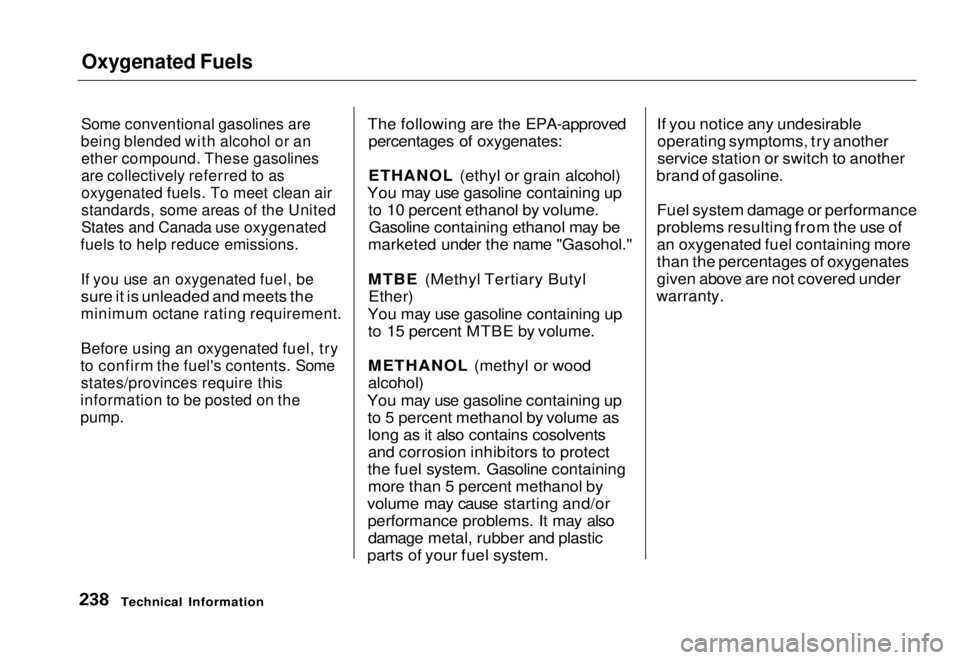
Some conventional gasolines are
being blended with alcohol or an
ether compound. These gasolines
are collectively referred to as
oxygenated fuels. To meet clean air
standards, some areas of the United
States and Canada use oxygenated
fuels to help reduce emissions.
If you use an oxygenated fuel, be
sure it is unleaded and meets the
minimum octane rating requirement.
Before using an oxygenated fuel, try
to confirm the fuel's contents. Some
states/provinces require this
information to be posted on the
pump.
The following are the EPA-approved
percentages of oxygenates:
ETHANOL (ethyl or grain alcohol)
You may use gasoline containing up to 10 percent ethanol by volume.Gasoline containing ethanol may be
marketed under the name "Gasohol.''
MTBE (Methyl Tertiary Butyl Ether)
You may use gasoline containing up to 15 percent MTBE by volume.
METHANOL (methyl or wood
alcohol)
You may use gasoline containing up to 5 percent methanol by volume aslong as it also contains cosolvents
and corrosion inhibitors to protect
the fuel system. Gasoline containing more than 5 percent methanol by
volume may cause starting and/or performance problems. It may alsodamage metal, rubber and plastic
parts of your fuel system. If you notice any undesirable
operating symptoms, try another
service station or switch to another
brand of gasoline.
Fuel system damage or performance
problems resulting from the use of
an oxygenated fuel containing more
than the percentages of oxygenates
given above are not covered under
warranty.
Technical InformationMain Menu Table of Contents s t
Page 239 of 251

Driving In Foreign Countries
Technical Information
If you are planning to take your
Honda outside the U.S. or Canada,
contact the tourist bureaus in the
areas you will be traveling in to find out about the availability of unleaded
gasoline with the proper octane
rating.
If unleaded gasoline is not available,
be aware that using leaded gasoline in your Honda will affect perfor-
mance and fuel mileage, and damage
its emissions controls. It will no
longer comply with U.S. and Canadian emissions regulations, and
will be illegal to operate in North
America. To bring your vehicle back into compliance will require the re-
placement of several components, such as the oxygen sensors and the
three way catalytic converter. These
replacements are not covered under
warranty.Main Menu Table of Contents s t
Page 246 of 251
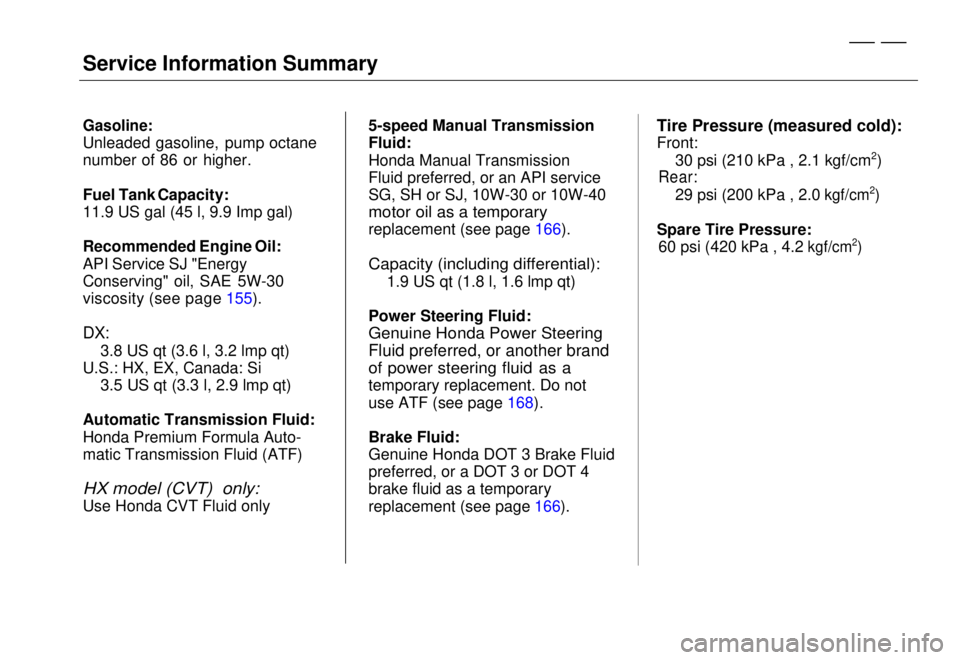
Gasoline:
Unleaded gasoline, pump octane
number of 86 or higher.
Fuel Tank Capacity:
11.9 US gal (45 l, 9.9 Imp gal)
Recommended Engine Oil:
API Service SJ "Energy
Conserving" oil, SAE 5W-30
viscosity (see page 155).
DX:
3.8 US qt (3.6 l, 3.2 lmp qt)
U.S.: HX, EX, Canada: Si
3.5 US qt (3.3 l, 2.9 lmp qt)
Automatic Transmission Fluid:
Honda Premium
Formula Auto-
matic Transmission Fluid (ATF)
HX model (CVT)
only:
Use Honda CVT Fluid only 5-speed Manual Transmission
Fluid:
Honda Manual Transmission
Fluid preferred, or an API service
SG, SH or SJ,
10W-30 or 10W-40
motor oil as a temporary
replacement (see page 166).
Capacity (including differential):
1.9 US qt (1.8 l, 1.6 lmp qt)
Power Steering Fluid:
Genuine Honda Power Steering
Fluid preferred, or another brand
of power steering fluid as a
temporary replacement. Do not
use ATF (see page 168).
Brake
Fluid:
Genuine Honda DOT 3 Brake Fluid
preferred, or a DOT 3 or DOT 4
brake fluid as a temporary
replacement (see page
166).
Tire Pressure (measured cold):
Front:
30 psi (210 kPa , 2.1 kgf/cm2)
Rear:
29 psi (200 kPa , 2.0
kgf/cm2
)
Spare Tire Pressure:
60 psi (420 kPa , 4.2
kgf/cm 2
)
Service
Information SummaryMain Menu s t
Page 250 of 251
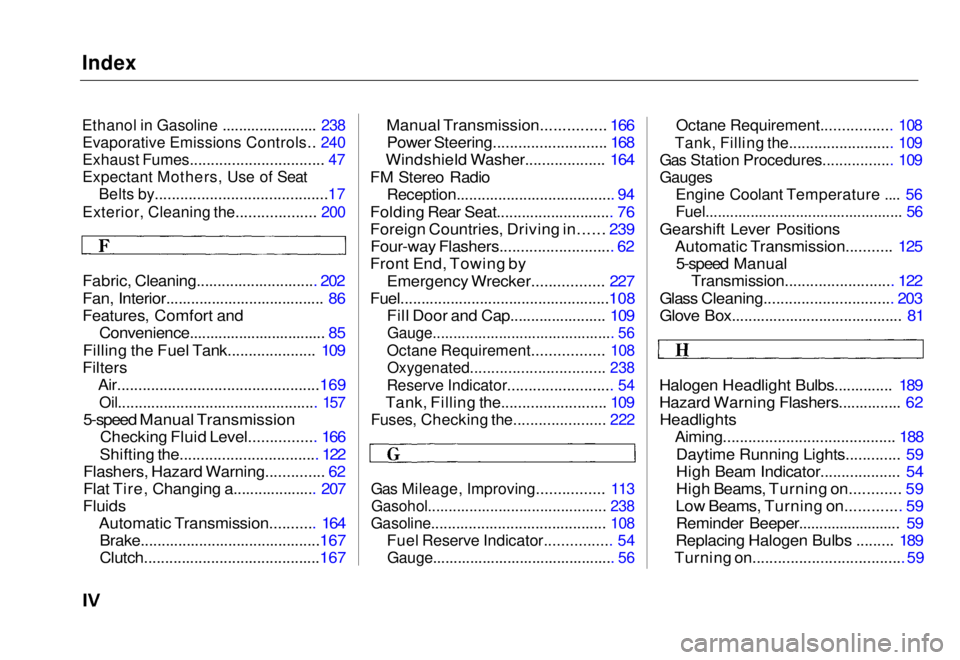
Index
Ethanol in Gasoline ....................... 238
Evaporative Emissions Controls.. 240
Exhaust Fumes................................ 47
Expectant Mothers, Use of Seat
Belts by.........................................17
Exterior, Cleaning the................... 200
Fabric, Cleaning............................. 202
Fan, Interior...................................... 86
Features, Comfort and Convenience................................. 85
Filling the Fuel Tank..................... 109
Filters
Air................................................169
Oil................................................ 157
5-speed Manual Transmission
Checking Fluid Level................ 166
Shifting the................................. 122
Flashers, Hazard Warning.............. 62
Flat Tire, Changing a.................... 207
Fluids
Automatic Transmission........... 164
Brake...........................................167
Clutch..........................................167
Manual Transmission............... 166
Power Steering........................... 168
Windshield Washer................... 164
FM Stereo Radio
Reception...................................... 94
Folding Rear Seat............................ 76
Foreign Countries, Driving in...... 239
Four-way Flashers........................... 62
Front End, Towing by
Emergency Wrecker................. 227
Fuel..................................................108
Fill Door and Cap....................... 109
Gauge............................................ 56
Octane Requirement................. 108
Oxygenated................................ 238
Reserve Indicator......................... 54
Tank, Filling the......................... 109
Fuses, Checking the...................... 222
Gas Mileage, Improving................ 113
Gasohol........................................... 238
Gasoline.......................................... 108
Fuel Reserve Indicator................ 54
Gauge............................................ 56
Octane Requirement................. 108
Tank, Filling the......................... 109
Gas Station Procedures................. 109
Gauges
Engine Coolant Temperature .... 56
Fuel................................................ 56
Gearshift Lever Positions Automatic Transmission........... 1255-speed Manual Transmission.......................... 122
Glass Cleaning............................... 203
Glove Box......................................... 8 1
Haloge n Headligh t
Bulbs.............. 189
Hazard Warning Flashers............... 62
Headlights
Aiming......................................... 188
Daytime Running Lights............. 59
High Beam Indicator................... 54
High Beams, Turning on............ 59
Low Beams, Turning on............. 59 Reminder Beeper......................... 59
Replacing Halogen Bulbs ......... 189
Turning on....................................
59Main Menu s t