tire type HONDA CIVIC COUPE 1998 Owners Manual
[x] Cancel search | Manufacturer: HONDA, Model Year: 1998, Model line: CIVIC COUPE, Model: HONDA CIVIC COUPE 1998Pages: 251, PDF Size: 2.04 MB
Page 6 of 251
Important Safety Precautions
You'll find many safety recommendations throughout thissection, and throughout this manual.
Following are a few
recommendations we consider most important.
Always Wear Your Seat Belt
A seat belt is your best protection in all types of collisions. Airbags
supplement seat belts, but airbags
are designed to inflate only in a
severe frontal collision. So even with
airbags, make sure you and your
passengers always wear your seat
belts, and wear them properly. (See
page 13.)
Restrain All Children Children are safest when they are
properly restrained in the back seat,
not the front seat. A child who is too small for a seat belt must be properly
restrained in a child safety seat. (See
page 19.) Be Aware of Airbag Hazards
While airbags save lives, they can cause serious or fatal injuries to
occupants who sit too close to them,or are not properly restrained.
Infants, young children, and short
adults are at the greatest risk. Besure to follow all instructions and
warnings in this manual. (See page 5.)
Don't Drink and Drive
Alcohol and driving don't mix. Even one drink can reduce your ability to
respond to changing conditions. Reaction time gets worse with every
additional drink. So don't drink and
drive, and don't let your friends drink
and drive, either. Control Your Speed
Excessive speed is a major factor in
crash injuries and deaths, Generally,
the higher the speed the greater the
risk, but serious accidents can also occur at lower speeds. Never drive
faster than is safe for current conditions, regardless of the
maximum speed posted.
Keep Your Vehicle in Safe
Condition
Having a
tire blowout or a
mechanical failure can be extremely
hazardous. To reduce the possibility of such problems, check your tire
pressures and condition frequently, and perform all regularly scheduled
maintenance. (See page 146.)
Driver and Passenger SafetyMain Menu Table of Contents s t
Page 180 of 251

Tires
To safely operate your vehicle, your tires must be the proper type andsize, in good condition with adequate
tread, and correctly inflated. The
following pages give more detailed information on how and when to
check air pressure, how to inspect
your tires for damage and wear, and what to do when your tires need to
be replaced.
Inflation
Keeping the tires properly inflated
provides the best combination of
handling, tread life and riding comfort. Underinflated tires wear
unevenly, adversely affect handling and fuel economy, and are more
likely to fail from being overheated. Overinflated tires can make your
vehicle ride more harshly, are more prone to damage from road hazards,and wear unevenly.
We recommend that you visually check your tires every day. If you
think a tire might be low, check it
immediately with a tire gauge. Use a gauge to measure the air
pressure at least once a month. Even
tires that are in good condition may
lose one to two psi (10 to 20 kPa, 0.1 to 0.2 kgf/cm2) per month.Remember to check the spare tire at
the same time you check all the other tires.
Check the pressure in the tires when
they are cold. This means the vehicle
has been parked for at least three
hours. If you have to drive the
vehicle before checking the tire pressure, the tires can still be
considered "cold" if you drive less
than 1 mile (1.6 km).
CONTINUED
Maintenance
Using tires that are excessively
worn or improperly inflated can
cause a crash in which you can be seriously hurt or killed.
Follow all instructions in this
owner's manual regarding tire
inflation and maintenance.Main Menu Table of Contents s t
Page 184 of 251

Tires
Replacing Tires and Wheels
The tires that came with your vehicle were selected to match the performance capabilities of the
vehicle while providing the best combination of handling, ride
comfort, and long life. You should
replace them with radial tires of thesame size, load range, speed rating,
and maximum cold tire pressure
rating (as shown on the tire's sidewall). Mixing radial and bias-ply
tires on your vehicle can reduce its
braking ability, traction, and steering
accuracy.
It is best to replace all four tires at
the same time. If that is not possible
or necessary, then replace the two
front tires or the two rear tires as a
pair. Replacing just one tire can seriously affect your vehicle's han-
dling.
The ABS works by comparing the
speed of the wheels. When replacing
tires, use the same size originally supplied with the vehicle. Tire size
and construction can affect wheel speed and may cause the system to
work inconsistently.
If you ever need to replace a wheel,
make sure the wheel's specifications
match those of the original wheel
that came on your vehicle. Re-
placement wheels are available at
your Honda dealer.
Maintenance
Installing improper tires on your
vehicle can affect handling and
stability. This can cause a crash in which you can be seriously
hurt or killed.
Always use the size and type of
tires recommended in this owner's manual.Main Menu Table of Contents s t
Page 186 of 251
Tires
Tire Chains
Mount snow chains on your vehicle
when warranted by driving condi- tions or required by local laws. Makesure the chains are the correct size
for your tires. Install them only on
the front tires. If metal chains are
used, they must be SAE class "S".Cable type traction devices can also
be used.
When installing chains, follow the manufacturer's instructions and
mount them as tightly as you can.
Drive slowly with chains installed. If
you hear the chains contacting the body or chassis, stop and investigate
them. Make sure the chains areinstalled tightly, and that they are
not contacting the brake lines or
suspension. Remove the chains as
soon as you begin driving on cleared
roads.
Chains of the wrong size or that are
improperly installed can damage your
vehicle's brake lines, suspension, body,
and wheels. Stop driving if you hear the chains hitting any part of the
vehicles.
Maintenance
NOTICEMain Menu Table of Contents s t
Page 227 of 251
Emergency Towing
If your vehicle needs to be towed,
call a professional towing service or,
if you belong to one, an organization
that provides roadside assistance.
Never tow your vehicle behind another vehicle with just a rope or
chain. It is very dangerous.
There are three popular types of
professional towing equipment.Flat-bed Equipment - The operatorloads your vehicle on the back of a
truck. This is the best way to transport your Honda.
Wheel-Lift Equipment - The tow
truck uses two pivoting arms that go under the tires (front or rear) and lift
them off the ground. The other two
tires remain on the ground.This is an acceptable way to tow
your Honda.
Sling-type Equipment - The tow
truck uses metal cables with hookson the ends. These hooks go around parts of the frame or suspension and
the cables lift that end of the vehicle off the ground. Your vehicle's
suspension and body can be seriously
damaged. This method of towing is
unacceptable.
If your Honda cannot be transported
by flat-bed, it should be towed by
wheel-lift equipment with the front
wheels off the ground. If, due to damage, your vehicle must be towed
with the front wheels on the ground, do the following.
5-speed Manual Transmission
Release the parking brake.Shift the transmission to Neutral.
Automatic Transmission Release the parking brake.Start the engine.
Shift to D4, then to N.
Turn off the engine.
Improper towing preparation will
damage the transmission. Follow
the above procedure exactly. If you
cannot shift the transmission or
start the engine (automatic
transmission), your vehicle must be
transported with the front wheels
off the ground.
With the front wheels on the
ground, it is best to tow the vehicle
no farther than 50 miles (80 km), and keep the speed below 35 mph
(55 km/h).
If you decide to tow your vehicle
with all four wheels on the ground,
make sure you use a properly-
designed and attached tow bar.
Prepare the vehicle for towing as
described above, and leave theignition switch in Accessory (I) so
the steering wheel does not lock.
Make sure the radio and any items
Taking Care of the Unexpected
NOTICEMain Menu Table of Contents s t
Page 235 of 251
Tire Information
Tire Size Designation
A tire's sidewall is marked with a tire size designation. You will need this
information when selecting replace-
ment tires for your vehicle. The
following explains what the letters and numbers in the tire size
designation mean.
(Example tire size designation)
P185/65R14 85S
P — Applicable vehicle type (tires
marked with the prefix "P" are
intended for use on passenger
vehicles; however, not all tires have this marking).
185 — Tire width in millimeters.
65 — Aspect ratio. The tire's section
height as a percentage of its width.
R — Tire construction code (Radial).
14 — Rim diameter in inches. 85 — Load Index, a numerical code
associated with the maximum load
the tire can carry.
S — Speed Symbol. See the speed
rating chart in this section foradditional information.
Wheel Size Designation
Wheels are also marked with important information that you need
if you ever have to replace one. The
following explains what the letters and numbers in the wheel size
designation mean.
(Example wheel size designation)
14 x 5J
14 — Ri
m diameter in inches.
5 — Rim width in inches.
J — Rim contour designation. Tire Speed Ratings
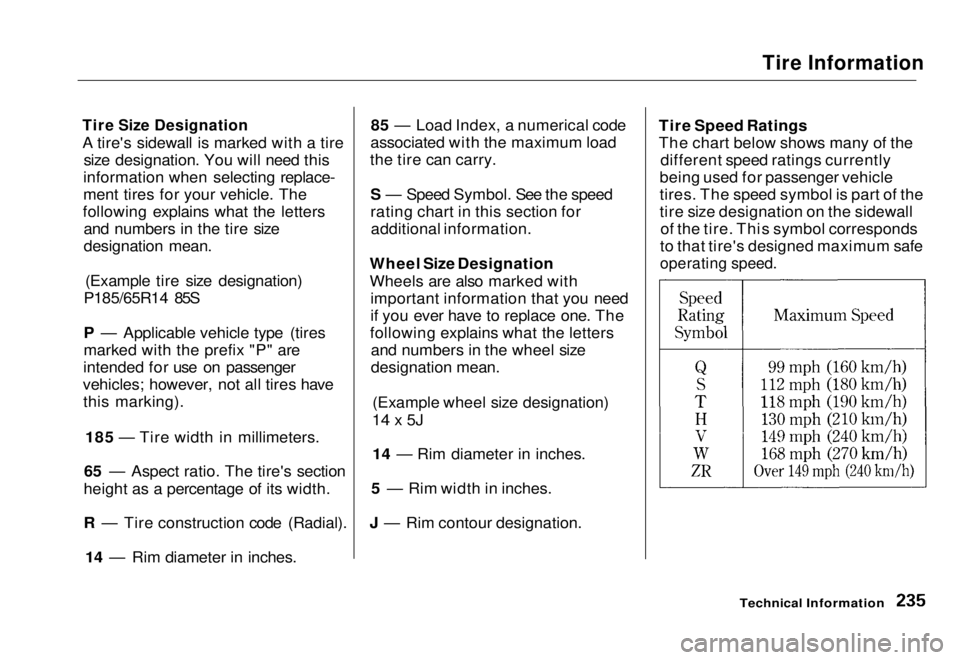
The chart below shows many of the
different speed ratings currently
being used for passenger vehicle
tires. The speed symbol is part of the
tire size designation on the sidewall of the tire. This symbol corresponds
to that tire's designed maximum safe
operating speed.
Technical InformationMain Menu Table of Contents s t
Page 244 of 251

Warranty Coverages
U.S. Owners
Your new Honda is covered by these
warranties:
New Vehicle Limited Warranty —
covers your new vehicle, except for
the battery, emissions controlsystems and accessories, against
defects in materials and
workmanship.
Emissions Control Systems Defects Warranty and Emissions
Performance Warranty — these two
warranties cover your vehicle's emis- sions control systems. Time, mileage,
and coverage are conditional. Please
read the warranty manual for exact
information.
Original Equipment Battery Limited
Warranty — this warranty gives up
to 100 percent credit toward a
replacement battery. Seat Belt Limited Warranty — a seat
belt that fails to function properly is covered for the useful life of the
vehicle.
Rust Perforation Limited Warranty
— all exterior body panels are
covered for rust-through from the
inside for the specified time period
with no mileage limit.
Accessory Limited Warranty —
Genuine Honda Accessories are
covered under this warranty. Time
and mileage limits depend on the
type of accessory and other factors.
Please read your warranty manual
for details.
Replacement Parts Limited Warranty — covers all Genuine
Honda replacement parts against
defects in materials and workman-
ship.
Replacement Battery Limited
Warranty — provides prorated
coverage for a replacement battery
purchased from a Honda dealer.
Replacement Muffler LifetimeLimited Warranty — provides
coverage for as long as the pur-
chaser of the muffler owns the
vehicle.
Restrictions and exclusions apply to
all these warranties. Please read the 1998 Honda Warranty Information
booklet that came with your vehicle for precise information on warranty
coverages. Your Honda's original
tires are covered by their manufactur- er. Tire warranty information is in a
separate booklet.
Canadian Owners
Please refer to the 1998 Warranty
Manual that came with your vehicle.
Warranty and Customer RelationsMain Menu Table of Contents s t