automatic transmission HONDA CIVIC COUPE 1999 User Guide
[x] Cancel search | Manufacturer: HONDA, Model Year: 1999, Model line: CIVIC COUPE, Model: HONDA CIVIC COUPE 1999Pages: 269, PDF Size: 2.42 MB
Page 146 of 269
Automatic Transmission (CVT)
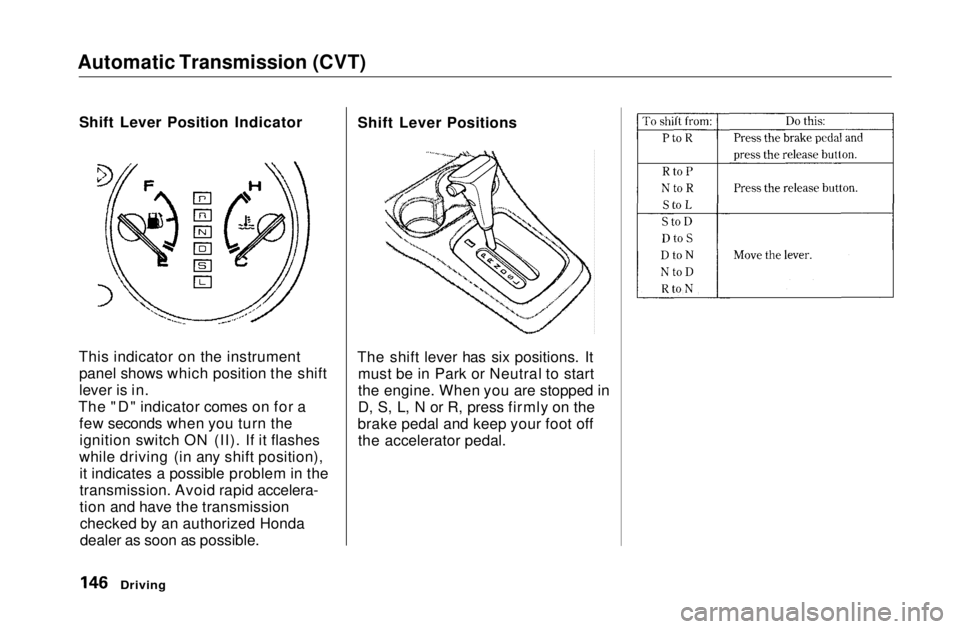
Shift Lever Position Indicator
This indicator on the instrument panel shows which position the shift
lever is in.
The "D" indicator comes on for a few seconds when you turn theignition switch ON (II). If it flashes
while driving (in any shift position), it indicates a possible problem in the
transmission. Avoid rapid accelera-
tion and have the transmissionchecked by an authorized Honda
dealer as soon as possible. Shift Lever Positions
The shift lever has six positions. It must be in Park or Neutral to start
the engine. When you are stopped in
D, S, L, N or R, press firmly on the
brake pedal and keep your foot off the accelerator pedal.
DrivingMain Menu Table of Contents s t
Page 147 of 269
Automatic Transmission (CVT)
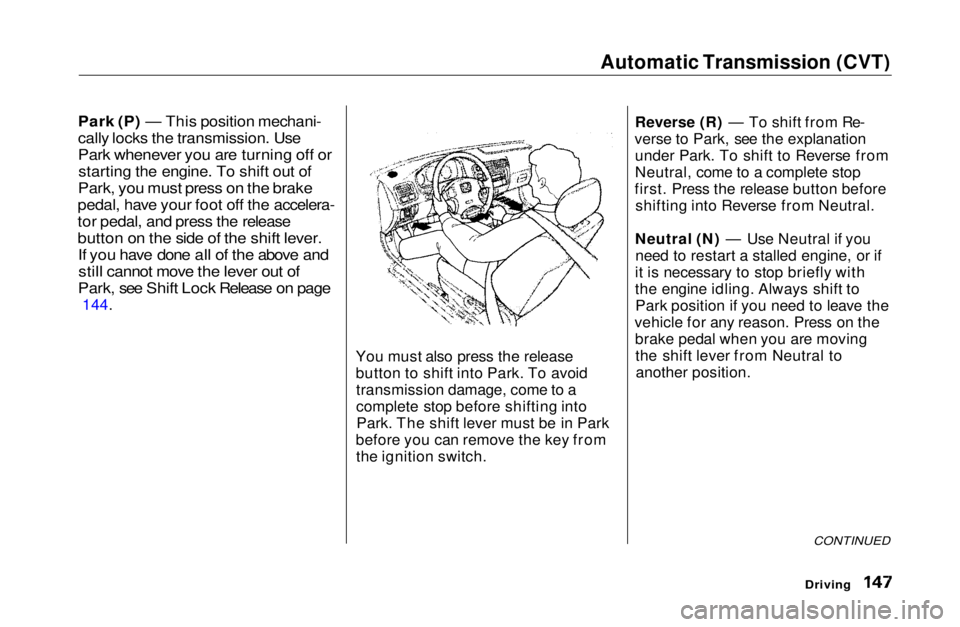
Park (P) — This position mechani-
cally locks the transmission. Use
Park whenever you are turning off or
starting the engine. To shift out of
Park, you must press on the brake
pedal, have your foot off the accelera-
tor pedal, and press the release
button on the side of the shift lever.
If you have done all of the above andstill cannot move the lever out of
Park, see Shift Lock Release on page
144.
You must also press the release
button to shift into Park. To avoidtransmission damage, come to a
complete stop before shifting intoPark. The shift lever must be in Park
before you can remove the key from the ignition switch. Reverse (R) — To shift from Re-
verse to Park, see the explanation under Park. To shift to Reverse from
Neutral, come to a complete stop
first. Press the release button before shifting into Reverse from Neutral.
Neutral (N) — Use Neutral if you need to restart a stalled engine, or if
it is necessary to stop briefly with
the engine idling. Always shift to Park position if you need to leave the
vehicle for any reason. Press on the brake pedal when you are movingthe shift lever from Neutral toanother position.
CONTINUED
DrivingMain Menu Table of Contents s t
Page 148 of 269
Automatic Transmission (CVT)
Drive (D) — Use this position for
your normal driving. The transmis- sion automatically adjusts to keep
the engine at the best speed for
driving conditions. To help the engine warm up faster, the transmis-
sion will select ratios that allow the
engine to run at higher speeds when
it is cold.
Second (S) — Selecting Second
shifts the transmission into a lower
range of ratios for better accelera-
tion and increased engine braking. Use Second when you are goingdown a steep hill, or in stop-and-go
driving.
Low (L) — To shift to Low, press
the release button on the side of the shift lever. Use Low to get more
power when climbing, and for maximum engine braking when
going down steep hills.
For faster acceleration when in D, S
or L, the transmission will
automatically "kick down" to a lower range of ratios when you push the
accelerator pedal to the floor. Maximum Allowable Speeds
The CVT shifts automatically to maintain proper engine speed in anyshift position.
When the vehicle reaches the maximum speed in any shift position,
you may feel the engine cut in and out. This is caused by a limiter (112
mph, 180 km/h) in the engine's computer controls. The engine will
run normally when you reduce the speed below the maximum.
DrivingMain Menu Table of Contents s t
Page 149 of 269
Parking
Always use the parking brake when
you park your car. The indicator on the instrument panel shows that theparking brake is not fully released; it
does not indicate that the parking
brake is firmly set. Make sure the parking brake is set firmly or your
car may roll if it is parked on an
incline.
If your car has an automatic
transmission, set the parking brake
before you put the transmission inPark. This keeps the car from
moving and putting pressure on the
parking mechanism in the
transmission — making it easier to
move the shift lever out of Park
when you want to drive away. If the car is facing uphill, turn the
front wheels away from the curb. If
you have a manual transmission, put it in first gear.
If the car is facing downhill, turn the
front wheels toward the curb. If you
have a manual transmission, put it in reverse gear.
Make sure the parking brake is fully
released before driving away.
Driving with the parking brake
partially set can overheat or damage
the rear brakes. Parking Tips Make sure the moonroof and the
windows are closed. Turn off the lights.
Place any packages, valuables, etc.,
in the trunk or take them with you. Lock the doors with the key or the
remote transmitter.
Never park over dry leaves, tall
grass, or other flammable materials. The three way catalytic
converter gets very hot, and could
cause these materials to catch on
fire.
DrivingMain Menu Table of Contents s t
Page 156 of 269
Maintenance
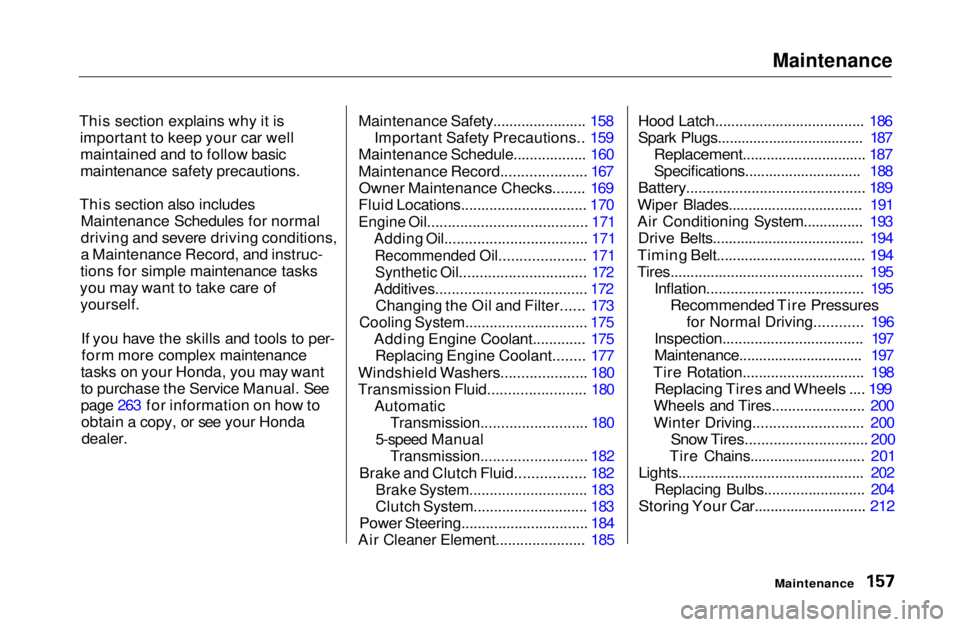
This section explains why it is important to keep your car wellmaintained and to follow basic
maintenance safety precautions.
This section also includes Maintenance Schedules for normal
driving and severe driving conditions,
a Maintenance Record, and instruc-
tions for simple maintenance tasks
you may want to take care of yourself.
If you have the skills and tools to per-form more complex maintenance
tasks on your Honda, you may want
to purchase the Service Manual. See
page 263 for information on how to obtain a copy, or see your Honda
dealer.
Maintenance Safety....................... 158
Important Safety Precautions.. 159
Maintenance Schedule.................. 160
Maintenance Record..................... 167 Owner Maintenance Checks........ 169
Fluid Locations............................... 170
Engine Oil....................................... 171
Adding Oil................................... 171
Recommended Oil..................... 171Synthetic Oil............................... 172
Additives..................................... 172
Changing the Oil and Filter...... 173
Cooling System.............................. 175
Adding Engine Coolant............. 175Replacing Engine Coolant........ 177
Windshield Washers..................... 180
Transmission Fluid........................ 180
Automatic
Transmission.......................... 180
5-speed Manual
Transmission.......................... 182
Brake and Clutch Fluid................. 182
Brake System............................. 183
Clutch System............................ 183
Power Steering............................... 184
Air Cleaner Element...................... 185 Hood Latch..................................... 186
Spark Plugs..................................... 187
Replacement............................... 187
Specifications............................. 188
Battery............................................ 189
Wiper Blades.................................. 191
Air Conditioning System............... 193 Drive Belts...................................... 194
Timing Belt..................................... 194
Tires................................................ 195 Inflation....................................... 195
Recommended Tire Pressures
for Normal Driving............ 196
Inspection................................... 197
Maintenance............................... 197
Tire Rotation.............................. 198
Replacing Tires and Wheels .... 199
Wheels and Tires....................... 200
Winter Driving........................... 200
Snow Tires.............................. 200
Tire Chains............................. 201
Lights.............................................. 202 Replacing Bulbs......................... 204
Storing Your Car............................ 212
MaintenanceMain Menu s t
Page 168 of 269
Owner Maintenance Checks
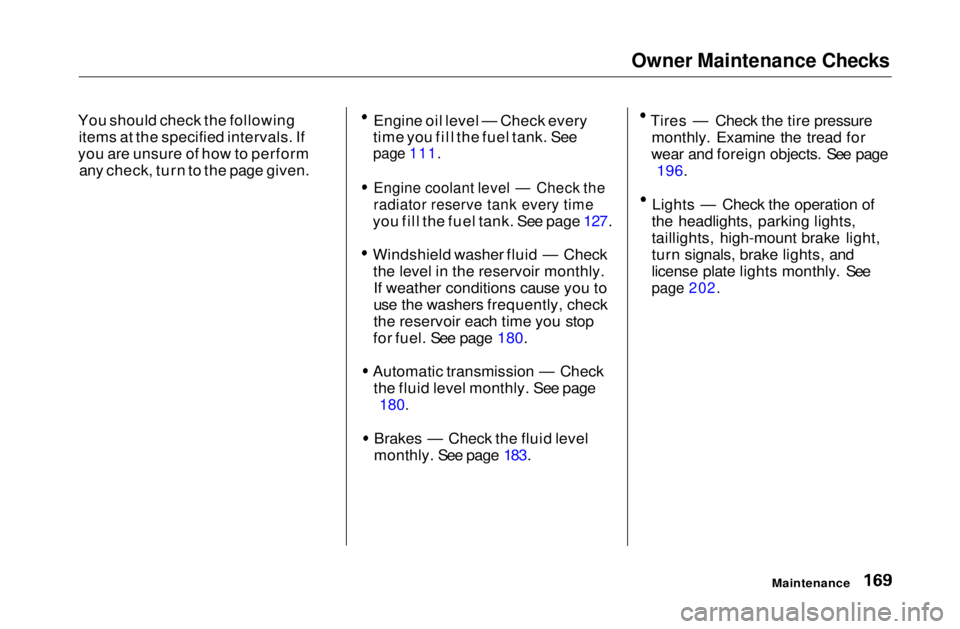
You should check the following items at the specified intervals. If
you are unsure of how to perform any check, turn to the page given. Engine oil level — Check every
time you fill the fuel tank. See
page 111. Engine coolant level — Check the
radiator reserve tank every time
you fill the fuel tank. See page 127. Windshield washer fluid — Check
the level in the reservoir monthly.If weather conditions cause you to
use the washers frequently, check
the reservoir each time you stop
for fuel. See page 180. Automatic transmission — Check
the fluid level monthly. See page
180.
Brakes — Check the fluid level
monthly. See page 183.Tires — Check the tire pressure
monthly. Examine the tread for
wear and foreign objects. See page 196. Lights — Check the operation of
the headlights, parking lights,
taillights, high-mount brake light,
turn signals, brake lights, and
license plate lights monthly. See
page 202.
MaintenanceMain Menu Table of Contents s t
Page 169 of 269
Fluid Locations
Maintenance
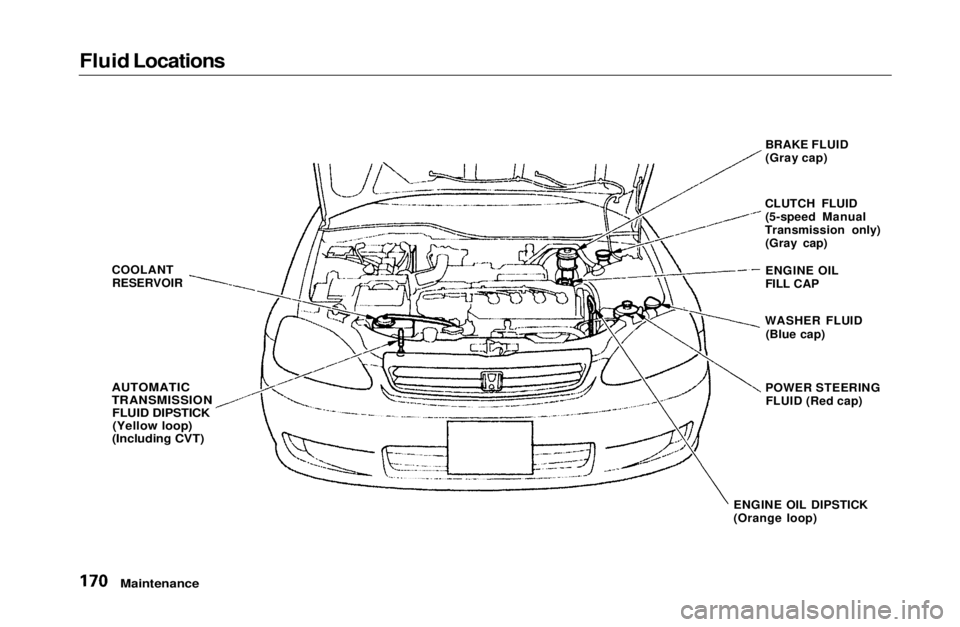
COOLANT
RESERVOIR
AUTOMATIC
TRANSMISSION
FLUID DIPSTICK(Yellow loop)
(Including CVT)
BRAKE FLUID
(Gray cap)
CLUTCH FLUID (5-speed Manual
Transmission only) (Gray cap)
ENGINE OIL DIPSTICK
(Orange loop) ENGINE OIL
FILL CAP
WASHER FLUID (Blue cap)
POWER STEERING FLUID (Red cap)Main Menu Table of Contents s t
Page 177 of 269
Cooling System
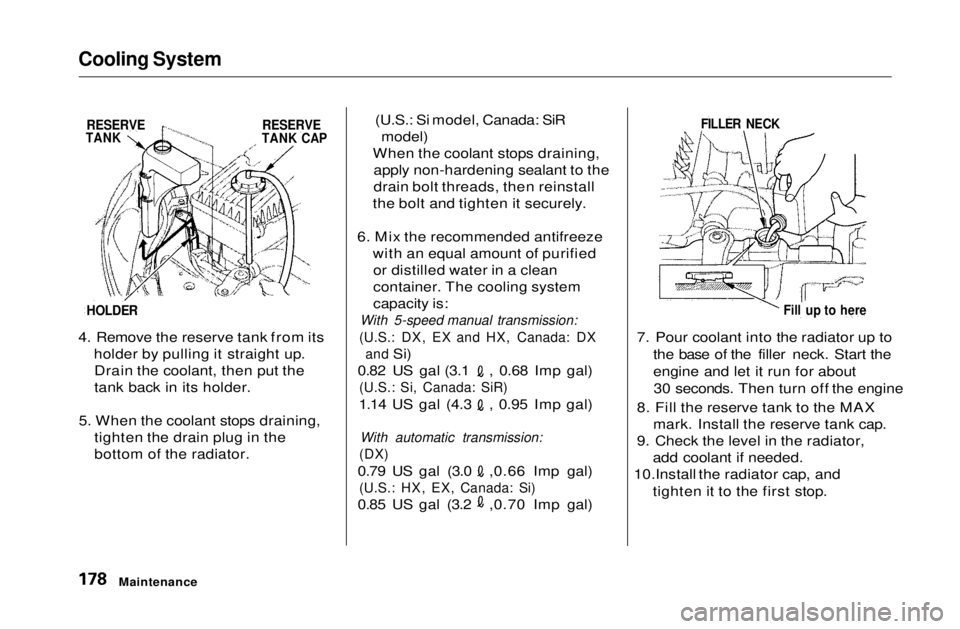
4. Remove the reserve tank from its
holder by pulling it straight up.Drain the coolant, then put the
tank back in its holder.
5. When the coolant stops draining, tighten the drain plug in the
bottom of the radiator. (U.S.: Si model, Canada: SiR
model)
When the coolant stops draining, apply non-hardening sealant to the
drain bolt threads, then reinstall
the bolt and tighten it securely.
6. Mix the recommended antifreeze with an equal amount of purifiedor distilled water in a clean
container. The cooling system
capacity is:
With 5-speed manual transmission:
(U.S.: DX, EX and HX, Canada: DX and
Si) 0.82 US gal (3.1 , 0.68 Imp gal)
(U.S.: Si, Canada: SiR)
1.14 US gal (4.3 , 0.95 Imp gal)
With automatic transmission:
(DX)
0.79 US gal (3.0 ,0.66 Imp gal)
(U.S.: HX, EX, Canada: Si)
0.85 US gal (3.2 ,0.70 Imp gal)7. Pour coolant into the radiator up to
the base of the filler neck. Start the
engine and let it run for about30 seconds. Then turn off the engine
8. Fill the reserve tank to the MAX mark. Install the reserve tank cap.
9. Check the level in the radiator, add coolant if needed.
10.Install the radiator cap, and
tighten it to the first stop.
Maintenance
RESERVE
TANK
RESERVE
TANK CAP
HOLDER
FILLER NECK
Fill up to hereMain Menu Table of Contents s t
Page 179 of 269
Windshield Washers, Transmission Fluid
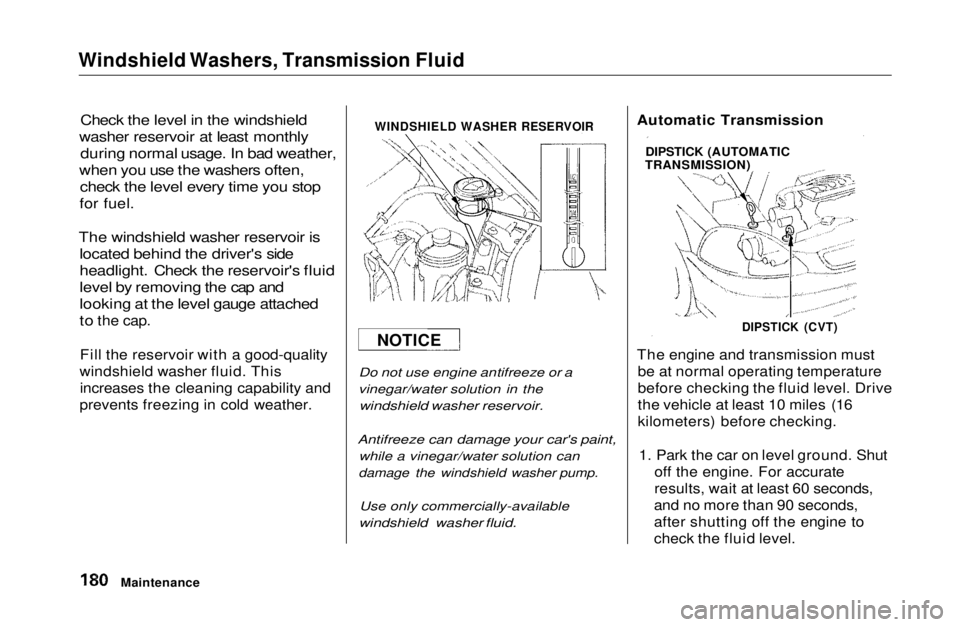
Check the level in the windshield
washer reservoir at least monthly during normal usage. In bad weather,
when you use the washers often, check the level every time you stop
for fuel.
The windshield washer reservoir is located behind the driver's side
headlight. Check the reservoir's fluid
level by removing the cap and
looking at the level gauge attached
to
the cap.
Fill the reservoir with a good-quality
windshield washer fluid. This increases the cleaning capability and
prevents freezing in cold weather.
WINDSHIELD WASHER RESERVOIR
Do not use engine antifreeze or a
vinegar/water solution in the
windshield washer reservoir.
Antifreeze can damage your car's paint,
while a vinegar/water solution can
damage the windshield washer pump.
Use only commercially-available
windshield washer fluid.
The engine and transmission must
be at normal operating temperature
before checking the fluid level. Drive
the vehicle at least 10 miles (16
kilometers) before checking.
1. Park the car on level ground. Shut off the engine. For accurate
results, wait at least 60 seconds,
and no more than 90 seconds,
after shutting off the engine to
check the fluid level.
Maintenance
NOTICE
Automatic Transmission
DIPSTICK (AUTOMATIC
TRANSMISSION)
DIPSTICK (CVT)Main Menu Table of Contents s t
Page 180 of 269
Transmission Fluid
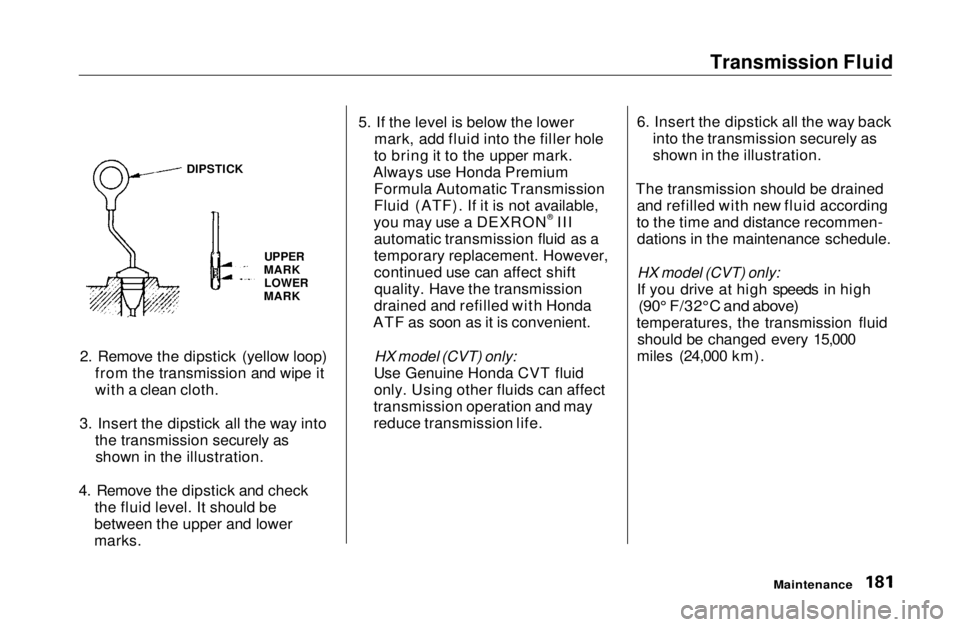
2. Remove the dipstick (yellow loop) from the transmission and wipe it
with a clean cloth.
3. Insert the dipstick all the way into the transmission securely asshown in the illustration.
4. Remove the dipstick and check the fluid level. It should be
between the upper and lower
marks. 5. If the level is below the lower
mark, add fluid into the filler hole
to bring it to the upper mark.
Always use Honda Premium Formula Automatic Transmission
Fluid (ATF). If it is not available,
you may use a DEXRON® III automatic transmission fluid as a
temporary replacement. However,
continued use can affect shiftquality. Have the transmission
drained and refilled with Honda
ATF as soon as it is convenient.
HX model (CVT) only:
Use Genuine Honda CVT fluid
only. Using other fluids can affect
transmission operation and may
reduce transmission life. 6. Insert the dipstick all the way back
into the transmission securely as
shown in the illustration.
The transmission should be drained and refilled with new fluid according
to the time and distance recommen- dations in the maintenance schedule.
HX model (CVT) only:
If you drive at high speeds in high
(90° F/32°C and above)
temperatures, the transmission fluid should be changed every 15,000
miles (24,000 km).
Maintenance
DIPSTICK
UPPER
MARK LOWER
MARKMain Menu Table of Contents s t