cooling HONDA CIVIC COUPE 1999 Owner's Manual
[x] Cancel search | Manufacturer: HONDA, Model Year: 1999, Model line: CIVIC COUPE, Model: HONDA CIVIC COUPE 1999Pages: 269, PDF Size: 2.42 MB
Page 228 of 269
If Your Engine Overheats
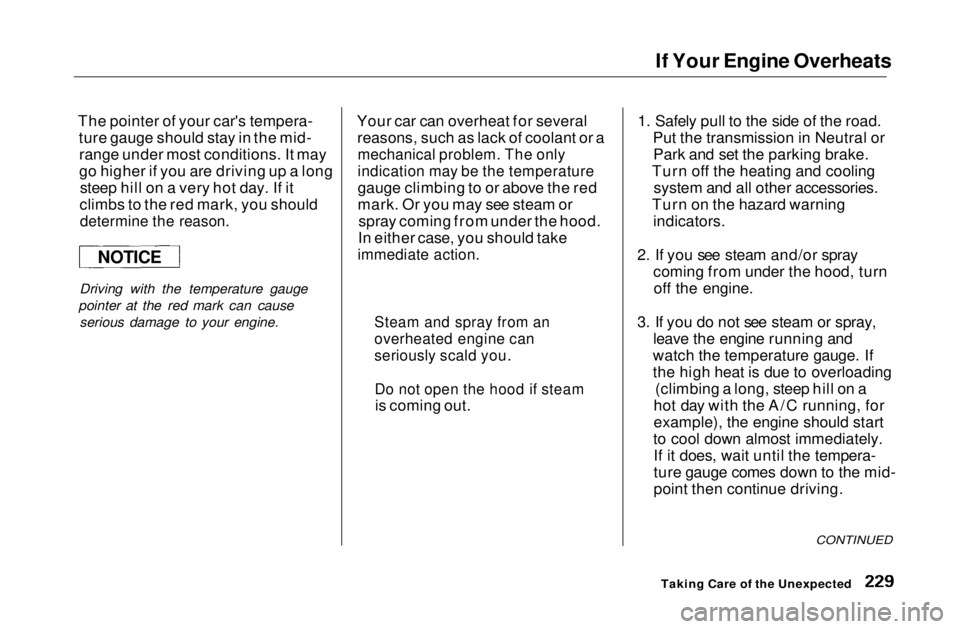
The pointer of your car's tempera- ture gauge should stay in the mid-range under most conditions. It may
go higher if you are driving up a long steep hill on a very hot day. If it
climbs to the red mark, you should
determine the reason.
Driving with the temperature gauge
pointer at the red mark can cause serious damage to your engine. Your car can overheat for several
reasons, such as lack of coolant or a
mechanical problem. The only
indication may be the temperature
gauge climbing to or above the red
mark. Or you may see steam or spray coming from under the hood.
In either case, you should take
immediate action.
1. Safely pull to the side of the road.
Put the transmission in Neutral orPark and set the parking brake.
Turn off the heating and cooling system and all other accessories.
Turn on the hazard warning indicators.
2. If you see steam and/or spray coming from under the hood, turnoff the engine.
3. If you do not see steam or spray, leave the engine running and
watch the temperature gauge. If
the high heat is due to overloading (climbing a long, steep hill on a
hot day with the A/C running, for
example), the engine should start
to cool down almost immediately. If it does, wait until the tempera-
ture gauge comes down to the mid-
point then continue driving.
CONTINUED
Taking Care of the Unexpected
NOTICE
Steam and spray from an
overheated engine can
seriously scald you.
Do not open the hood if steam
is coming out.Main Menu Table of Contents s t
Page 229 of 269
If Your Engine Overheats
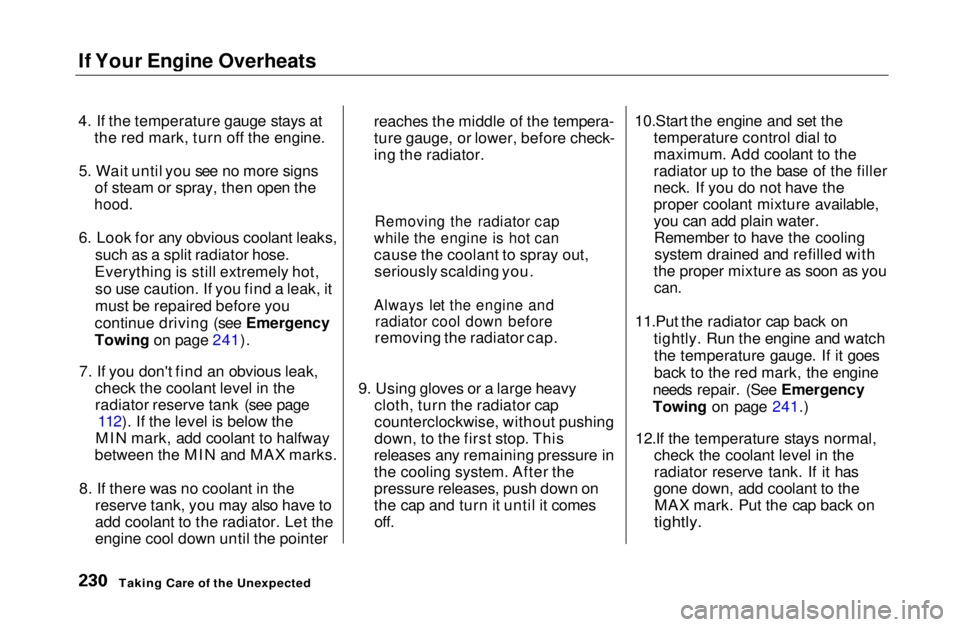
4. If the temperature gauge stays at
the red mark, turn off the engine.
5. Wait until you see no more signs of steam or spray, then open the
hood.
6. Look for any obvious coolant leaks, such as a split radiator hose.
Everything is still extremely hot, so use caution. If you find a leak, it
must be repaired before you
continue driving (see Emergency
Towing on page 241).
7. If you don't find an obvious leak, check the coolant level in the
radiator reserve tank (see page112). If the level is below the
MIN mark, add coolant to halfway
between the MIN and MAX marks.
8. If there was no coolant in the reserve tank, you may also have to
add coolant to the radiator. Let the
engine cool down until the pointer reaches the middle of the tempera-
ture gauge, or lower, before check-
ing the radiator.
9. Using gloves or a large heavy cloth, turn the radiator cap
counterclockwise, without pushing
down, to the first stop. This
releases any remaining pressure in
the cooling system. After the
pressure releases, push down on
the cap and turn it until it comes off. 10.Start the engine and set the
temperature control dial to
maximum. Add coolant to the
radiator up to the base of the filler
neck. If you do not have the
proper coolant mixture available,
you can add plain water.Remember to have the coolingsystem drained and refilled with
the proper mixture as soon as you
can.
11.Put the radiator cap back on tightly. Run the engine and watchthe temperature gauge. If it goes
back to the red mark, the engine
needs repair. (See Emergency
Towing on page 241.)
12.If the temperature stays normal, check the coolant level in the
radiator reserve tank. If it has
gone down, add coolant to the MAX mark. Put the cap back on
tightly.
Taking Care of the Unexpected
Removing the radiator cap
while the engine is hot can
cause the coolant to spray out, seriously scalding you.
Always let the engine and radiator cool down before
removing the radiator cap.Main Menu Table of Contents s t
Page 264 of 269
Index
Heating and Cooling........................ 88
High Altitude, Starting at.............. 137
High-Low Beam Switch.................. 61
High-mount Brake Light............... 209
Hood, Opening the........................ 126
Horn................................................... 60
Hot Coolant, Warning about........ 175
Hydraulic Clutch............................ 183
Hydroplaning.................................. 154
Identification Number, Vehicle.... 244
If Your Car Has to be Towed....... 241
Ignition
Keys............................................... 69
Switch............................................ 69
Timing Control System............. 255
Important Safety Precautions.......... 6
Indicator Lights, Instrument
Panel.............................................. 53
Infant Restraint................................ 29
Inflation, Proper Tire .................... 195
High Speed Driving................... 250
Normal Driving.......................... 195
Inside Mirror.................................... 81
Inspection, Tire.............................. 197
Instrument Panel............................. 52
Instrument Panel Brightness......... 62
Interior Cleaning............................ 216
Interior Light.................................... 86
Introduction......................................... i
Jacking up the Car......................... 221
Jack, Tire........................................ 221
Jump Starting................................. 227
Keys................................................... 69
Label, Certification........................ 244
Lane Change, Signaling.................. 62
Lap Belt............................................. 43
Lap/Shoulder Belts......................... 42
Leaking of Exhaust into Car.......... 49
Lights
Bulb Replacement..................... 204
Indicator........................................ 53
Parking.......................................... 64
Turn Signal................................... 62
LOCK (Ignition Key Position)....... 70
Locks
Anti-theft Steering Column........ 70Fuel Fill Door............................. 125
Power Door.................................. 71
Trunk............................................ 75
Low Coolant Level......................... 128 Low Fuel Indicator.......................... 58
Lower Gear, Downshifting to a.... 138
Low Oil Pressure Indicator.... 55, 231
Lubricant Specifications Chart.... 247
Luggage.......................................... 132
CONTINUED
Maintenance................................... 157
Owner Maintenance Checks.... 169
Record.................................. 167-168
Required Indicator....................... 59Main Menu s t