fog light HONDA CIVIC COUPE 1999 Owners Manual
[x] Cancel search | Manufacturer: HONDA, Model Year: 1999, Model line: CIVIC COUPE, Model: HONDA CIVIC COUPE 1999Pages: 269, PDF Size: 2.42 MB
Page 5 of 269
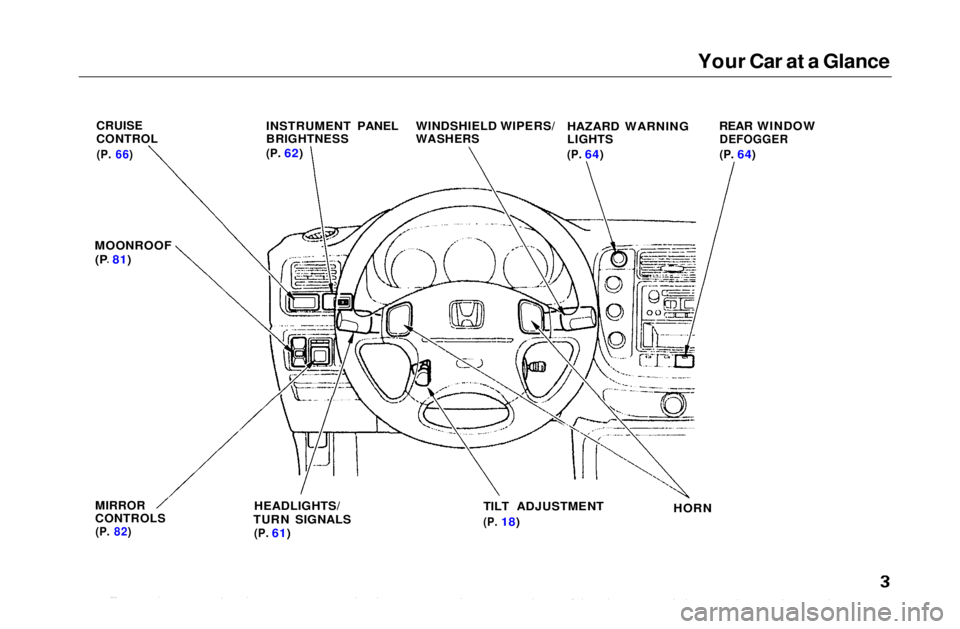
Your Car at a Glance
CRUISE
CONTROL
(P.
66)
INSTRUMENT PANEL
BRIGHTNESS
(P.
62)
WINDSHIELD WIPERS/
WASHERS
HAZARD WARNING
LIGHTS
(P.
64) REAR WINDOW
DEFOGGER
(P.
64)
MOONROOF (P 81)
MIRROR
CONTROLS
(P.
82)
HEADLIGHTS/
TURN SIGNALS
(P.
61) TILT ADJUSTMENT
(P.
18)
HORNMain Menu s t
Page 52 of 269
Instruments and Controls
This section gives information about
the controls and displays thatcontribute to the daily operation of
your Honda. All the essential
controls are within easy reach.
Control Locations............................ 52
Indicator Lights................................ 53
Gauges.............................................. 57
Speedometer................................ 57
Tachometer.................................. 57
Odometer...................................... 57
Trip Meter.................................... 57
Fuel Gauge................................... 58
Temperature Gauge.................... 58
Maintenance Required
Indicator.................................... 59
Controls Near the Steering Wheel........................................ 60
Headlights.................................... 61
Daytime Running Lights............. 61
Instrument Panel Brightness..... 62
Turn Signals................................. 62
Windshield Wipers...................... 63
Windshield Washers................... 63
Hazard Warning........................... 64
Rear Window Defogger.............. 64
Steering Wheel Adjustment....... 65
Steering Wheel Controls ................ 66 Cruise Control.............................. 66
Keys and Locks................................ 69
Keys.............................................. 69
Ignition Switch............................. 69
Door Locks................................... 70
Power Door Locks....................... 71
Remote Transmitter.................... 72
Trunk............................................ 75
Seat Adjustments............................. 76
Front Seat Adjustments.............. 76
Rear Seat Access......................... 77
Head Restraints........................... 77
Folding Rear Seat............................ 78
Power Windows............................... 79
Moonroof.......................................... 81
Mirrors.............................................. 81
Adjusting the Power Mirrors..... 82
Parking Brake.................................. 83 Glove Box......................................... 83
Beverage Holder.............................. 84
Accessory Power Socket................ 85
Ashtrays............................................ 85
Interior Light.................................... 86
Instruments and ControlsMain Menu s t
Page 61 of 269
Controls Near the Steering Wheel
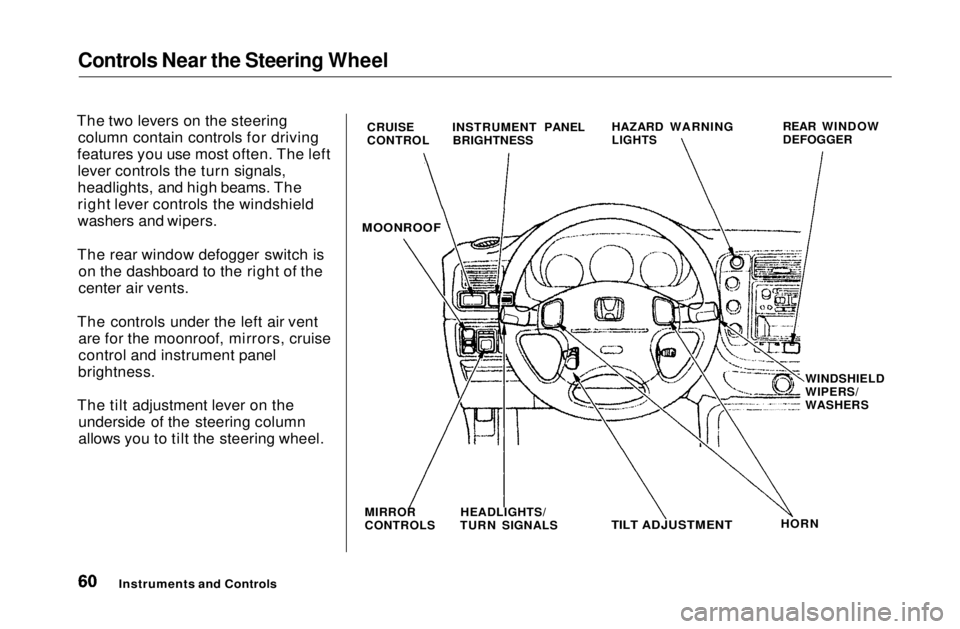
The two levers on the steering column contain controls for driving
features you use most often. The left lever controls the turn signals,
headlights, and high beams. The
right lever controls the windshield
washers and wipers.
The rear window defogger switch is on the dashboard to the right of the
center air vents.
The controls under the left air vent are for the moonroof, mirrors, cruise
control and instrument panel
brightness.
The tilt adjustment lever on the underside of the steering column
allows you to tilt the steering wheel.
Instruments and Controls
CRUISE
CONTROL
INSTRUMENT PANEL
BRIGHTNESS HAZARD WARNING
LIGHTS
REAR WINDOW
DEFOGGER
MOONROOF
MIRROR
CONTROLS HEADLIGHTS/
TURN SIGNALS
TILT ADJUSTMENT
HORNWINDSHIELD
WIPERS/
WASHERSMain Menu Table of Contents s t
Page 65 of 269
Controls Near the Steering Wheel
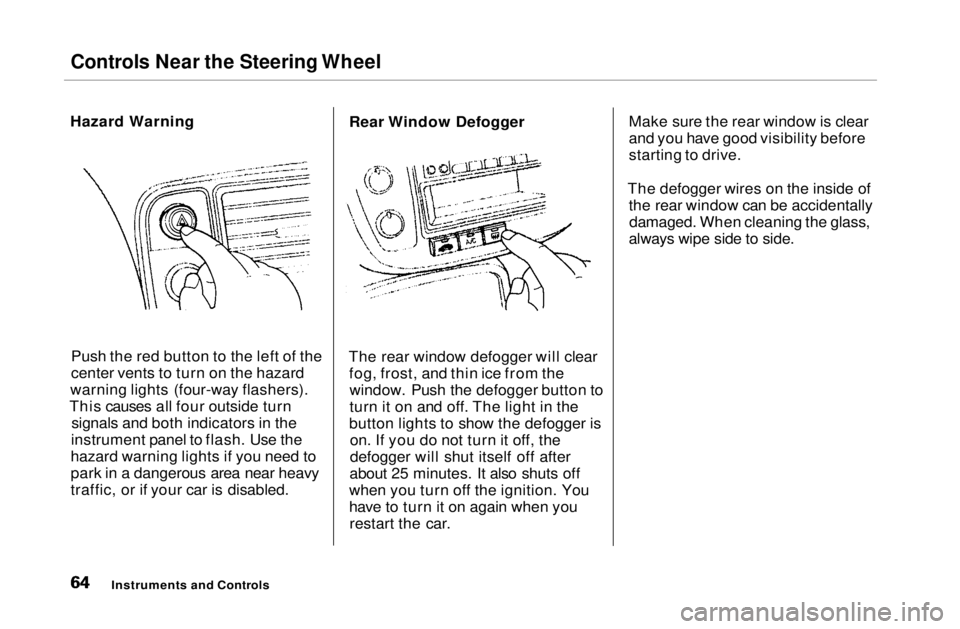
Hazard Warning
Push the red button to the left of the
center vents to turn on the hazard
warning lights (four-way flashers).
This causes all four outside turn signals and both indicators in the
instrument panel to flash. Use the
hazard warning lights if you need to
park in a dangerous area near heavy
traffic, or if your car is disabled. Rear Window Defogger
The rear window defogger will clear fog, frost, and thin ice from thewindow. Push the defogger button to
turn it on and off. The light in the
button lights to show the defogger is on. If you do not turn it off, the
defogger will shut itself off after
about 25 minutes. It also shuts off
when you turn off the ignition. You
have to turn it on again when you restart the car. Make sure the rear window is clear
and you have good visibility before
starting to drive.
The defogger wires on the inside of the rear window can be accidentallydamaged. When cleaning the glass,
always wipe side to side.
Instruments and ControlsMain Menu Table of Contents s t
Page 83 of 269
Mirrors
On HX. KX and Si models in the U.S.. Si
and SiR models in Canada
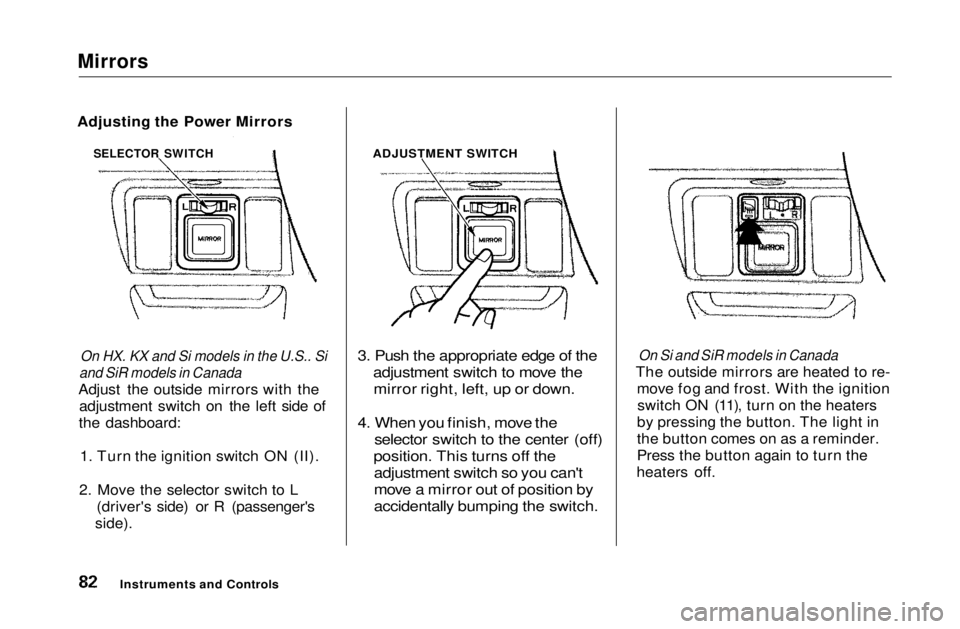
Adjust the outside mirrors with the adjustment switch on the left side of
the dashboard:
1. Turn the ignition switch ON (II).
2. Move the selector switch to L (driver's side) or R (passenger's
side).
3. Push the appropriate edge of the
adjustment switch to move the
mirror right, left, up or down.
4. When you finish, move the
selector switch to the center (off)
position. This turns off the
adjustment switch so you can't
move a mirror out of position by
accidentally bumping the switch.
On Si and SiR models in Canada
The outside mirrors are heated to re- move fog and frost. With the ignitionswitch ON (11), turn on the heaters
by pressing the button. The light in
the button comes on as a reminder.
Press the button again to turn the
heaters off.
Instruments and Controls ADJUSTMENT SWITCH
Adjusting the Power Mirrors
SELECTOR SWITCHMain Menu Table of Contents s t
Page 154 of 269
Driving in Bad Weather
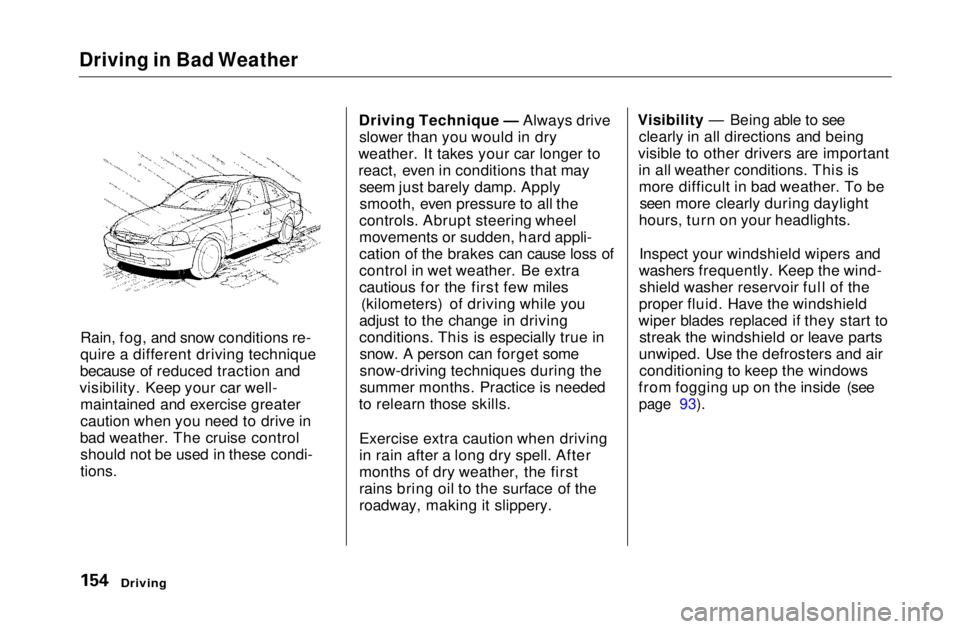
Rain, fog, and snow conditions re-
quire a different driving technique
because of reduced traction and
visibility. Keep your car well- maintained and exercise greater
caution when you need to drive in
bad weather. The cruise control should not be used in these condi-
tions.
Driving Technique — Always drive
slower than you would in dry
weather. It takes your car longer to
react, even in conditions that may seem just barely damp. Applysmooth, even pressure to all the
controls. Abrupt steering wheel
movements or sudden, hard appli-
cation of the brakes can cause loss of
control in wet weather. Be extra
cautious for the first few miles (kilometers) of driving while you
adjust to the change in driving
conditions. This is especially true in snow. A person can forget some
snow-driving techniques during the
summer months. Practice is needed
to relearn those skills.
Exercise extra caution when driving
in rain after a long dry spell. After
months of dry weather, the first
rains bring oil to the surface of the
roadway, making it slippery. Visibility — Being able to see
clearly in all directions and being
visible to other drivers are important in all weather conditions. This ismore difficult in bad weather. To be seen more clearly during daylight
hours, turn on your headlights.
Inspect your windshield wipers and
washers frequently. Keep the wind- shield washer reservoir full of the
proper fluid. Have the windshield
wiper blades replaced if they start to streak the windshield or leave parts
unwiped. Use the defrosters and air conditioning to keep the windows
from fogging up on the inside (see
page 93).
DrivingMain Menu Table of Contents s t
Page 262 of 269
Index
Consumer Information*................ 258
Controls, Instruments and.............. 51
Coolant
Adding.........................................171
Checking..................................... 128
Proper Solution.......................... 175
Replacing.................................... 177
Temperature Gauge.................... 58
Corrosion Protection..................... 217
Crankcase Emissions Control
System......................................... 254
Cruise Control Operation............... 66
Customer Relations Office........... 258
DANGER, Explanation of................. ii
Dashboard........................................ 52
Daytime Running Lights................. 61
Dead Battery, What to Do............ 227
Defects, Reporting Safety............. 262 Defog and Defrost........................... 93
Defogger, Rear Window................. 64
Defrosting the Windows................. 93
DEXRON® III Automatic
Transmission Fluid.................... 181
Dimensions..................................... 246
Dimming the Headlights................ 61
Dipstick
Automatic Transmission........... 181
Engine Oil................................... 128
Directional Signals........................... 62
Disabled, Towing Your Car If...... 241
Disc Brake Wear Indicators......... 150
Disposal of Used Oil...................... 174
Doors Locking and Unlocking............... 70Power Door Locks....................... 71
DOT Tire Quality Grading........... 250
Downshifting, 5-speed Manual Transmission.............................. 138
Driver and Passenger Safety............ 5
Drive Belts...................................... 194
Driving............................................ 135
Economy..................................... 129
In Bad Weather.......................... 154
In Foreign Countries................. 253
Economy, Fuel............................... 129
Emergencies on the Road............. 219
Battery, Jump Starting.............. 227
Brake System Indicator............ 234 Changing a Flat Tire................. 221
Charging System Indicator...... 232
Checking the Fuses................... 237
Low Oil Pressure Indicator...... 231 Malfunction Indicator Lamp.... 233
Manually Closing Moonroof.... 235
Overheated Engine................... 229
Emergency Brake............................ 82 Emergency Flashers....................... 64
Emergency Towing ........................ 241
Emissions Controls........................ 254Engine Coolant Temperature Gauge ..... 58
Malfunction Indicator Lamp................................. 55, 233
Oil Pressure Indicator......... 55, 231
Oil, What Kind to Use............... 171
Overheating................................ 229
Specifications............................. 246
Engine Speed Limiter............139, 144
CONTINUEDMain Menu s t
Page 268 of 269
Index
Turn Signals..................................... 62
Underside, Cleaning...................... 214
Unexpected, Taking Care
of the........................................... 219
Uniform Tire Quality Grading..... 250
Unleaded Gasoline......................... 124
Upholstery Cleaning...................... 216
Used Oil, How to Dispose of........ 174
Vehicle Capacity Load .................. 132 Vehicle Dimensions....................... 246
Vehicle Identification Number..... 244
Vehicle Storage.............................. 211 Ventilation......................................... 90
VIN.................................................. 244
Vinyl Cleaning................................ 216
Viscosity, Oil................................... 172 Warning Beepers
Headlights on............................... 61
Key in Ignition.............................. 70
Seat Belts...................................... 54
WARNING, Explanation of.............. ii
Warning Labels, Location of.......... 50
Warranty Coverages*................... 261
Washer, Windshield Checking the Fluid Level......... 180Operation...................................... 63
Washing.......................................... 214 Waxing and Polishing................... 214
Wheels
Adjusting the Steering................ 65
Alignment and Balance............. 197Compact Spare........................... 220
Wrench....................................... 222
Windows
Cleaning...................................... 217Operating the Power................... 79
Rear, Defogger............................ 64
Windshield Cleaning........................................ 63
Defroster...................................... 93 Wipers, Windshield
Changing Blades........................ 191Operation...................................... 63
Worn Tires..................................... 195
Wrecker, Emergency Towing...... 241
* : U.S. and Canada onlyMain Menu s t