maintenance schedule HONDA CIVIC COUPE 1999 Owners Manual
[x] Cancel search | Manufacturer: HONDA, Model Year: 1999, Model line: CIVIC COUPE, Model: HONDA CIVIC COUPE 1999Pages: 269, PDF Size: 2.42 MB
Page 1 of 269
1999 Civic Coupe Online Reference Owner's Manual
Use these links (and links throughout this manual) to navigate through this reference.
For a printed owner's manual, click on authorized manuals or go to www.helminc.com.
Contents
Introduction........................................................................\
............................................................................. i
A Few Words About Safety ........................................................................\
.................................................. ii
Your Vehicle at a Glance ........................................................................\
....................................................... 2
Driver and Passenger Safety ........................................................................\
............................................... 5
Pr op
er use and care of your vehicle's seat belts, and Supplemental Restraint System.
Instruments and Controls........................................................................\
...................................................51
Instrument panel in
dicator and gauge, and how to use dashboard and steering column controls.
Comfort and Convenience Features........................................................................\
.................................87
How to op
erate the climate control system, the audio system, and other convenience features.
Before Driving ........................................................................\
.....................................................................123
What gasoli n
e to u
se, how to break-in your new vehicle, and how to load luggage and other cargo.
Driving........................................................................\
...................................................................................135
The proper way t o
start the engine, shift the tr ansmission, and park, plus towing a trailer.
Maintenance........................................................................\
.........................................................................157
T h
e Ma
intenance Schedule shows you when you need to take your vehicle to the dealer.
Appearance Care........................................................................\
.................................................................213
T i
ps on cl
eaning and protecting your vehicle. Things to look for if your car ever needs body repairs.
Taking Care of the Unexpected........................................................................\
.......................................219
This section covers sever
a
l problems motorists someti mes experience, and how to handle them.
Technical Information........................................................................\
.......................................................243
ID numbers, dimens ions, capacities, and techn
ical information.
Warranty and Customer Relations (U.S. and Canada)......................................................................257
A summary of th
e warr
anties covering your new Honda, and how to contact us.
Authorized Manuals (U.S. only)........................................................................\
.......................................263
How t o
order
manuals and other technical literature.
Index ........................................................................\
......................................................................................... I
Servic e Inf
ormation Summary
A summary of informa
tion you need when you pull up to the fuel pump.
Owner's Identification
Page 2 of 269

Introduction
Congratulations ! Your selection of a 1999 Honda Civic was a wise
investment. It will give you years of driving pleasure.
One of the best ways to enhance the enjoyment of your new Honda is to
read this manual. In it, you will learn how to operate its driving controls and
convenience items. Afterwards, keep this owner's manual in your car so you
can refer to it at any time.
Several warranties protect your new Honda. Read the warranty booklet
thoroughly so you understand the coverages and are aware of your rights and responsibilities.
Maintaining your car according to the schedules given in this manual helps
to keep your driving trouble-free while it preserves your investment. When
your car needs maintenance, keep in mind that your Honda dealer's staff is specially trained in servicing the many systems unique to your Honda. Your
Honda dealer is dedicated to your satisfaction and will be pleased to answer
any questions and concerns. As you read this manual, you will
find information that is preceded by symbol. This
information is intended to help you
avoid damage to your Honda, other
property, or the environment.
a NOTICEMain Menu s t
Page 7 of 269
Important Safety Precautions
You'll find many safety recommendations throughout thissection, and throughout this manual.
The recommendations on this page are the ones we consider to be the
most important.
Always Wear Your Seat Belt
A seat bel
t is your best protection in
all types of collisions. Airbags supplement seat belts, but airbags
are designed to inflate only in a
moderate to severe frontal collision. So even though your car is equipped
with airbags, make sure you and
your passengers always wear your seat belts, and wear them properly. (See page 15.)
Restrain All Children Children are safest when they are
properly restrained in the back seat, not the front seat. A child who is too
small for a seat belt must be properly
restrained in a child safety seat. (See
page 21.) Be Aware of Airbag Hazards
While airbags save lives, they can cause serious or fatal injuries to
occupants who sit too close to them,
or are not properly restrained.
Infants, young children, and short
adults are at the greatest risk. Be sure to follow all instructions and
warnings in this manual. (See page 7.)
Don't Drink and Drive
Alcohol and driving don't mix. Even one drink can reduce your ability to
respond to changing conditions, and
your reaction time gets worse with every additional drink. So don't drink
and drive, and don't let your friends
drink and drive, either. Control Your Speed
Excessive speed is a major factor in
crash injuries and deaths. Generally,
the higher the speed the greater the
risk, but serious accidents can also
occur at lower speeds. Never drive
faster than is safe for current conditions, regardless of the
maximum speed posted.
Keep Your Car in Safe Condition
Having a tire blowout or a
mechanical failure can be extremely
hazardous. To reduce the possibilityof such problems, check your tire
pressures and condition frequently, and perform all regularly scheduled
maintenance. (See page 162.)
Driver and Passenger SafetyMain Menu Table of Contents s t
Page 60 of 269
Gauges
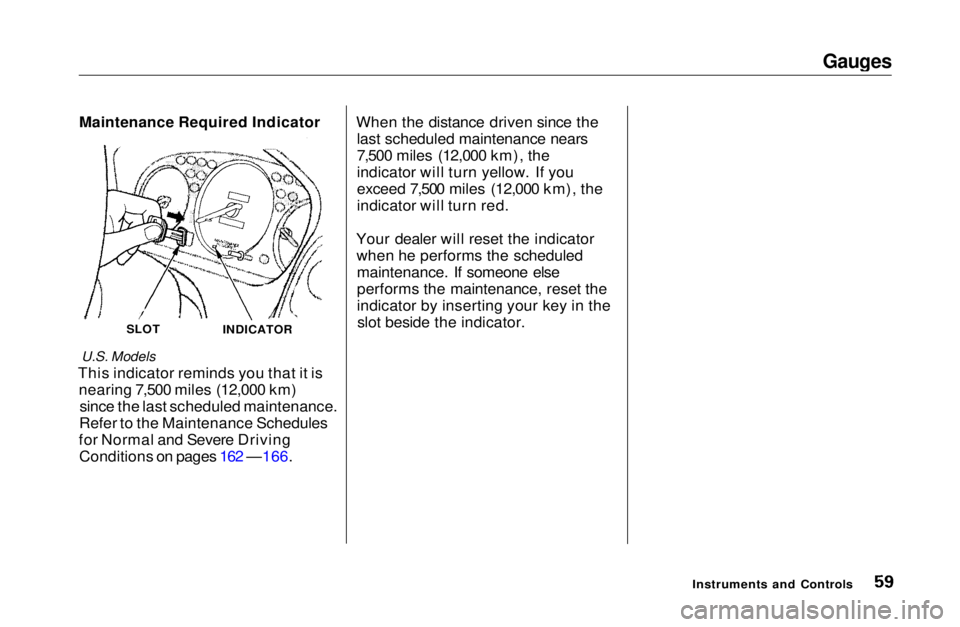
Maintenance Required Indicator
U.S. Models
This indicator reminds you that it is nearing 7,500 miles (12,000 km)since the last scheduled maintenance.
Refer to the Maintenance Schedules
for Normal and Severe Driving Conditions on pages 162 —166. When the distance driven since the
last scheduled maintenance nears
7,500 miles (12,000 km), the
indicator will turn yellow. If you
exceed 7,500 miles (12,000 km), the
indicator will turn red.
Your dealer will reset the indicator when he performs the scheduledmaintenance. If someone else
performs the maintenance, reset the
indicator by inserting your key in theslot beside the indicator.
Instruments and Controls
INDICATOR
SLOTMain Menu Table of Contents s t
Page 129 of 269
Fuel Economy
The condition of your car and your driving habits are the two most
important things that affect the fuel
mileage you get.
Vehicle Condition Always maintain your car according to the maintenance schedule. This
will keep it in top operating condition.
An important part of that mainte- nance is the Owner MaintenanceChecks (see page 169). For
example, an underinflated tire
causes more "rolling resistance,"
which uses fuel. It also wears out faster, so check the tire pressure at
least monthly.
In winter, the build-up of snow on
your car's underside adds weight and rolling resistance. Frequent cleaning
helps your fuel mileage and reduces the chance of corrosion.
Driving Habits
You can improve fuel economy by
driving moderately. Rapid acceler-
ation, abrupt cornering, and hard braking use more fuel.
Always drive in the highest gear that
allows the engine to run and acceler-
ate smoothly.
Depending on traffic conditions, try
to maintain a constant speed. Every
time you slow down and speed up.
your car uses extra fuel. Use the cruise control, when appropriate, to
increase fuel economy. A cold engine uses more fuel than a
warm engine. It is not necessary to "warm-up" a cold engine by letting it
idle for a long time. You can drive
away in about a minute, no matter
how cold it is outside. The engine
will warm up faster, and you get better fuel economy. To cut down on
the number of "cold starts," try tocombine several short trips into one.
The air conditioning puts an extra
load on the engine which makes it
use more fuel. Turn off the A/C to
cut down on air conditioning use.
Use the flow-through ventilation
when the outside air temperature is moderate.
Before DrivingMain Menu Table of Contents s t
Page 156 of 269
Maintenance
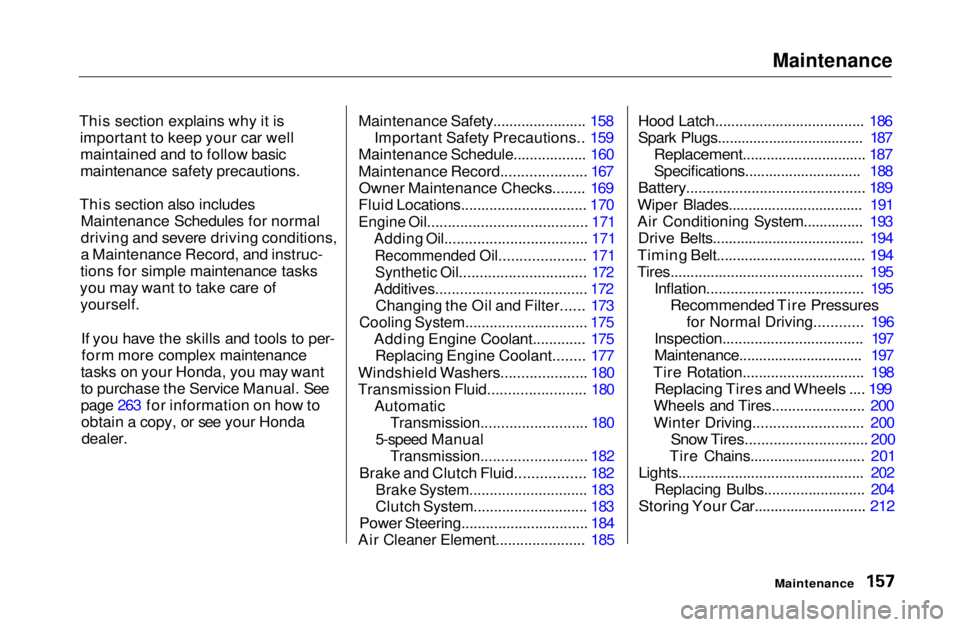
This section explains why it is important to keep your car wellmaintained and to follow basic
maintenance safety precautions.
This section also includes Maintenance Schedules for normal
driving and severe driving conditions,
a Maintenance Record, and instruc-
tions for simple maintenance tasks
you may want to take care of yourself.
If you have the skills and tools to per-form more complex maintenance
tasks on your Honda, you may want
to purchase the Service Manual. See
page 263 for information on how to obtain a copy, or see your Honda
dealer.
Maintenance Safety....................... 158
Important Safety Precautions.. 159
Maintenance Schedule.................. 160
Maintenance Record..................... 167 Owner Maintenance Checks........ 169
Fluid Locations............................... 170
Engine Oil....................................... 171
Adding Oil................................... 171
Recommended Oil..................... 171Synthetic Oil............................... 172
Additives..................................... 172
Changing the Oil and Filter...... 173
Cooling System.............................. 175
Adding Engine Coolant............. 175Replacing Engine Coolant........ 177
Windshield Washers..................... 180
Transmission Fluid........................ 180
Automatic
Transmission.......................... 180
5-speed Manual
Transmission.......................... 182
Brake and Clutch Fluid................. 182
Brake System............................. 183
Clutch System............................ 183
Power Steering............................... 184
Air Cleaner Element...................... 185 Hood Latch..................................... 186
Spark Plugs..................................... 187
Replacement............................... 187
Specifications............................. 188
Battery............................................ 189
Wiper Blades.................................. 191
Air Conditioning System............... 193 Drive Belts...................................... 194
Timing Belt..................................... 194
Tires................................................ 195 Inflation....................................... 195
Recommended Tire Pressures
for Normal Driving............ 196
Inspection................................... 197
Maintenance............................... 197
Tire Rotation.............................. 198
Replacing Tires and Wheels .... 199
Wheels and Tires....................... 200
Winter Driving........................... 200
Snow Tires.............................. 200
Tire Chains............................. 201
Lights.............................................. 202 Replacing Bulbs......................... 204
Storing Your Car............................ 212
MaintenanceMain Menu s t
Page 157 of 269
Maintenance Safety
Regularly maintaining your car is the
best way to protect your investment.
Proper maintenance is essential to
your safety and the safety of your passengers. It will also reward you
with more economical, trouble-free driving and help reduce air pollution. This section includes instructions for
simple maintenance tasks, such as
checking and adding oil. Any service
items not detailed in this section should be performed by a Honda
technician or other qualified mechanic. Some of the most important safety
precautions are given here. However,
we cannot warn you of every conceivable hazard that can arise in
performing maintenance. Only you
can decide whether or not youshould perform a given task.
Maintenance
Improperly maintaining this car
or failing to correct a problem before driving can cause a
crash in which you can be
seriously hurt or killed.
Always follow the inspection
and maintenance recommendations and
schedules in this owner's
manual.
Failure to properly follow
maintenance instructions and
precautions can cause you to
be seriously hurt or killed.
Always follow the procedures and precautions in this owner'smanual.Main Menu Table of Contents s t
Page 159 of 269
Maintenance Schedule
The Maintenance Schedule specifies how often you should have your carserviced and what things need
attention. It is essential that you have
your car serviced as scheduled to retain its high level of safety,dependability, and emissions control
performance.
The services and time or distance
intervals shown in the maintenanceschedule assume you will use your
car as normal transportation for
passengers and their possessions.
You should also follow these
recommendations:
Avoid exceeding your car's loadlimit. This puts excess stress onthe engine, brakes, and many
other parts of your car. The load
limit is shown on the label on thedriver's doorjamb.
Operate your car on reasonable
roads within the legal speed limit.
Drive your car regularly over adistance of several miles
(kilometers).
Always use unleaded gasoline with
the proper octane rating (see page
124). Which Schedule to Follow:
Service your car according to the
time and mileage periods on one of
the Maintenance Schedules on the
following pages. Select the schedule
for "Severe Conditions" if most of
your driving is done under one or more of the conditions listed on that
page. Otherwise, follow the schedule
for "Normal Conditions."
MaintenanceMain Menu Table of Contents s t
Page 160 of 269

Maintenance Schedule
Your authorized Honda dealer knows your car best and can provide competent, efficient service.However, service at a dealer is not
mandatory to keep your warrantiesin effect. Maintenance may be done
by any qualified service facility or person who is skilled in this type of automotive service. Keep all the
receipts as proof of completion, and
have the person who does the work
fill out the Maintenance Record. Check your warranty booklet for
more information. We recommend the use of Genuine
Acura parts and fluids whenever you have maintenance done. These aremanufactured to the same high-quality standards as the original
components, so you can be confidentof their performance and durability.
U.S. Vehicles:
Maintenance, replacement orrepair of emissions control
devices and systems may be done
by any automotive repair establishment or individual using
parts that are "certified" to EPAstandards. According to state and federal
regulations, failure to performmaintenance on the items marked
with # will not void your emissions warranties. However, Hondarecommends that all maintenance services be performed at the
recommended time or mileage
period to ensure long-term reliability.
MaintenanceMain Menu Table of Contents s t
Page 161 of 269
Maintenance Schedule (Normal Conditions)
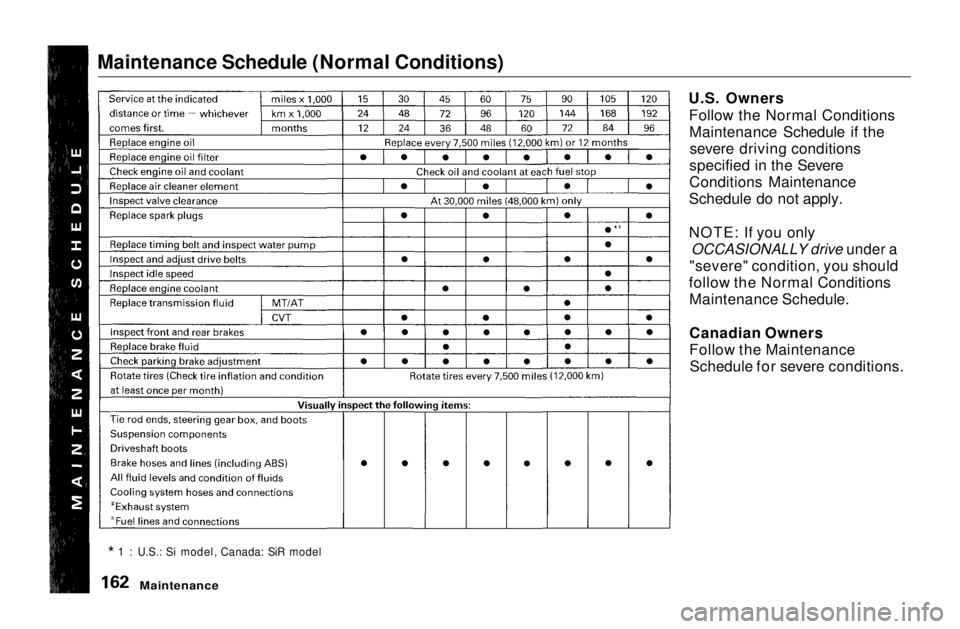
U.S. OwnersFollow the Normal ConditionsMaintenance Schedule if thesevere driving conditions
specified in the Severe
Conditions Maintenance
Schedule do not apply.
NOTE: If you only
OCCASIONALLY drive under a
"severe" condition, you should
follow the Normal Conditions Maintenance Schedule.
Canadian Owners
Follow the MaintenanceSchedule for severe conditions.
* 1 : U.S.: Si model, Canada: SiR model
MaintenanceMain Menu Table of Contents s t