ECU HONDA CIVIC COUPE 2002 7.G User Guide
[x] Cancel search | Manufacturer: HONDA, Model Year: 2002, Model line: CIVIC COUPE, Model: HONDA CIVIC COUPE 2002 7.GPages: 319, PDF Size: 5.02 MB
Page 39 of 319

Supervise the child. Even mature
children sometimes need to be
reminded to f asten the seat belts
or sit properly.
If you decide that a child can saf ely
ride up f ront, be sure to:
Caref ully read the owner’s manual
and make sure you understand all
seat belt instructions and all saf ety
inf ormation.
Move the vehicle seat to the rear-
most position.
Have the child sit up straight, back
against the seat, and feet on or
near the f loor.
Check that the child’s seat belt is
properly positioned and secured.
Of course, children vary widely. And
while age may be one indicator of
when a child can saf ely ride in the
f ront, there are other important
f actors you should consider.
Physically, a child must be large
enough f or the lap/shoulder belt to
properly f it over the hips, chest, and
shoulder (see pages and ). If
the seat belt does not f it properly,
the child should not sit in the f ront.
To saf ely ride in f ront, a child must
be able to f ollow the rules, including
sitting properly and wearing the seat
belt properly throughout a ride.
16 38
Physical Size
Maturity
Protecting Children
Driver and Passenger Saf ety40
Page 40 of 319
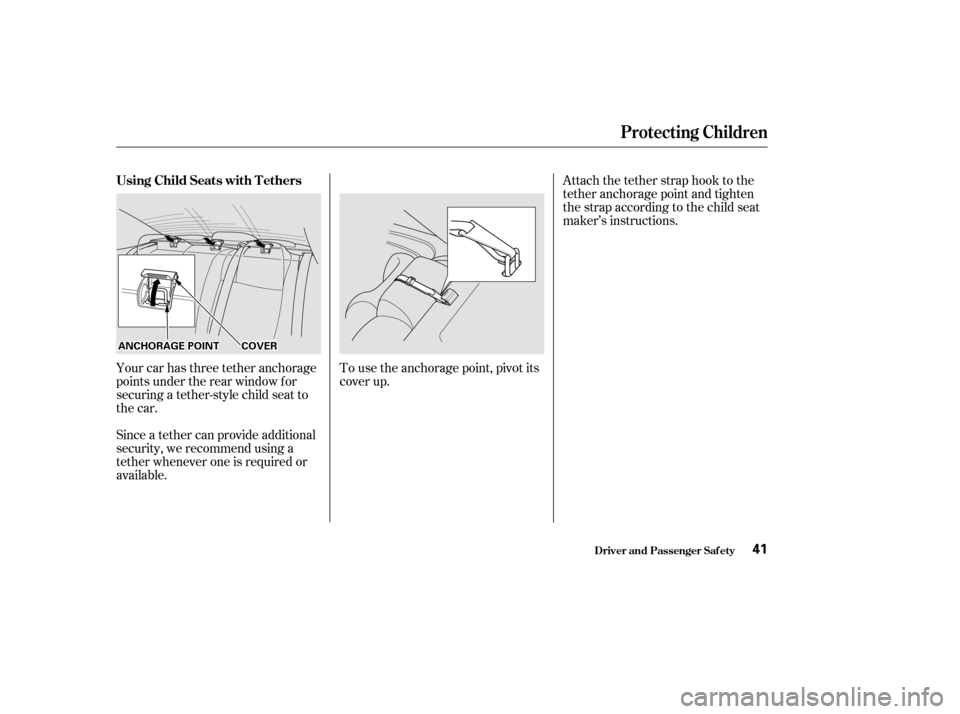
To use the anchorage point, pivot its
cover up.
Your car has three tether anchorage
points under the rear window f or
securing a tether-style child seat to
the car.
Since a tether can provide additional
security, we recommend using a
tether whenever one is required or
available. Attach the tether strap hook to the
tether anchorage point and tighten
the strap according to the child seat
maker’s instructions.
Using Child Seats with T ethers
Protecting Children
Driver and Passenger Saf ety41
AANNCCHHOORRAAGGEEPPOOIINNTTCCOOVVEERR
Page 41 of 319
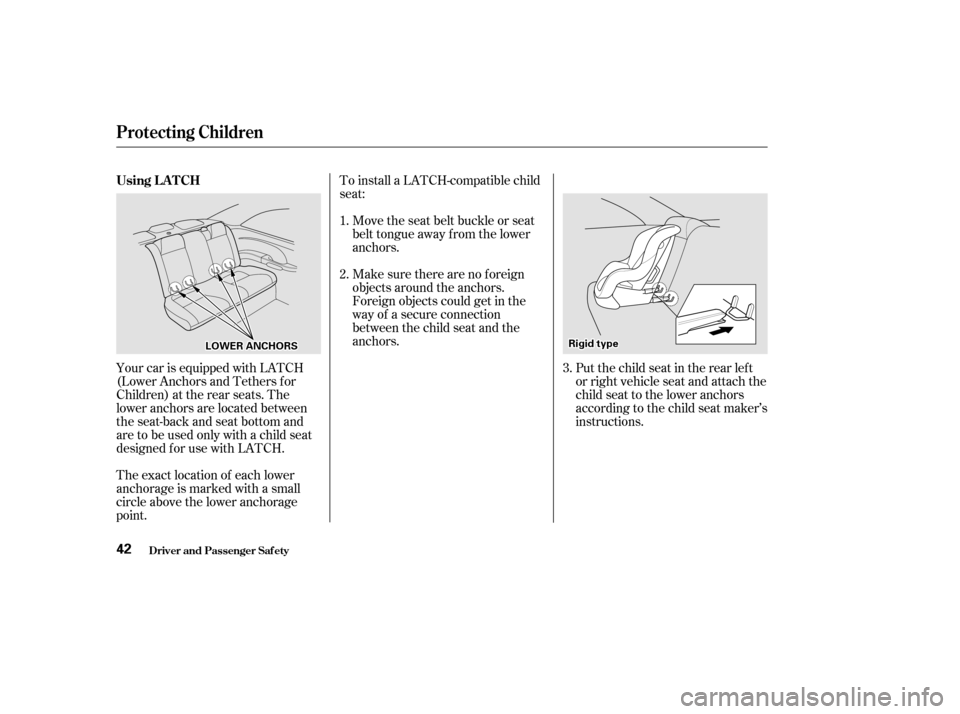
Your car is equipped with LATCH
(Lower Anchors and Tethers f or
Children) at the rear seats. The
lower anchors are located between
the seat-back and seat bottom and
aretobeusedonlywithachildseat
designed f or use with LATCH.
The exact location of each lower
anchorage is marked with a small
circle above the lower anchorage
point.To install a LATCH-compatible child
seat:
Make sure there are no f oreign
objects around the anchors.
Foreign objects could get in the
way of a secure connection
between the child seat and the
anchors. Put the child seat in the rear lef t
or right vehicle seat and attach the
child seat to the lower anchors
according to the child seat maker’s
instructions.
Move the seat belt buckle or seat
belt tongue away f rom the lower
anchors.
1. 2.
3.
Protecting Children
Driver and Passenger Saf ety
Using L A T CH
42
RRiiggiiddttyyppeeLLOOWWEERRAANNCCHHOORRSS
Page 42 of 319
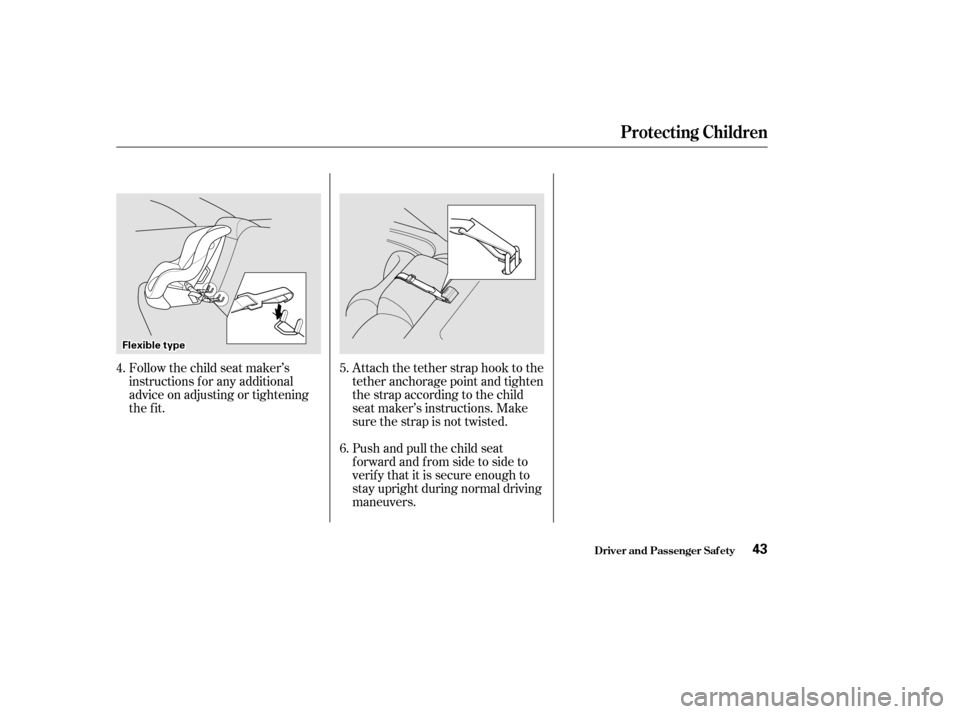
Follow the child seat maker’s
instructions f or any additional
advice on adjusting or tightening
the fit.Attach the tether strap hook to the
tether anchorage point and tighten
the strap according to the child
seat maker’s instructions. Make
sure the strap is not twisted.
Push and pull the child seat
f orward and f rom side to side to
verif y that it is secure enough to
stay upright during normal driving
maneuvers.
4.
5. 6.
Protecting Children
Driver and Passenger Saf ety43
FFlleexxiibblleettyyppee
Page 43 of 319
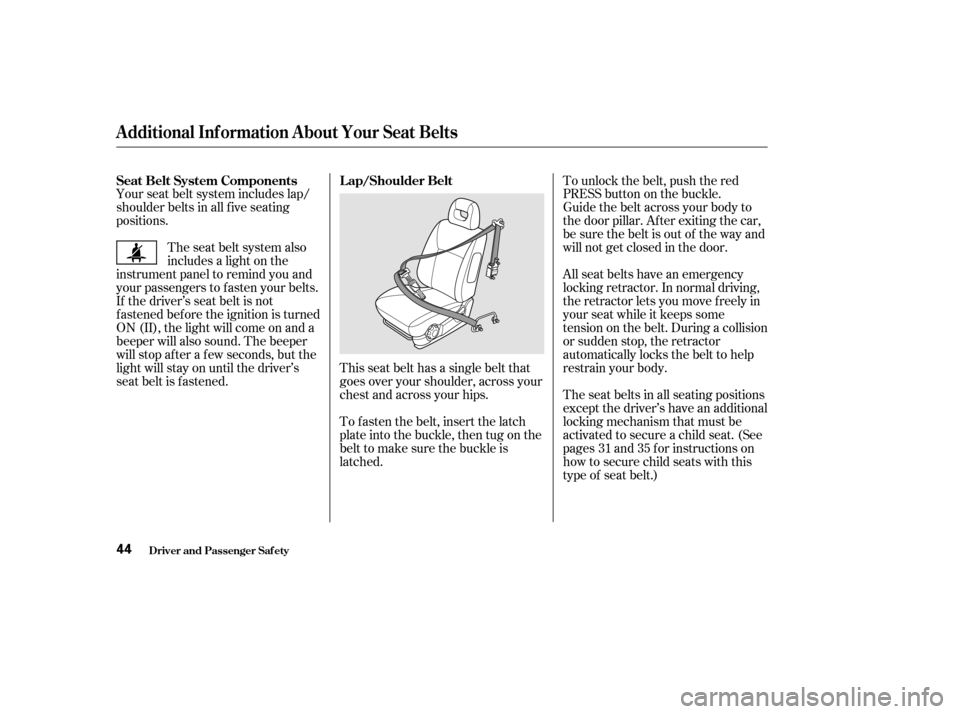
This seat belt has a single belt that
goes over your shoulder, across your
chest and across your hips.
Your seat belt system includes lap/
shoulder belts in all f ive seating
positions.
The seat belt system also
includes a light on the
instrument panel to remind you and
your passengers to f asten your belts.
If the driver’s seat belt is not
fastened before the ignition is turned
ON (II), the light will come on and a
beeper will also sound. The beeper
will stop af ter a f ew seconds, but the
light will stay on until the driver’s
seat belt is f astened. The seat belts in all seating positions
except the driver’s have an additional
locking mechanism that must be
activated to secure a child seat. (See
pages and f or instructions on
how to secure child seats with this
type of seat belt.)
All seat belts have an emergency
locking retractor. In normal driving,
the retractor lets you move f reely in
your seat while it keeps some
tension on the belt. During a collision
or sudden stop, the retractor
automatically locks the belt to help
restrain your body.
Guide the belt across your body to
the door pillar. Af ter exiting the car,
be sure the belt is out of the way and
will not get closed in the door.
To unlock the belt, push the red
PRESSbuttononthebuckle.
To fasten the belt, insert the latch
plate into the buckle, then tug on the
belt to make sure the buckle is
latched. 31 35
Seat Belt System Components L ap/Shoulder Belt
Additional Inf ormation About Your Seat Belts
Driver and Passenger Saf ety44
Page 74 of 319
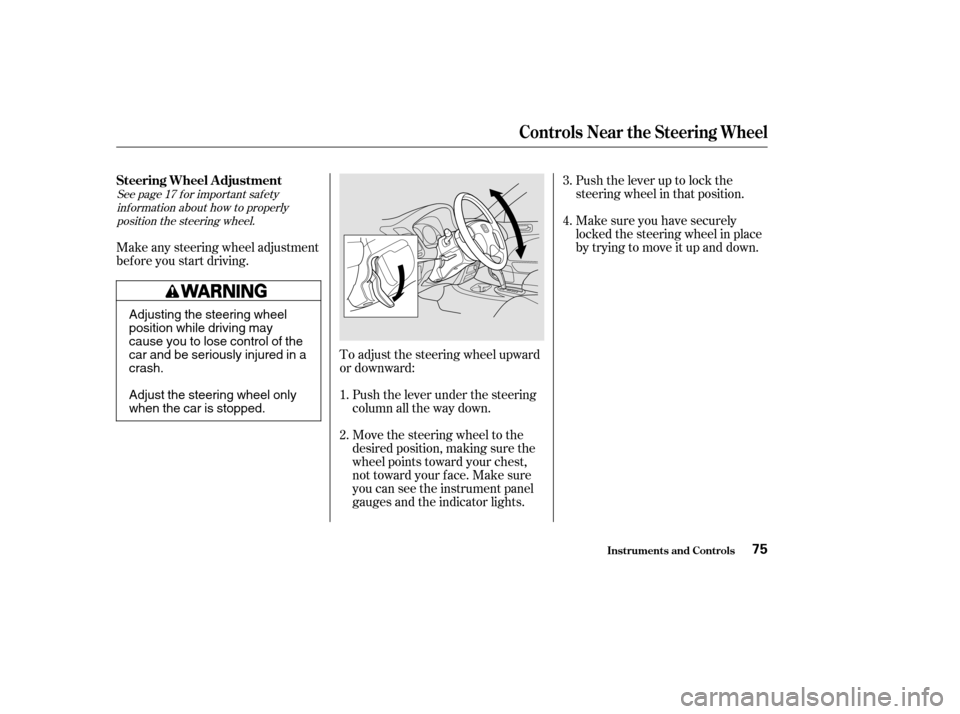
Push the lever up to lock the
steering wheel in that position.
Make sure you have securely
locked the steering wheel in place
by trying to move it up and down.
Move the steering wheel to the
desired position, making sure the
wheel points toward your chest,
not toward your f ace. Make sure
you can see the instrument panel
gauges and the indicator lights.
Push the lever under the steering
column all the way down.
To adjust the steering wheel upward
or downward:
Make any steering wheel adjustment
bef ore you start driving.
1.4.
3.
2.
See page f or important saf ety inf ormation about how to properlyposition the steering wheel. 17
Inst rument s and Cont rols
Controls Near the Steering Wheel
Steering Wheel A djustment
75
Adjusting the steering wheel
position while driving may
cause you to lose control of the
car and be seriously injured in acrash.
Adjust the steering wheel only
when the car is stopped.
Page 90 of 319
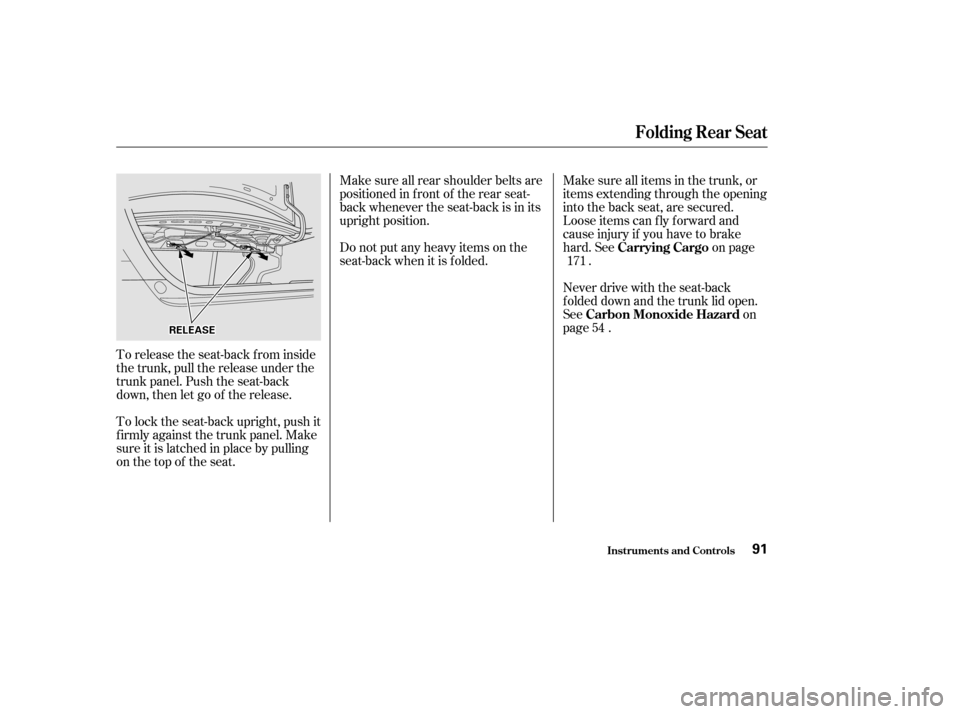
To release the seat-back from inside
the trunk, pull the release under the
trunk panel. Push the seat-back
down, then let go of the release.
To lock the seat-back upright, push it
f irmly against the trunk panel. Make
sure it is latched in place by pulling
on the top of the seat.Make sure all rear shoulder belts are
positioned in f ront of the rear seat-
back whenever the seat-back is in its
upright position.
Do not put any heavy items on the
seat-back when it is folded.
Make sure all items in the trunk, or
items extending through the opening
into the back seat, are secured.
Looseitemscanflyforwardand
cause injury if you have to brake
hard. See on page
.
Never drive with the seat-back
f olded down and the trunk lid open.
See on
page . 54
171
Carrying Cargo
Carbon Monoxide Hazard
Folding Rear Seat
Inst rument s and Cont rols91
RREELLEEAASSEE
Page 164 of 319
If you can open the hood without
lifting the hood latch handle, or the
hood latch handle moves stif f ly or
does not spring back as bef ore, the
mechanism should be cleaned and
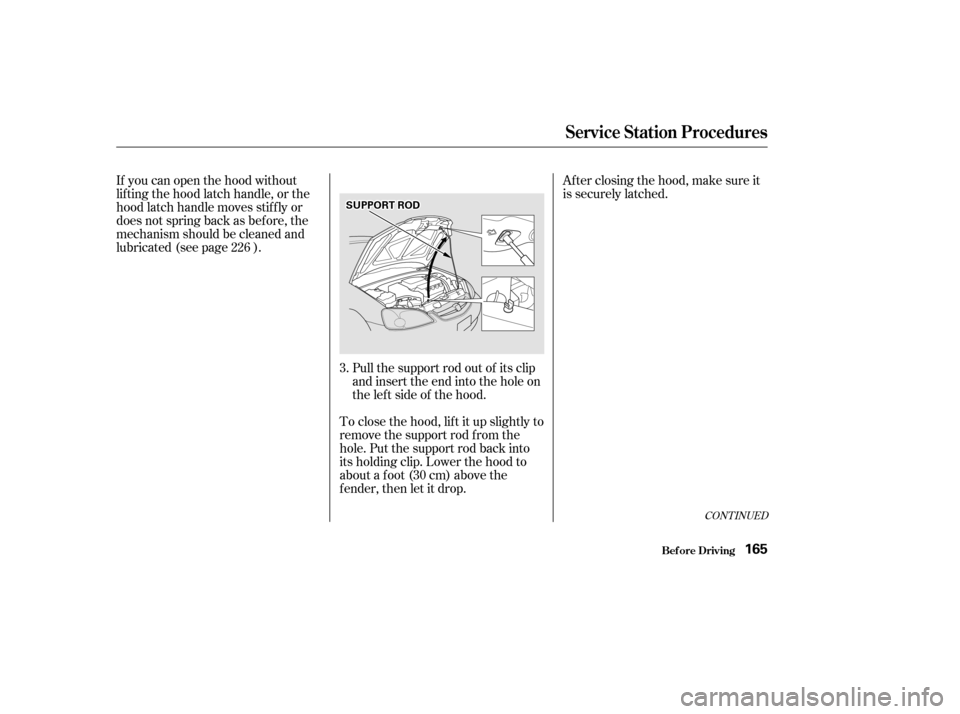
lubricated (see page ).Pull the support rod out of its clip
and insert the end into the hole on
theleftsideof thehood.After closing the hood, make sure it
is securely latched.
To close the hood, lif t it up slightly to
remove the support rod f rom the
hole. Put the support rod back into
its holding clip. Lower the hood to
about a f oot (30 cm) above the
fender,thenletitdrop.
3.
226
CONT INUED
Service Station Procedures
Bef ore Driving165
SSUUPPPPOORRTTRROODD
Page 171 of 319

Store or secure all items that could
be thrown around and hurt
someone during a crash.
Be sure items placed on the f loor
behind the f ront seats cannot roll
under the seats and interf ere with
the driver’s ability to operate the
pedals, or with the proper
operation of the seats.
Keep the glove box closed while
driving. If the lid is open, a
passenger could injure their knees
during a crash or sudden stop.
This f igure includes the total weight
of all occupants, cargo, and
accessories.
To f igure out how much cargo you
can carry:
Add up the weight of all occupants.
The f inal number is the total weight
of cargo you can carry.
The maximum load for your car is
850 lbs (395 kg).
Subtract the total f rom 850 lbs
(395 kg). Do not put any items on top of the
rear shelf . They can block your
view and be thrown around the car
during a crash.
Carrying Items in the Passenger
Compartment
Load Limit
Carrying Cargo
Bef ore Driving172
Overloading or improper
loading can affect handling and
stability and cause a crash in
which you can be hurt or killed.
Follow all load limits and other
loading guidelines in thismanual.
Page 173 of 319
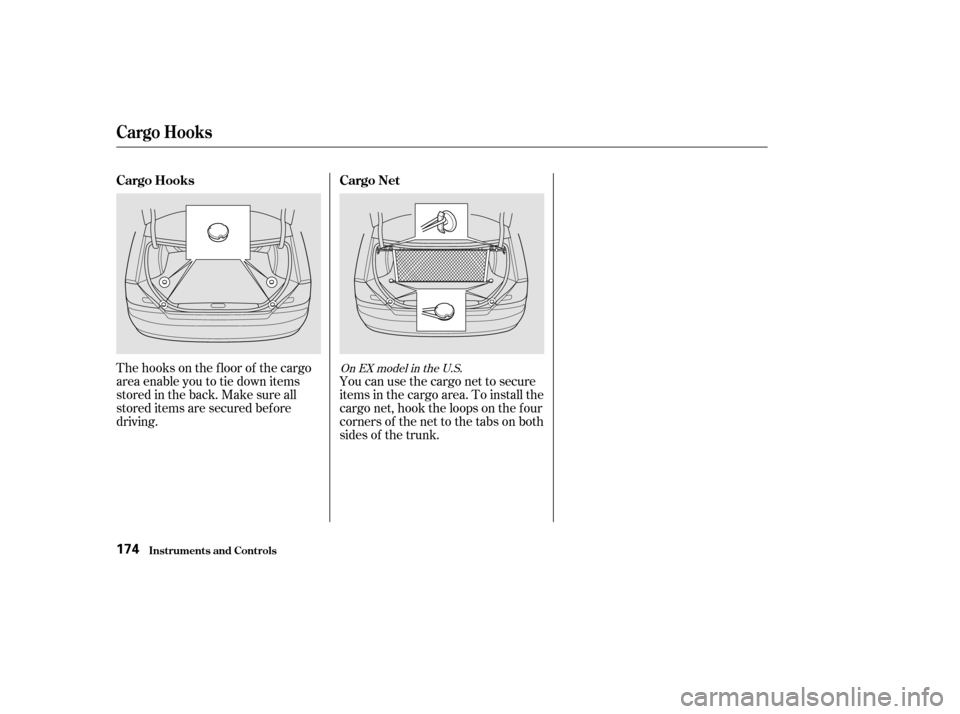
The hooks on the f loor of the cargo
area enable you to tie down items
stored in the back. Make sure all
stored items are secured bef ore
driving.You can use the cargo net to secure
items in the cargo area. To install the
cargo net, hook the loops on the f our
corners of the net to the tabs on both
sides of the trunk.On EX model in the U.S.
Inst rument s and Cont rols
Cargo Hooks Cargo Net
Cargo Hooks
174