lock HONDA CIVIC COUPE 2002 7.G User Guide
[x] Cancel search | Manufacturer: HONDA, Model Year: 2002, Model line: CIVIC COUPE, Model: HONDA CIVIC COUPE 2002 7.GPages: 319, PDF Size: 5.02 MB
Page 35 of 319
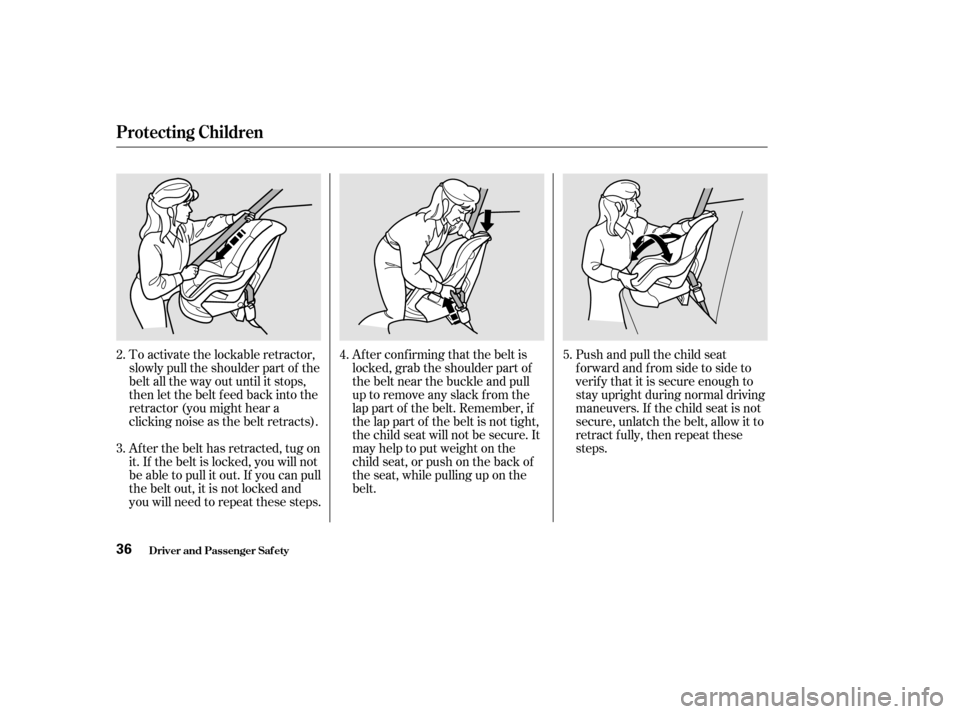
Push and pull the child seat
f orward and f rom side to side to
verif y that it is secure enough to
stay upright during normal driving
maneuvers. If the child seat is not
secure, unlatch the belt, allow it to
retract f ully, then repeat these
steps.
Af ter conf irming that the belt is
locked, grab the shoulder part of
the belt near the buckle and pull
up to remove any slack from the
lap part of the belt. Remember, if
the lap part of the belt is not tight,
the child seat will not be secure. It
mayhelptoputweightonthe
child seat, or push on the back of
the seat, while pulling up on the
belt.
To activate the lockable retractor,
slowly pull the shoulder part of the
belt all the way out until it stops,
then let the belt f eed back into the
retractor (you might hear a
clicking noise as the belt retracts).
Af ter the belt has retracted, tug on
it. If the belt is locked, you will not
be able to pull it out. If you can pull
the belt out, it is not locked and
you will need to repeat these steps. 4.
5.
2. 3.
Protecting Children
Driver and Passenger Saf ety36
Page 36 of 319

When a child reaches the
recommended weight or height limit
for a forward-facing child seat, the
child should sit in the back seat and
wear a lap/shoulder belt.
If a child is too short f or the shoulder
part of the belt to properly f it, we
recommend that the child use a
booster seat until the child is tall
enough to use the seat belt without a
booster.
The f ollowing pages give
instructions on how to check proper
seat belt f it, what kind of booster
seat to use if one is needed, and
important precautions f or a child
who must sit in the f ront seat.
To deactivate the locking
mechanism in order to remove a
child seat, unlatch the buckle,
unroute the seat belt, and let the belt
fully retract.
Protecting L arger Children
Protecting Children
Driver and Passenger Saf ety37
Allowing a larger child to sit
improperly in the front seat can
result in injury or death if the
passenger’s front airbag inflates.
If a larger child must sit in front,
make sure the child moves the
seat as far back as possible
and wears the seat belt properly.
Page 43 of 319
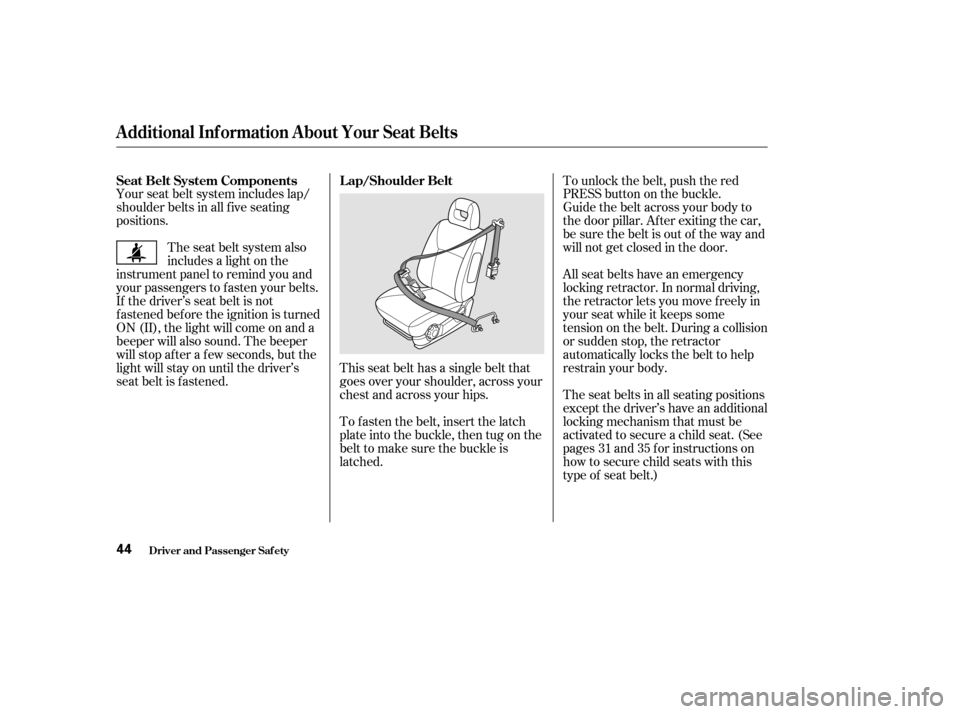
This seat belt has a single belt that
goes over your shoulder, across your
chest and across your hips.
Your seat belt system includes lap/
shoulder belts in all f ive seating
positions.
The seat belt system also
includes a light on the
instrument panel to remind you and
your passengers to f asten your belts.
If the driver’s seat belt is not
fastened before the ignition is turned
ON (II), the light will come on and a
beeper will also sound. The beeper
will stop af ter a f ew seconds, but the
light will stay on until the driver’s
seat belt is f astened. The seat belts in all seating positions
except the driver’s have an additional
locking mechanism that must be
activated to secure a child seat. (See
pages and f or instructions on
how to secure child seats with this
type of seat belt.)
All seat belts have an emergency
locking retractor. In normal driving,
the retractor lets you move f reely in
your seat while it keeps some
tension on the belt. During a collision
or sudden stop, the retractor
automatically locks the belt to help
restrain your body.
Guide the belt across your body to
the door pillar. Af ter exiting the car,
be sure the belt is out of the way and
will not get closed in the door.
To unlock the belt, push the red
PRESSbuttononthebuckle.
To fasten the belt, insert the latch
plate into the buckle, then tug on the
belt to make sure the buckle is
latched. 31 35
Seat Belt System Components L ap/Shoulder Belt
Additional Inf ormation About Your Seat Belts
Driver and Passenger Saf ety44
Page 44 of 319
If the shoulder part of the belt is
pulled all the way out, the locking
mechanism will activate. The belt
will retract, but it will not allow the
passenger to move f reely.
To deactivate the locking
mechanism, unlatch the buckle and
let the seat belt f ully retract. To
ref asten the belt, pull it out only as
f ar as needed.
See page f or instructions on how
to wear the lap/shoulder belt
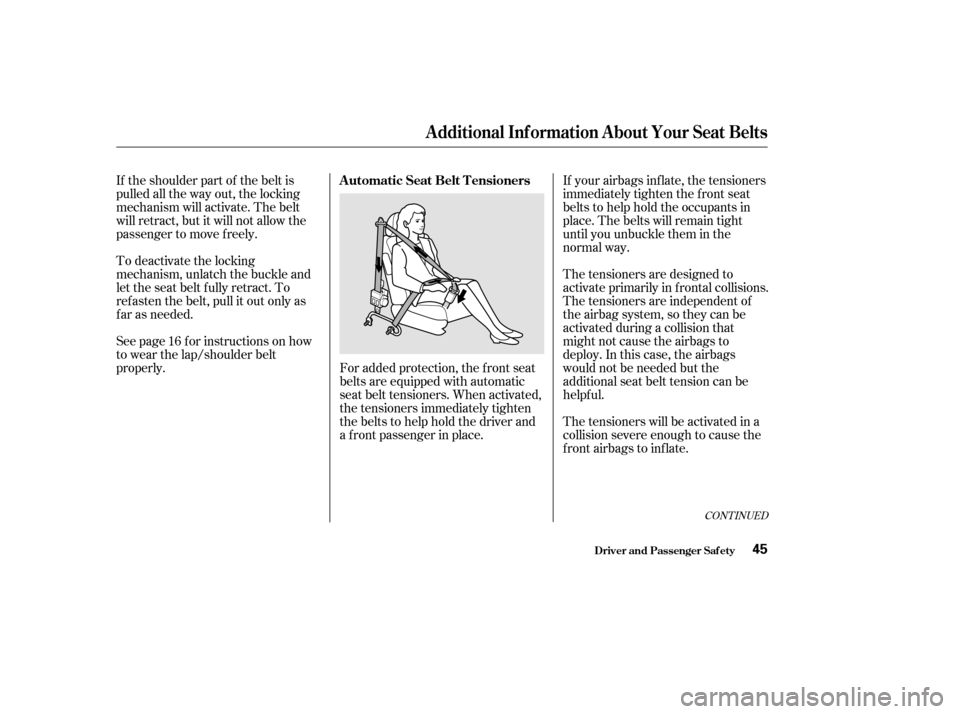
properly. For added protection, the f ront seatbelts are equipped with automatic
seat belt tensioners. When activated,
the tensioners immediately tighten
the belts to help hold the driver and
a f ront passenger in place.If your airbags inf late, the tensioners
immediately tighten the f ront seat
belts to help hold the occupants in
place. The belts will remain tight
until you unbuckle them in the
normal way.
The tensioners will be activated in a
collision severe enough to cause the
f ront airbags to inf late.
The tensioners are designed to
activate primarily in f rontal collisions.
The tensioners are independent of
the airbag system, so they can be
activated during a collision that
might not cause the airbags to
deploy. In this case, the airbags
would not be needed but the
additional seat belt tension can be
helpf ul.
16
CONT INUED
A utomatic Seat Belt T ensioners
Additional Inf ormation About Your Seat Belts
Driver and Passenger Saf ety45
Page 56 of 319

This section gives inf ormation about
the controls and displays that
contribute to the daily operation of
your Honda. All the essential
controls are within easy reach............................
Control Locations . 58 ...............................
Indicator Lights . 59
.............................................
Gauges . 66
...............................
Speedometer . 66
.................................
Tachometer . 66
.....................................
Odometer . 66
...................................
Trip Meter . 67
..................................
Fuel Gauge . 67
...................
Temperature Gauge . 68
Controls Near the Steering .......................................
Wheel . 69
...................................
Headlights . 70
............
Daytime Running Lights . 71
....
Instrument Panel Brightness . 71
................................
Turn Signals . 72
.....................
Windshield Wipers . 72
..................
Windshield Washers . 73
..........................
Hazard Warning . 74
.............
Rear Window Def ogger . 74
......
Steering Wheel Adjustment . 75
...............................
Keys and Locks . 76
..............................................
Keys . 76
....................
Immobilizer System . 77
............................
Ignition Switch . 78
..................................
Door Locks . 80
......................
Power Door Locks . 81
...................
Remote Transmitter . 81 ...........................................
Trunk . 84
........
Emergency Trunk Opener . 85
............................
Seat Adjustments . 86
.............
Front Seat Adjustments . 86
Driver’s Seat Height
..............................
Adjustment . 87
................
Driver’s Seat Armrest . 87
........................
Rear Seat Access . 87
..........................
Head Restraints . 89
...........................
Folding Rear Seat . 90
..............................
Power Windows . 92
.........................................
Moonroof . 94
.............................................
Mirrors . 95
....
Adjusting the Power Mirrors . 95
.................................
Parking Brake . 96
........................................
Glove Box . 97
.............................
Beverage Holder . 98
...................
Console Compartment . 98
..........................................
Coin Box . 99
.................................
Center Pocket . 99
...............
Accessory Power Socket . 99
......................................
Coat Hook . 100
...............................
Interior Lights . 100
..............................
Ceiling Light . 100
...................................
Spotlights . 101
........................
Courtesy Lights . 102
Instruments and Controls
Inst rument s and Cont rols57
Page 61 of 319

This light has two f unctions:This indicator comes on when you
turn the ignition switch ON (II). It
is a reminder to check the parking
brake. Driving with the parking
brake not f ully released can
damage the brakes and tires.
If the indicator remains lit after
you have f ully released the
parking brake while the engine is
running, or if it comes on while
driving, it can indicate a problem
in the brake system. For complete
inf ormation, see page . This light normally comes on f or a
f ew seconds when you turn the
ignition switch ON (II), and when
the ignition switch is turned to
START (III). If this light comes on at
any other time, there is a problem in
theABS.If thishappens,takethe
cartoyourdealertohaveitchecked.
With the light on, your car still has
normal braking ability but no anti-
lock. For complete inf ormation, see
page .
This indicator lights when you turn
the ignition switch to ON (II) with
the headlight switch of f and the
parking brake set. It should go of f if
youturnontheheadlightsorrelease
the parking brake. If it comes on at
any other time, it means there is a
problem with the DRL. There may
also be a problem with the high
beam headlights.
1. 2.
282192
Only on models equipped with ABS (see
page ) Canadian models only
190
Indicator L ights
Inst rument s and Cont rols
Parking Brake
and Brake
System
Indicator Anti-lock Brake
System (A BS)
Indicator
‘‘Daytime Running
Lights’’ Indicator
62
U.S. Canada U.S. Canada
Page 63 of 319

This indicator comes on f or a f ew
seconds when you turn the ignition
switch ON (II). It will then go of f if
you have inserted a properly-coded
ignition key. If it is not a properly-
coded key, the indicator will blink
and the engine will not start (see
page ).
This indicator also blinks several
times when you turn the ignition
switch f rom ON (II) to ACCESSORY
(I) or LOCK (0).This indicator reminds you that it is
time to take your car in for
scheduled maintenance.
Ref er to the Maintenance Schedules
f or Normal and Severe Driving
Conditions on pages and .
For the f irst 8,000 miles (12,800 km)
af ter the Maintenance Required
Indicator is reset, it will come on f or
two seconds when you turn the
ignition switch ON (II).Between 8,000 miles (12,800 km)
and 10,000 miles (16,000 km) this
indicator will light f or two seconds
when you f irst turn the ignition
switch ON (II), and then f lash f or
ten seconds.
If you exceed 10,000 miles (16,000
km) without having the scheduled
maintenance perf ormed, this
indicator will remain on as a constant
reminder.
77
204
198
Indicator L ights
Immobilizer System
Indicator Maintenance Required
Indicator
Inst rument s and Cont rols64
Page 69 of 319
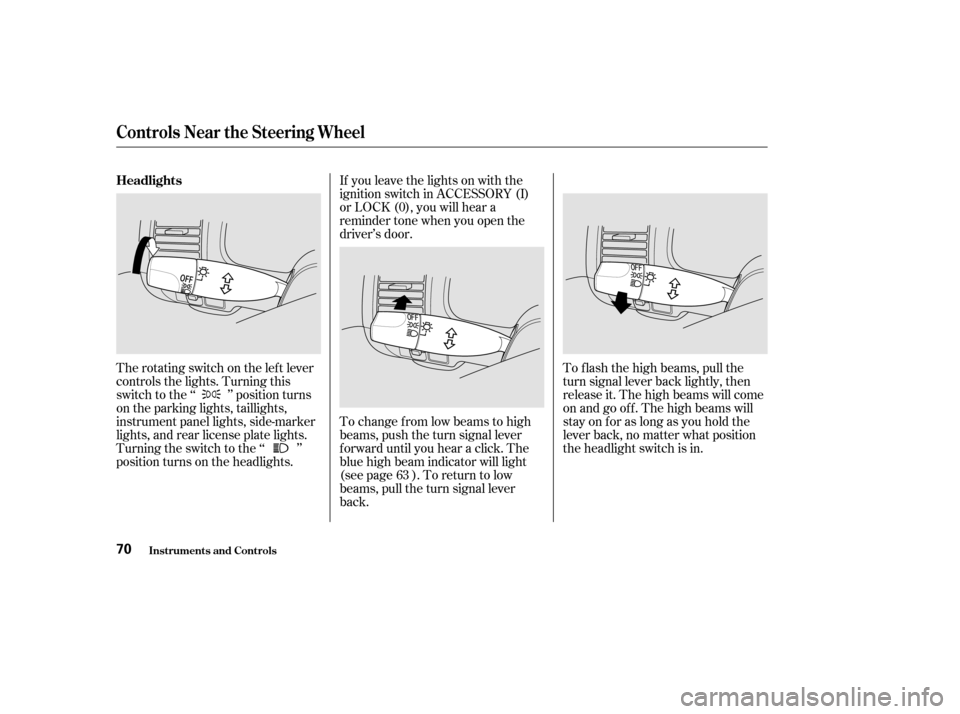
The rotating switch on the lef t lever
controls the lights. Turning this
switch to the ‘‘ ’’ position turns
on the parking lights, taillights,
instrument panel lights, side-marker
lights, and rear license plate lights.
Turning the switch to the ‘‘ ’’
position turns on the headlights.To change f rom low beams to high
beams, push the turn signal lever
f orward until you hear a click. The
blue high beam indicator will light
(see page ). To return to low
beams, pull the turn signal lever
back.
If you leave the lights on with the
ignition switch in ACCESSORY (I)
or LOCK (0), you will hear a
reminder tone when you open the
driver’s door.
To f lash the high beams, pull the
turn signal lever back lightly, then
release it. The high beams will come
on and go of f . The high beams will
stay on f or as long as you hold the
lever back, no matter what position
the headlight switch is in.
63
Headlights
Controls Near the Steering Wheel
Inst rument s and Cont rols70
Page 74 of 319
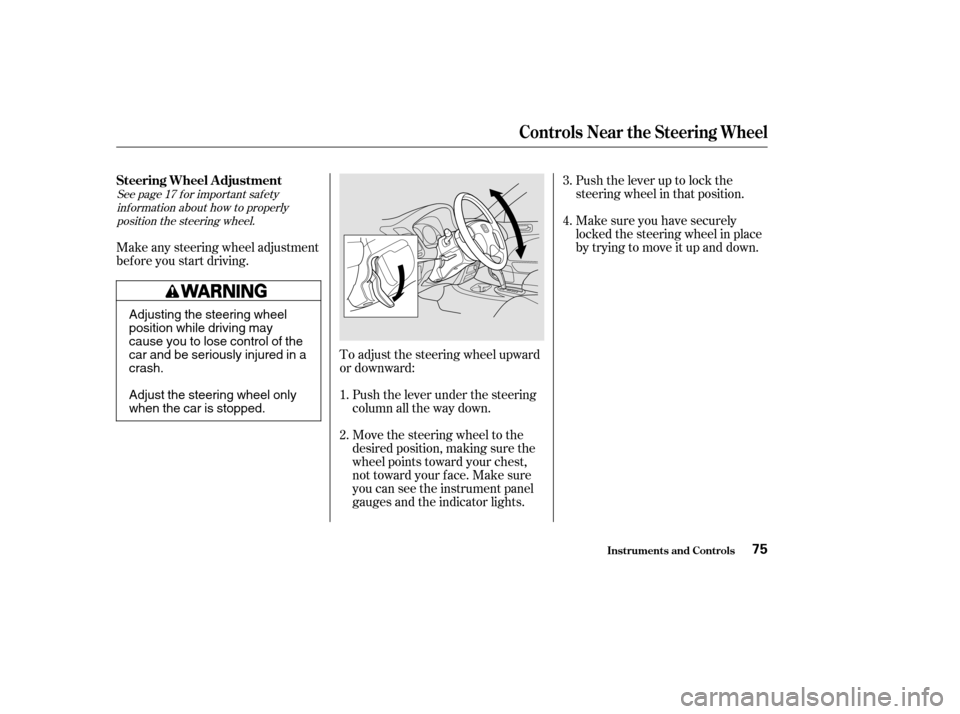
Push the lever up to lock the
steering wheel in that position.
Make sure you have securely
locked the steering wheel in place
by trying to move it up and down.
Move the steering wheel to the
desired position, making sure the
wheel points toward your chest,
not toward your f ace. Make sure
you can see the instrument panel
gauges and the indicator lights.
Push the lever under the steering
column all the way down.
To adjust the steering wheel upward
or downward:
Make any steering wheel adjustment
bef ore you start driving.
1.4.
3.
2.
See page f or important saf ety inf ormation about how to properlyposition the steering wheel. 17
Inst rument s and Cont rols
Controls Near the Steering Wheel
Steering Wheel A djustment
75
Adjusting the steering wheel
position while driving may
cause you to lose control of the
car and be seriously injured in acrash.
Adjust the steering wheel only
when the car is stopped.
Page 75 of 319
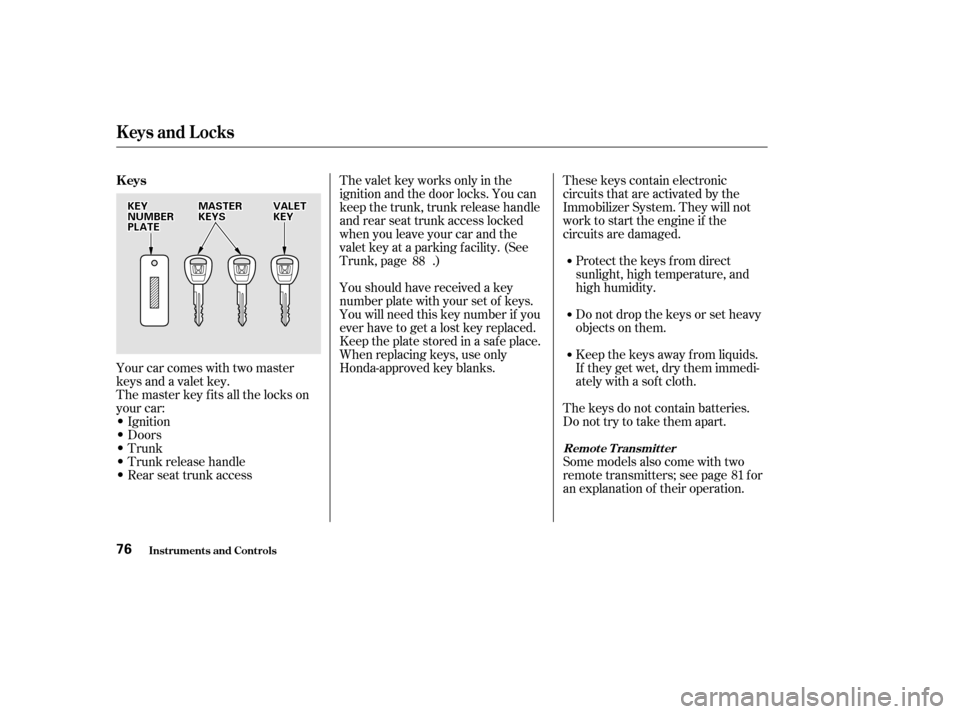
Your car comes with two master
keys and a valet key.
The master key fits all the locks on
your car:
Ignition
Doors
Trunk
Trunk release handle
Rear seat trunk accessYoushouldhavereceivedakey
number plate with your set of keys.
You will need this key number if you
ever have to get a lost key replaced.
Keep the plate stored in a saf e place.
When replacing keys, use only
Honda-approved key blanks.
The valet key works only in the
ignition and the door locks. You can
keep the trunk, trunk release handle
and rear seat trunk access locked
when you leave your car and the
valet key at a parking f acility. (See
Trunk, page .)
These keys contain electronic
circuits that are activated by the
Immobilizer System. They will not
work to start the engine if the
circuits are damaged.
Protect the keys f rom direct
sunlight, high temperature, and
high humidity.
Donotdropthekeysorsetheavy
objects on them.
Keep the keys away f rom liquids.
If they get wet, dry them immedi-
ately with a soft cloth.
The keys do not contain batteries.
Do not try to take them apart.
Some models also come with two
remote transmitters; see page for
an explanation of their operation.
88
81
Inst rument s and Cont rols
Keys
Remote Transmitter
Keys and Locks
76
KKEEYYNNUUMMBBEERRPPLLAATTEE
MMAASSTTEERRKKEEYYSSVVAALLEETTKKEEYY