ignition HONDA CIVIC COUPE 2012 9.G Owners Manual
[x] Cancel search | Manufacturer: HONDA, Model Year: 2012, Model line: CIVIC COUPE, Model: HONDA CIVIC COUPE 2012 9.GPages: 33, PDF Size: 2.75 MB
Page 6 of 33
Indicators
6
Instrument Panel
IndicatorName On/Blinking ExplanationMessage
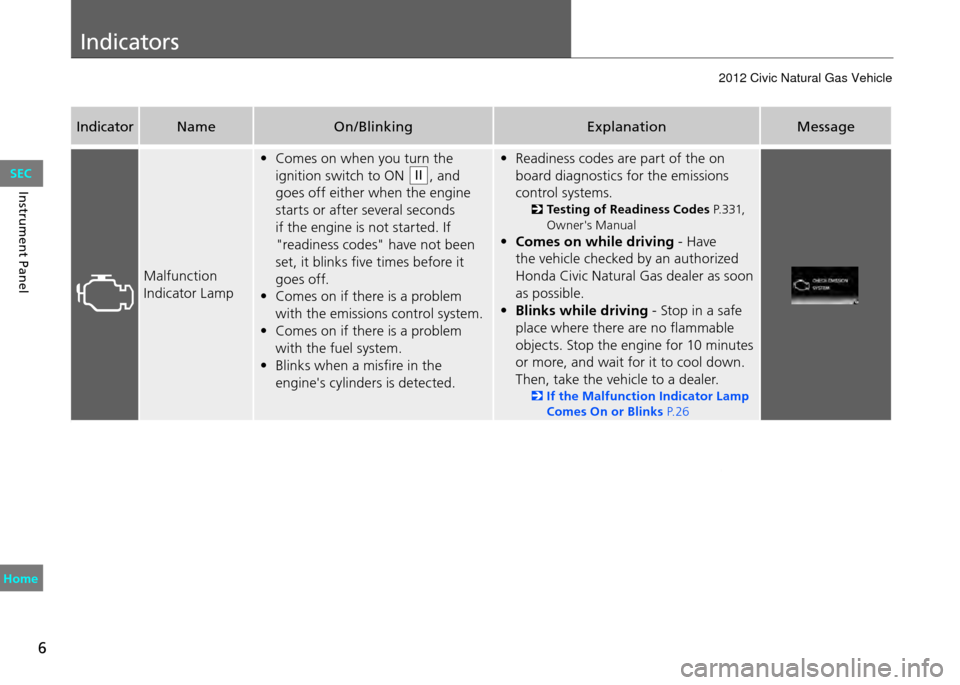
Malfunction
Indicator Lamp• Comes on when you turn the
ignition switch to ON
II, and
goes off either when the engine
starts or after several seconds
if the engine is not started. If
"readiness codes" have not been
set, it blinks five times before it
goes off.
• Comes on if there is a problem with the emissions control system.
• Comes on if there is a problem with the fuel system.
• Blinks when a misfire in the engine's cylinders is detected. • Readiness codes are part of the on
board diagnostics for the emissions
control systems.
Testing of Readiness Code s P.331,
Owner's Manual
• Comes on while driving - Have
the vehicle checked by an authorized
Honda Civic Natural Gas dealer as soon
as possible.
• Blinks while driving - Stop in a safe
place where there are no flammable
objects. Stop the engine for 10 minutes
or more, and wait for it to cool down.
Then, take the vehicle to a dealer.
If the Malfunction Indicator Lamp
Comes On or Blinks P. 2 6
Home SEC
2012 Civic Natural Gas Vehicle
Page 7 of 33
7
Instrument Panel
IndicatorName On/Blinking ExplanationMessage
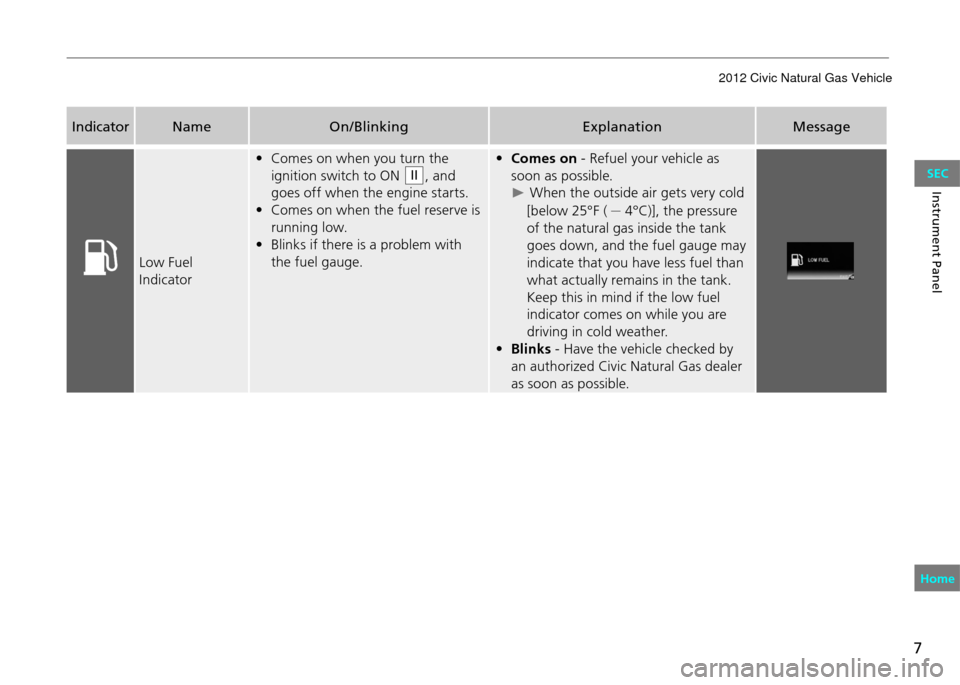
Low Fuel
Indicator• Comes on when you turn the
ignition switch to ON
II, and
goes off when the engine starts.
• Comes on when the fuel reserve is running low.
• Blinks if there is a problem with the fuel gauge. •
Comes on - Refuel your vehicle as
soon as possible.
When the outside air gets very cold
[below 25°F (
-4°C)], the pressure
of the natural gas inside the tank
goes down, and the fuel gauge may
indicate that you have less fuel than
what actually remains in the tank.
Keep this in mind if the low fuel
indicator comes on while you are
driving in cold weather.
• Blinks - Have the vehicle checked by
an authorized Civic Natural Gas dealer
as soon as possible.
HomeSEC
2012 Civic Natural Gas Vehicle
Page 9 of 33
9
Gauges and Displays
Instrument Panel
Gauges
Fuel Gauge Fuel Gauge
The quantity of fuel remaining in the tank is
calculated based on the pressure and temperature
of the natural gas in the fuel tank.
The gauge, average fuel, range, and instant fuel
economy show more or less than the actual
amount. The tank temperature, fill method, and
ambient conditions may affect the pressure and
temperature of the natural gas.
You can choose whether to reset trip A and average
fuel economy A when you refuel, using the multi-
information display.
Refueling a small amount of gas may not trigger trip
A and the average fuel economy to reset.
FUEL LID OPEN
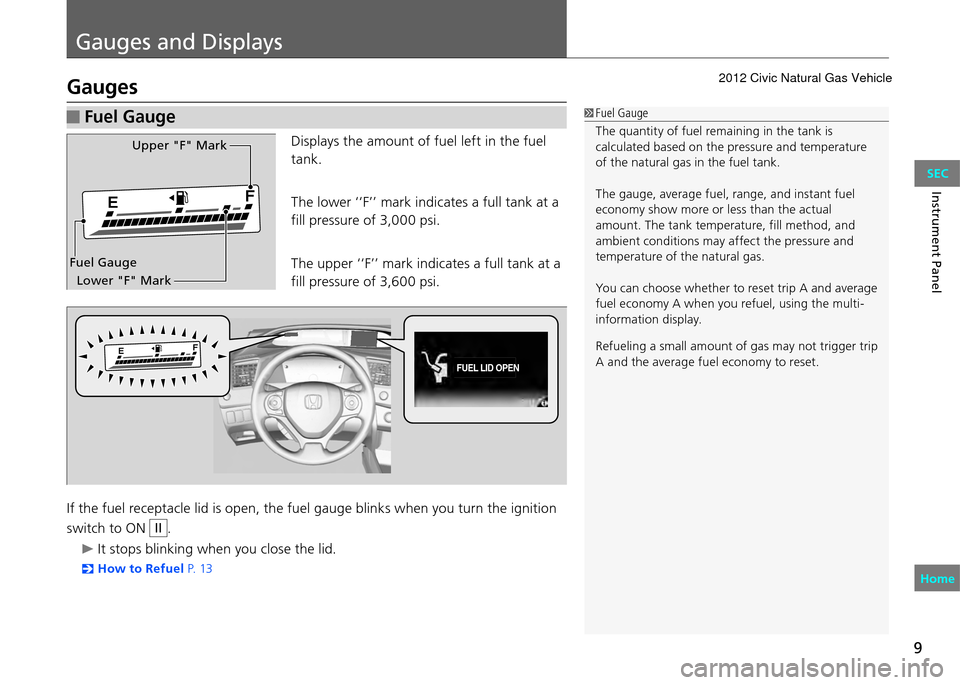
Displays the amount of fuel left in the fuel
tank.
The lower ‘‘F’’ mark indicates a full tank at a
fill pressure of 3,000 psi.
The upper ‘‘F’’ mark indicates a full tank at a
fill pressure of 3,600 psi.
If the fuel receptacle lid is open, the fuel gauge blinks when you turn the ignition
switch to ON
II.
It stops blinking when you close the lid.
How to Refue l
P. 13
Upper "F" Mark
Lower "F" Mark
Fuel Gauge
Home SEC
2012 Civic Natural Gas Vehicle
Page 12 of 33
When Driving Starting the Engine
12
Driving
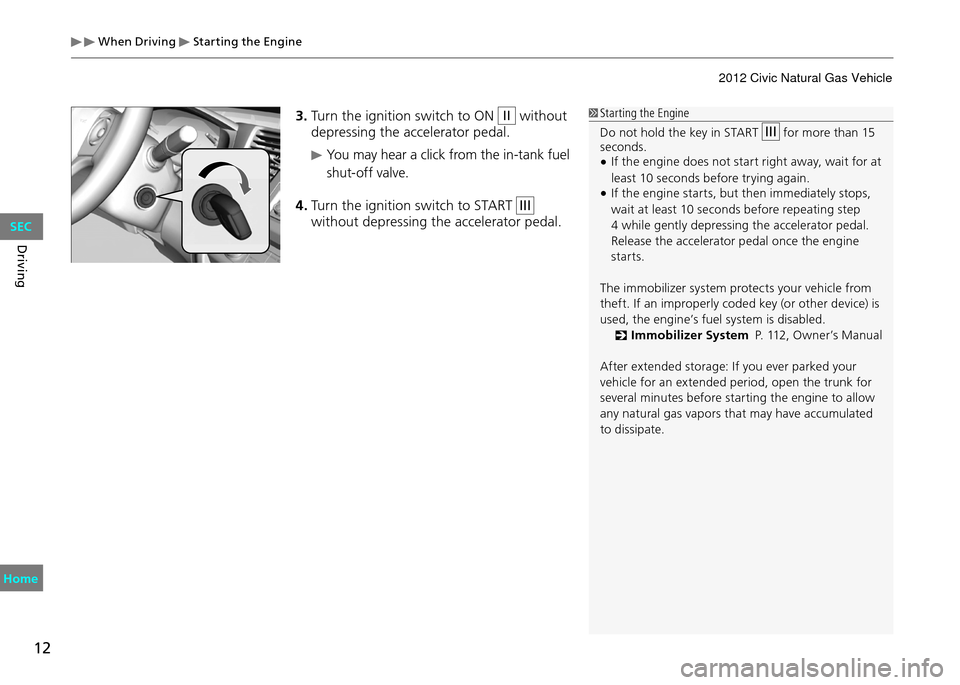
3. Turn the ignition switch to ON II without
depressing the accelerator pedal.
You may hear a click from the in-tank fuel
shut-off valve.
4. Turn the ignition switch to START III
without depressing the accelerator pedal.
Starting the Engine
Do not hold the key in START
III for more than 15
seconds.
If the engine does not start right away, wait for at
•least 10 seconds before trying again.
If the engine starts, but then immediately stops,
•wait at least 10 seconds before repeating step
4 while gently depressing the accelerator pedal.
Release the accelerator pedal once the engine
starts.
The immobilizer system protects your vehicle from
theft. If an improperly coded key (or other device) is
used, the engine’s fuel system is disabled. Immobilizer Syste m
P. 112, Owner’s Manual
After extended storage: If you ever parked your
vehicle for an extended period, open the trunk for
several minutes before starting the engine to allow
any natural gas vapors that may have accumulated
to dissipate.
Home SEC
2012 Civic Natural Gas Vehicle
Page 25 of 33
25
Fuel Leaks
Handling the Unexpected
If a Fuel Leak is Detected
If you smell natural gas or hear a hissing sound, except when refueling, the fuel
system may have a leak. If a Fuel Leak is Detected
WARNING
Compressed natural gas is flammable and
highly explosive. You could be killed or
seriously injured if leaking natural gas is
ignited.
If you suspect a leak, have your vehicle
immediately inspected and repaired by an
authorized CNG dealer.
Do not jump start your vehicle if you suspect a fuel
gas leak.
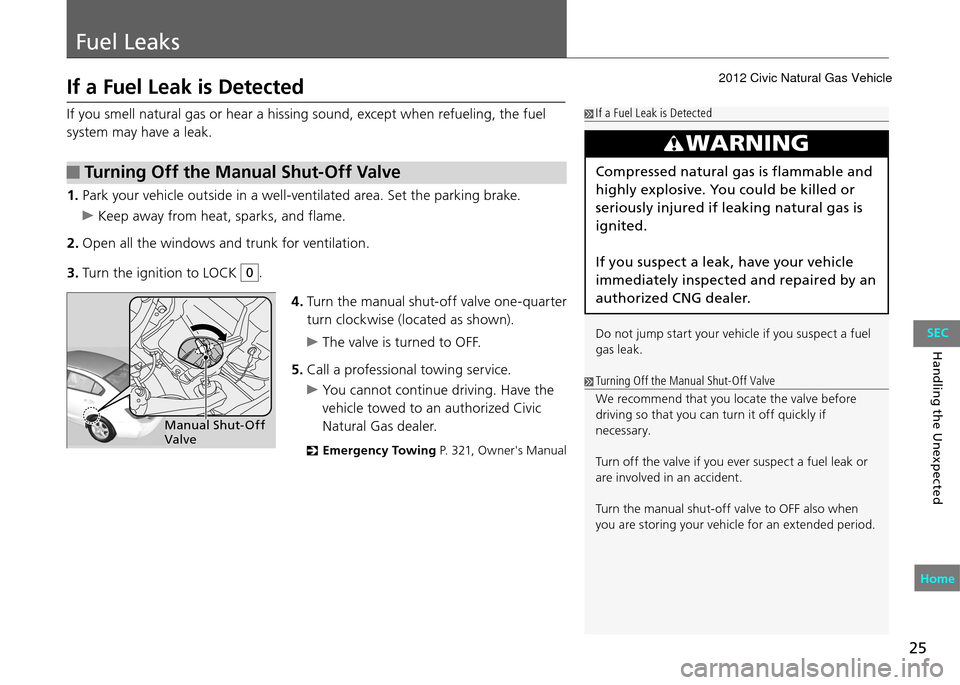
Turning Off the Manual Shut-Off Valve
We recommend that you locate the valve before
driving so that you can turn it off quickly if
ne ce s s ar y.
Turn off the valve if you ever suspect a fuel leak or
are involved in an accident.
Turn the manual shut-off valve to OFF also when
you are storing your vehicle for an extended period.
Turning Off the Manual Shut-Off Valve
4. Turn the manual shut-off valve one-quarter
turn clockwise (located as shown).
The valve is turned to OFF.
5. Call a professional towing service.
You cannot continue driving. Have the
vehicle towed to an authorized Civic
Natural Gas dealer.
Emergency Towing
P. 321, Owner's Manual
1. Park your vehicle outside in a well-ventilated area. Set the parking brake.
Keep away from heat, sparks, and flame.
2. Open all the windows and trunk for ventilation.
3. Turn the ignition to LOCK
0.
Manual Shut-Off
Valve
Home SEC
2012 Civic Natural Gas Vehicle