tow HONDA CIVIC HATCHBACK 2003 7.G User Guide
[x] Cancel search | Manufacturer: HONDA, Model Year: 2003, Model line: CIVIC HATCHBACK, Model: HONDA CIVIC HATCHBACK 2003 7.GPages: 275, PDF Size: 6.75 MB
Page 183 of 275
Check the battery terminals for
corrosion (a white or yellowish
powder). To remove it, cover the
terminals with a solution of baking
soda and water. It will bubble up and
turn brown. When this stops, wash it
of f with plain water. Dry of f the
battery with a cloth or paper towel.
Coat the terminals with grease to
help prevent f uture corrosion.
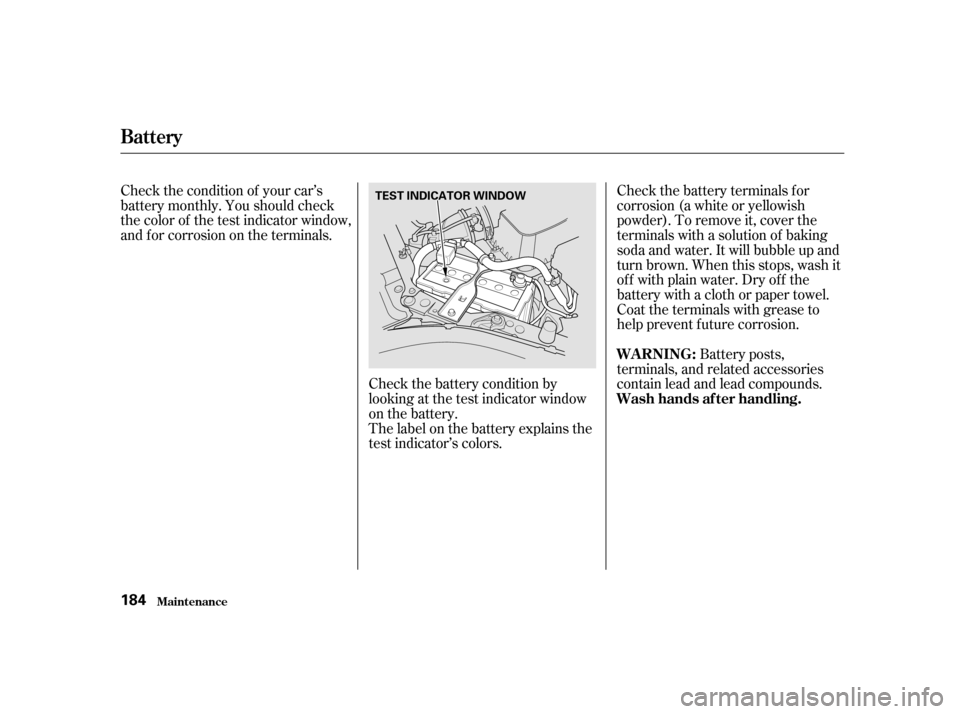
Check the battery condition by
looking at the test indicator window
on the battery.
The label on the battery explains the
test indicator’s colors.
Check the condition of your car’s
battery monthly. You should check
the color of the test indicator window,
and f or corrosion on the terminals.
Battery posts,
terminals, and related accessories
contain lead and lead compounds.
WARNING:
Wash hands af ter handling.
Battery
Maint enance
184 TEST INDICATOR WINDOW
Page 185 of 275
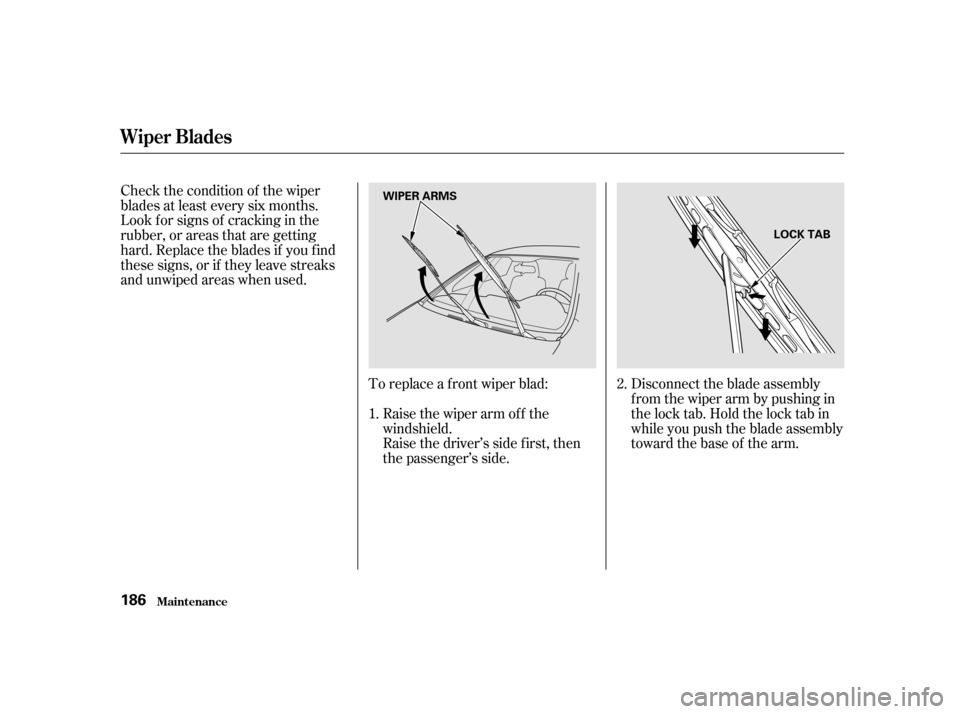
Disconnect the blade assembly
fromthewiperarmbypushingin
the lock tab. Hold the lock tab in
while you push the blade assembly
toward the base of the arm.
Raise the wiper arm of f the
windshield.
Check the condition of the wiper
blades at least every six months.
Look f or signs of cracking in the
rubber, or areas that are getting
hard. Replace the blades if you f ind
these signs, or if they leave streaks
and unwiped areas when used.
To replace a f ront wiper blad:Raise the driver’s side f irst, then
the passenger’s side. 2.
1.
Wiper Blades
Maint enance
186 WIPER ARMS
LOCK TAB
Page 203 of 275
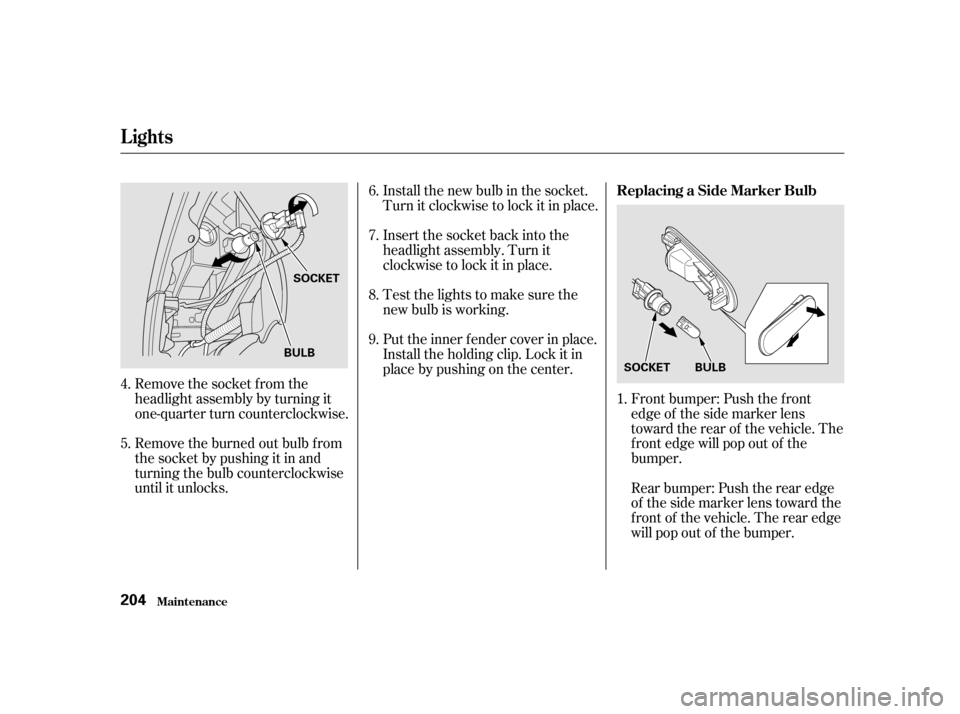
Remove the socket from the
headlight assembly by turning it
one-quarter turn counterclockwise.
Remove the burned out bulb f rom
thesocketbypushingitinand
turning the bulb counterclockwise
until it unlocks.Install the new bulb in the socket.
Turn it clockwise to lock it in place.
Insert the socket back into the
headlight assembly. Turn it
clockwise to lock it in place.
Testthelightstomakesurethe
new bulb is working.
Put the inner f ender cover in place.
Install the holding clip. Lock it in
placebypushingonthecenter.
Front bumper: Push the f ront
edge of the side marker lens
toward the rear of the vehicle. The
f ront edge will pop out of the
bumper.
Rear bumper: Push the rear edge
of thesidemarkerlenstowardthe
f ront of the vehicle. The rear edge
will pop out of the bumper.
4. 5. 6. 7. 8. 9.
1.
Replacing a Side Marker Bulb
Lights
Maint enance
204 SOCKET
BULB BULB
SOCKET
Page 206 of 275
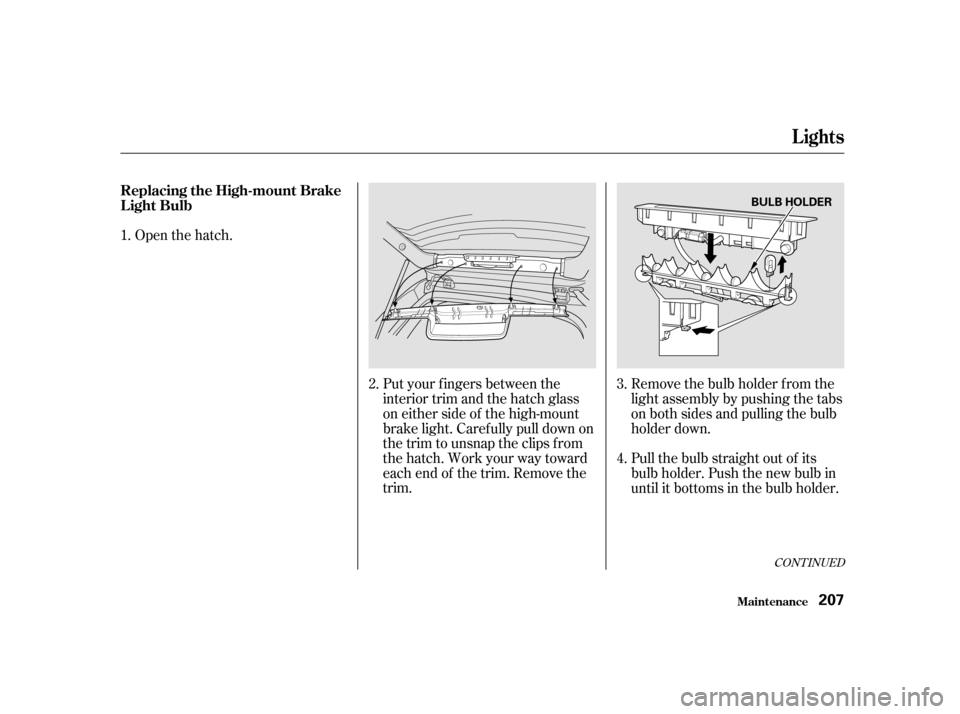
Open the hatch.Put your fingers between the
interior trim and the hatch glass
on either side of the high-mount
brake light. Caref ully pull down on
the trim to unsnap the clips f rom
the hatch. Work your way toward
each end of the trim. Remove the
trim.Remove the bulb holder f rom the
light assembly by pushing the tabs
on both sides and pulling the bulb
holder down.
Pull the bulb straight out of its
bulb holder. Push the new bulb in
until it bottoms in the bulb holder.
1.
3.
2.
4.
CONT INUED
Replacing the High-mount Brake
Light Bulb
Lights
Maint enance207
BULB HOLDER
Page 207 of 275
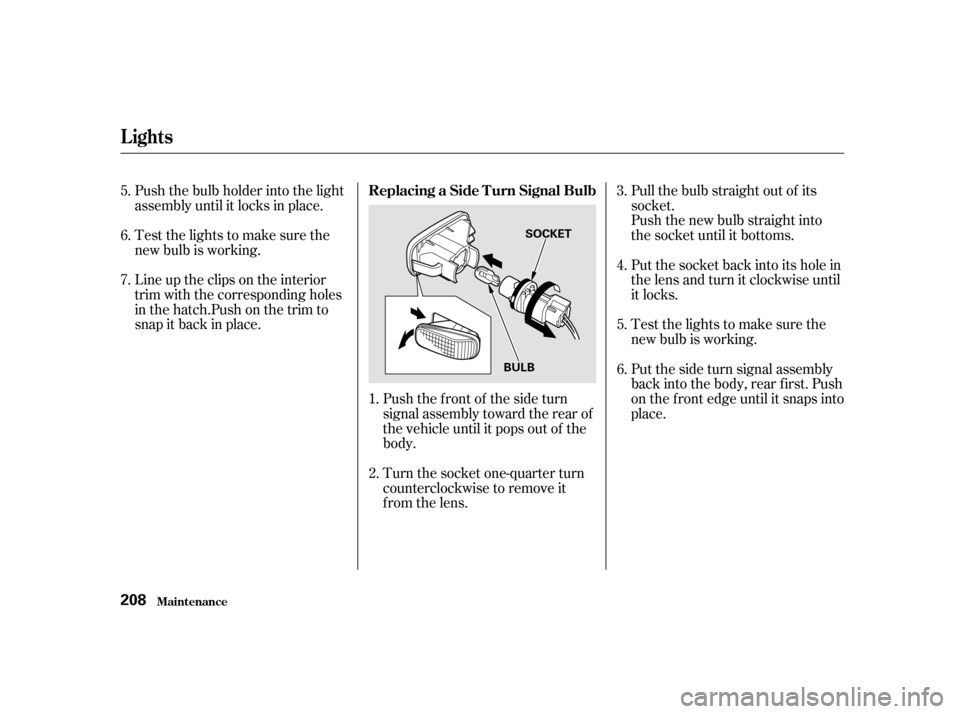
Push the new bulb straight into
the socket until it bottoms.
Pull the bulb straight out of its
socket.
Put the socket back into its hole in
the lens and turn it clockwise until
it locks.
Put the side turn signal assembly
back into the body, rear first. Push
on the f ront edge until it snaps into
place.
Push the bulb holder into the light
assembly until it locks in place.
Testthelightstomakesurethe
new bulb is working.
Testthelightstomakesurethe
new bulb is working.
Line up the clips on the interior
trim with the corresponding holes
in the hatch.Push on the trim to
snap it back in place.
Pushthefrontof thesideturn
signal assembly toward the rear of
the vehicle until it pops out of the
body.
Turn the socket one-quarter turn
counterclockwise to remove it
from the lens.
1.
2. 3. 5. 6.
4.
6.7.
5.
Replacing a Side T urn Signal Bulb
Maint enance
Lights
208 BULB
SOCKET
Page 211 of 275

Block the rear wheels.
Fill the f uel tank.
Change the engine oil and f ilter
(see page ).
Wash and dry the exterior
completely.
Cleantheinterior.Makesurethe
carpeting, floor mats, etc. are
completely dry.
If you need to park your car f or an
extended period (more than one
month), there are several things you
should do to prepare it f or storage.
Proper preparation helps prevent
deterioration and makes it easier to
get your car back on the road. If
possible, store your car indoors.
If the car is to be stored for a
longer period, it should be
supported on jackstands so the
tires are of f the ground.
Leave one window open slightly (if
the car is being stored indoors).Coverthecarwitha‘‘breathable’’
cover, one made f rom a porous
material such as cotton.
Nonporous materials, such as
plastic sheeting, trap moisture,
which can damage the paint.
Disconnect the battery.
Support the f ront and rear wiper
blade arms with a f olded towel or
ragsotheydonottouchthe
windshield.
To minimize sticking, apply a
silicone spray lubricant to all door
and hatch seals. Also, apply a body
wax to the painted surf aces that
mate with the door and hatch seals. If possible, run the engine f or a
while periodically (pref erably once
amonth).
If you store your car f or 12 months
or longer, have your Honda dealer
perf orm the inspections called f or in
the 24 months/30,000 miles (48,000
km) maintenance schedule (Normal
Conditions) as soon as you take it
out of storage (see page ). The
replacements called f or in the
maintenance schedule are not
needed unless the car has actually
reached that time or mileage.
Leave the parking brake off. Put
the transmission in Reverse. 158
169
St oring Your Car
Maint enance
212
Page 213 of 275

Fill a bucket with cool water. Mix
in a mild detergent, such as
dishwashing liquid or a product
made especially f or car washing.When you have washed and rinsed
the whole exterior, dry it with a
chamois or sof t towel. Letting it
air-dry will cause dulling and water
spots.
Only use the solvents and cleaners
recommendedinthisOwner’s
Manual.
Frequent washing helps preserve
your car’s beauty. Dirt and grit can
scratch the paint, while tree sap and
bird droppings can permanently ruin
the f inish.
Wash your car in a shady area, not in
direct sunlight. If the car is parked in
the sun, move it into the shade and
let the exterior cool down bef ore you
start.
Rinse the car thoroughly with cool
water to remove loose dirt.
As you dry the car, inspect it f or
chips and scratches that could allow
corrosion to start. Repair them with
touch-up paint (see page ).
Wash the car using the water and
detergent solution and a sof t-
bristle brush, sponge, or sof t cloth.
Start at the top and work your way
down. Rinse f requently.
Check the body f or road tar, tree
sap, etc. Remove these stains with
tar remover or turpentine. Rinse it
of f immediately so it does not
harm the f inish. Remember to re-
wax these areas, even if the rest of
the car does not need waxing. 216
Exterior Care
Appearance Care
Washing 214
Chemical solvents and strong cleaners
can damage the paint, metal, and
plastic on your car.
Page 217 of 275
If your seat belts get dirty, you can
use a sof t brush with a mixture of
mild soap and warm water to clean
them. Do not use bleach, dye, or
cleaning solvents. They can weaken
the belt material. Let the belts air-
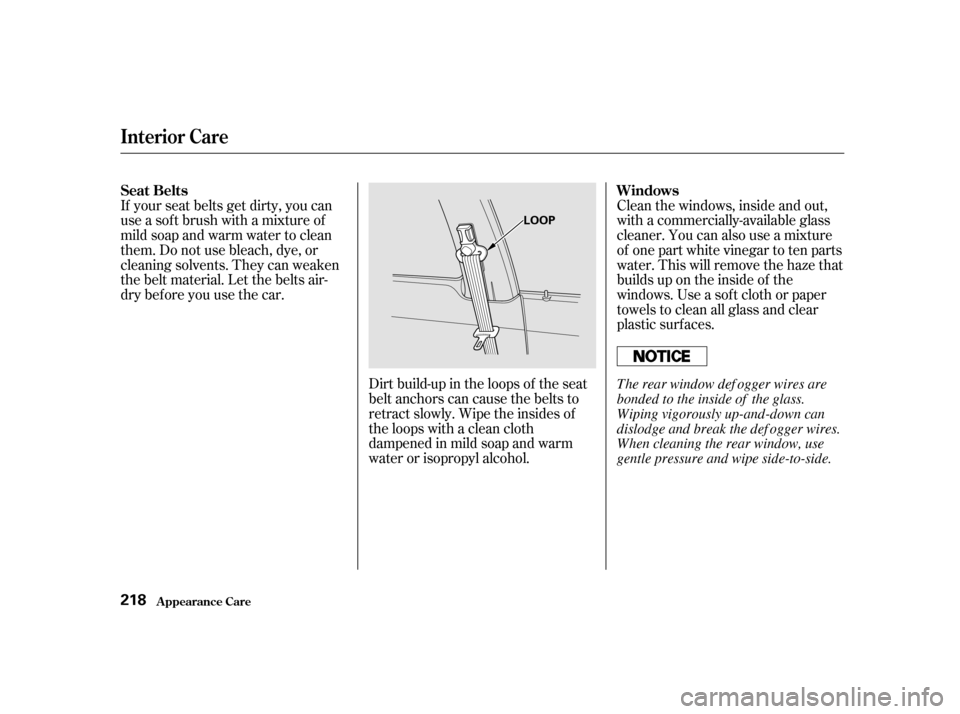
drybeforeyouusethecar.Dirt build-up in the loops of the seat
belt anchors can cause the belts to
retract slowly. Wipe the insides of
the loops with a clean cloth
dampened in mild soap and warm
water or isopropyl alcohol.Clean the windows, inside and out,
with a commercially-available glass
cleaner. You can also use a mixture
of one part white vinegar to ten parts
water. This will remove the haze that
builds up on the inside of the
windows. Use a sof t cloth or paper
towels to clean all glass and clear
plastic surf aces.
Appearance Care
Interior Care
Seat Belts Windows
218 LOOP
The rear window def ogger wires are
bonded to the inside of the glass.
Wiping vigorously up-and-down can
dislodge and break the def ogger wires.
When cleaning the rear window, use
gentle pressure and wipe side-to-side.
Page 220 of 275

This section covers the more-
common problems that motorists
experience with their vehicles. It
gives you inf ormation about how to
safely evaluate the problem and what
to do to correct it. If the problem has
stranded you on the side of the road,
you may be able to get going again.
If not, you will also f ind instructions
on getting your car towed.......................
Compact Spare Tire . 222
....................
Changing a Flat Tire . 223
..........
If Your Engine Won’t Start . 228
Nothing Happens or theStarter Motor Operates ............................
Very Slowly . 228
The Starter Operates ................................
Normally . 229
................................
Jump Starting . 230
............
If Your Engine Overheats . 232
.........
Low Oil Pressure Indicator . 234
..........
Charging System Indicator . 235
.......
Malf unction Indicator Lamp . 236
.......................
Readiness Codes . 237
...............
Brake System Indicator . 238
..................
Closing the Moonroof . 239
..............................................
Fuses . 240
..........
Checking and Replacing . 241
......................
Emergency Towing . 245
Taking Care of the Unexpected
T aking Care of t he Unexpect ed 221
Page 228 of 275

Turn the ignition switch to START
(III). If the headlights do not dim,
check the condition of the f uses. If
thefusesareOK,thereisproba-
bly something wrong with the
electrical circuit for the ignition
switch or starter motor. You will
need a qualif ied technician to
determine the problem. (Seeon page .)
If the headlights dim noticeably or
go out when you try to start the
engine, either the battery is dis-
charged or the connections are
corroded. Check the condition of
the battery and terminal connec-
tions (see page ). You can
then try jump starting the car from
a booster battery (see page ). In this case, the starter motor’s
speed sounds normal, or even f aster
than normal, when you turn the
ignition switch to START (III), but
the engine does not run.
Do you have f uel? Turn the
ignition switch to ON (II) for a
minute and watch the f uel gauge.
The low f uel level warning light
may not be working, so you were
not reminded to f ill the tank.
There may be an electrical
problem, such as no power to the
f uel pump. Check all the f uses
(see page ).
Your car has the Immobilizer
System. You should use a
properly-coded master or valet key
to start the engine (see page ).
A key that is not properly coded
will cause the immobilizer system
indicator in the dash panel to blink
rapidly.
Are you using the proper starting
procedure? Ref er to
on page . If youfindnothingwrong,youwill
need a qualif ied technician to f ind
the problem. See
on page .
143 74
245
184 230 241
245
If Your Engine Won’t Start
T aking Care of t he Unexpect ed
Emergency T owing
T he Starter Operates Normally
Starting the
Engine Emergency
Towing
229