check engine HONDA CIVIC HYBRID 2003 7.G Owner's Manual
[x] Cancel search | Manufacturer: HONDA, Model Year: 2003, Model line: CIVIC HYBRID, Model: HONDA CIVIC HYBRID 2003 7.GPages: 317, PDF Size: 4.17 MB
Page 201 of 317
Turn of f the engine, let it sit f or
several minutes, then check the oil
level. If necessary, add oil to bring
the level to the upper mark on the
dipstick.
Put the under cover back in place
and reinstall the nine holding clips.
Lock the clips securely by pushing
on the center of each clip.
Put a new washer on the drain bolt,
then reinstall the drain bolt.
Tighten it to:
Refill the engine with the recom-
mended oil.
Engine oil change capacity
(including f ilter):
Replace the engine oil f ill cap.
Start the engine. The oil pressure
indicator light should go out within
f ive seconds. If it does not, turn of f
the engine and reinspect your
work.
Let the engine run f or several
minutes and check the drain bolt
and oil f ilter f or leaks.
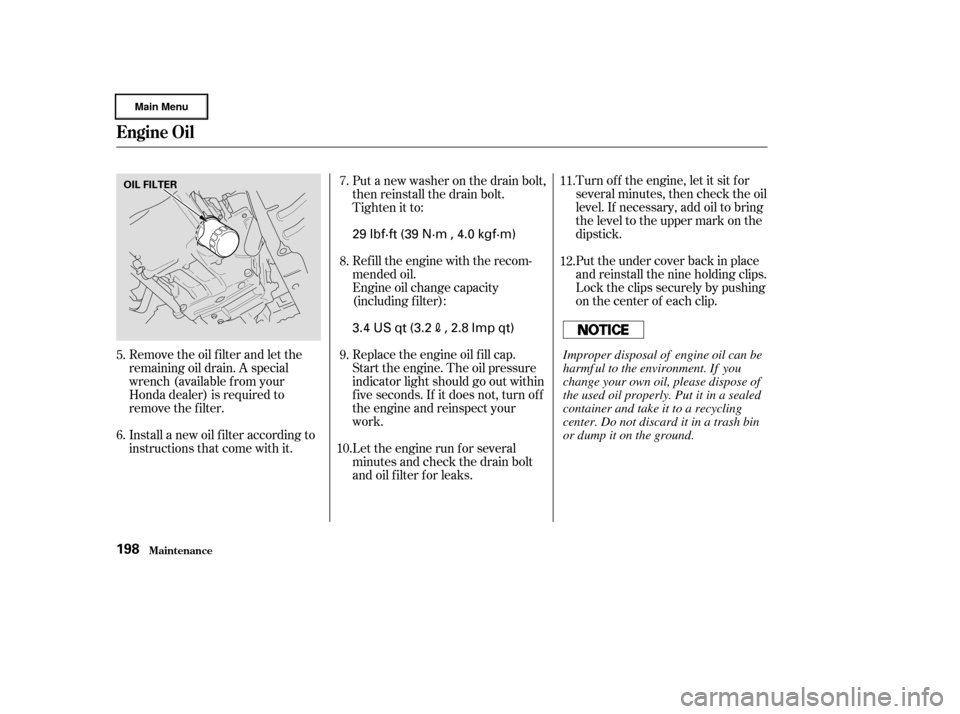
Remove the oil f ilter and let the
remaining oil drain. A special
wrench (available from your
Honda dealer) is required to
remove the f ilter.
Install a new oil f ilter according to
instructions that come with it. 7.
8.
9.
10. 12. 11.
5.
6.
Engine Oil
Maint enance198
OIL FILTER
29 lbf·ft (39 N·m , 4.0 kgf·m)
3.4 US qt (3.2
, 2.8 Imp qt) Improper disposal of engine oil can be
harmf ul to the environment. If you
change your own oil, please dispose of
the used oil properly. Put it in a sealed
container and take it to a recycling
center. Do not discard it in a trash bin
or dump it on the ground.
Page 202 of 317
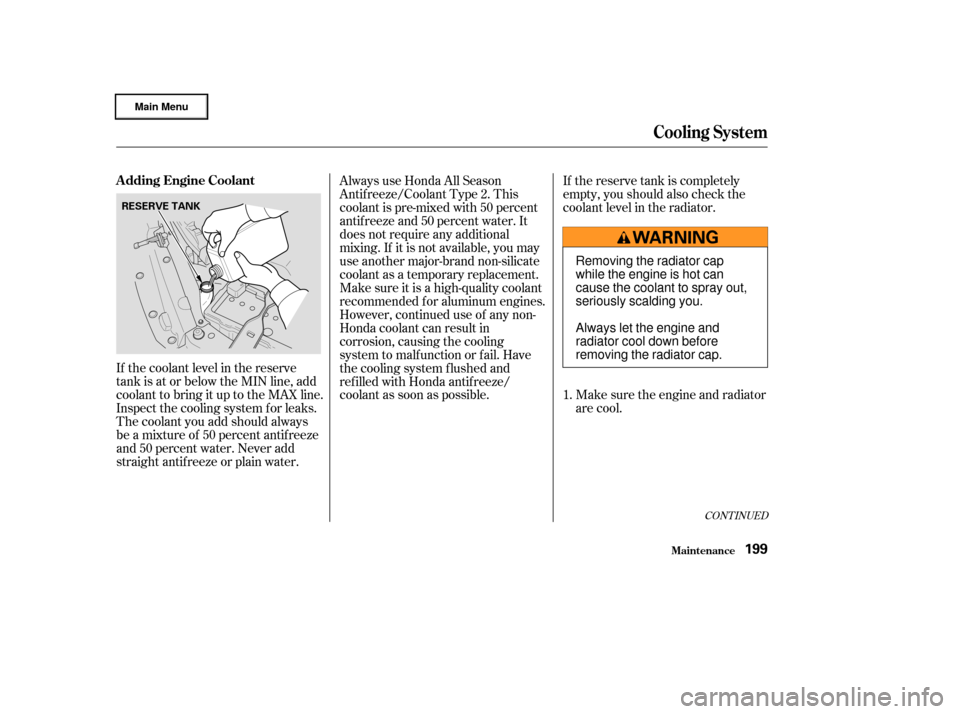
If the coolant level in the reserve
tank is at or below the MIN line, add
coolant to bring it up to the MAX line.
Inspect the cooling system f or leaks.
The coolant you add should always
be a mixture of 50 percent antif reeze
and 50 percent water. Never add
straight antif reeze or plain water.If the reserve tank is completely
empty, you should also check the
coolant level in the radiator.
Make sure the engine and radiator
are cool.
Always use Honda All Season
Antif reeze/Coolant Type 2. This
coolant is pre-mixed with 50 percent
antif reeze and 50 percent water. It
does not require any additional
mixing. If it is not available, you may
use another major-brand non-silicate
coolant as a temporary replacement.
Make sure it is a high-quality coolant
recommended f or aluminum engines.
However, continued use of any non-
Honda coolant can result in
corrosion, causing the cooling
system to malf unction or f ail. Have
the cooling system f lushed and
ref illed with Honda antif reeze/
coolant as soon as possible.
1.
CONT INUED
A dding Engine Coolant
Cooling Syst em
Maint enance199
RESERVE TANK
Removing the radiator cap
while the engine is hot can
cause the coolant to spray out,
seriously scalding you.
Always let the engine and
radiator cool down before
removing the radiator cap.
Page 207 of 317
Start the engine and let it run until
the radiator cooling f an comes on
at least twice. Then stop the
engine.
Remove the radiator cap. Fill the
radiator with coolant up to the
base of the f iller neck.
The cooling system capacity is:
Tighten the bleeder bolt when
coolant comes out in a steady
stream with no bubbles.
Start the engine and let it run f or
about 30 seconds. Then turn of f
the engine.
Check the level in the radiator,
add coolant if needed.
Fill the reserve tank to the MAX
mark. Install the reserve tank cap.
Install the radiator cap, and
tighten it to the first stop.
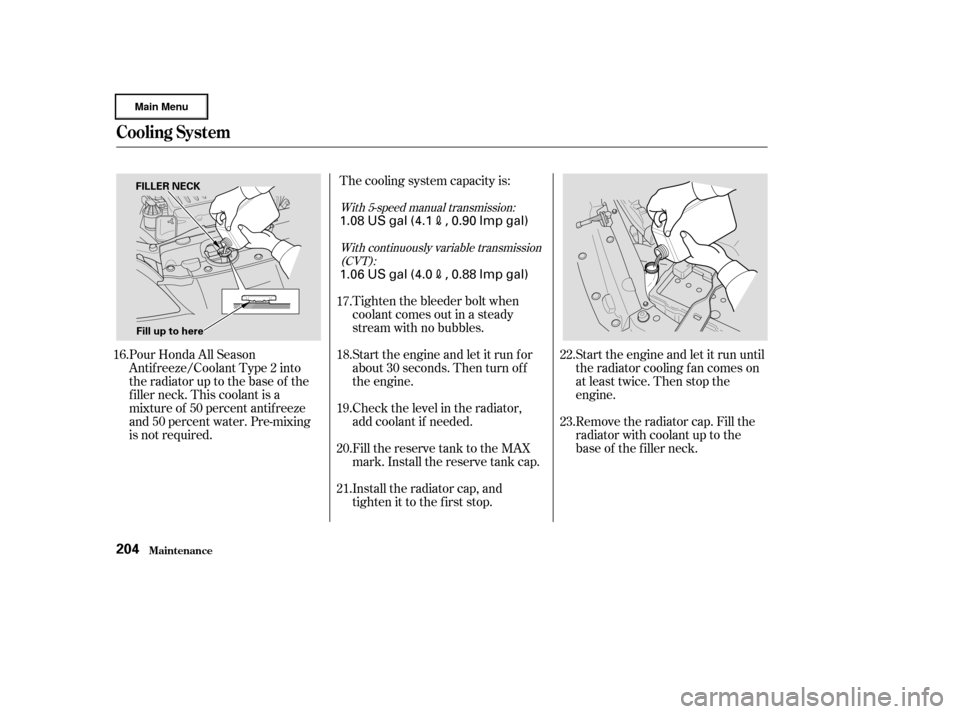
Pour Honda All Season
Antif reeze/Coolant Type 2 into
the radiator up to the base of the
f iller neck. This coolant is a
mixture of 50 percent antif reeze
and 50 percent water. Pre-mixing
is not required.
16.
17.
18.
19.
20.
21.22.
23.
With 5-speed manual transmission:
With continuously variable transmission(CVT):
Cooling Syst em
Maint enance204
FILLER NECK
Fill up to here
1.08 US gal (4.1, 0.90 Imp gal)
1.06 US gal (4.0
, 0.88 Imp gal)
Page 208 of 317
Fill the reservoir with a good-quality
windshield washer f luid. This
increases the cleaning capability and
prevents f reezing in cold weather.
Check the level in the windshield
washer reservoir at least monthly
during normal usage. In bad weather,
when you use the washers of ten,
check the level every time you stop
for fuel.
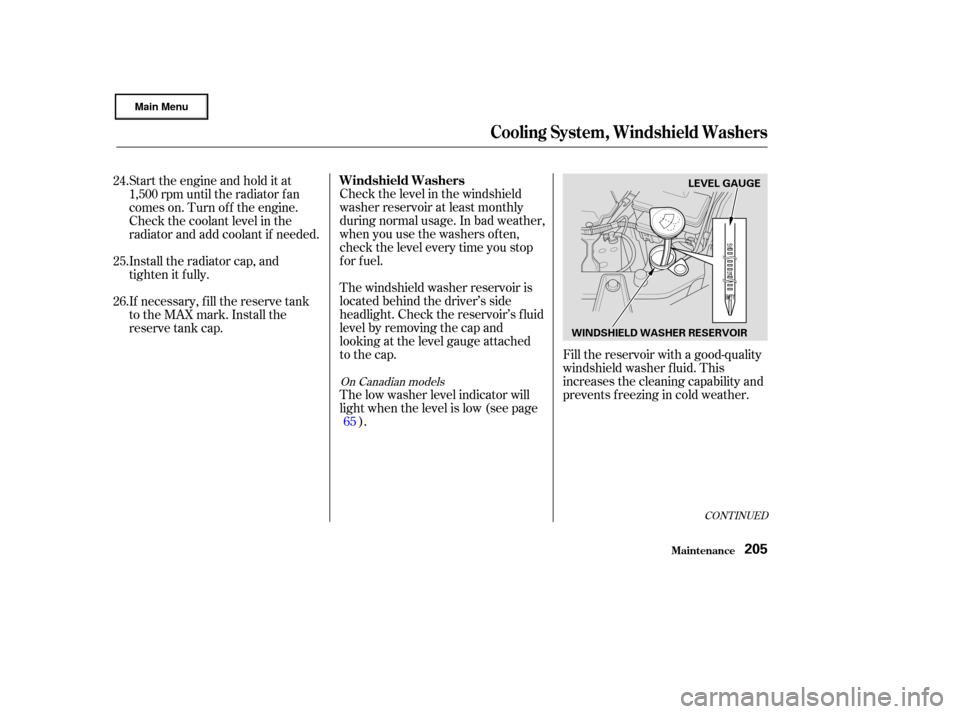
The windshield washer reservoir is
located behind the driver’s side
headlight. Check the reservoir’s f luid
level by removing the cap and
looking at the level gauge attached
to the cap.
The low washer level indicator will
light when the level is low (see page
).
Start the engine and hold it at
1,500 rpm until the radiator f an
comes on. Turn of f the engine.
Check the coolant level in the
radiator and add coolant if needed.
Install the radiator cap, and
tighten it fully.
If necessary, f ill the reserve tank
to the MAX mark. Install the
reserve tank cap.
65
24.
25.
26.
On Canadian models
CONT INUED
Maint enance
Cooling System, Windshield Washers
Windshield Washers
205
LEVEL GAUGE
WINDSHIELD WASHER RESERVOIR
Page 209 of 317
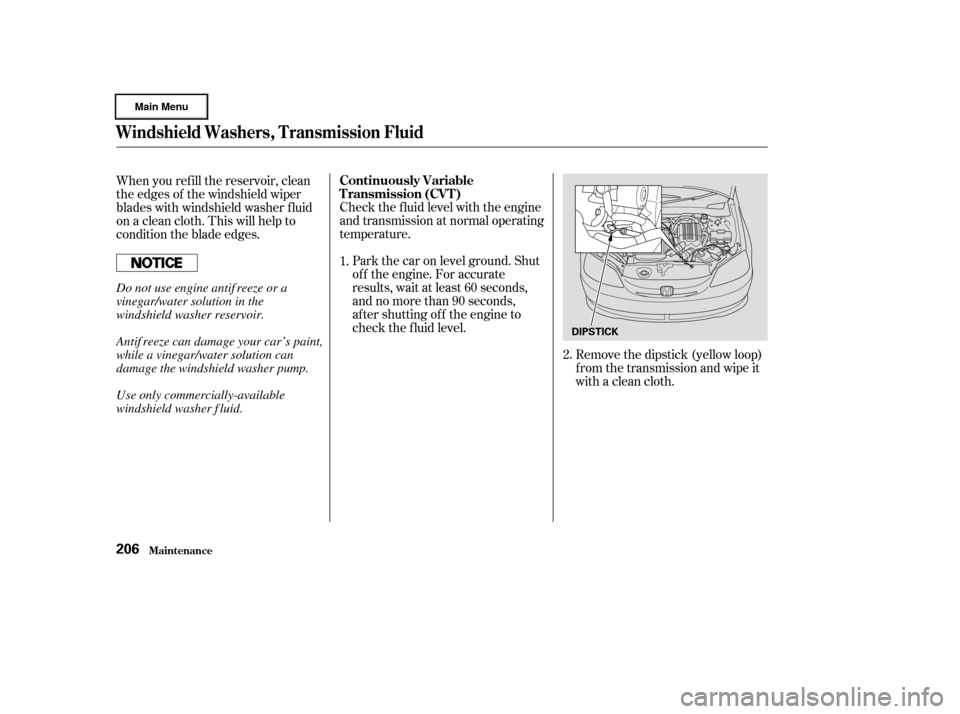
Check the f luid level with the engine
and transmission at normal operating
temperature.Park the car on level ground. Shut
of f the engine. For accurate
results, wait at least 60 seconds,
andnomorethan90seconds,
af ter shutting of f the engine to
check the f luid level. Remove the dipstick (yellow loop)
f rom the transmission and wipe it
with a clean cloth.
When you ref ill the reservoir, clean
the edges of the windshield wiper
blades with windshield washer f luid
on a clean cloth. This will help to
condition the blade edges.
1.
2.
Maint enance
Continuously Variable
T ransmission (CVT )
Windshield Washers, T ransmission Fluid
206
DIPSTICK
Do not use engine antif reeze or a
vinegar/water solution in the
windshield washer reservoir.
Antif reeze can damage your car’s paint,
while a vinegar/water solution can
damage the windshield washer pump.
Use only commercially-available
windshield washer f luid.
Page 210 of 317
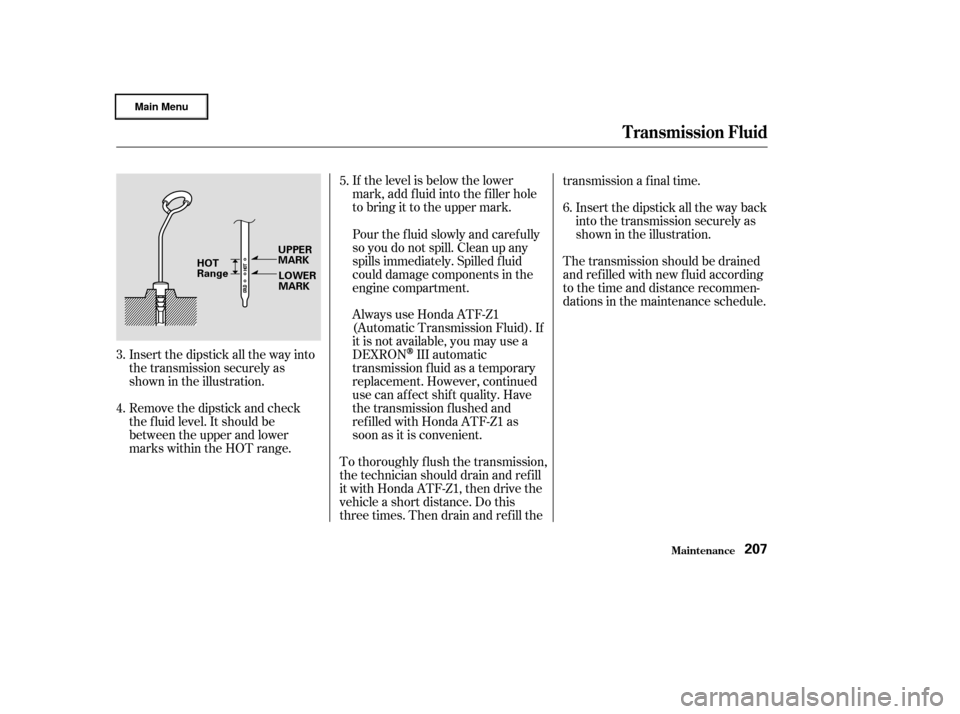
If the level is below the lower
mark, add f luid into the f iller hole
to bring it to the upper mark.
Insert the dipstick all the way into
the transmission securely as
shown in the illustration.
Remove the dipstick and check
the f luid level. It should be
between the upper and lower
marks within the HOT range. Always use Honda ATF-Z1
(Automatic Transmission Fluid). If
it is not available, you may use a
DEXRON
III automatic
transmission f luid as a temporary
replacement. However, continued
use can affect shift quality. Have
the transmission f lushed and
ref illed with Honda ATF-Z1 as
soon as it is convenient.
To thoroughly f lush the transmission,
the technician should drain and ref ill
it with Honda ATF-Z1, then drive the
vehicle a short distance. Do this
three times. Then drain and ref ill the transmission a final time.
Pour the f luid slowly and caref ully
so you do not spill. Clean up any
spills immediately. Spilled f luid
could damage components in the
engine compartment. The transmission should be drained
and ref illed with new f luid according
to the time and distance recommen-
dations in the maintenance schedule.Insert the dipstick all the way back
into the transmission securely as
shown in the illustration.
5.
6.
3.
4.
T ransmission Fluid
Maint enance207
HOT
Range UPPER
MARK
LOWER
MARK
Page 211 of 317
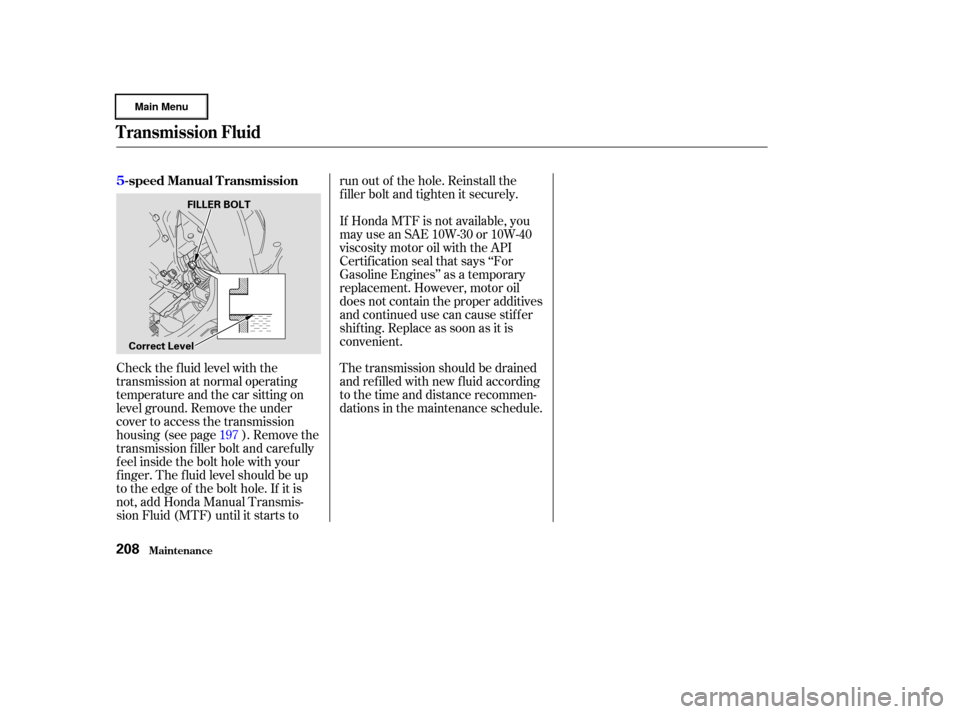
Check the f luid level with the
transmission at normal operating
temperature and the car sitting on
level ground. Remove the under
cover to access the transmission
housing(seepage ).Removethe
transmission f iller bolt and caref ully
f eel inside the bolt hole with your
f inger. The f luid level should be up
to the edge of the bolt hole. If it is
not, add Honda Manual Transmis-
sion Fluid (MTF) until it starts torun out of the hole. Reinstall the
f iller bolt and tighten it securely.
If Honda MTF is not available, you
may use an SAE 10W-30 or 10W-40
viscosity motor oil with the API
Certif ication seal that says ‘‘For
Gasoline Engines’’ as a temporary
replacement. However, motor oil
does not contain the proper additives
andcontinuedusecancausestiffer
shif ting. Replace as soon as it is
convenient.
The transmission should be drained
and ref illed with new f luid according
to the time and distance recommen-
dations in the maintenance schedule.
197
5-speed Manual Transmission
T ransmission Fluid
Maint enance208
Correct Level
FILLER BOLT
Page 212 of 317
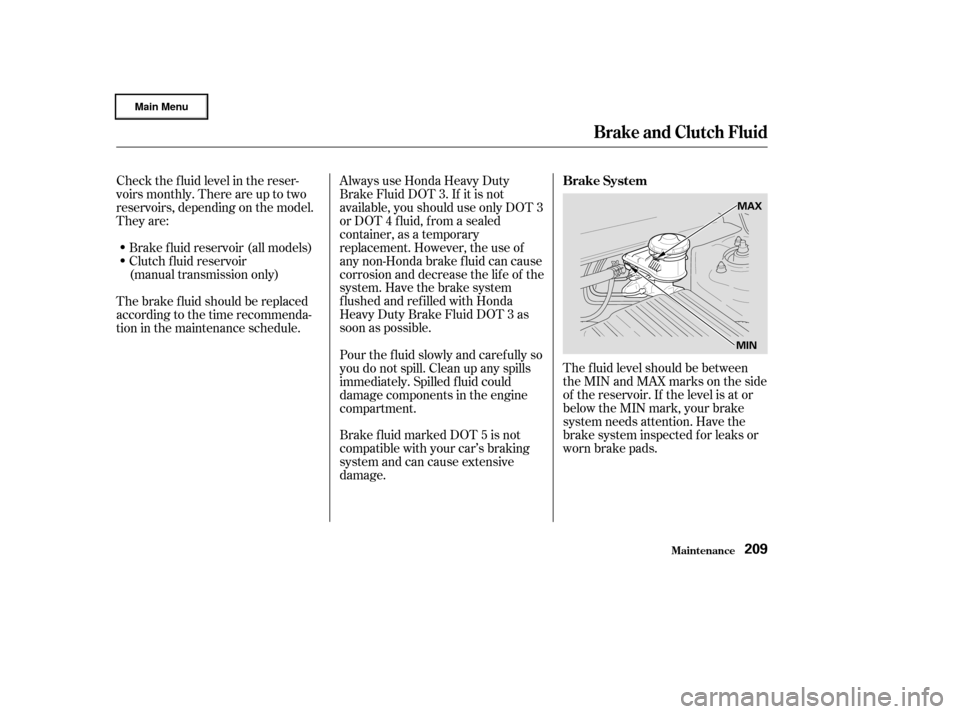
The f luid level should be between
theMINandMAXmarksontheside
of the reservoir. If the level is at or
below the MIN mark, your brake
system needs attention. Have the
brake system inspected f or leaks or
worn brake pads.
Always use Honda Heavy Duty
Brake Fluid DOT 3. If it is not
available, you should use only DOT 3
or DOT 4 f luid, f rom a sealed
container, as a temporary
replacement. However, the use of
any non-Honda brake fluid can cause
corrosion and decrease the lif e of the
system. Have the brake system
f lushed and ref illed with Honda
Heavy Duty Brake Fluid DOT 3 as
soon as possible.
Check the f luid level in the reser-
voirs monthly. There are up to two
reservoirs, depending on the model.
They are:
Brake f luid reservoir (all models)
Clutch f luid reservoir
(manual transmission only)
The brake f luid should be replaced
according to the time recommenda-
tion in the maintenance schedule. Pour the f luid slowly and caref ully so
you do not spill. Clean up any spills
immediately. Spilled f luid could
damage components in the engine
compartment.
Brake f luid marked DOT 5 is not
compatible with your car’s braking
system and can cause extensive
damage.Brake System
Brake and Clutch Fluid
Maint enance209
MAX
MIN
Page 224 of 317
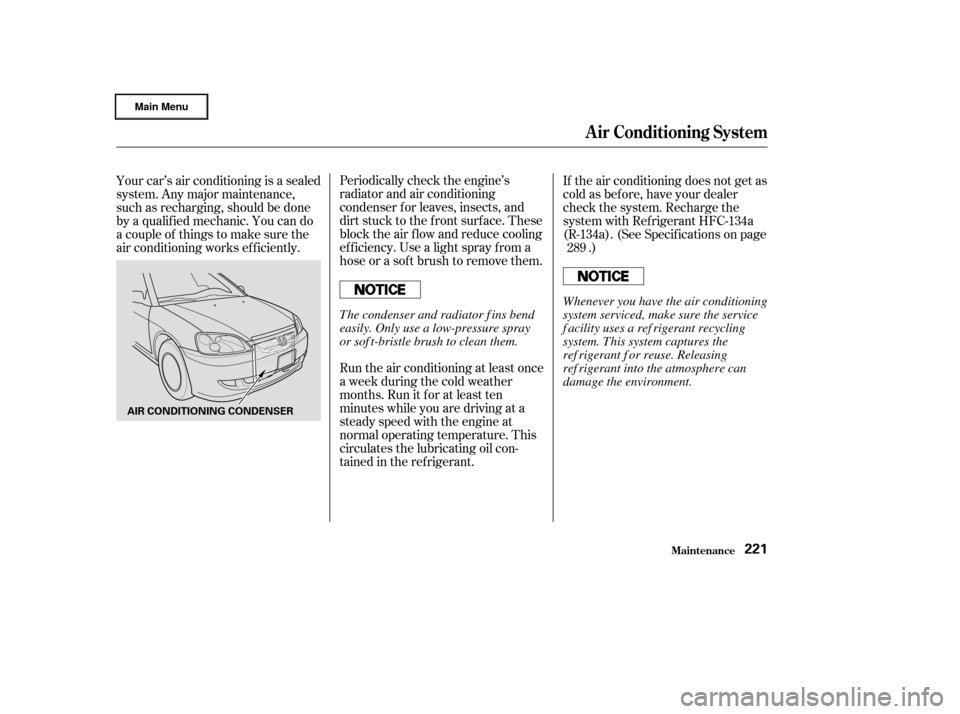
Periodically check the engine’s
radiator and air conditioning
condenser f or leaves, insects, and
dirt stuck to the f ront surf ace. These
block the air f low and reduce cooling
ef f iciency. Use a light spray f rom a
hose or a sof t brush to remove them.If the air conditioning does not get as
cold as before, have your dealer
check the system. Recharge the
system with Ref rigerant HFC-134a
(R-134a). (See Specif ications on page
.)
Run the air conditioning at least once
a week during the cold weather
months. Run it f or at least ten
minutes while you are driving at a
steady speed with the engine at
normal operating temperature. This
circulates the lubricating oil con-
tained in the ref rigerant.
Your car’s air conditioning is a sealed
system. Any major maintenance,
such as recharging, should be done
by a qualif ied mechanic. You can do
a couple of things to make sure the
air conditioning works ef f iciently.
289
A ir Condit ioning Syst em
Maint enance221
AIR CONDITIONING CONDENSER
Whenever you have the air conditioning
system serviced, make sure the service
f acility uses a ref rigerant recycling
system. This system captures the
ref rigerant f or reuse. Releasing
ref rigerant into the atmosphere can
damage the environment.
The condenser and radiator f ins bend
easily. Only use a low-pressure spray
or sof t-bristle brush to clean them.
Page 258 of 317
This section covers the more-
common problems that motorists
experience with their vehicles. It
gives you inf ormation about how to
safely evaluate the problem and what
to do to correct it. If the problem has
stranded you on the side of the road,
you may be able to get going again.
If not, you will also f ind instructions
on getting your car towed.......................
Compact Spare Tire .256
....................
Changing a Flat Tire .257
..........
If Your Engine Won’t Start . 263
Nothing Happens or the Starter Motor Operates Very .....................................
Slowly .263
The Starter Operates ................................
Normally .264
................................
Jump Starting .265
............
If Your Engine Overheats . 268
.........
Low Oil Pressure Indicator . 271
..........
Charging System Indicator . 272
.......
Malf unction Indicator Lamp . 273
.......................
Readiness Codes .274
...............
Brake System Indicator . 275
..............................................
Fuses .276
..........
Checking and Replacing . 277
......................
Emergency Towing .282
Taking Care of the Unexpected
T aking Care of t he Unexpect ed255