ignition HONDA CIVIC HYBRID 2003 7.G Owners Manual
[x] Cancel search | Manufacturer: HONDA, Model Year: 2003, Model line: CIVIC HYBRID, Model: HONDA CIVIC HYBRID 2003 7.GPages: 317, PDF Size: 4.17 MB
Page 29 of 317
Leaving children without
adult supervision is illegal in most
states and Canadian provinces,
and can be very hazardous. For
example, inf ants and small
childrenleftinavehicleonahot
day can die f rom heatstroke. And
children lef t alone with the key in the ignition can accidentally set
the vehicle in motion, possibly
injuring themselves or others.
Using this f eature will
prevent children f rom opening the
doors and accidentally f alling out
(see page ).
Using
this f eature will prevent children
f rom playing with the windows,
which could expose them to
hazards or distract the driver (see
page ).
Many parents say they pref er to put
an inf ant or small child in the f ront
passenger seat so they can watch the
child, or because the child requires
attention.
Placing a child in the f ront seat
exposes the child to hazards f rom
the passenger’s f ront airbag, and
paying close attention to a child
distracts the driver f rom the
important tasks of driving, placing
both of you at risk.
If a child requires physical attention
or f requent visual contact, we
strongly recommend that another
adult ride with the child in the back
seat. The back seat is far safer for a
child than the front. Children
who play in cars can accidentally
get trapped inside the trunk and
be seriously injured or could die.
Teach your children not to play in
or around cars. Know how to
operate the emergency trunk
opener (U.S. models only) and
decide if your children should be
shown how to use this f eature (see
page ).
Even very young
children learn how to unlock
vehicle doors, turn on the ignition,
and open the trunk, which can
lead to accidental injury or death.
92
98 93
Protecting Children
Driver and Passenger Saf ety
Do not leave children alone in your
vehicle.
Use childproof door locks t o
prevent children f rom opening t hedoors.
Use t he main power windowswit ch t o prevent children f romopening t he rear windows. L ock all doors and t he t runk when
your vehicle is not in use.
K eep car keys and remot etransmitters out of the reach ofchildren.
Additional Saf ety Precautions
If a Child Requires Close
Attention
26
Page 48 of 317
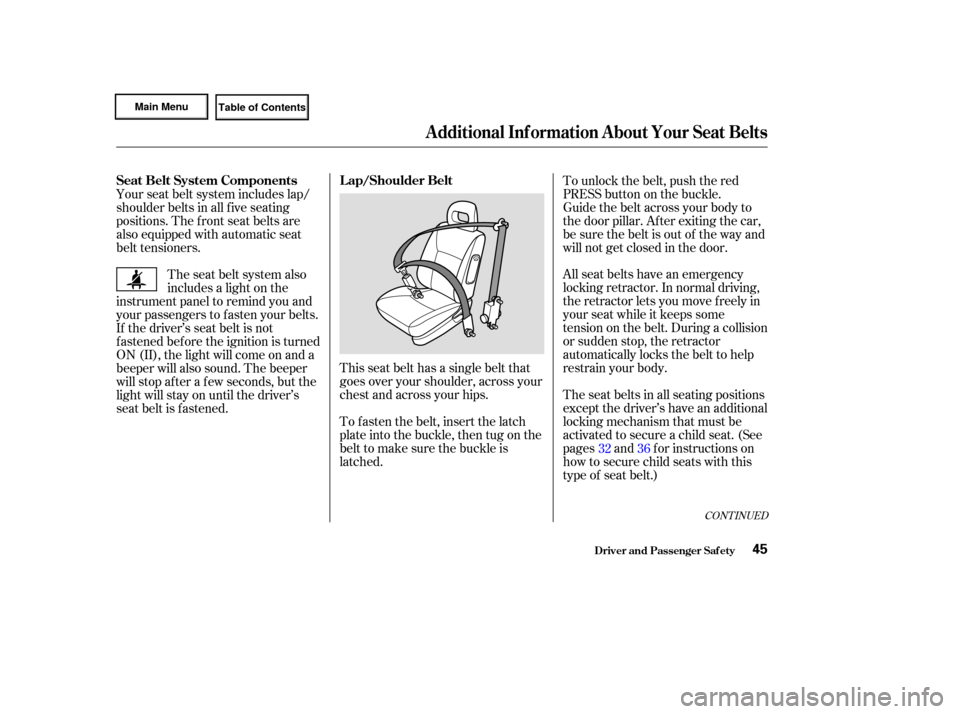
This seat belt has a single belt that
goes over your shoulder, across your
chest and across your hips.The seat belts in all seating positions
except the driver’s have an additional
locking mechanism that must be
activated to secure a child seat. (See
pages and f or instructions on
how to secure child seats with this
type of seat belt.) All seat belts have an emergency
locking retractor. In normal driving,
the retractor lets you move f reely in
your seat while it keeps some
tension on the belt. During a collision
or sudden stop, the retractor
automatically locks the belt to help
restrain your body. Guide the belt across your body to
the door pillar. Af ter exiting the car,
be sure the belt is out of the way and
will not get closed in the door. To unlock the belt, push the red
PRESSbuttononthebuckle.
To fasten the belt, insert the latch
plate into the buckle, then tug on the
belt to make sure the buckle is
latched.
The seat belt system also
includes a light on the
instrument panel to remind you and
your passengers to f asten your belts.
If the driver’s seat belt is not
fastened before the ignition is turned
ON (II), the light will come on and a
beeper will also sound. The beeper
will stop af ter a f ew seconds, but the
light will stay on until the driver’s
seat belt is f astened. Your seat belt system includes lap/
shoulder belts in all f ive seating
positions. The f ront seat belts are
also equipped with automatic seat
belt tensioners.
32 36
CONT INUED
Seat Belt System Components L ap/Shoulder Belt
Additional Inf ormation About Your Seat Belts
Driver and Passenger Saf ety45
Page 51 of 317
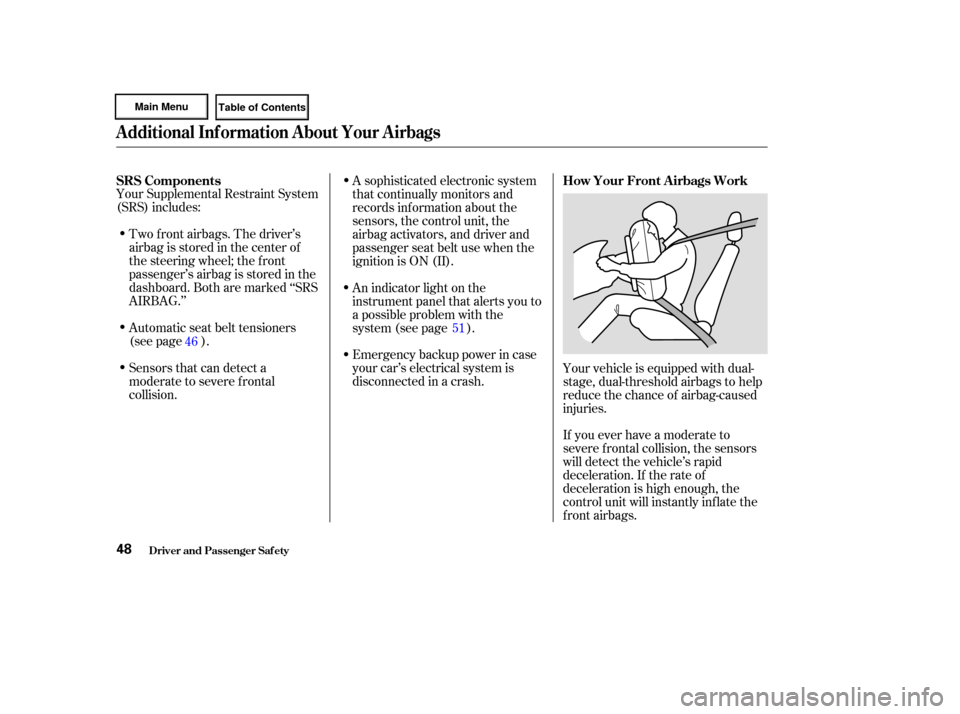
Your Supplemental Restraint System
(SRS) includes:Two f ront airbags. The driver’s
airbag is stored in the center of
the steering wheel; the f ront
passenger’sairbagisstoredinthe
dashboard. Both are marked ‘‘SRS
AIRBAG.’’ A sophisticated electronic system
that continually monitors and
records inf ormation about the
sensors, the control unit, the
airbag activators, and driver and
passenger seat belt use when the
ignition is ON (II).
Sensors that can detect a
moderate to severe frontal
collision. Automatic seat belt tensioners
(see page ). An indicator light on the
instrument panel that alerts you to
a possible problem with the
system (see page ).
Emergency backup power in case
your car’s electrical system is
disconnected in a crash.
If you ever have a moderate to
severe f rontal collision, the sensors
will detect the vehicle’s rapid
deceleration. If the rate of
deceleration is high enough, the
control unit will instantly inf late the
f ront airbags. Your vehicle is equipped with dual-
stage, dual-threshold airbags to help
reduce the chance of airbag-caused
injuries.
51
46
SRS Components
How Your Front A irbags Work
Additional Inf ormation About Your Airbags
Driver and Passenger Saf ety48
Page 54 of 317
If the light comes on at any other
time, or does not come on at all, you
should have the system checked by
your dealer. For example:If the SRS indicator light does not
come on after you turn the ignition
ON (II).
If the light stays on after the
engine starts.
If the light comes on or f lashes on
andoff whileyoudrive.
The SRS indicator light
alerts you to a potential
problem with your f ront airbags and
automatic seat belt tensioners.
On models with side airbags, this
light will also alert you to a potential
problem with your side airbags or
passenger’s side airbag automatic
cutof f system (see page ).
When you turn the ignition ON (II),
this indicator will light brief ly then
go out. This tells you that the system
is working properly. If you see any of these indications,
your f ront or side airbags may not
deploy, your passenger’s side airbag
automatic cutoff system may not
work properly, or your seat belt
tensioners may not work when you
need them. See your Honda dealer
as soon as possible.
52
How the SRS Indicator L ight
Works
Additional Inf ormation About Your Airbags
Driver and Passenger Saf ety51
Ignoring the SRS indicator light
can result in serious injury or
death if the airbags, cutoff
system, or tensioners do not
work properly.
Have your vehicle checked by a
dealer as soon as possible if
the SRS light alerts you to a
potential problem.
Page 55 of 317
A f ront seat passenger should not
use a cushion or other object as a
backrest. It may prevent the cutof f
system f rom working properly.
When you turn the ignition ON (II),
the indicator should light brief ly and
goout(seepage ).Ifitdoesn’t
light, stays on, or comes on while
driving without a passenger in the
f ront seat, have the system checked.
If a small-statured adult leans
sideways, or larger adult slouches
and leans sideways into the
deployment path of the side airbag,
the system may also shut of f the side
airbag.
If the side airbag cutof f indicator
light comes on, you should have the
passenger sit upright. Once the
passenger is out of the deployment
path of the side airbag, the system
will turn the airbag back on and the
light will go out.
To reduce the risk of injury f rom an
inf lating side airbag, your car has an
automatic cutoff system for the
passenger’s side airbag.
Although Honda does not encourage
children to ride in the f ront, this
system is designed to shut of f the
side airbag if a child leans sideways
and the child’s head is in the side
airbag deployment path. If does not mean there is a problem
with your side airbags. It means that
thesideairbagcutoff systemhas
activated to prevent the side airbag
f rom deploying. This light alerts you that
the passenger’s side airbag
has been automatically shut of f . 61
Only on U.S. models equipped with side
airbags
Additional Inf ormation About Your Airbags
Driver and Passenger Saf ety
How the Side Airbag Cutof f
Indicator L ight Works
52
Page 60 of 317
This section gives inf ormation about
the controls and displays that
contribute to the daily operation of
your Honda. All the essential
controls are within easy reach............................
Control Locations .58 ...............................
Indicator Lights .59
.............................................
Gauges .67
...............................
Speedometer .69
.................................
Tachometer .69
...............
Odometer/Trip Meter . 69
.................
Current Fuel Mileage . 70
................................
Trip Mileage .70
Turning Of f the Mileage .....................................
Display .71
..................................
Fuel Gauge .71
...................
Temperature Gauge . 71
..................
Battery Level Gauge . 72
................
Charge/Assist Gauge . 73
Controls Near the Steering .......................................
Wheel .74
...................................
Headlights .75
............
Daytime Running Lights . 76
....
Instrument Panel Brightness . 77
................................
Turn Signals .78
.....................
Windshield Wipers .78
..................
Windshield Washers . 80
..........................
Hazard Warning .80
.............
Rear Window Def ogger . 81
......
Steering Wheel Adjustment . 82
...............................
Keys and Locks .83
..............................................
Keys .83 ....................
Immobilizer System . 84
............................
Ignition Switch .86
......................
Power Door Locks .87
...................
Remote Transmitter . 89
..............
Childproof Door Locks . 92
...........................................
Trunk .92
........
Emergency Trunk Opener . 93
............................
Seat Adjustments .94
.............
Front Seat Adjustments . 94
................
Driver’s Seat Armrest . 95
..........................
Head Restraints .96
..............................
Power Windows .97
.............................................
Mirrors .99
....
Adjusting the Power Mirrors . 99
...............................
Parking Brake .100
......................................
Glove Box .101
...........................
Beverage Holder .102
.................
Console Compartment . 102
........................................
Coin Box .103
...............................
Center Pocket .103
.............
Accessory Power Socket . 103
...............................
Interior Lights .104
..............................
Ceiling Light .104
...................................
Spotlights .104
................
Ignition Switch Light . 105
Instruments and Controls
Inst rument s and Cont rols57
Page 64 of 317

The instrument panel has many
indicators to give you important
inf ormation about your car.
This indicator lights when you turn
the ignition switch ON (II). It is a
reminder to you and your passengers
to protect yourselves by f astening
the seat belts. A beeper also sounds
if you have not fastened your seat
belt.
If you do not f asten your seat belt,
the beeper will stop af ter a f ew
seconds but the light stays on until
you do. Both the light and the beeper
stay of f if you f asten your seat belt
bef ore turning on the ignition.This indicator lights when you turn
the ignition switch ON (II). If it
comes on at any other time, it
indicates that the passenger’s side
airbag has automatically shut off.
For complete inf ormation, see page
.
This indicator lights when you turn
the ignition switch ON (II). If it
comes on at any other time, it
indicates a potential problem with
your f ront airbags or automatic seat
belt tensioners. On models equipped
with side airbags, this light will also
alert you to a potential problem with
your side airbags or passenger’s side
airbag automatic cutoff system. For
complete inf ormation, see page .
5152
CONT INUED
Only on U.S. models equipped with side
airbags
Indicator L ights
Inst rument s and Cont rols
Seat Belt Reminder L ight Supplemental Restraint
System Indicator
Side A irbag Cutof f
Indicator
61
Page 65 of 317
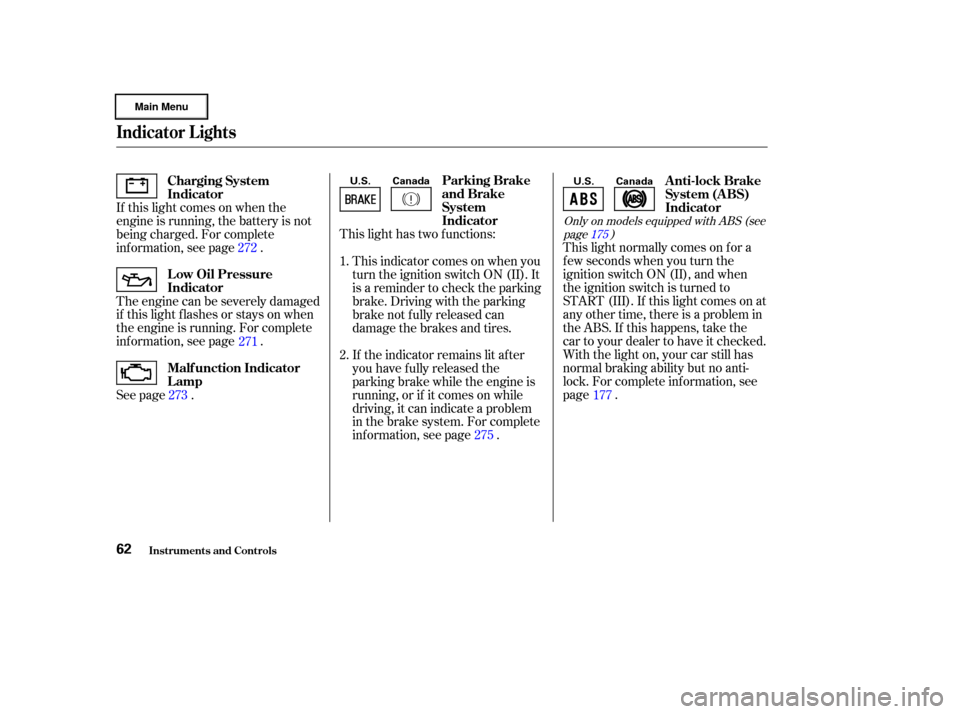
This light has two f unctions:This light normally comes on f or a
f ew seconds when you turn the
ignition switch ON (II), and when
the ignition switch is turned to
START (III). If this light comes on at
any other time, there is a problem in
theABS.If thishappens,takethe
cartoyourdealertohaveitchecked.
With the light on, your car still has
normal braking ability but no anti-
lock. For complete inf ormation, see
page .
If this light comes on when the
engine is running, the battery is not
being charged. For complete
inf ormation, see page .
The engine can be severely damaged
if this light f lashes or stays on when
the engine is running. For complete
inf ormation, see page .
This indicator comes on when you
turn the ignition switch ON (II). It
is a reminder to check the parking
brake. Driving with the parking
brake not f ully released can
damage the brakes and tires.
If the indicator remains lit after
you have f ully released the
parking brake while the engine is
running, or if it comes on while
driving, it can indicate a problem
in the brake system. For complete
inf ormation, see page .
See page . 1.
2.
272
271 275177
273
Only on models equipped with ABS (see
page ) 175
Parking Brake
and Brake
System
Indicator Anti-lock Brake
System (A BS)
Indicator
Charging System
Indicator
L ow Oil Pressure
Indicator
Malf unction Indicator
Lamp
Indicator L ights
Inst rument s and Cont rols62
U.S. Canada
U.S. Canada
Page 66 of 317

This light normally comes on when
you turn the ignition ON (II) and
goes of f af ter the engine starts. If it
comes on at any other time, there is
a problem in the Electric Power
Steering system. If this happens,
stop the car in a safe place and turn
of f the engine. Reset the system by
restarting the engine. The indicator
will not turn of f immediately. If it
does not go of f af ter driving a short
distance, or comes back on again
while driving, take the car to your
dealer to have it checked. With the
light on, the EPS may be turned of f ,
making the car harder to steer.This indicator comes on f or a f ew
seconds when you turn the ignition
switch ON (II). It will then go of f if
you have inserted a properly-coded
ignition key. If it is not a properly-
coded key, the indicator will blink
and the engine will not start (see
page ).
This indicator also blinks several
times when you turn the ignition
switch f rom ON (II) to ACCESSORY
(I) or LOCK (0).
This indicator normally comes on f or
a f ew seconds when you turn the
ignition switch ON (II). If it comes
on at any other time, it indicates a
problem in the Integrated Motor
Assist (IMA) system. With the IMA
indicator on, the vehicle may not
accelerate as it normally does. Have
the vehicle checked by the dealer as
soon as possible.
See pages and .
84
172
164
Indicator L ights
Inst rument s and Cont rols
Electric Power Steering
(EPS) Indicator Immobilizer System
IndicatorIMA System Indicator
A uto Idle Stop Indicator
63
Page 67 of 317

This light comes on with the high
beam headlights. See page for
inf ormation on the headlight
controls.This indicator lights when you turn
the ignition switch to ON (II) with
the headlight switch of f and the
parking brake set. It should go of f if
youturnontheheadlightsorrelease
the parking brake. If it comes on at
any other time, it means there is a
problem with the DRL. There may
also be a problem with the high
beam headlights.
The lef t or right turn signal light
blinks when you signal a lane change
or turn. If the light does not blink or
blinks rapidly, it usually means one
of the turn signal bulbs is burned out
(see page ). Replace the bulb as
soon as possible, since other drivers
cannot see that you are signalling.
WhenyouturnontheHazard
Warning switch, both turn signal
lights blink. All turn signals on the
outside of the car should f lash. 75
235Canadian models only
High Beam Indicator ‘‘Daytime Running
Lights’’ Indicator
Turn Signal and
Hazard Warning
Indicators
Indicator L ights
Inst rument s and Cont rols64