brake sensor HONDA CIVIC SEDAN 2019 Owner's Manual (in English)
[x] Cancel search | Manufacturer: HONDA, Model Year: 2019, Model line: CIVIC SEDAN, Model: HONDA CIVIC SEDAN 2019Pages: 679, PDF Size: 40.24 MB
Page 28 of 679
26
Quick Reference Guide
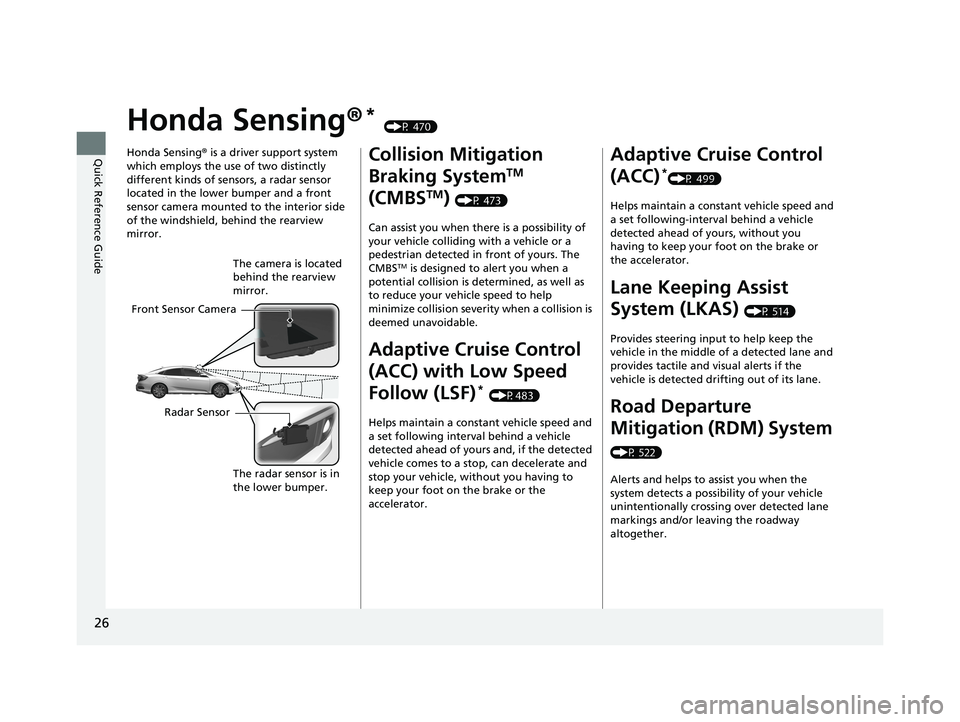
Honda Sensing®* (P 470)
Honda Sensing ® is a driver support system
which employs the use of two distinctly
different kinds of sensors, a radar sensor
located in the lower bumper and a front
sensor camera mounted to the interior side
of the windshield, behind the rearview
mirror.
Front Sensor Camera The camera is located
behind the rearview
mirror.
Radar Sensor The radar sensor is in
the lower bumper.
Collision Mitigation
Braking System
TM
(CMBS
TM) (P 473)
Can assist you when there is a possibility of
your vehicle colliding with a vehicle or a
pedestrian detected in front of yours. The
CMBS
TM is designed to alert you when a
potential collision is determined, as well as
to reduce your vehicle speed to help
minimize collision severity when a collision is
deemed unavoidable.
Adaptive Cruise Control
(ACC) with Low Speed
Follow (LSF)
* (P483)
Helps maintain a constant vehicle speed and
a set following interval behind a vehicle
detected ahead of yours and, if the detected
vehicle comes to a stop, can decelerate and
stop your vehicle, wi thout you having to
keep your foot on the brake or the
accelerator.
Adaptive Cruise Control
(ACC)
*(P 499)
Helps maintain a constant vehicle speed and
a set following-interval behind a vehicle
detected ahead of yours, without you
having to keep your foot on the brake or
the accelerator.
Lane Keeping Assist
System (LKAS)
(P 514)
Provides steering input to help keep the
vehicle in the middle of a detected lane and
provides tactile and visual alerts if the
vehicle is detected drifting out of its lane.
Road Departure
Mitigation (RDM) System
(P 522)
Alerts and helps to assist you when the
system detects a possibility of your vehicle
unintentionally crossing over detected lane
markings and/or leaving the roadway
altogether.
19 CIVIC 4D HCM_HMIN_J (KA KL KC)-31TBA6301.book 26 ページ 2018年10月26日 金曜日 午前7時42分
Page 80 of 679
78
uuIndicators u
Instrument Panel
*1:Models with the smart entry system have an ENGINE START/STOP button instead of an ignition switch.
IndicatorNameOn/BlinkingExplanationMessage
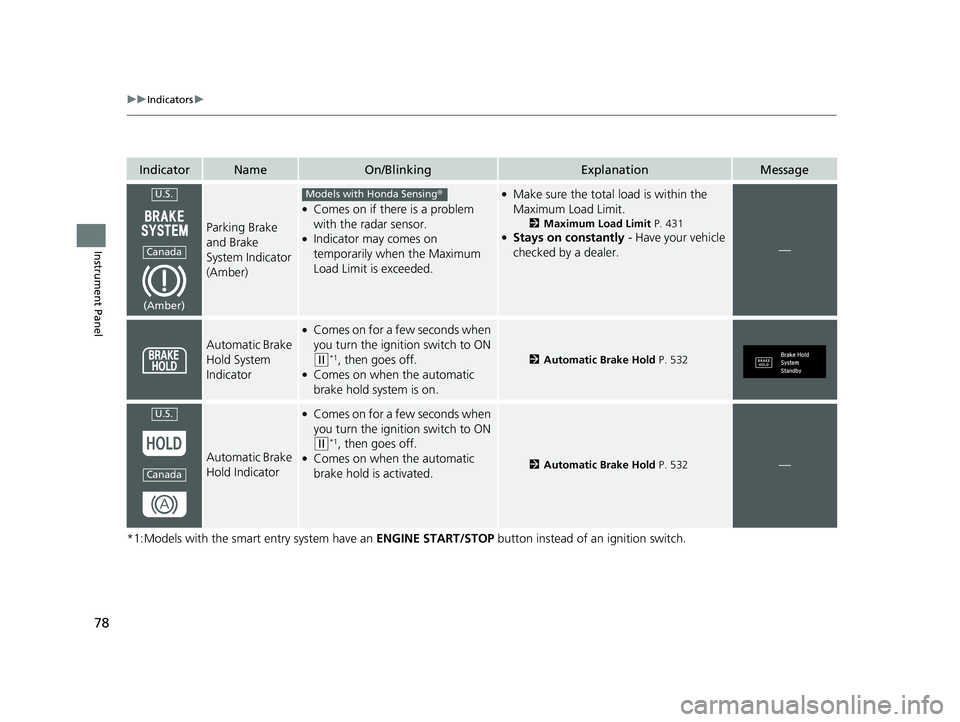
Parking Brake
and Brake
System Indicator
(Amber)
●Comes on if there is a problem
with the radar sensor.
●Indicator may comes on
temporarily when the Maximum
Load Limit is exceeded.
●Make sure the total load is within the
Maximum Load Limit.
2Maximum Load Limit P. 431●Stays on constantly - Have your vehicle
checked by a dealer.—
Automatic Brake
Hold System
Indicator
●Comes on for a few seconds when
you turn the igniti on switch to ON
(w*1, then goes off.●Comes on when the automatic
brake hold system is on.
2Automatic Brake Hold P. 532
Automatic Brake
Hold Indicator
●Comes on for a few seconds when
you turn the ignition switch to ON
(w*1, then goes off.●Comes on when the automatic
brake hold is activated.2Automatic Brake Hold P. 532—
U.S.
Canada
(Amber)
Models with Honda Sensing ®
U.S.
Canada
19 CIVIC 4D HCM_HMIN_J (KA KL KC)-31TBA6301.book 78 ページ 2018年10月26日 金曜日 午前7時42分
Page 188 of 679
186
uuAdjusting the Seats uRear Seats
Controls
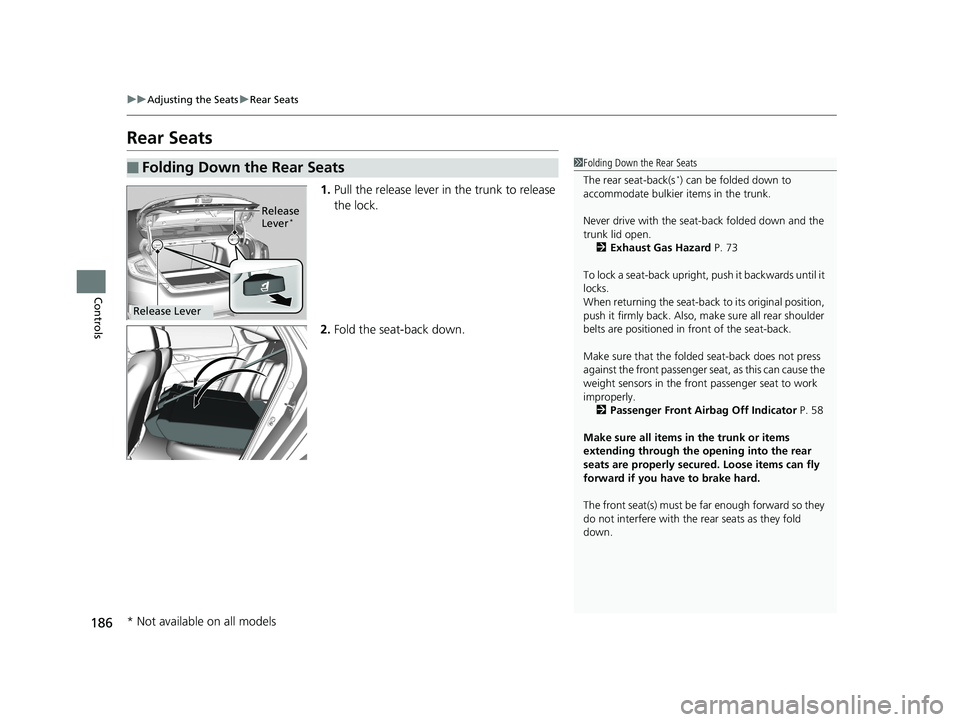
Rear Seats
1. Pull the release lever in the trunk to release
the lock.
2. Fold the seat-back down.
■Folding Down the Rear Seats1Folding Down the Rear Seats
The rear seat-back(s
*) can be folded down to
accommodate bulkier items in the trunk.
Never drive with the seat-back folded down and the
trunk lid open. 2 Exhaust Gas Hazard P. 73
To lock a seat-back upright, push it backwards until it
locks.
When returning the seat-back to its original position,
push it firmly back. Also, m ake sure all rear shoulder
belts are positioned in front of the seat-back.
Make sure that the folded seat-back does not press
against the front passenger seat, as this can cause the
weight sensors in the front passenger seat to work
improperly. 2 Passenger Front Airbag Off Indicator P. 58
Make sure all items in the trunk or items
extending through the opening into the rear
seats are properly secured. Loose items can fly
forward if you have to brake hard.
The front seat(s) must be far enough forward so they
do not interfere with the rear seats as they fold
down.
Release
Lever*
Release Lever
* Not available on all models
19 CIVIC 4D HCM_HMIN_J (KA KL KC)-31TBA6301.book 186 ページ 2018年10月26日 金曜日 午前7時42分
Page 429 of 679
427
Driving
This chapter discusses driving and refueling.
Before Driving................................... 428
Towing a Trailer ................................ 433
When Driving
Starting the Engine .................. 434, 437
Precautions While Driving................. 442
Continuously Variable Transmission*... 443Shifting ............................ 444, 446, 450
SPORT Mode*.................................. 453
ECON Mode*................................... 454
Adaptive Damper System*............... 455
Cruise Control*................................ 456Vehicle Stability Assist® (VSA®), aka Electronic
Stability Control (ESC), System .............. 459
Agile Handling Assist ....................... 461Limited Slip Differential (LSD)*............. 462
Tire Pressure Monitoring System (TPMS)*.. 463
Tire Pressure Monitoring System (TPMS) -
Required Federal Explanation*........ 466
LaneWatchTM*.................................. 468
Honda Sensing ®*.............................. 470
Collision Mitigati on Braking SystemTM
(CMBSTM) ....................................... 473
Adaptive Cruise Control (ACC) with Low Speed Follow (LSF)
*....................... 483
Adaptive Cruise Control (ACC)*....... 499 Lane Keeping Assist System (LKAS) .. 514
Road Departure Mitigation (RDM) System.... 522Front Sensor Camera ....................... 526
Radar Sensor ................................... 528
Braking
Brake System ................................... 529
Anti-lock Brake System (ABS) ........... 535
Brake Assist System ......................... 536
Parking Your Vehicle ........................ 537
Multi-View Rear Camera .................. 539
Refueling ........................................... 541
Fuel Economy and CO
2 Emissions .... 544
Turbo Engine Vehicle*...................... 545
* Not available on all models
19 CIVIC 4D HCM_HMIN_J (KA KL KC)-31TBA6301.book 427 ページ 2018年10月26日 金曜日 午前7時42分
Page 475 of 679
473
uuHonda Sensing ®*uCollision Mitigation Braking SystemTM (CMBSTM)
Continued
Driving
Collision Mitigation Braking SystemTM (CMBSTM)
Can assist you when there is a possibility of your vehicle colliding with a vehicle or a
pedestrian detected in front of yours. The CMBSTM is designed to alert you when a
potential collision is determined, as well as to reduce your vehicle speed to help
minimize collision severity when a collision is deemed unavoidable.
1 Collision Mitigation Braking SystemTM (CMBSTM)
Important Safety Reminder
The CMBS
TM is designed to reduce the severity of an
unavoidable collision. It does not prevent collision nor
stop the vehicle automatically. It is still your
responsibility to operate the brake pedal and steering
wheel appropriately acco rding to the driving
conditions.
When the CMBS
TM activates, the engine may stop
automatically.
Start the engine by normal operation if the engine
stops. 2 Starting the Engine P. 434, 437
The CMBS
TM may not activate or may not detect a
vehicle in front of y our vehicle under certain
conditions: 2 CMBS
TM Conditions and Limitations P. 478
You can read about handling information for the
camera equipped with this system. 2 Front Sensor Camera P. 526
For directions on the prop er handling of the radar
sensor, refer to the following page.
2 Radar Sensor P. 528
Manual transmission models
19 CIVIC 4D HCM_HMIN_J (KA KL KC)-31TBA6301.book 473 ページ 2018年10月26日 金曜日 午前7時42分
Page 476 of 679
uuHonda Sensing ®*uCollision Mitigation Braking SystemTM (CMBSTM)
474
Driving
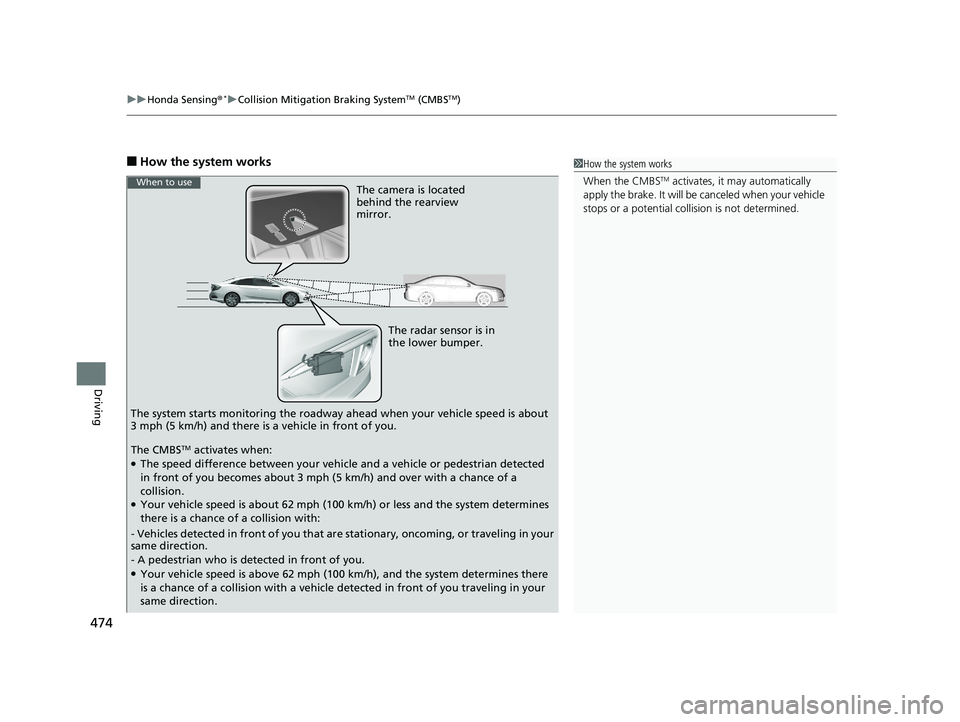
■How the system works1How the system works
When the CMBS
TM activates, it may automatically
apply the brake. It will be canceled when your vehicle
stops or a potential coll ision is not determined.
The radar sensor is in
the lower bumper.
The camera is located
behind the rearview
mirror.
The system starts monitoring th e roadway ahead when your vehicle speed is about
3 mph (5 km/h) and there is a vehicle in front of you.
When to use
The CMBSTM activates when:●The speed difference between your vehicle and a vehicle or pedestrian detected
in front of you becomes about 3 mph (5 km/h) and over with a chance of a
collision.
●Your vehicle speed is about 62 mph (100 km/h) or less and the system determines
there is a chance of a collision with:
- Vehicles detected in front of you that ar e stationary, oncoming, or traveling in your
same direction.
- A pedestrian who is detected in front of you.
●Your vehicle speed is above 62 mph (100 km/h), and the system determines there
is a chance of a collision with a vehicle detected in front of you traveling in your
same direction.
19 CIVIC 4D HCM_HMIN_J (KA KL KC)-31TBA6301.book 474 ページ 2018年10月26日 金曜日 午前7時42分
Page 481 of 679
479
uuHonda Sensing ®*uCollision Mitigation Braking SystemTM (CMBSTM)
Continued
Driving
■Vehicle conditions
• Headlight lenses are dirty or the h eadlights are not properly adjusted.
• The outside of the windshield is blocked by dirt, mud, leaves, wet snow, etc.
• The inside of the windshield is fogged.
• An abnormal tire or wheel condition (wro ng size, varied size or construction,
improperly inflated, co mpact spare tire, etc.).
• When tire chains are installed.
• The vehicle is tilted due to a heavy load or suspension modifications.
• The camera temperature gets too high.
• Driving with the parking brake applied.
• When the radar sensor in the lower bumper gets dirty.
•Driving at night or in a dark condition such as a tunnel with the headlights turned off.
■Detection limitations
• A vehicle or pedestrian suddenly crosses in front of you.
• The distance between your vehicle and the vehicle or pedestrian ahead of you is
too short.
• A vehicle cuts in front of you at a slow speed, and it brakes suddenly.
• When you accelerate rapidly and approach the vehicle or pedestrian ahead of you
at high speed.
•The vehicle ahead of you is a motorcycle, bicycle, mobility scooter or other small vehicle.
• When there are animals in front of your vehicle.
• When you drive on a curved, winding or und ulating road that makes it difficult for
the sensor to properly detect a vehicle in front of you.
• The speed difference between your vehicle an d a vehicle or pedestrian in front of
you is significantly large.
• An oncoming vehicle suddenly comes in front of you.
• Another vehicle suddenly comes in front of you at an intersection, etc.
• Your vehicle abruptly crosses over in front of an oncoming vehicle.
• When driving through a narrow iron bridge.
• When the lead vehicl e suddenly slows down.
19 CIVIC 4D HCM_HMIN_J (KA KL KC)-31TBA6301.book 479 ページ 2018年10月26日 金曜日 午前7時42分
Page 485 of 679
483
uuHonda Sensing ®*uAdaptive Cruise Control (ACC) with Low Speed Follow (LSF)*
Continued
Driving
Adaptive Cruise Control (ACC) with Low Speed Follow (LSF)*
Helps maintain a constant vehicle speed an d a set following-interval behind a vehicle
detected ahead of yours and, if the detect ed vehicle comes to a stop, can decelerate
and stop your ve hicle, without yo u having to keep your foot on the brake or the
accelerator.
When ACC with LSF slows your vehicle by applying the brakes, your vehicle’s brake
lights will illuminate.1 Adaptive Cruise Control (ACC) with Low Speed Follow (LSF)*
Important Reminder
As with any system, there are limits to ACC with LSF.
Use the brake pedal whenever necessary, and always
keep a safe interval between your vehicle and other
vehicles.
The radar sensor for ACC with LSF is shared with the
collision mitigation braking system
TM (CMBSTM).
2 Collision Mitigation Braking SystemTM
(CMBSTM) P. 473
3WARNING
Improper use of ACC with LSF can lead
to a crash.
Use ACC with LSF only when driving on
expressways or freeways and in good
weather conditions.
3WARNING
ACC with LSF has limited braking
capability and may not stop your vehicle
in time to avoid a co llision with a vehicle
that quickly stops in front of you.
Always be prepared to apply the brake
pedal if the cond itions require.
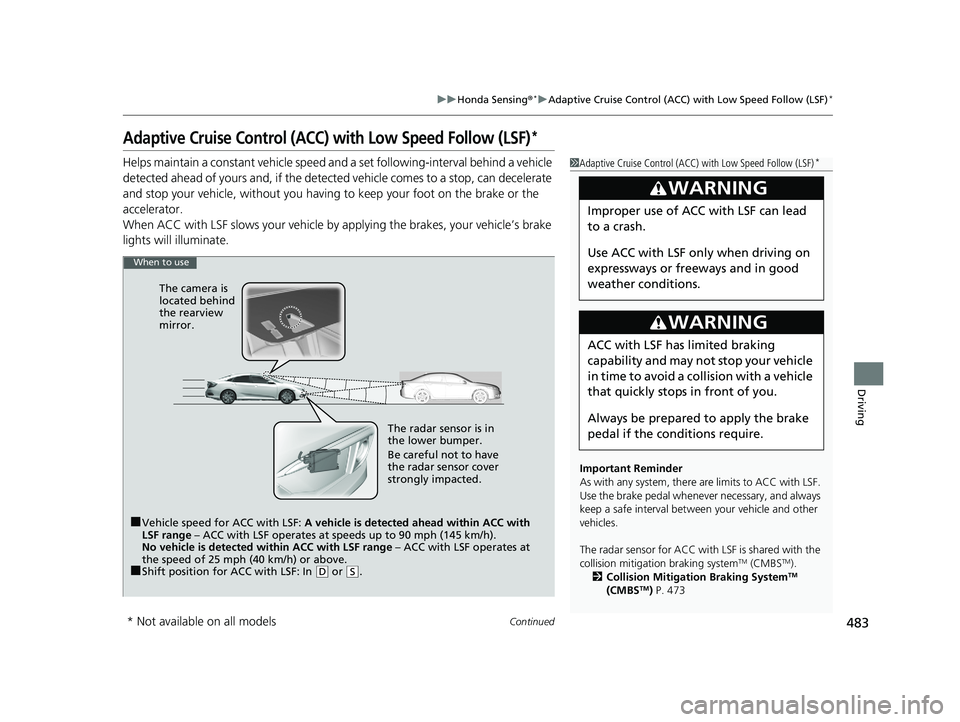
When to use
■Vehicle speed for ACC with LSF: A vehicle is detected ahead within ACC with
LSF range – ACC with LSF operates at speeds up to 90 mph (145 km/h).
No vehicle is detected within ACC with LSF range – ACC with LSF operates at
the speed of 25 mph (40 km/h) or above.
■Shift position for ACC with LSF: In (D or (S. The radar sensor is in
the lower bumper.
Be careful not to have
the radar sensor cover
strongly impacted.
The camera is
located behind
the rearview
mirror.
* Not available on all models
19 CIVIC 4D HCM_HMIN_J (KA KL KC)-31TBA6301.book 483 ページ 2018年10月26日 金曜日 午前7時42分
Page 486 of 679
uuHonda Sensing ®*uAdaptive Cruise Control (ACC) with Low Speed Follow (LSF)*
484
Driving
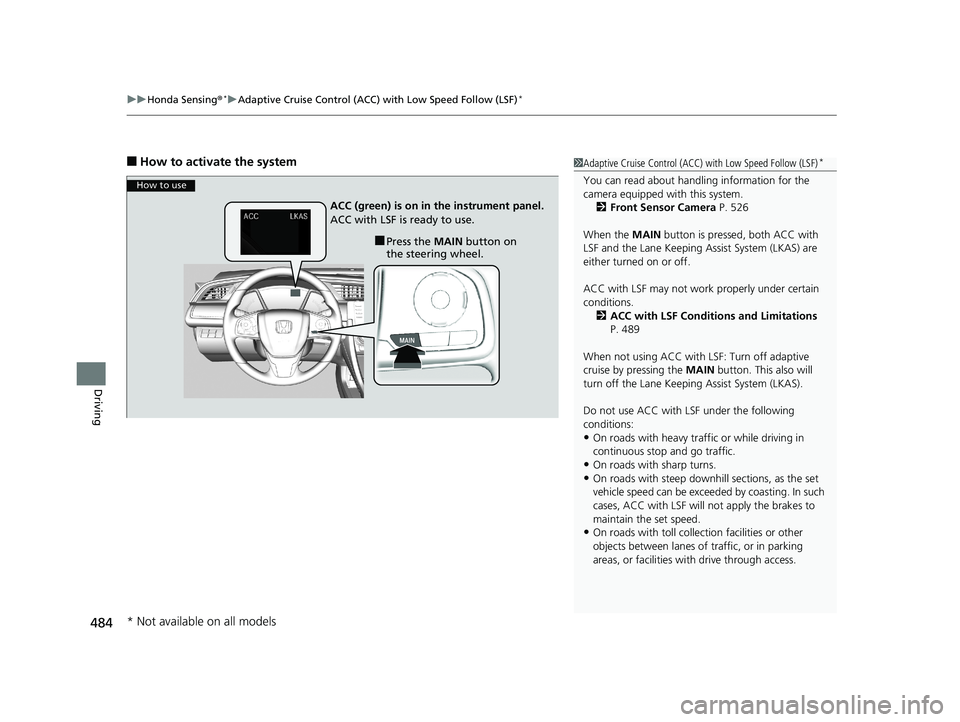
■How to activate the system1Adaptive Cruise Control (ACC) with Low Speed Follow (LSF)*
You can read about handling information for the
camera equipped with this system.
2 Front Sensor Camera P. 526
When the MAIN button is pressed, both ACC with
LSF and the Lane Keeping Assist System (LKAS) are
either turned on or off.
ACC with LSF may not work properly under certain
conditions. 2 ACC with LSF Conditions and Limitations
P. 489
When not using ACC with LSF: Turn off adaptive
cruise by pressing the MAIN button. This also will
turn off the Lane Keeping Assist System (LKAS).
Do not use ACC with LSF under the following
conditions:
•On roads with heavy traf fic or while driving in
continuous stop and go traffic.
•On roads with sharp turns.
•On roads with steep downhill sections, as the set
vehicle speed can be exceeded by coasting. In such
cases, ACC with LSF will not apply the brakes to
maintain the set speed.
•On roads with toll collection facilities or other
objects between lanes of traffic, or in parking
areas, or faci lities with driv e through access.
How to use
■Press the MAIN button on
the steering wheel.
ACC (green) is on in the instrument panel.
ACC with LSF is ready to use.
* Not available on all models
19 CIVIC 4D HCM_HMIN_J (KA KL KC)-31TBA6301.book 484 ページ 2018年10月26日 金曜日 午前7時42分
Page 491 of 679
Continued489
uuHonda Sensing ®*uAdaptive Cruise Control (ACC) with Low Speed Follow (LSF)*
Driving
The system may automatically shut off and the ACC indicator will come on under
certain conditions. Some examples of thes e conditions are listed below. Other
conditions may reduce some of the ACC functions.
2 Front Sensor Camera P. 526
■Environmental conditions
• Driving in bad weather (rain, fog, snow, etc.).
■Roadway conditions
• Driving on a snowy or wet roadway (obs cured lane marking, vehicle tracks,
reflected lights, road spray, high contrast).
■Vehicle conditions
• The outside of the windshield is blocked by dirt, mud, leaves, wet snow, etc.
• An abnormal tire or wheel condition (Wro ng size, varied size or construction,
improperly inflated, co mpact spare tire, etc.).
• The camera temperature gets too high.
• The parking brake is applied.
• When the lower bumper is dirty.
• The vehicle is tilted due to a heavy load or suspension modifications.
• When tire chains are installed.
■ACC with LSF Conditions and Limitations1ACC with LSF Conditions and Limitations
If you need the radar sensor to be repaired, or
removed, or the radar se nsor cover is strongly
impacted, turn off the system by pressing the MAIN
button and take your vehicle to a dealer.
Have your vehicle checked by a dealer if you find any
unusual behavior of the system (e.g., the warning
message appears too frequently).
19 CIVIC 4D HCM_HMIN_J (KA KL KC)-31TBA6301.book 489 ページ 2018年10月26日 金曜日 午前7時42分