ECU HONDA CR-V 2003 RD4-RD7 / 2.G User Guide
[x] Cancel search | Manufacturer: HONDA, Model Year: 2003, Model line: CR-V, Model: HONDA CR-V 2003 RD4-RD7 / 2.GPages: 374, PDF Size: 4.46 MB
Page 45 of 374
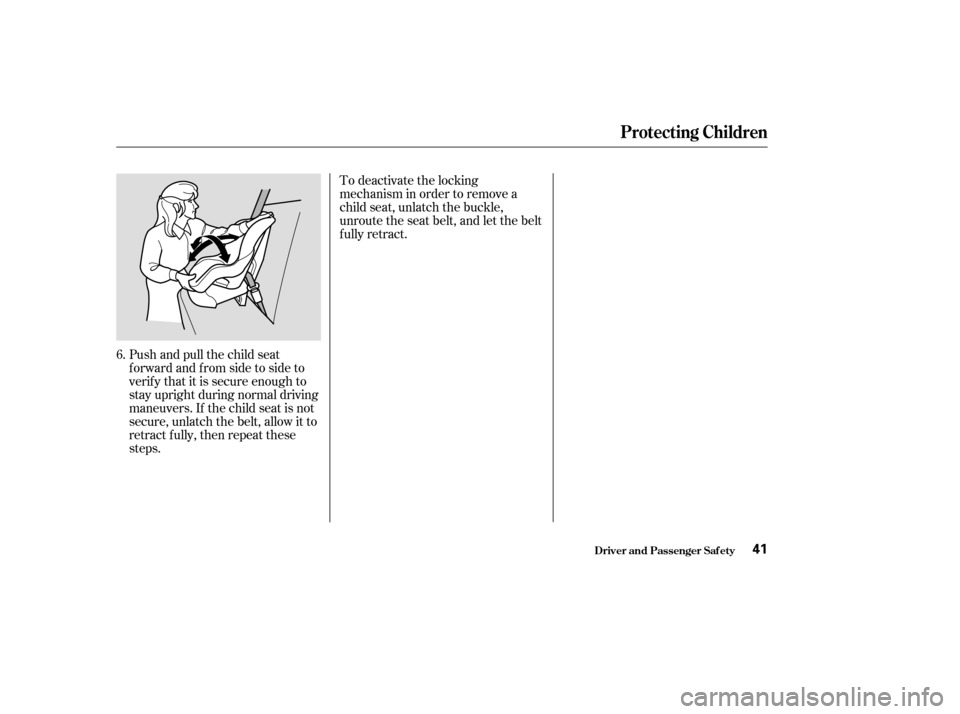
To deactivate the locking
mechanism in order to remove a
child seat, unlatch the buckle,
unroute the seat belt, and let the belt
fully retract.
Push and pull the child seat
f orward and f rom side to side to
verif y that it is secure enough to
stay upright during normal driving
maneuvers. If the child seat is not
secure, unlatch the belt, allow it to
retract f ully, then repeat these
steps.
6.
Protecting Children
Driver and Passenger Saf ety41
Page 47 of 374
Whichever style you select, f ollow
the booster seat maker’s instructions. If a child needs a booster seat, we
recommend choosing a high or low-
back style that allows the child to be
directly secured with the lap/
shoulder belt.
This could cause
very serious injuries during a crash.
It also increases the chance that the
child will slide under the belt in a
crash and be injured.
Devices intended to improve
occupant comf ort or reposition the
shoulder part of a seat belt, severely
compromise the protective capability
of the seat belt and increase the
chance of serious injury in a crash.
If they do, they could
be very seriously injured in a crash.
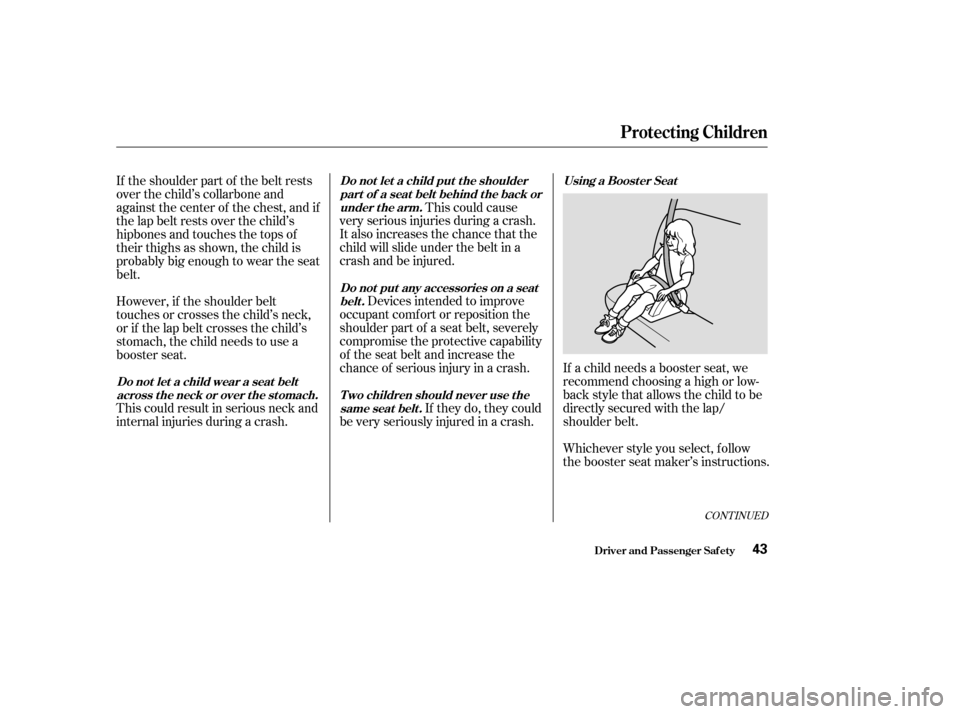
If the shoulder part of the belt rests
over the child’s collarbone and
against the center of the chest, and if
the lap belt rests over the child’s
hipbones and touches the tops of
their thighs as shown, the child is
probably big enough to wear the seat
belt.
However, if the shoulder belt
touchesorcrossesthechild’sneck,
or if the lap belt crosses the child’s
stomach, the child needs to use a
booster seat.
This could result in serious neck and
internal injuries during a crash.
CONT INUED
Using a Boost er Seat
Do not let a child put the shoulder
part of a seat belt behind t he back orunder t he arm.
Do not put any accessories on a seatbelt.
T wo children should never use t hesame seat belt .
Do not let a child wear a seat belt
across t he neck or over t he st omach.
Protecting Children
Driver and Passenger Saf ety43
Page 49 of 374

If you decide that a child can saf ely
ride up f ront, be sure to:Caref ully read the owner’s manual
and make sure you understand all
seat belt instructions and all saf ety
inf ormation.
Move the vehicle seat to the rear-
most position.
Have the child sit up straight, back
against the seat, and feet on or
near the f loor.
Check that the child’s seat belt is
properly positioned and secured.
Supervise the child. Even mature
children sometimes need to be
reminded to f asten the seat belts
or sit properly.
Physically, a child must be large
enough f or the lap/shoulder belt to
properly f it over the hips, chest, and
shoulder (see pages and ). If
the seat belt does not f it properly,
the child should not sit in the f ront.
To saf ely ride in f ront, a child must
be able to f ollow the rules, including
sitting properly and wearing the seat
belt properly throughout a ride.
17 42Physical Size
Maturity
Protecting Children
Driver and Passenger Saf ety45
Page 50 of 374
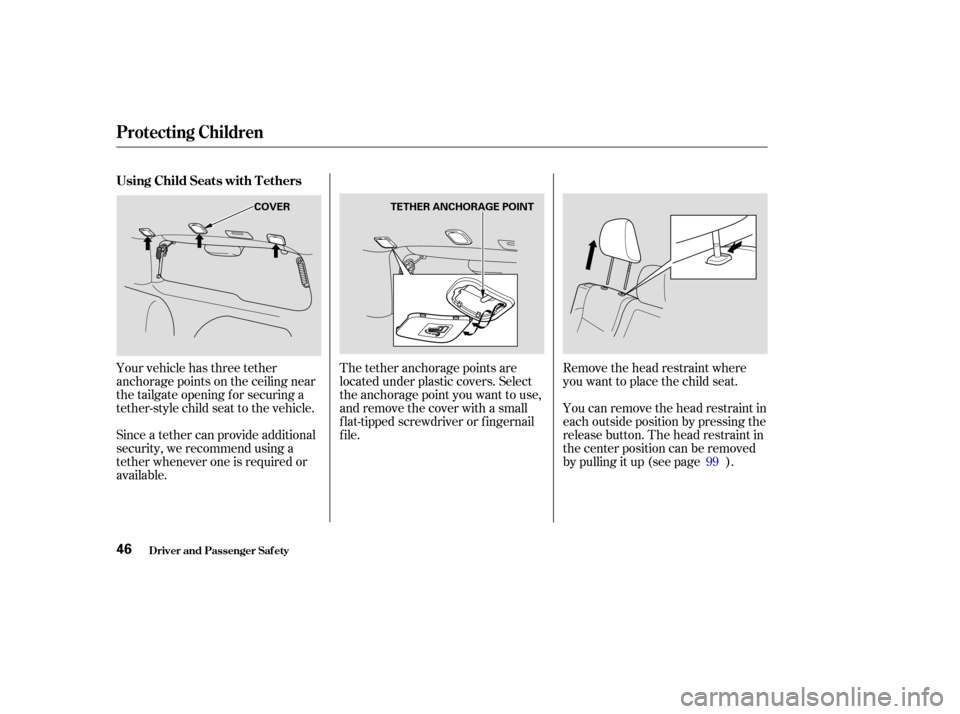
Your vehicle has three tether
anchorage points on the ceiling near
the tailgate opening f or securing a
tether-style child seat to the vehicle.Remove the head restraint where
you want to place the child seat.
You can remove the head restraint in
each outside position by pressing the
release button. The head restraint in
the center position can be removed
by pulling it up (see page ).
The tether anchorage points are
located under plastic covers. Select
the anchorage point you want to use,
and remove the cover with a small
f lat-tipped screwdriver or f ingernail
f ile.
Since a tether can provide additional
security, we recommend using a
tether whenever one is required or
available. 99
Using Child Seats with T ethers
Protecting Children
Driver and Passenger Saf ety46
COVER
TETHER ANCHORAGE POINT
Page 51 of 374
Make sure the removed head
restraints are secured in the cargo
area. Reinstall the head restraints
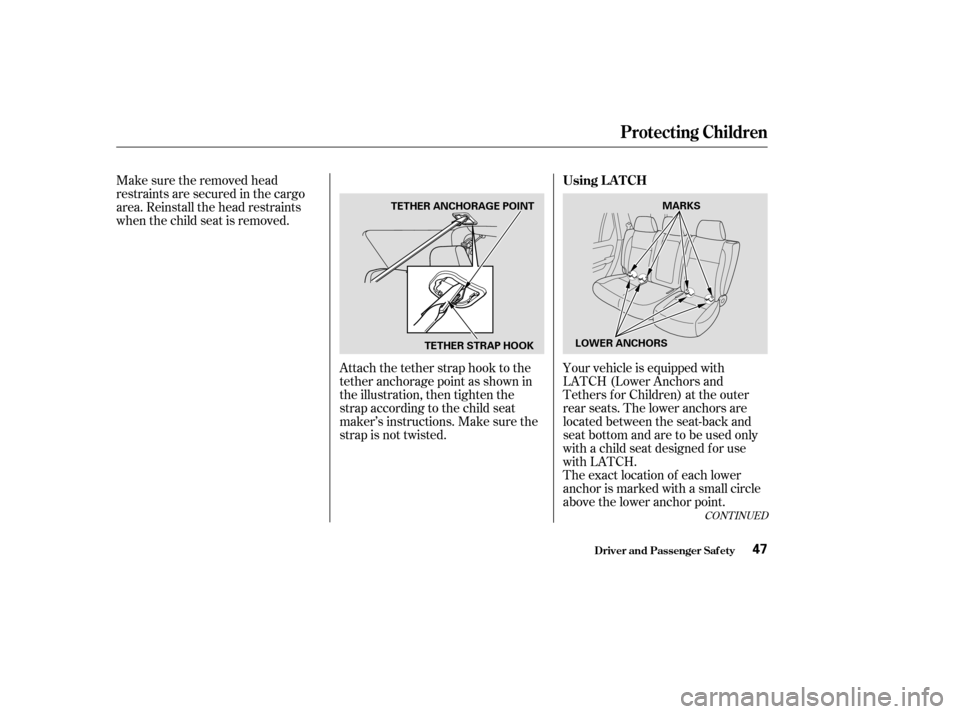
when the child seat is removed.Attach the tether strap hook to the
tether anchorage point as shown in
the illustration, then tighten the
strap according to the child seat
maker’s instructions. Make sure the
strap is not twisted.Your vehicle is equipped with
LATCH (Lower Anchors and
Tethers for Children) at the outer
rear seats. The lower anchors are
located between the seat-back and
seat bottom and are to be used only
with a child seat designed f or use
with LATCH.
The exact location of each lower
anchor is marked with a small circle
above the lower anchor point.
CONT INUED
Driver and Passenger Saf ety
Protecting Children
Using L A T CH
47
TETHER ANCHORAGE POINT
TETHER STRAP HOOK LOWER ANCHORSMARKS
Page 52 of 374
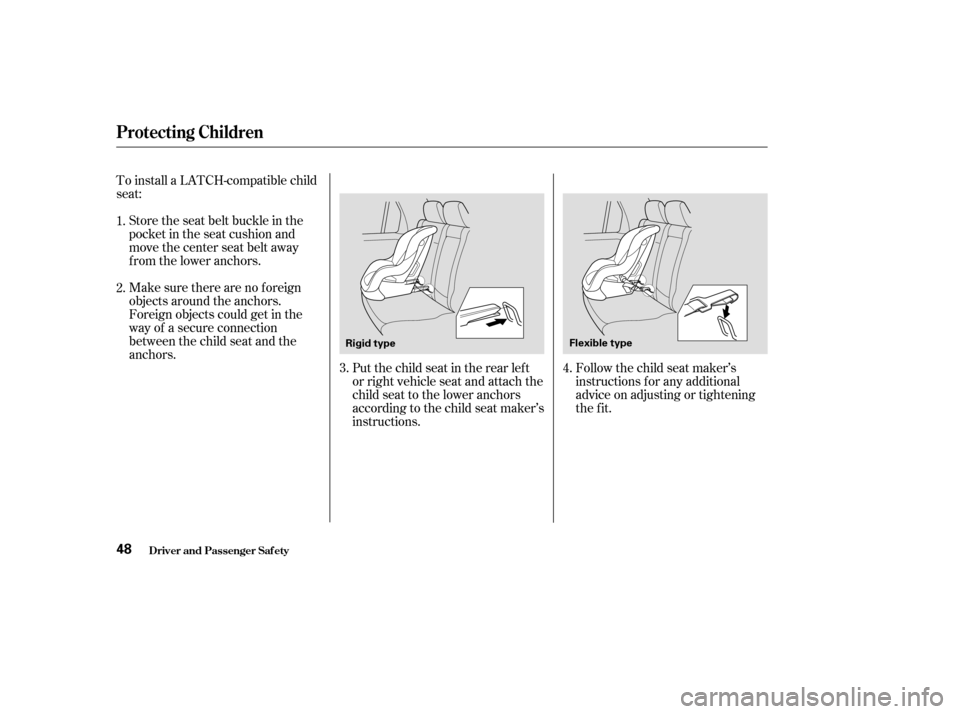
To install a LATCH-compatible child
seat:Store the seat belt buckle in the
pocket in the seat cushion and
move the center seat belt away
f rom the lower anchors.
Make sure there are no f oreign
objects around the anchors.
Foreign objects could get in the
way of a secure connection
between the child seat and the
anchors. Put the child seat in the rear lef t
or right vehicle seat and attach the
child seat to the lower anchors
according to the child seat maker’s
instructions.Follow the child seat maker’s
instructions f or any additional
advice on adjusting or tightening
the fit.
1.
2.
4.
3.
Protecting Children
Driver and Passenger Saf ety48
Rigid type Flexible type
Page 53 of 374
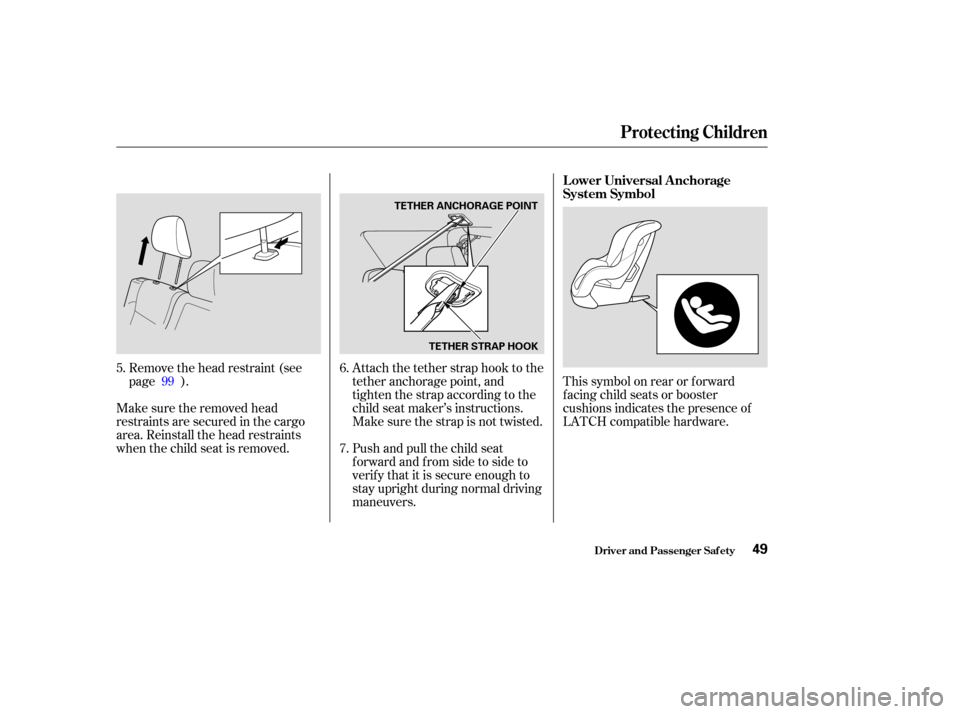
Remove the head restraint (see
page ).
Make sure the removed head
restraints are secured in the cargo
area. Reinstall the head restraints
when the child seat is removed. Attach the tether strap hook to the
tether anchorage point, and
tighten the strap according to the
child seat maker’s instructions.
Make sure the strap is not twisted.
Push and pull the child seat
f orward and f rom side to side to
verif y that it is secure enough to
stay upright during normal driving
maneuvers.This symbol on rear or f orward
f acing child seats or booster
cushions indicates the presence of
LATCH compatible hardware.
5.
6.
7.
99
Protecting Children
Driver and Passenger Saf ety
L ower Universal Anchorage
System Symbol
49
TETHER ANCHORAGE POINT
TETHER STRAP HOOK
Page 55 of 374
The seat belts in all seating positions
except the driver’s have an additional
locking mechanism that must be
activated to secure a child seat. (See
pages and f or instructions on
how to secure child seats with this
type of seat belt.)
If the shoulder part of the belt is
pulled all the way out, the locking
mechanism will activate. The belt
will retract, but it will not allow the
passenger to move f reely.
To deactivate the locking
mechanism, unlatch the buckle and
let the seat belt f ully retract. To
ref asten the belt, pull it out only as
f ar as needed.
See page f or instructions on how
to wear the lap/shoulder belt
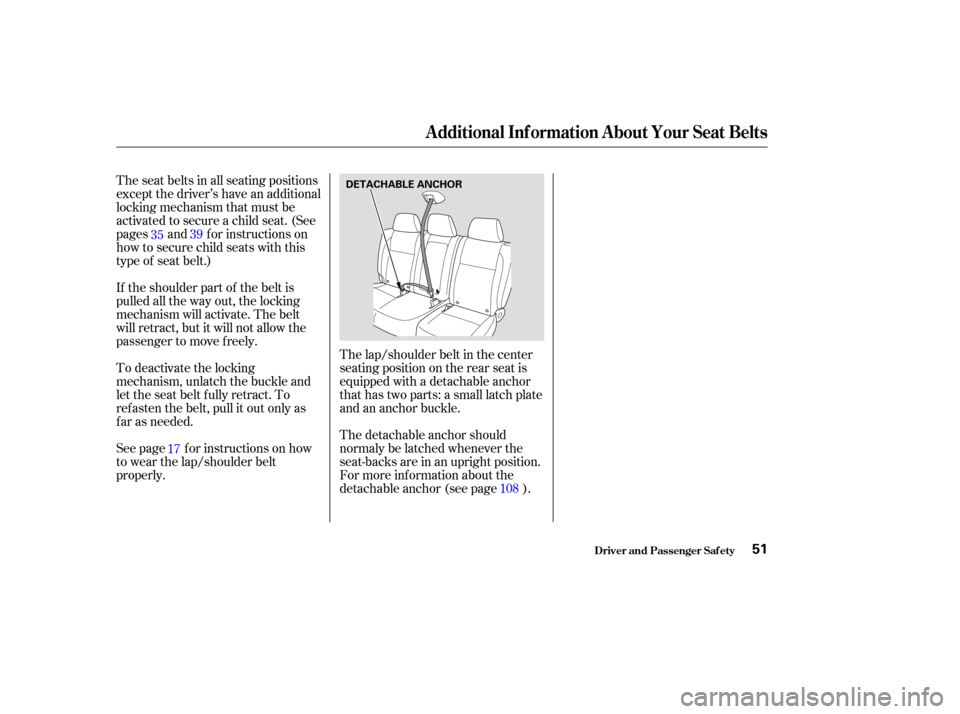
properly.The lap/shoulder belt in the center
seating position on the rear seat is
equipped with a detachable anchor
that has two parts: a small latch plate
and an anchor buckle.
The detachable anchor should
normaly be latched whenever the
seat-backs are in an upright position.
For more inf ormation about the
detachable anchor (see page ).
35
39
17 108
Additional Inf ormation About Your Seat Belts
Driver and Passenger Saf ety51
DETACHABLE ANCHOR
Page 87 of 374
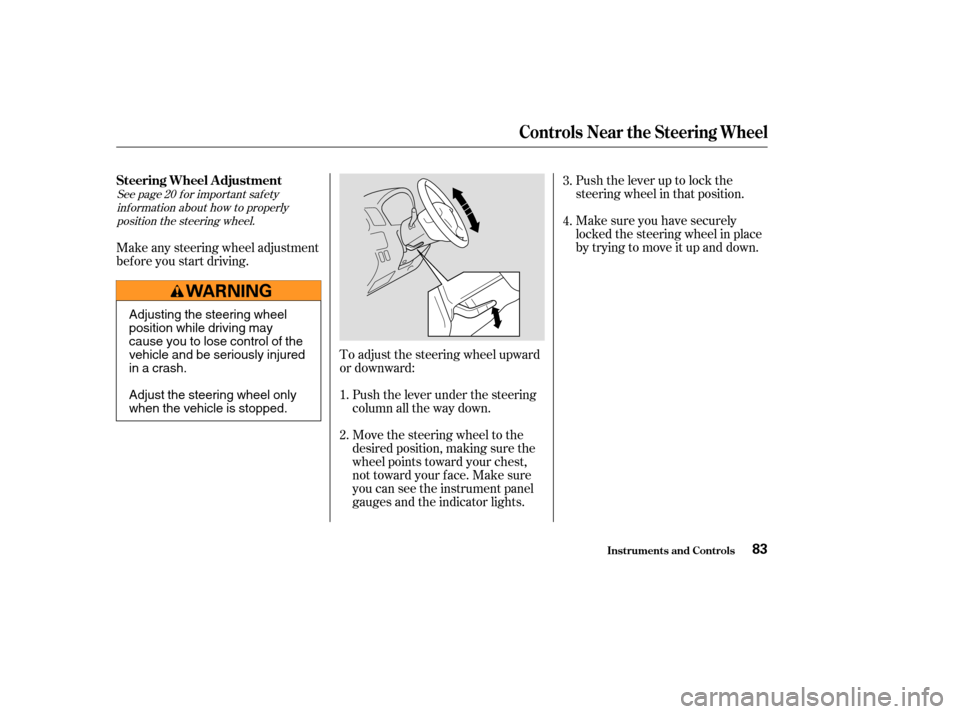
Push the lever up to lock the
steering wheel in that position.
Make sure you have securely
locked the steering wheel in place
by trying to move it up and down.
Push the lever under the steering
column all the way down.
Move the steering wheel to the
desired position, making sure the
wheel points toward your chest,
not toward your f ace. Make sure
you can see the instrument panel
gauges and the indicator lights.
To adjust the steering wheel upward
or downward:
Make any steering wheel adjustment
bef ore you start driving.
1.
2.3.
4.
See page f or important saf ety
inf ormation about how to properlyposition the steering wheel. 20
Inst rument s and Cont rols
Controls Near the Steering Wheel
Steering Wheel A djustment
83
Adjusting the steering wheel
position while driving may
cause you to lose control of the
vehicle and be seriously injured
inacrash.
Adjust the steering wheel only
when the vehicle is stopped.
Page 99 of 374
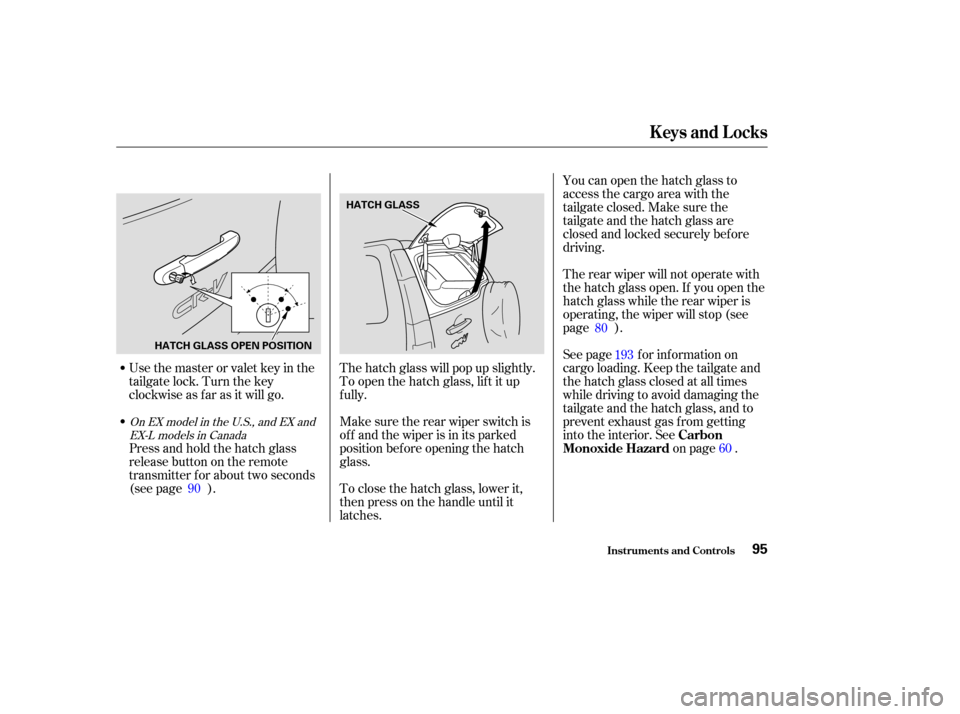
Youcanopenthehatchglassto
access the cargo area with the
tailgate closed. Make sure the
tailgate and the hatch glass are
closed and locked securely bef ore
driving.
The rear wiper will not operate with
the hatch glass open. If you open the
hatch glass while the rear wiper is
operating, the wiper will stop (see
page ).
See page for information on
cargo loading. Keep the tailgate and
the hatch glass closed at all times
while driving to avoid damaging the
tailgate and the hatch glass, and to
prevent exhaust gas f rom getting
into the interior. Seeon page .
Press and hold the hatch glass
release button on the remote
transmitter for about two seconds
(see page ). Use the master or valet key in the
tailgate lock. Turn the key
clockwise as f ar as it will go. The hatch glass will pop up slightly.
To open the hatch glass, lif t it up
f ully.
Make sure the rear wiper switch is
of f and the wiper is in its parked
position bef ore opening the hatch
glass.
To close the hatch glass, lower it,
then press on the handle until it
latches.
90 80
193
60
On EX model in the U.S., and EX andEX-L models in Canada
Keys and Locks
Inst rument s and Cont rols
Carbon
Monoxide Hazard
95
HATCH GLASS OPEN POSITION HATCH GLASS