cooling HONDA CR-V 2003 RD4-RD7 / 2.G User Guide
[x] Cancel search | Manufacturer: HONDA, Model Year: 2003, Model line: CR-V, Model: HONDA CR-V 2003 RD4-RD7 / 2.GPages: 374, PDF Size: 4.46 MB
Page 137 of 374

If the interior is very warm f rom
beingparkedinthesun,youcancool
it down more rapidly by setting up
the controls this way:Start the engine.
Turn on the A/C by pressing the
button. Make sure the tempera-
ture control dial is all the way to
the left.
Set the f an to maximum speed.
Open the windows partially. Select and Fresh Air mode.
When the interior has cooled down
to a more comf ortable temperature,
close the windows and set the
controls as described f or normal
cooling. To warm the interior:
Air conditioning places an extra load
on the engine. Watch the engine
coolant temperature gauge (see page
) when driving in stop-and-go
traf f ic or climbing a long, steep hill.
If it moves near the red zone, turn
of f the A/C until the gauge reads
normally. Start the engine.
Select .
Set the f an to the desired speed.
Adjust the warmth of the air with
the temperature control dial.
1.
2.
3.
4. 1.
2.
3.
4.
74
CONT INUED
Heating and Cooling
Comf ort and Convenience Feat ures
To Heat
133
Page 138 of 374

Air conditioning, as it cools, removes
moisture from the air. When used in
combination with the heater, it
makes the interior warm and dry.Set the f an to the desired speed.
Turn on the air conditioning.
Select and Fresh Air mode.
Adjust the temperature control
dial so the mixture of heated and
cooled air f eels comf ortable.
This setting is suitable f or all driving
conditions whenever the outside
temperature is above 32°F (0°C). To remove f og f rom the inside of the
windows:
Set the f an to the desired speed.
Select .
When you select , the
system automatically switches to
Fresh Air mode and turns on the
A/C.
Adjust the temperature control
dial so the air f low f rom the
def roster vents f eels warm.
Turn on the rear window def ogger
to help clear the rear window.
When you switch to another mode
f rom , the A/C stays on.
Press the A/C button to turn it of f . To remove exterior f rost or ice f rom
the windshield and side windows
after the vehicle has been sitting out
in cold weather:
Start the engine.
Select .
When you select , the
system automatically switches
to Fresh Air mode and turns on
the A/C.
Set the f an and temperature
controls to maximum.
To rapidly remove exterior f rost or
ice f rom the windshield (on very cold
days), f irst select the Recirculation
mode. Once the windshield is clear,
select the Fresh Air mode to avoid
f ogging the windows.
1.
2.
3.
4.
1.
2.
3.
4. 1.
2.
3.
T o Heat and Dehumidif y wit h A ir
Condit ioning T o Def og and Def rost
Heating and Cooling
Comf ort and Convenience Feat ures134
Page 139 of 374
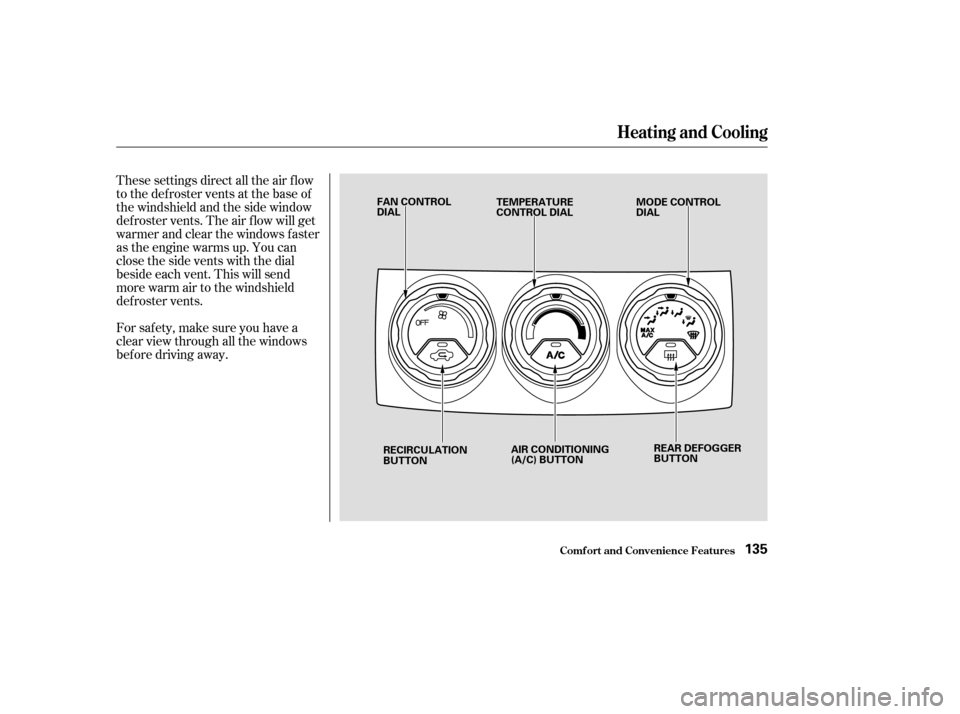
These settings direct all the air f low
to the defroster vents at the base of
the windshield and the side window
def roster vents. The air f low will get
warmer and clear the windows faster
as the engine warms up. You can
close the side vents with the dial
beside each vent. This will send
more warm air to the windshield
defroster vents.
For saf ety, make sure you have a
clear view through all the windows
bef ore driving away.
Heating and Cooling
Comf ort and Convenience Feat ures135
FAN CONTROL
DIALTEMPERATURE
CONTROL DIAL MODE CONTROL
DIAL
RECIRCULATION
BUTTON REAR DEFOGGER
BUTTON
AIR CONDITIONING
(A/C) BUTTON
Page 140 of 374

To shut of f the system temporarily,
turn the fan speed and temperature
control dials all the way to the lef t.
No air f low can cause the windows to
fogup.Itisrecommendedthatyou
keep the fan on at all times so stale
air and moisture do not build up in
the interior and cause f ogging. To Turn Everything Of f
Comf ort and Convenience Feat ures
Heating and Cooling
136
Page 225 of 374

Many states and Canadian provinces
require special outside mirrors when
towing a trailer. Even if they don’t,
you should install special mirrors if
you cannot clearly see behind you, or
if the trailer creates a blind spot.
Askyourtrailersalesorrental
agency if any other items are
recommended or required f or your
towing situation.When preparing to tow, and bef ore
driving away, be sure to check the
f ollowing:
The vehicle has been properly
serviced, and the tires, brakes,
suspension, and cooling system
are in good operating condition. The lights and brakes on your
vehicle and the trailer are working
properly.
The trailer has been properly
serviced and is in good condition.
Allitemsonandinthetrailerare
properly secured and cannot shif t
while you drive. Thehitch,safetychains,andany
other attachments are secure. Your vehicle tires and spare are
properly inf lated (see page ),
and the trailer tires and spare are
inflated as recommended by the
trailer maker.
All weights and loads are within
limits (see pages and ). If you tow f requently, f ollow the
Severe Conditions maintenance
schedule. 217 218 278
Additional Trailer EquipmentPre-T ow Checklist
Towing a Trailer
Driving221
Page 237 of 374
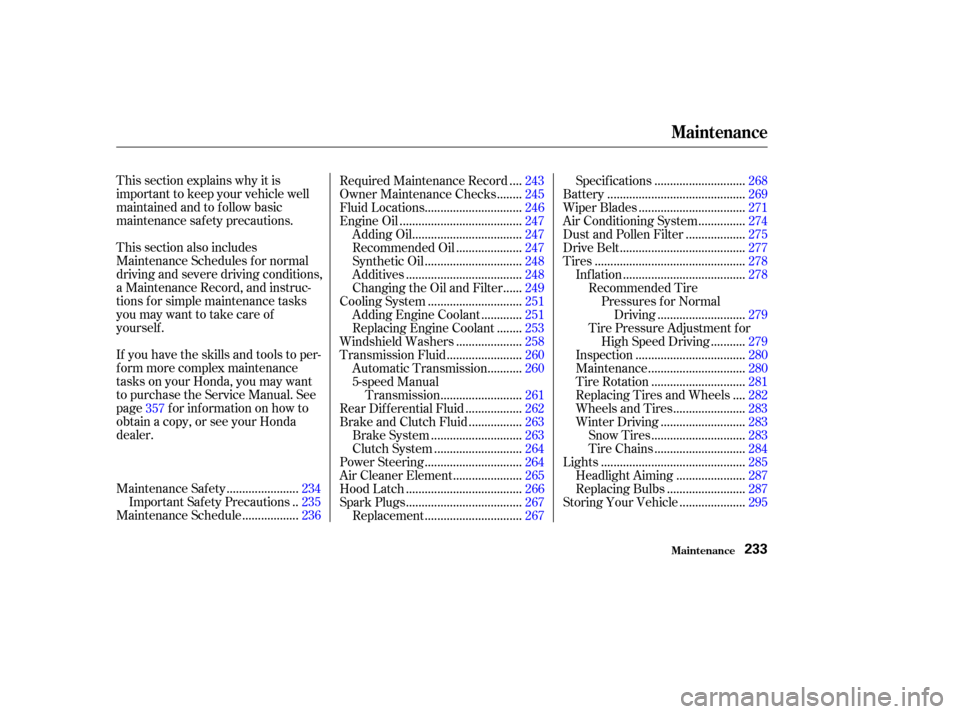
This section explains why it is
important to keep your vehicle well
maintained and to f ollow basic
maintenance saf ety precautions.
This section also includes
Maintenance Schedules f or normal
driving and severe driving conditions,
a Maintenance Record, and instruc-
tions f or simple maintenance tasks
you may want to take care of
yourself .
If you have the skills and tools to per-
f orm more complex maintenance
tasks on your Honda, you may want
to purchase the Service Manual. See
page f or inf ormation on how to
obtain a copy, or see your Honda
dealer.......................
Maintenance Saf ety .234
.
Important Safety Precautions . 235
.................
Maintenance Schedule . 236 ...
Required Maintenance Record . 243
.......
Owner Maintenance Checks . 245
..............................
Fluid Locations .246
......................................
Engine Oil .247
..................................
Adding Oil .247
....................
Recommended Oil .247
..............................
Synthetic Oil .248
....................................
Additives .248
.....
Changing the Oil and Filter . 249
.............................
Cooling System .251
............
Adding Engine Coolant . 251
.......
Replacing Engine Coolant . 253
....................
Windshield Washers .258
.......................
Transmission Fluid .260
..........
Automatic Transmission . 260
5-speed Manual .........................
Transmission .261
.................
Rear Dif f erential Fluid . 262
................
Brake and Clutch Fluid . 263
............................
Brake System .263
...........................
Clutch System .264
..............................
Power Steering .264
.....................
Air Cleaner Element .265
....................................
Hood Latch .266
....................................
Spark Plugs .267
..............................
Replacement .267 ............................
Specif ications .268
...........................................
Battery .269
.................................
Wiper Blades .271
..............
Air Conditioning System . 274
..................
Dust and Pollen Filter . 275
.......................................
Drive Belt .277
...............................................
Tires .278
......................................
Inf lation .278
Recommended Tire Pressures f or Normal ...........................
Driving .279
Tire Pressure Adjustment f or ..........
High Speed Driving . 279
..................................
Inspection .280
..............................
Maintenance .280
.............................
Tire Rotation .281
...
Replacing Tires and Wheels . 282
......................
Wheels and Tires .283
..........................
Winter Driving .283
.............................
Snow Tires .283
............................
Tire Chains .284
.............................................
Lights .285
.....................
Headlight Aiming .287
........................
Replacing Bulbs .287
....................
Storing Your Vehicle .295
357
Maintenance
Maint enance233
Page 255 of 374
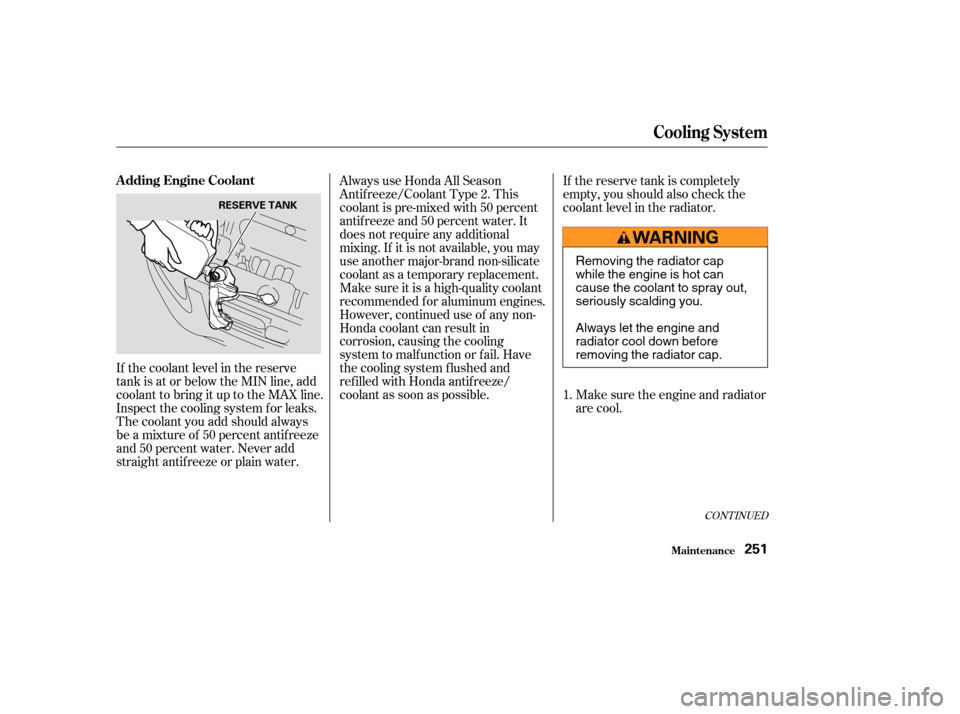
If the coolant level in the reserve
tank is at or below the MIN line, add
coolant to bring it up to the MAX line.
Inspect the cooling system f or leaks.
The coolant you add should always
be a mixture of 50 percent antif reeze
and 50 percent water. Never add
straight antif reeze or plain water.Always use Honda All Season
Antif reeze/Coolant Type 2. This
coolant is pre-mixed with 50 percent
antif reeze and 50 percent water. It
does not require any additional
mixing. If it is not available, you may
use another major-brand non-silicate
coolant as a temporary replacement.
Make sure it is a high-quality coolant
recommended f or aluminum engines.
However, continued use of any non-
Honda coolant can result in
corrosion, causing the cooling
system to malf unction or f ail. Have
the cooling system f lushed and
ref illed with Honda antif reeze/
coolant as soon as possible.
If the reserve tank is completely
empty, you should also check the
coolant level in the radiator.
Make sure the engine and radiator
are cool.
1.
CONT INUED
A dding Engine Coolant
Cooling Syst em
Maint enance251
RESERVE TANK
Removing the radiator cap
while the engine is hot can
cause the coolant to spray out,
seriously scalding you.
Always let the engine and
radiator cool down before
removing the radiator cap.
Page 256 of 374
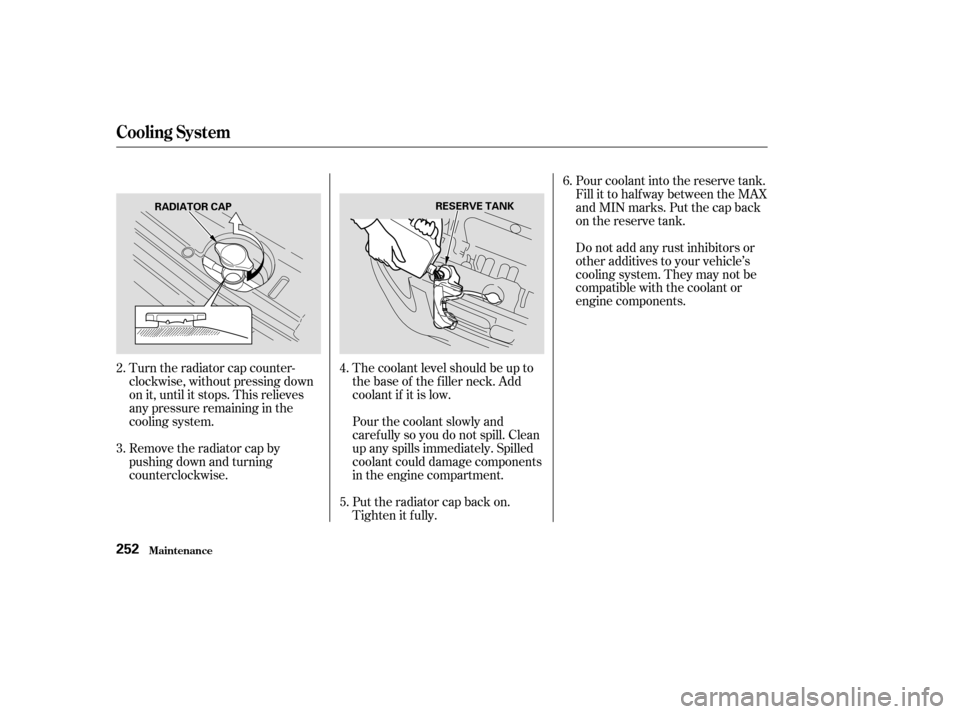
The coolant level should be up to
the base of the f iller neck. Add
coolant if it is low.
Turn the radiator cap counter-
clockwise, without pressing down
on it, until it stops. This relieves
any pressure remaining in the
cooling system.
Remove the radiator cap by
pushing down and turning
counterclockwise. Pour coolant into the reserve tank.
Fill it to half way between the MAX
and MIN marks. Put the cap back
on the reserve tank.
Do not add any rust inhibitors or
other additives to your vehicle’s
cooling system. They may not be
compatible with the coolant or
engine components.
Put the radiator cap back on.
Tighten it f ully. Pourthecoolantslowlyand
caref ully so you do not spill. Clean
up any spills immediately. Spilled
coolant could damage components
in the engine compartment.
2.
3.
4.
5. 6.
Cooling Syst em
Maint enance252
RADIATOR CAP
RESERVE TANK
Page 257 of 374
CONT INUED
Thecoolingsystemshouldbe
completely drained and ref illed with
new coolant according to the time
and distance recommendations in
the maintenance schedule. Only use
Honda All Season Antif reeze/
Coolant Type 2.
Draining the coolant requires access
to the underside of the vehicle.
Unless you have the tools and
knowledge, you should have this
maintenance done by a skilled
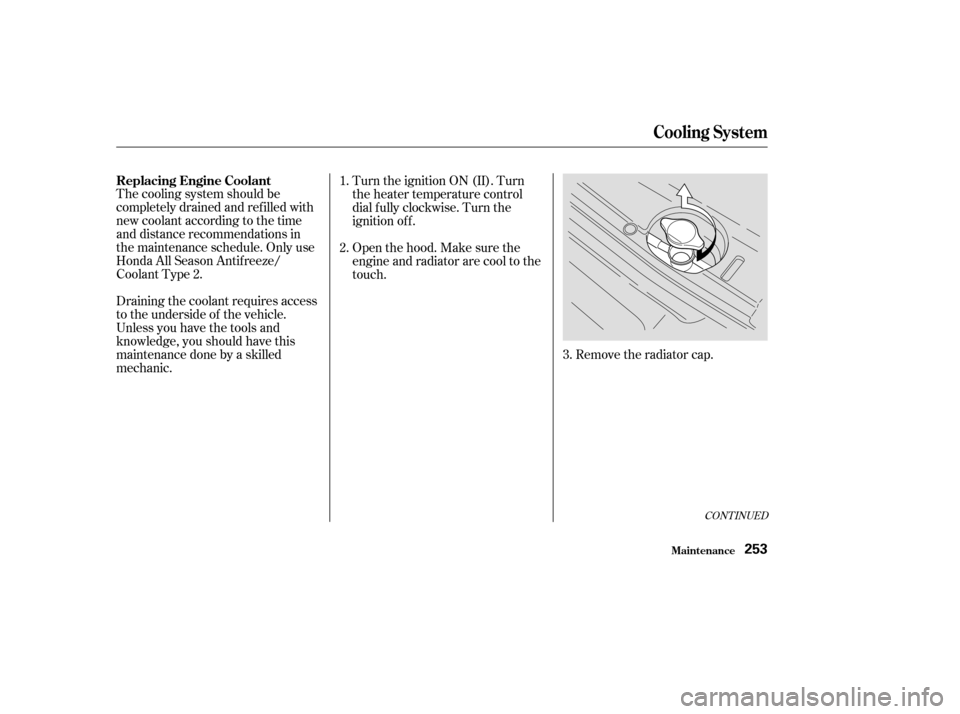
mechanic.Remove the radiator cap.
Turn the ignition ON (II). Turn
the heater temperature control
dial f ully clockwise. Turn the
ignition of f .
Openthehood.Makesurethe
engine and radiator are cool to the
touch.
1.
2.
3.
Replacing Engine Coolant
Cooling Syst em
Maint enance253
Page 258 of 374
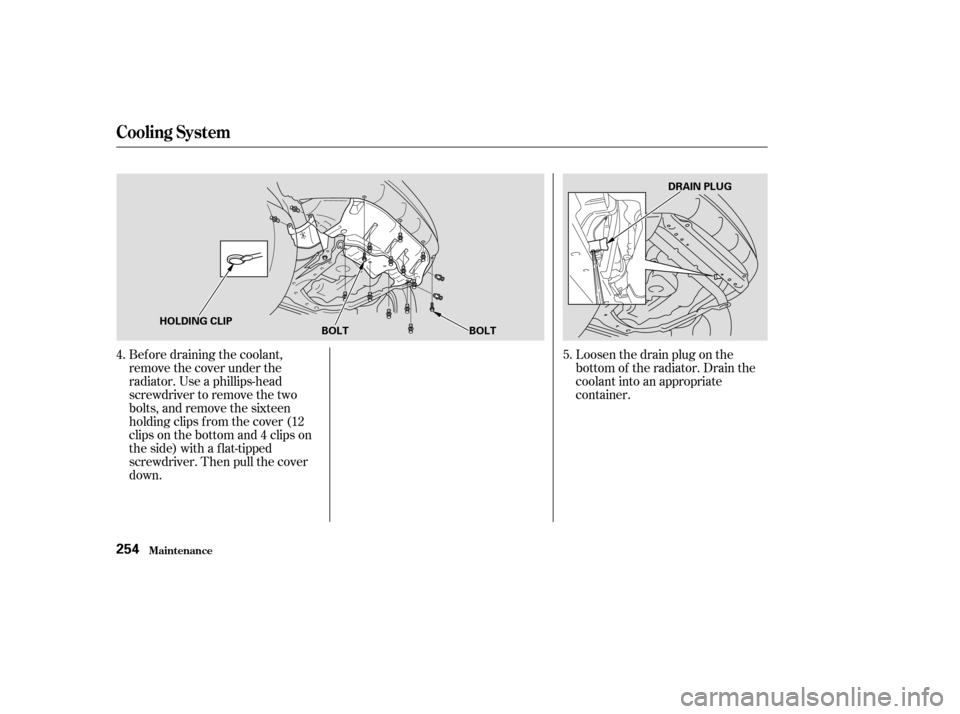
Loosen the drain plug on the
bottom of the radiator. Drain the
coolant into an appropriate
container.
Bef ore draining the coolant,
remove the cover under the
radiator. Use a phillips-head
screwdriver to remove the two
bolts, and remove the sixteen
holding clips f rom the cover (12
clips on the bottom and 4 clips on
the side) with a flat-tipped
screwdriver. Then pull the cover
down.
4.
5.
Cooling Syst em
Maint enance254
HOLDING CLIP
BOLTBOLT DRAIN PLUG