heating HONDA CR-V 2003 RD4-RD7 / 2.G User Guide
[x] Cancel search | Manufacturer: HONDA, Model Year: 2003, Model line: CR-V, Model: HONDA CR-V 2003 RD4-RD7 / 2.GPages: 374, PDF Size: 4.46 MB
Page 138 of 374
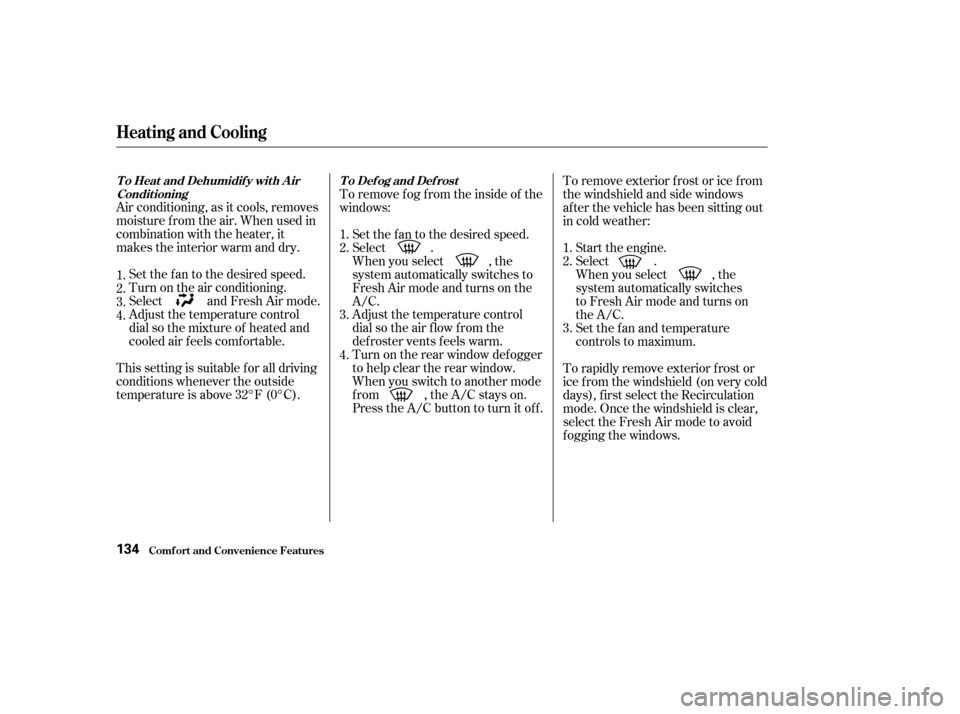
Air conditioning, as it cools, removes
moisture from the air. When used in
combination with the heater, it
makes the interior warm and dry.Set the f an to the desired speed.
Turn on the air conditioning.
Select and Fresh Air mode.
Adjust the temperature control
dial so the mixture of heated and
cooled air f eels comf ortable.
This setting is suitable f or all driving
conditions whenever the outside
temperature is above 32°F (0°C). To remove f og f rom the inside of the
windows:
Set the f an to the desired speed.
Select .
When you select , the
system automatically switches to
Fresh Air mode and turns on the
A/C.
Adjust the temperature control
dial so the air f low f rom the
def roster vents f eels warm.
Turn on the rear window def ogger
to help clear the rear window.
When you switch to another mode
f rom , the A/C stays on.
Press the A/C button to turn it of f . To remove exterior f rost or ice f rom
the windshield and side windows
after the vehicle has been sitting out
in cold weather:
Start the engine.
Select .
When you select , the
system automatically switches
to Fresh Air mode and turns on
the A/C.
Set the f an and temperature
controls to maximum.
To rapidly remove exterior f rost or
ice f rom the windshield (on very cold
days), f irst select the Recirculation
mode. Once the windshield is clear,
select the Fresh Air mode to avoid
f ogging the windows.
1.
2.
3.
4.
1.
2.
3.
4. 1.
2.
3.
T o Heat and Dehumidif y wit h A ir
Condit ioning T o Def og and Def rost
Heating and Cooling
Comf ort and Convenience Feat ures134
Page 139 of 374
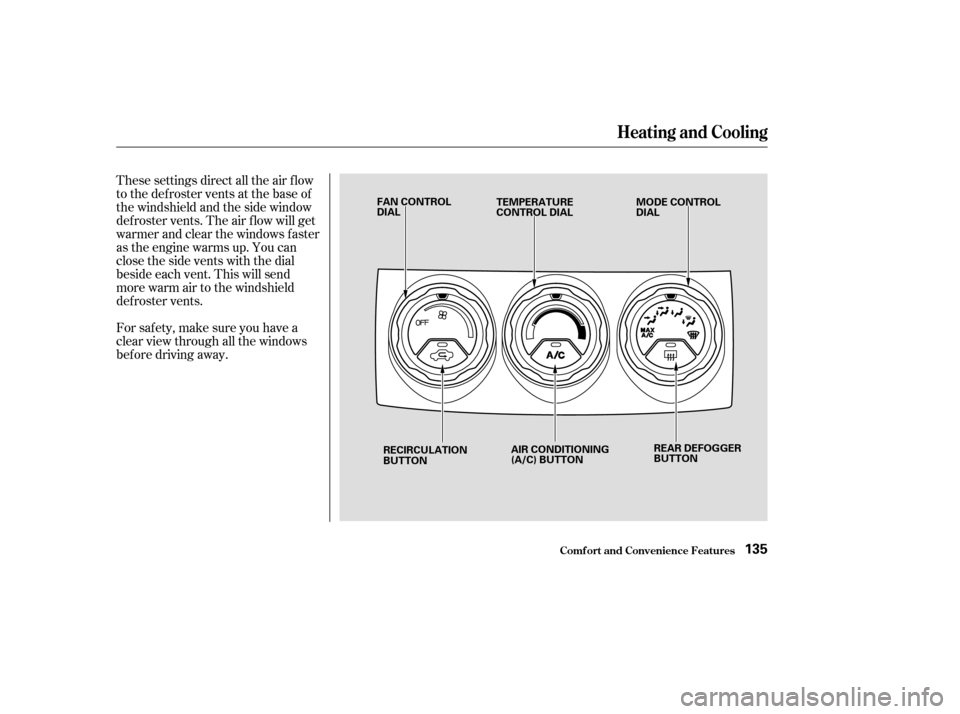
These settings direct all the air f low
to the defroster vents at the base of
the windshield and the side window
def roster vents. The air f low will get
warmer and clear the windows faster
as the engine warms up. You can
close the side vents with the dial
beside each vent. This will send
more warm air to the windshield
defroster vents.
For saf ety, make sure you have a
clear view through all the windows
bef ore driving away.
Heating and Cooling
Comf ort and Convenience Feat ures135
FAN CONTROL
DIALTEMPERATURE
CONTROL DIAL MODE CONTROL
DIAL
RECIRCULATION
BUTTON REAR DEFOGGER
BUTTON
AIR CONDITIONING
(A/C) BUTTON
Page 140 of 374

To shut of f the system temporarily,
turn the fan speed and temperature
control dials all the way to the lef t.
No air f low can cause the windows to
fogup.Itisrecommendedthatyou
keep the fan on at all times so stale
air and moisture do not build up in
the interior and cause f ogging. To Turn Everything Of f
Comf ort and Convenience Feat ures
Heating and Cooling
136
Page 206 of 374
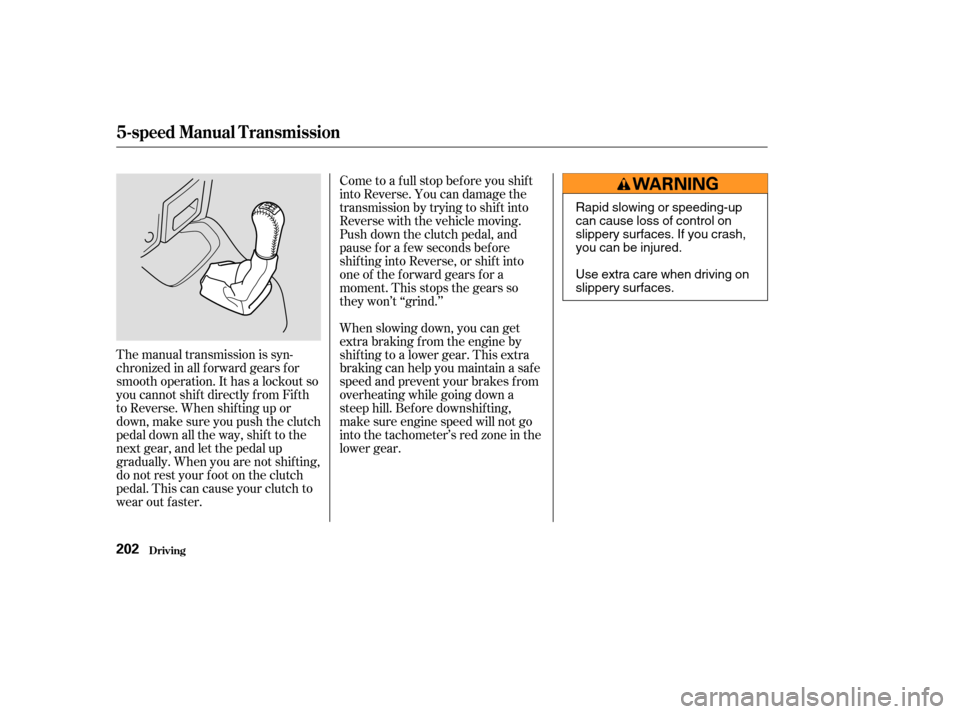
The manual transmission is syn-
chronizedinallforwardgearsfor
smooth operation. It has a lockout so
you cannot shift directly from Fifth
to Reverse. When shif ting up or
down,makesureyoupushtheclutch
pedal down all the way, shift to the
next gear, and let the pedal up
gradually. When you are not shif ting,
do not rest your f oot on the clutch
pedal. This can cause your clutch to
wear out faster.Come to a full stop before you shift
into Reverse. You can damage the
transmission by trying to shif t into
Reverse with the vehicle moving.
Push down the clutch pedal, and
pause f or a f ew seconds bef ore
shif ting into Reverse, or shif t into
one of the f orward gears f or a
moment. This stops the gears so
they won’t ‘‘grind.’’
When slowing down, you can get
extra braking f rom the engine by
shifting to a lower gear. This extra
braking can help you maintain a safe
speed and prevent your brakes f rom
overheating while going down a
steep hill. Bef ore downshif ting,
make sure engine speed will not go
into the tachometer’s red zone in the
lower gear.
5-speed Manual T ransmission
Driving202
Rapid slowing or speeding-up
can cause loss of control on
slippery surfaces. If you crash,
you can be injured.
Use extra care when driving on
slippery surfaces.
Page 279 of 374
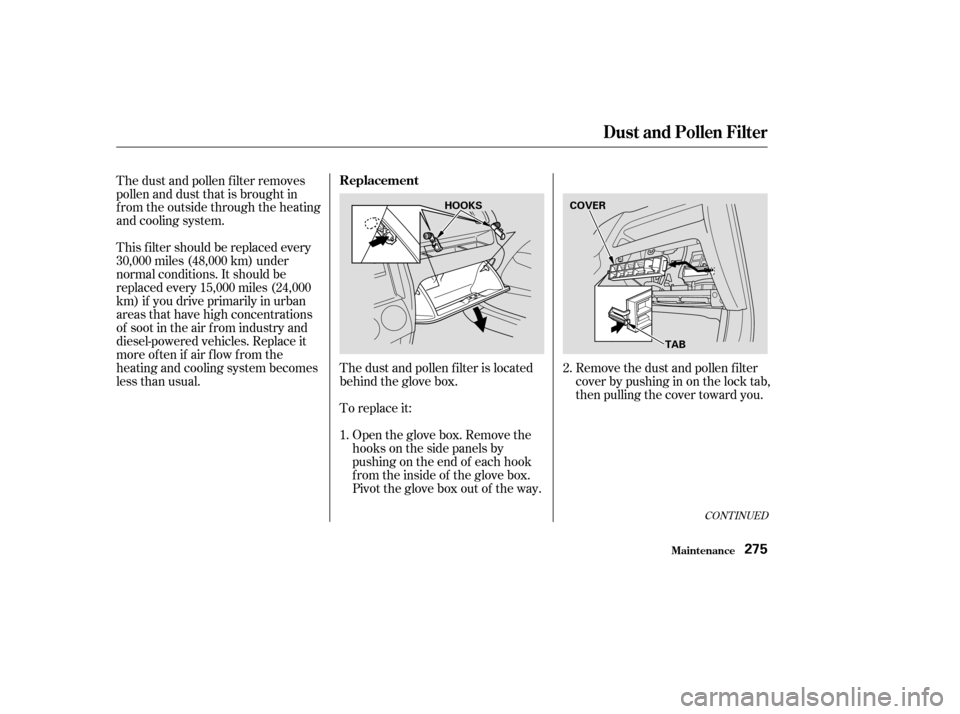
To replace it: The dust and pollen f ilter is located
behind the glove box.Remove the dust and pollen f ilter
cover by pushing in on the lock tab,
then pulling the cover toward you.
The dust and pollen f ilter removes
pollen and dust that is brought in
f rom the outside through the heating
andcoolingsystem.
This f ilter should be replaced every
30,000 miles (48,000 km) under
normal conditions. It should be
replaced every 15,000 miles (24,000
km) if you drive primarily in urban
areas that have high concentrations
of soot in the air f rom industry and
diesel-powered vehicles. Replace it
more of ten if air f low f rom the
heating and cooling system becomes
less than usual.
Open the glove box. Remove the
hooks on the side panels by
pushingontheendof eachhook
fromtheinsideof theglovebox.
Pivot the glove box out of the way.
1. 2.
CONT INUED
Maint enance
Dust and Pollen Filter
Replacement
275
HOOKS
COVER
TAB
Page 327 of 374
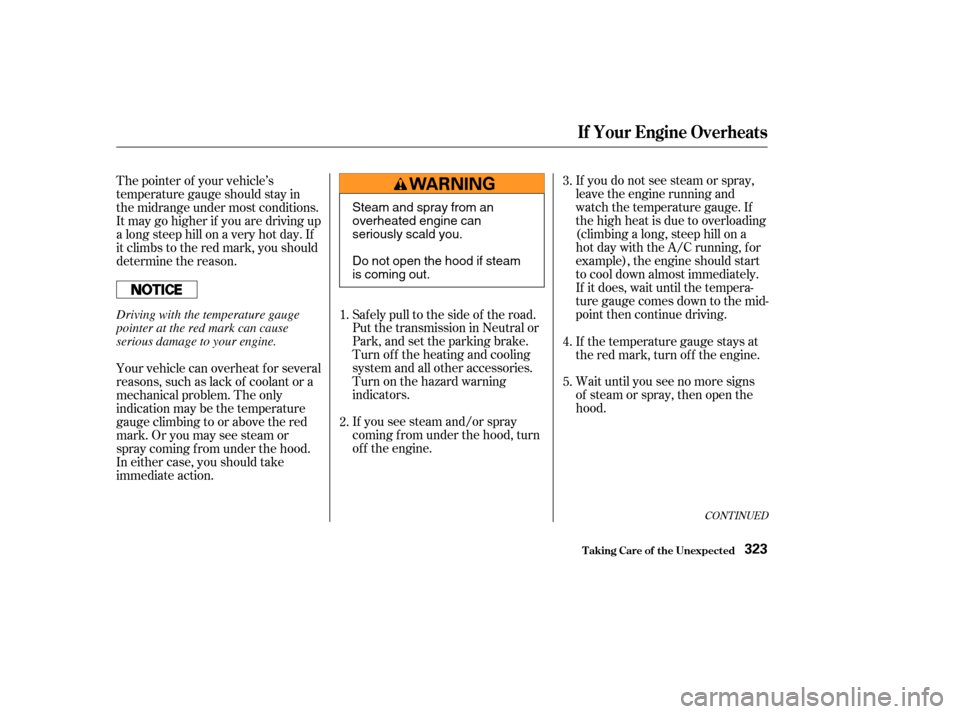
If you see steam and/or spray
coming f rom under the hood, turn
of f the engine.If you do not see steam or spray,
leave the engine running and
watch the temperature gauge. If
the high heat is due to overloading
(climbing a long, steep hill on a
hot day with the A/C running, for
example), the engine should start
to cool down almost immediately.
If it does, wait until the tempera-
ture gauge comes down to the mid-
point then continue driving.
The pointer of your vehicle’s
temperature gauge should stay in
the midrange under most conditions.
Itmaygohigherif youaredrivingup
a long steep hill on a very hot day. If
it climbs to the red mark, you should
determine the reason.
Saf ely pull to the side of the road.
Put the transmission in Neutral or
Park, and set the parking brake.
Turn of f the heating and cooling
system and all other accessories.
Turn on the hazard warning
indicators.If the temperature gauge stays at
the red mark, turn of f the engine.
Wait until you see no more signs
of steam or spray, then open the
hood.
Your vehicle can overheat for several
reasons, such as lack of coolant or a
mechanical problem. The only
indication may be the temperature
gauge climbing to or above the red
mark. Or you may see steam or
spray coming f rom under the hood.
In either case, you should take
immediate action. 1.
2.3.
4.
5.
CONT INUED
If Your Engine Overheats
T aking Care of t he Unexpect ed323
Steam and spray from an
overheated engine can
seriously scald you.
Do not open the hood if steam
is coming out.
Driving with the temperature gauge
pointer at the red mark can cause
serious damage to your engine.
Page 367 of 374
CONT INUED
Dipstick
..........Automatic Transmission .260
..................................Engine Oil.188
..........................Directional Signals.77
........Disc Brake Wear Indicators .211
.....................Disposal of Used Oil.250
Doors
..............Locking and Unlocking .88
......................Power Door Locks.88
..........DOT Tire Quality Grading .344
Downshif ting,5-speed Manual
.............................Transmission.202
.......................................Drive Belt.277
...........................................Driving.197
....................................Economy.190
.........................In Bad Weather.215
................In Foreign Countries .347
........................Driving Guidelines.198
..................Dust and Pollen Filter .275
............................Fabric, Cleaning.302
...................................Fan, Interior.128
Features, Comfort and
..............................Convenience.127
....................Filling the Fuel Tank .185
Filters
................................Air Cleaner.265
.........................Dust and Pollen.275
...............................................Oil.249
5-speed Manual Transmission
...............Checking Fluid Level .261
................................Shif ting the.202
.............Flashers, Hazard Warning .81
...................Flat Tire, Changing a .308
..............................Economy, Fuel.190
............Emergencies on the Road .307
.............Battery, Jump Starting .320
...........Brake System Indicator .329
................Changing a Flat Tire .308
.....Charging System Indicator .326
..................Checking the Fuses .332
.....Low Oil Pressure Indicator .325
...Malf unction Indicator Lamp .327
...Manually Closing Moonroof .330
..................Overheated Engine .323
...........................Emergency Brake.82
......................Emergency Flashers.81
......................Emergency Towing.337
.......................Emissions Controls.349
.............Emissions Testing, State .352
Engine
....Coolant Temperature Gauge .74
...................................Drive Belt.277
......Engine Speed Limiter .203,208
Malf unction Indicator
................................Lamp.66,327
........Oil Pressure Indicator .66,325
..............Oil, What Kind to Use .247
...............................Overheating.323
............................Specif ications.342
.......................................Starting.200
......................Ethanol in Gasoline.347
.Evaporative Emissions Controls .349
...............................Exhaust Fumes.60
Expectant Mothers, Use of Seat
........................................Belts by.21
..................Exterior, Cleaning the .298
Index
E
F
III
Page 368 of 374
.............Halogen Headlight Bulbs .287
.....................................Hatch Glass.94
..............Hazard Warning Flashers .81
Headlights
........................................Aiming.287
............Daytime Running Lights .77
..................High Beam Indicator .69
........................Reminder Beeper.76
........Replacing Halogen Bulbs .287
...................................Turning on.76
..............................Head Restraints.99
.....................Heating and Cooling.128
.............High Altitude, Starting at .201
.................High-Low Beam Switch .76
..............High-mount Brake Light .292
....................................Hood Latch.266
.......................Hood, Opening the.186
..............................................Horn.3,75
...........................Hydraulic Clutch.264
.................................Hydroplaning.216
Fluids
..........Automatic Transmission .260
..........................................Brake.263
.........................................Clutch.264
..............Manual Transmission .261
..........................Power Steering.264
.......................Rear Differential.262
..................Windshield Washer .258
FM Stereo Radio
...................................Reception.161
.........................Folding Rear Seat.104
.....Foreign Countries, Driving in .348
..........................Four-way Flashers.81
............................Front Airbags.10,54
.................................................Fuel.184
......................Fill Door and Cap.185
...........................................Gauge.74
................Octane Requirement .184
...............................Oxygenated.347
........................Reserve Indicator.69
........................Tank, Filling the.185
.....................Fuses, Checking the.331
...............Gas Mileage, Improving .190
..........................................Gasohol.347
.........................................Gasoline.184
...............Fuel Reserve Indicator .69
...........................................Gauge.74
................Octane Requirement .184
........................Tank, Filling the.185
................Gas Station Procedures .185
Gauges
...Engine Coolant Temperature .74
...............................................Fuel.74
...............................Speedometer.72
.................................Tachometer.72
Gearshif t Lever Positions
..........Automatic Transmission .204
5-speed Manual
.........................Transmission.203
..............................Glass Cleaning.303
........................................Glove Box.96
...Identif ication Number, Vehicle .340
Ignition
..............................................Keys.84
...........................................Switch.86
............Timing Control System .350
........................Immobilizer System.85
.........Important Safety Precautions .6
.........Indicators, Instrument Panel .65
Index
G
H
I
IV
Page 370 of 374
...................
Neutral Gear Position . 206
..................
New Vehicle Break-in . 184
.....................
Normal Shif t Speeds .203
...................
NOTICE, Explanation of . i
...............
Numbers, Identif ication . 340
...................
Radiator Overheating . 323
Radio/Cassette/CD Sound ........................................
System .137
...........................
Readiness Codes .328
.................
Rear Dif f erential Fluid . 262
..
Rear Lights, Bulb Replacement . 290
........................
Rear Seat, Folding .104
..........................
Rear View Mirror .114
.................
Rear Window Def ogger . 81
.
Rear Window Wiper and Washer . 80
...............
Reclining the Seat Backs . 97
.......
Recommended Shif t Speeds . 203
.............................
Reminder Lights .65
.......................
Remote Transmitter .89
...
Octane Requirement, Gasoline . 184
.........................................
Odometer .73
...............................
Odometer, Trip .73
..............
Of f -Highway Guidelines . 226
Oil ........................
Change, How to .249
......................
Change, When to .238
......................
Checking Engine .188
..............
Pressure Indicator . 66,325
Selecting Proper Viscosity ......................................
Chart .248
...........
ON (Ignition Key Position) . 87
Onboard Ref ueling Vapor ....................................
Recovery .349
..
Operation in Foreign Countries . 348
............................
Outside Mirrors .114 ....
Outside Temperature Indicator . 73
.....................................
Over Drive .207
....................
Overheating, Engine .323
.......
Owner Maintenance Checks . 245
.........................
Oxygenated Fuels .347
..............................
Paint Touch-up .300
..............
Panel Brightness Control . 77
........................
Park Gear Position .205
...........................................
Parking .210
.................................
Parking Brake .82
Parking Brake and Brake .................
System Indicator . 66,329
.................................
Parking Lights .76
..
Parking Over Things that Burn . 210
.............................
PGM-FI System .350
..................
Polishing and Waxing . 299
............
Pre-Drive Saf ety Checklist . 12
.........
Pregnancy, Using Seat Belts . 21
............................
Protecting Adults .13
...
Additional Safety Precautions . 22
.....
Advice f or Pregnant Women . 21
........................
Protecting Children .24
.......................
Protecting Inf ants .34 .......
Protecting Larger Children . 42
.........
Protecting Small Children . 38
Using Child Seats with .....................................
Tethers .46
.............................
Using LATCH .47
Index
N
O R
P
VI