ignition HONDA CR-V 2003 RD4-RD7 / 2.G Workshop Manual
[x] Cancel search | Manufacturer: HONDA, Model Year: 2003, Model line: CR-V, Model: HONDA CR-V 2003 RD4-RD7 / 2.GPages: 374, PDF Size: 4.46 MB
Page 213 of 374
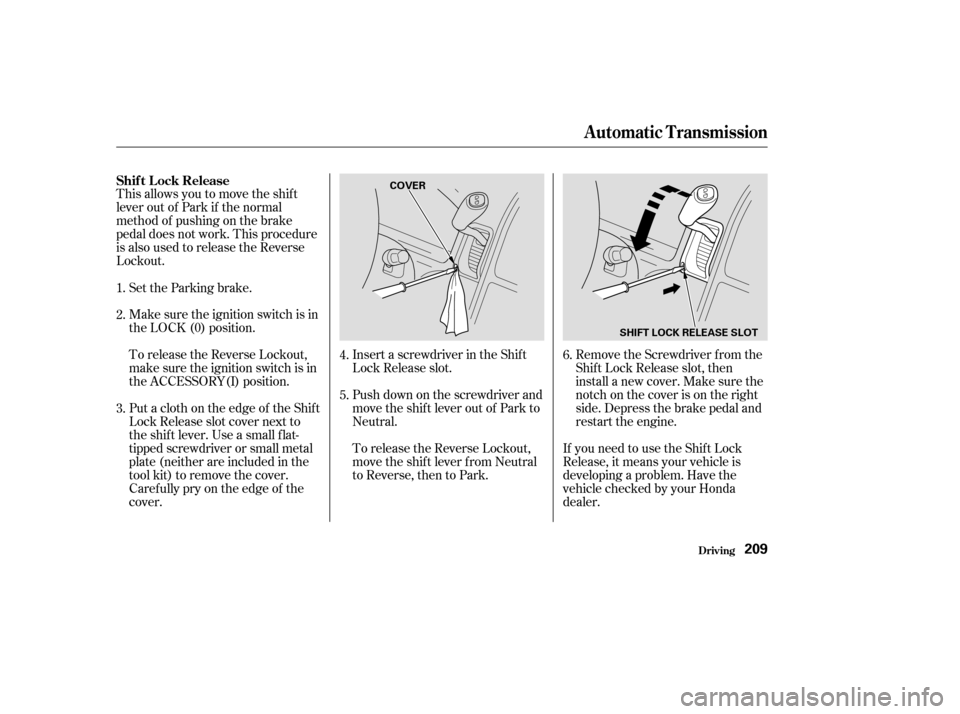
This allows you to move the shif t
lever out of Park if the normal
method of pushing on the brake
pedal does not work. This procedure
is also used to release the Reverse
Lockout.Put a cloth on the edge of the Shif t
Lock Release slot cover next to
theshiftlever.Useasmallflat-
tipped screwdriver or small metal
plate (neither are included in the
tool kit) to remove the cover.
Caref ully pry on the edge of the
cover. To release the Reverse Lockout,
make sure the ignition switch is in
the ACCESSORY(I) position. Make sure the ignition switch is in
the LOCK (0) position. Set the Parking brake. Insert a screwdriver in the Shif t
Lock Release slot.
Push down on the screwdriver and
move the shift lever out of Park to
Neutral.
To release the Reverse Lockout,
move the shift lever from Neutral
to Reverse, then to Park.Remove the Screwdriver f rom the
Shif t Lock Release slot, then
install a new cover. Make sure the
notchonthecoverisontheright
side. Depress the brake pedal and
restart the engine.
If you need to use the Shif t Lock
Release, it means your vehicle is
developing a problem. Have the
vehicle checked by your Honda
dealer.
1.
2.
3.
4.
5.
6.
Shif t L ock Release
Automatic Transmission
Driving209
COVER
SHIFT LOCK RELEASE SLOT
Page 228 of 374

When preparing to tow your CR-V,
make sure the transmission is
f illed to the correct level (see page). Do not overf ill.
Leave the key in the ignition
switch and the ignition switch in
ACCESSORY (I) so the steering
wheel does not lock. Make sure
the radio and any items plugged
into the accessory power sockets
are turned of f so you do not run
down the battery. Shif t the transmission to Neutral. Release the parking brake.
After attaching the tow bar to your
motorhome, do the following to
prepare your CR-V f or ‘‘f lat towing’’: When purchasing a tow bar, make
sure you select a reputable
manuf acturer and installer. Follow
the manufacturer’s attachment
instructions caref ully. Your CR-V can be towed behind a
motorhome at legal highway speeds
up to 65 mph(100 km/h). Do not
exceed 65 mph(100km/h).
Otherwise, severe transmission
damage will occur. To avoid damage
to the 4WD system, it must be towed
with all f our wheels on the ground
(f lat towing). When preparing to tow your CR-V,
make sure the transmission is f ull of
fluid (see page ). Maintaining
the correct level is very important.
Do not overf ill. Do the f ollowing
Follow the procedure exactly.
Otherwise, severe automatic
transmission damage will occur.
261
260
every day immediately bef ore you begin
towing.
5-speed Manual T ransmission A ut omat ic T ransmission
Towing Your Vehicle Behind a Motorhome
Driving224
Page 229 of 374

Start the engine.
Press on the brake pedal. Shif t the
lever through all the positions (P,
R, N, D, 2, 1)
ShifttoD,thentoN.Letthe
engine run f or three minutes, then
turn of f the engine.
Release the parking brake.
Leave the ignition switch in
ACCESSORY (I) so the steering
wheel does not lock. Make sure
the radio and any items plugged
into the accessory power sockets
are turned of f so you do not run
down the battery.If you tow more than 8 hours in one
day, you should repeat the above
procedure at least every 8 hours.
(when you stop f or f uel, etc.)
If youtowaCR-Vwithanautomatic
transmission, the transmission f luid
must be changed every two years or
30,000 miles (48,000 km), whichever
comes f irst.Ext ended T owing
Towing Your Vehicle Behind a Motorhome
Driving225
Failure to f ollow the above instructions
exactly will result in severe automatic
transmission damage. If you cannot
shif t the transmission or start the
engine, your vehicle must be
transported on a f lat-bed truck or
trailer. The steering system can be damaged if
the steering wheel is locked. Leave the
ignition switch in Accessory (I), and
make sure the steering wheel turns
f reely bef ore you begin towing.Severe automatic transmission damage
will occur if the vehicle is shif ted f rom
reverse to neutral and then towed with
the drive wheels on the ground.
Page 257 of 374
CONT INUED
Thecoolingsystemshouldbe
completely drained and ref illed with
new coolant according to the time
and distance recommendations in
the maintenance schedule. Only use
Honda All Season Antif reeze/
Coolant Type 2.
Draining the coolant requires access
to the underside of the vehicle.
Unless you have the tools and
knowledge, you should have this
maintenance done by a skilled
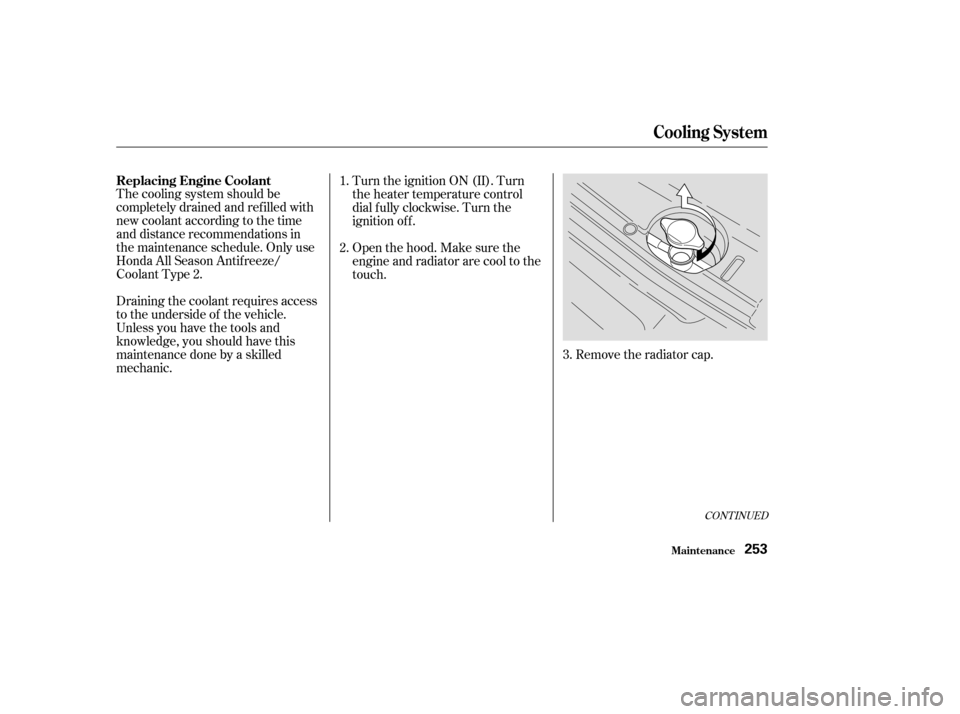
mechanic.Remove the radiator cap.
Turn the ignition ON (II). Turn
the heater temperature control
dial f ully clockwise. Turn the
ignition of f .
Openthehood.Makesurethe
engine and radiator are cool to the
touch.
1.
2.
3.
Replacing Engine Coolant
Cooling Syst em
Maint enance253
Page 271 of 374
CONT INUED
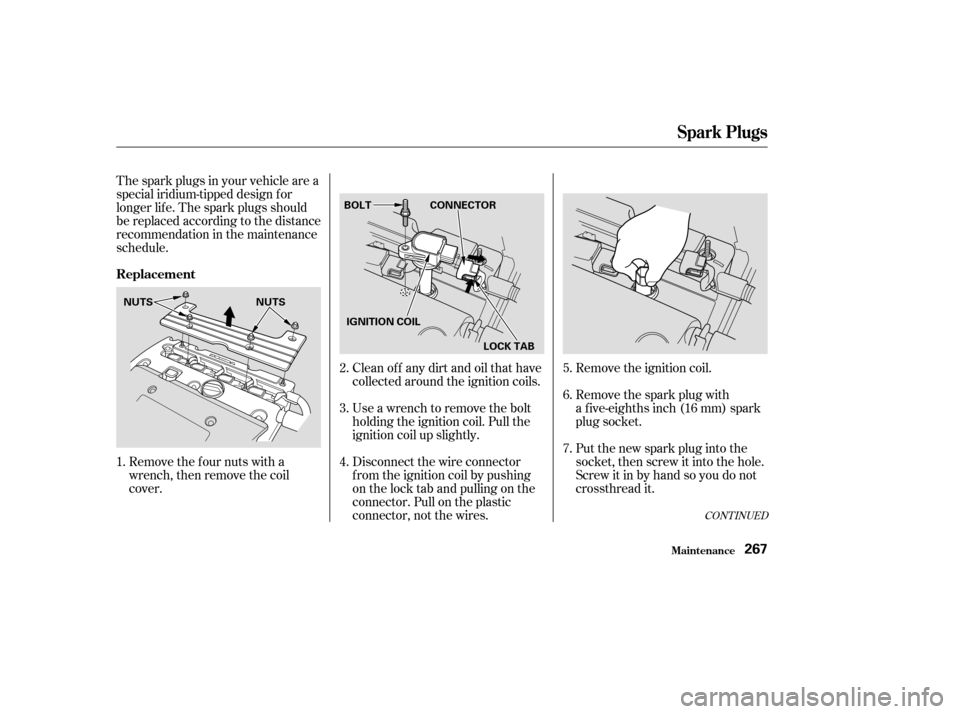
Clean off any dirt and oil that have
collected around the ignition coils.
Use a wrench to remove the bolt
holding the ignition coil. Pull the
ignition coil up slightly.
Disconnect the wire connector
f rom the ignition coil by pushing
on the lock tab and pulling on the
connector. Pull on the plastic
connector, not the wires.Remove the ignition coil.
Remove the spark plug with
a f ive-eighths inch (16 mm) spark
plug socket.
Put the new spark plug into the
socket, then screw it into the hole.
Screw it in by hand so you do not
crossthread it.
Remove the f our nuts with a
wrench, then remove the coil
cover.
The spark plugs in your vehicle are a
special iridium-tipped design f or
longer lif e. The spark plugs should
be replaced according to the distance
recommendation in the maintenance
schedule.
1.
6.
7. 5.
2.
4. 3.
Maint enance
Spark Plugs
Replacement
267
NUTS NUTSBOLT
IGNITION COIL CONNECTOR
LOCK TAB
Page 272 of 374
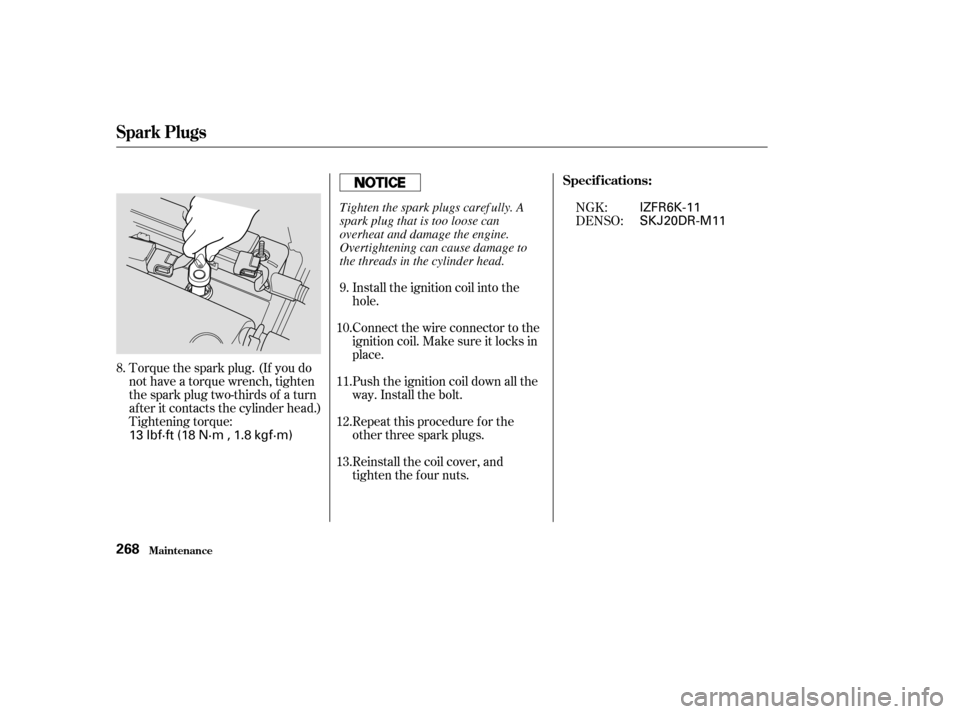
Torque the spark plug. (If you do
not have a torque wrench, tighten
the spark plug two-thirds of a turn
af ter it contacts the cylinder head.)
Tightening torque:Connect the wire connector to the
ignition coil. Make sure it locks in
place.
Push the ignition coil down all the
way. Install the bolt.
Repeat this procedure f or the
other three spark plugs.
Reinstall the coil cover, and
tighten the f our nuts. Install the ignition coil into the
hole.NGK:
DENSO:
8. 9.
10.
11.
12.
13.
Maint enance
Spark Plugs
Specif ications:
268
13 lbf·ft (18 N·m , 1.8 kgf·m) SKJ20DR-M11 IZFR6K-11
Tighten the spark plugs caref ully. A
spark plug that is too loose can
overheat and damage the engine.
Overtightening can cause damage to
the threads in the cylinder head.
Page 312 of 374
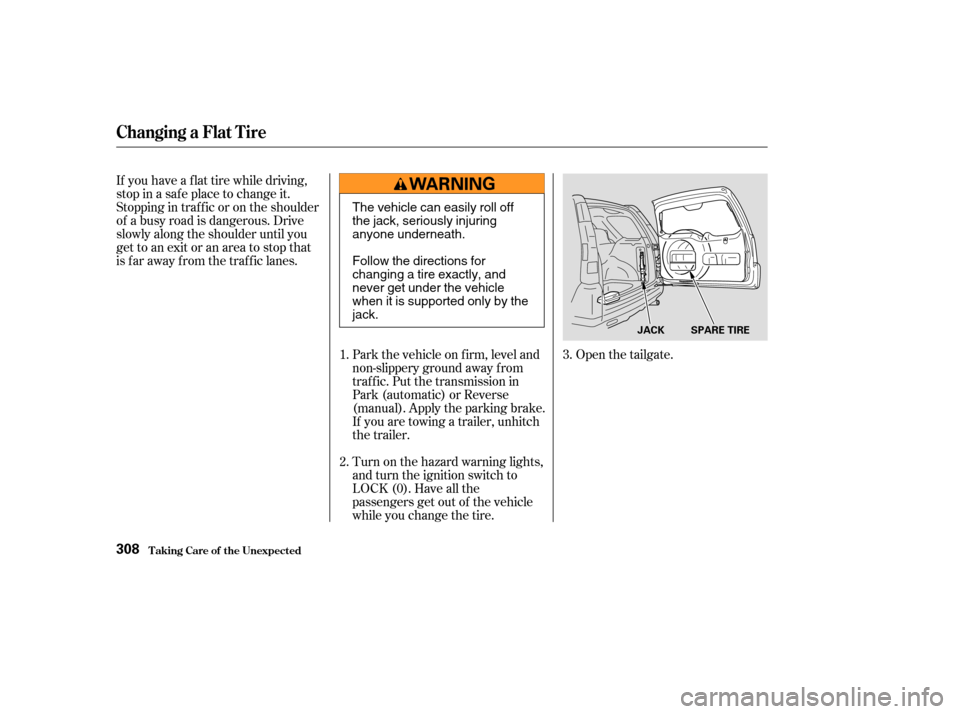
If you have a f lat tire while driving,
stop in a saf e place to change it.
Stopping in traf f ic or on the shoulder
of a busy road is dangerous. Drive
slowly along the shoulder until you
gettoanexitoranareatostopthat
is far away from the traffic lanes.Park the vehicle on f irm, level and
non-slippery ground away f rom
traffic. Put the transmission in
Park (automatic) or Reverse
(manual). Apply the parking brake.
Turn on the hazard warning lights,
and turn the ignition switch to
LOCK (0). Have all the
passengers get out of the vehicle
while you change the tire. If you are towing a trailer, unhitch
the trailer.Open the tailgate.
1.
2. 3.
T aking Care of t he Unexpect ed
Changing a Flat T ire
308
JACK SPARE TIRE
The vehicle can easily roll off
the jack, seriously injuring
anyone underneath.
Follow the directions for
changing a tire exactly, and
never get under the vehicle
when it is supported only by the
jack.
Page 322 of 374

Diagnosing why your engine won’t
start f alls into two areas, depending
on what you hear when you turn the
key to START (III):You hear nothing, or almost
nothing. The engine’s starter
motor does not operate at all, or
operates very slowly.
You can hear the starter motor
operating normally, or the starter
motor sounds like it is spinning
f aster than normal, but the engine
does not start up and run. Turn the ignition switch to ON (II).
Turn on the headlights and check
their brightness. If the headlights
are very dim or don’t light at all,
the battery is discharged. See
on page .
When you turn the ignition switch to
START (III), you do not hear the
normal noise of the engine trying to
start. You may hear a clicking sound
or series of clicks, or nothing at all.
Check these things:
Turn the ignition switch to START
(III). If the headlights do not dim,
check the condition of the f uses. If
the f uses are OK, there is proba-
bly something wrong with the
electrical circuit f or the ignition
switch or starter motor. You will
need a qualif ied technician to
determine the problem. (See on page .)
Check the transmission interlock.
If you have a manual transmission,
the clutch pedal must be pushed
all the way to the f loor or the
starter will not operate. With an
automatic transmission, it must be
in Park or Neutral. 320
337
Nothing Happens or the Starter
Motor Operates Very Slowly
Jump Starting
Emergency T owing
If Your Engine Won’t Start
T aking Care of t he Unexpect ed318
Page 323 of 374

If the headlights dim noticeably or
go out when you try to start the
engine, either the battery is dis-
charged or the connections are
corroded. Check the condition of the
battery and terminal connections
(see page ). You can then try
jump starting the vehicle from a
booster battery (see page ).In this case, the starter motor’s
speed sounds normal, or even f aster
than normal, when you turn the
ignition switch to START (III), but
the engine does not run.
Are you using the proper starting
procedure? Ref er to on page . There may be an electrical
problem, such as no power to the
f uel pump. Check all the f uses
(see page ).
If youfindnothingwrong,youwill
need a qualif ied technician to f ind
the problem. See on page .
Your vehicle has the Immobilizer
System. You should use a
properly-coded master or valet key
to start the engine (see page ).
A key that is not properly coded
will cause the immobilizer system
indicator in the dash panel to blink
rapidly. Do you have f uel? Turn the
ignition switch to ON (II) for a
minute and watch the f uel gauge.
The low f uel level warning light
may not be working, so you were
not reminded to f ill the tank.
269
320
200 331
337
85
T he Starter Operates Normally
Starting the
Engine Emergency
Towing
If Your Engine Won’t Start
T aking Care of t he Unexpect ed319
Page 329 of 374
Start the engine and watch the oil
pressure indicator. If the light
does not go out within ten seconds,
turn of f the engine. There is a
mechanical problem that needs to
be repaired bef ore you can
continue driving. (Seeon page .)
If necessary, add oil to bring the
level back to the full mark on the
dipstick (see page ).
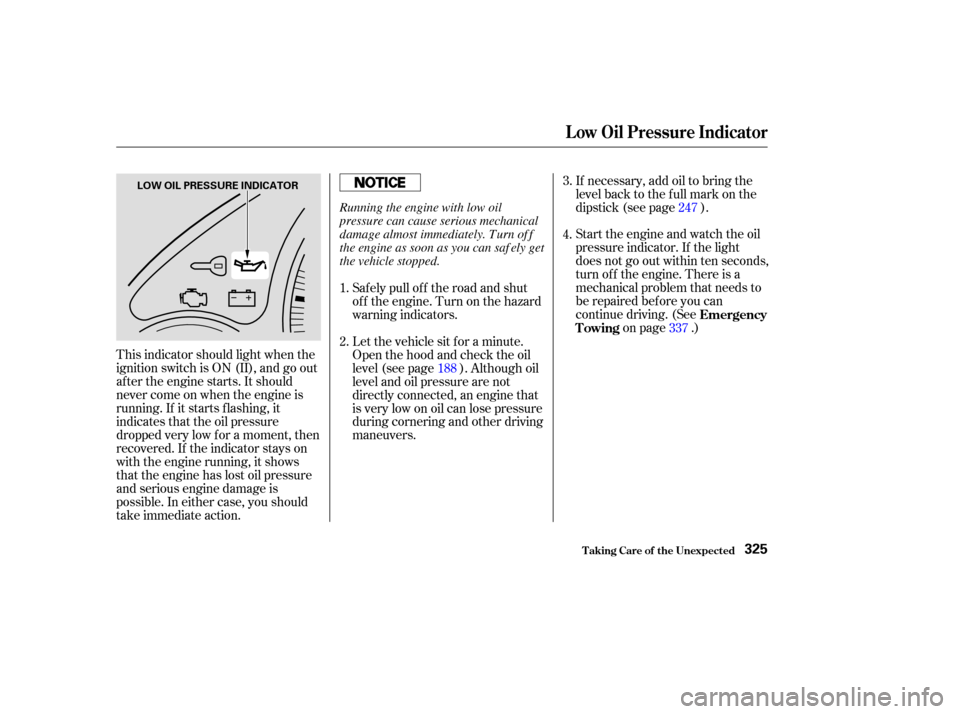
This indicator should light when the
ignition switch is ON (II), and go out
af ter the engine starts. It should
never come on when the engine is
running. If it starts f lashing, it
indicates that the oil pressure
dropped very low f or a moment, then
recovered. If the indicator stays on
with the engine running, it shows
that the engine has lost oil pressure
and serious engine damage is
possible. In either case, you should
take immediate action. Saf ely pull of f the road and shut
of f the engine. Turn on the hazard
warning indicators.
Let the vehicle sit f or a minute.
Open the hood and check the oil
level (see page ). Although oil
levelandoilpressurearenot
directly connected, an engine that
is very low on oil can lose pressure
during cornering and other driving
maneuvers.
1.
2.
4.
3.
188 247
337 Emergency
Towing
L ow Oil Pressure Indicator
T aking Care of t he Unexpect ed325
LOW OIL PRESSURE INDICATOR
Running the engine with low oil
pressure can cause serious mechanical
damage almost immediately. Turn of f
the engine as soon as you can saf ely get
the vehicle stopped.