engine HONDA CR-Z 2013 1.G Owners Manual
[x] Cancel search | Manufacturer: HONDA, Model Year: 2013, Model line: CR-Z, Model: HONDA CR-Z 2013 1.GPages: 325, PDF Size: 11.73 MB
Page 295 of 325
294
uuIndicator, Coming On/BlinkinguIf the Malfunction Indicator Lamp Comes On or Blinks
Handling the Unexpected
If the Malfunction Indicator Lamp Comes On or
Blinks■Reasons for the indicator lamp to come on or blink
• Comes on when there is a problem with the engine emissions control
system, or the fuel fill cap is missing, or loose.
• Blinks when engine misfiring is detected.
■ What to do when the indicator lamp comes on
Avoid high speeds and immediately get your vehicle inspected at a dealer.
■ What to do when the indicator lamp blinks
Park the vehicle in a safe place with no flammable items and wait at least
ten minutes or more with the engine stopped until it cools.
■ The message appears on when:
An evaporative system leak is detected. This may be caused by the fuel fill cap being
loose or not being installed. ■ What to do when the message appears:
1. Stop the engine.
2. Check that the fuel fill cap is fully installed.
uIf not, loosen the cap, and then retighten it until it clicks at least once.
3. Drive for several days of normal driving.
uThe message should go off.
■ When the malfunction indic ator lamp comes on
Malfunction indicator lamp comes on if the system continues to detect a leak of gasoline vapor. If this happens, check the fuel fill cap using the procedures described
above.
■Tighten Fuel Cap Message
1If the Malfunction Indicator Lamp Comes On or Blinks
NOTICE
If you drive with the malfunction indicator lamp on,
the emissions control system and the engine could be damaged.
If the malfunction indicator lamp blinks again when
restarting the engine, drive to the nearest dealer at
31 mph (50 km/h) or less. Have your vehicle
inspected.
Main MenuTable of Contents
Page 296 of 325
295
uuIndicator, Coming On/BlinkinguIf the Brake System Indicator (Red) Comes On
Handling the Unexpected
If the Brake System Indicator (Red) Comes On■Reasons for the indicator to come on
• The brake fluid is low.
• There is a malfunction in the brake system.
■ What to do when the indicator comes on while driving
Press the brake pedal lightly to check pedal pressure. • If normal, check the brake fluid level the next time you stop.
• If abnormal, take immediate action. If necessary, downshift the
transmission to slow the vehic le using engine braking.
If the EPS System Indicator Comes On
■Reasons for the indicator to come on
• Comes on when there is a problem with EPS system.
• If you depress the accelerator pedal repeatedly to increase the engine
speed while the engine is idling, the indicator comes on, and
sometimes the steering wheel becomes harder to operate.
■ What to do when the indicator comes on
Stop the vehicle in a safe place and restart the engine.
If the indicator comes on and stays on, immediately have your vehicle
inspected by a dealer.
1If the Brake System Indicator (Red) Comes On
Have your vehicle repaired immediately.
It is dangerous to drive with low brake fluid. If there
is no resistance from the brake pedal, stop immediately in a safe place. If necessary downshift
the gears.
If the brake system indicator and ABS indicator come
on simultaneously, the electronic brake distribution
system is not working. This can result in vehicle
instability under sudden braking.
Have your vehicle inspected by a dealer immediately.U.S.
Canada (Red)
1If the EPS System Indicator Comes On
NOTICE
If you repeatedly turn the steering wheel at an
extremely low speed, or hold the steering wheel on
the full left or right position for a while, the system
heats up. The system goes into a protective mode,
and limits its performance. The steering wheel
becomes harder and harder to operate. Once the
system cools down, EPS is restored. Repeated operation under these conditions can eventually damage the system.
Main MenuTable of Contents
Page 298 of 325
297
Continued
Handling the Unexpected
Fuses
Fuse Locations
If any electrical devices are not working,
turn the ignition switch to LOCK
(0
and
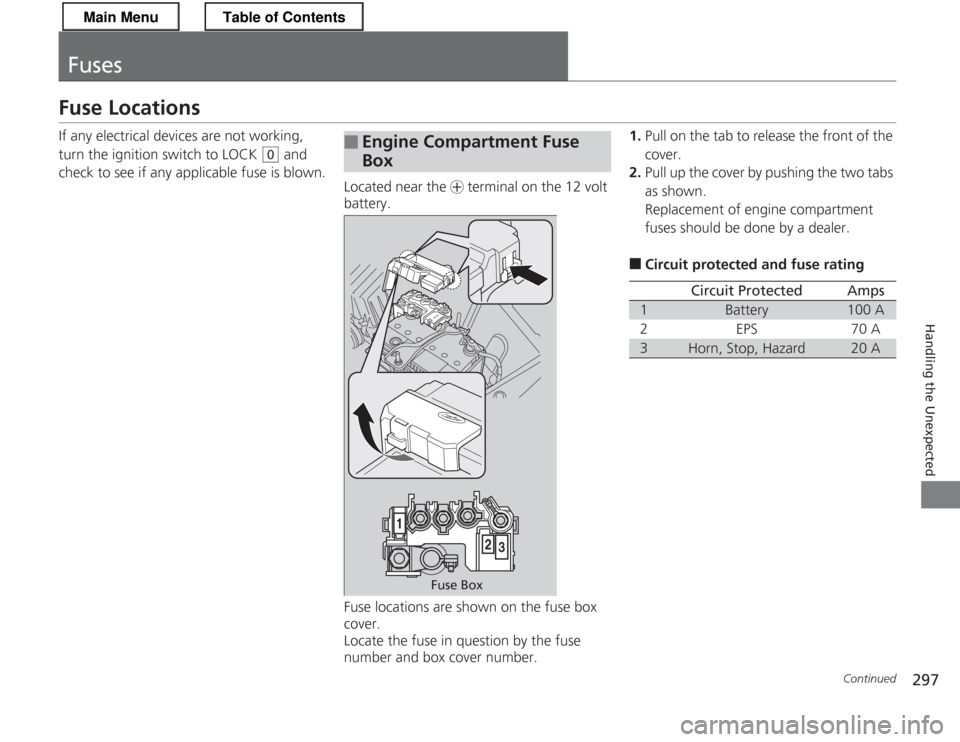
check to see if any applicable fuse is blown. Located near the + terminal on the 12 volt
battery.
Fuse locations are shown on the fuse box
cover.
Locate the fuse in question by the fuse
number and box cover number.■Engine Compartment Fuse Box
Fuse Box 1.
Pull on the tab to release the front of the
cover.
2. Pull up the cover by pushing the two tabs as shown.
Replacement of engine compartment
fuses should be done by a dealer.
■ Circuit protec ted and fuse rating
Circuit ProtectedAmps
1Battery100 A
2EPS70 A
3Horn, Stop, Hazard20 A
Main MenuTable of Contents
Page 301 of 325
300
uuFusesuInspecting and Changing Fuses
Handling the Unexpected
Inspecting and Changing Fuses1.Turn the ignition switch to LOCK
(0 . Turn
headlights and all accessories off.
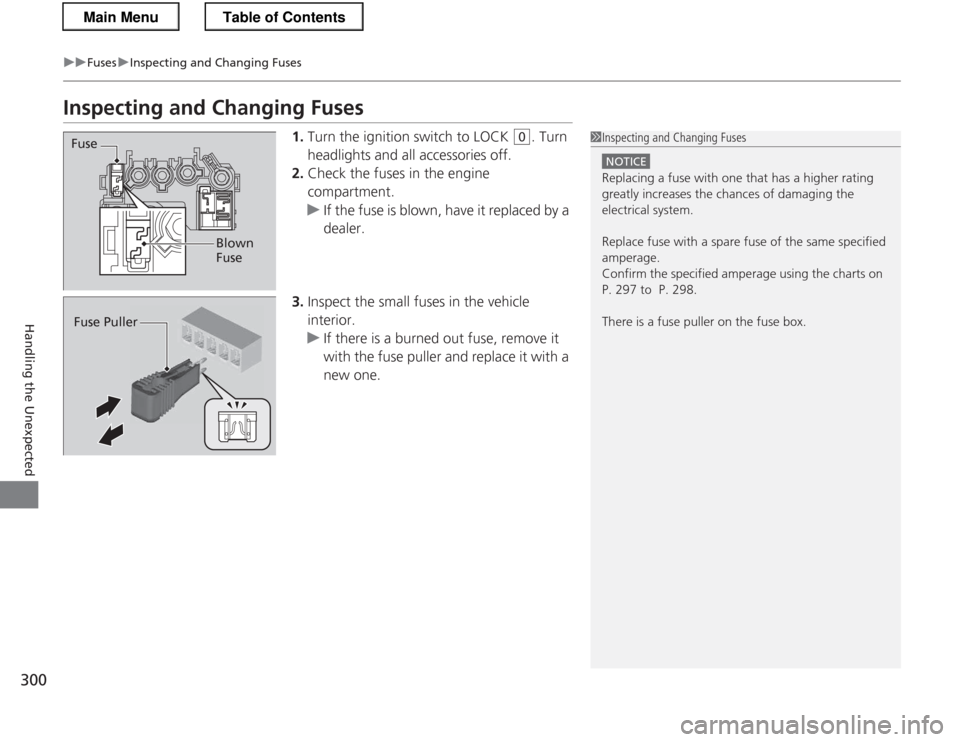
2. Check the fuses in the engine
compartment.
uIf the fuse is blown, have it replaced by a dealer.
3. Inspect the small fuses in the vehicle
interior.
uIf there is a burned out fuse, remove it with the fuse puller and replace it with a
new one.
1Inspecting and Changing Fuses
NOTICE
Replacing a fuse with one that has a higher rating
greatly increases the chances of damaging the
electrical system.
Replace fuse with a spare fuse of the same specified
amperage.
Confirm the specified amperage using the charts on
P. 297 to P. 298.
There is a fuse puller on the fuse box.
Fuse
Blown Fuse
Fuse Puller
Main MenuTable of Contents
Page 306 of 325

305
Information
This chapter includes your vehicle's specifications, locations of identification numbers, and other
information re quired by regulation.
Specifications.................................... 306
Identification Numbers Vehicle Identification Number (VIN) .. 308
Engine Number and Transmission
Number.......... ............................ 308
Devices that Emit Radio Waves ....... 309
Reporting Safety Defects ................. 310Emissions Testing
Testing of Readiness Codes.............. 311
Warranty Coverages ........................ 313
Authorized Manuals ......................... 315
Customer Service Information ......... 316
Main Menu
Page 307 of 325
306
Information
Specifications
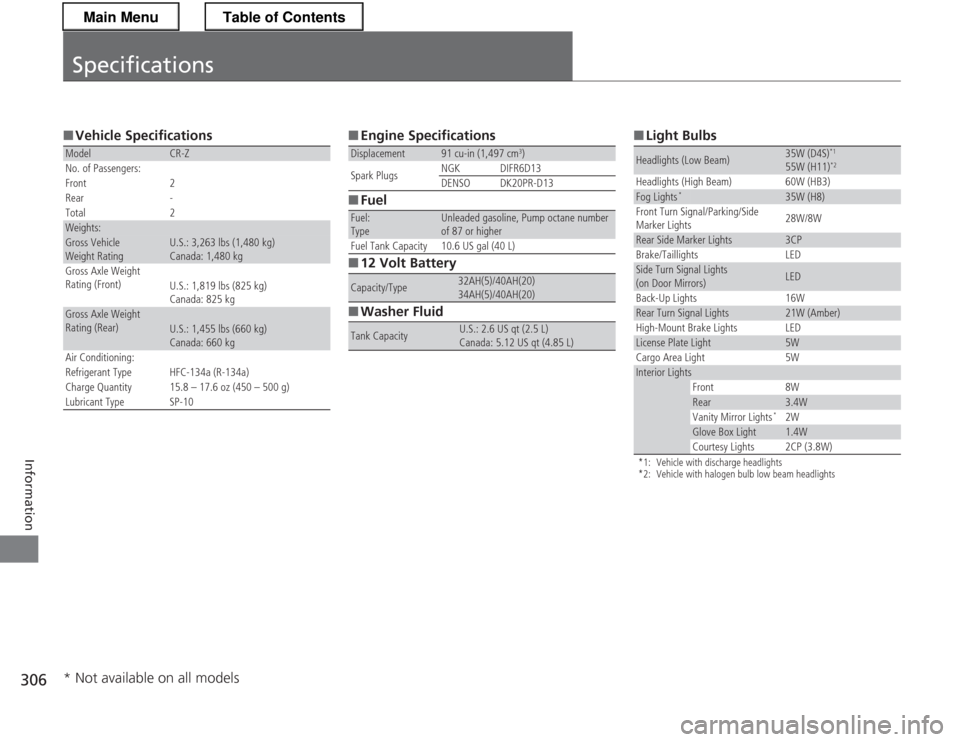
■Vehicle Specifications
ModelCR-Z
No. of Passengers:
Front 2
Rear -
Total 2
Weights:
Gross Vehicle
Weight Rating U.S.: 3,263 lbs (1,480 kg)
Canada: 1,480 kg
Gross Axle Weight
Rating (Front)
U.S.: 1,819 lbs (825 kg)
Canada: 825 kg
Gross Axle Weight
Rating (Rear)
U.S.: 1,455 lbs (660 kg)
Canada: 660 kg
Air Conditioning:
Refrigerant Type HFC-134a (R-134a)
Charge Quantity 15.8 – 17.6 oz (450 – 500 g)
Lubricant Type SP-10
■Engine Specifications
■Fuel
■12 Volt Battery
■Washer Fluid
Displacement91 cu-in (1,497 cm 3
)
Spark Plugs NGK DIFR6D13
DENSO DK20PR-D13
Fuel: TypeUnleaded gasoline, Pump octane number
of 87 or higher
Fuel Tank Capacity 10.6 US gal (40 L)
Capacity/Type32AH(5)/40AH(20)
34AH(5)/40AH(20)
Tank CapacityU.S.: 2.6 US qt (2.5 L)
Canada: 5.12 US qt (4.85 L)
■Light Bulbs
*1: Vehicle with discharge headlights
*2: Vehicle with halogen bulb low beam headlights
Headlights (Low Beam)35W (D4S) *1
55W (H11) *2
Headlights (High Beam) 60W (HB3)
Fog Lights *35W (H8)
Front Turn Signal/Parking/Side
Marker Lights 28W/8W
Rear Side Marker Lights3CP
Brake/Taillights LED
Side Turn Signal Lights
(on Door Mirrors)LED
Back-Up Lights 16W
Rear Turn Signal Lights21W (Amber)
High-Mount Brake Lights LED
License Plate Light5W
Cargo Area Light 5W
Interior Lights
Front 8W
Rear3.4W
Vanity Mirror Lights *
2W
Glove Box Light1.4W
Courtesy Lights 2CP (3.8W)
* Not available on all models
Main MenuTable of Contents
Page 308 of 325
307
uuSpecificationsu
Information
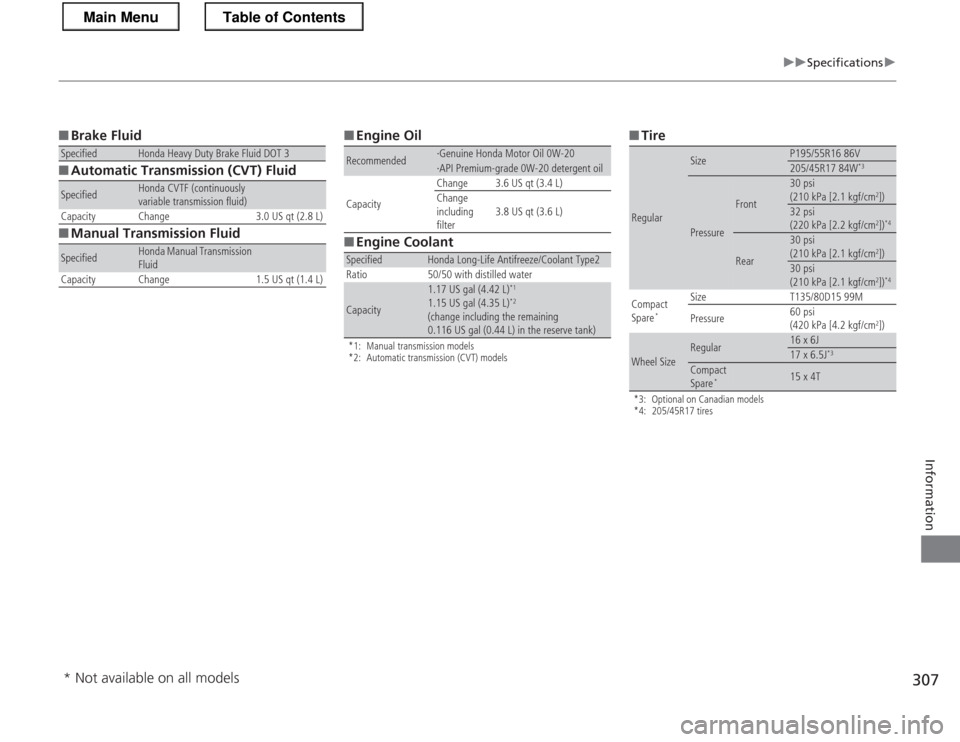
■Brake Fluid
■Automatic Transmission (CVT) Fluid
■Manual Transmission Fluid
SpecifiedHonda Heavy Duty Brake Fluid DOT 3
SpecifiedHonda CVTF (continuously
variable transmission fluid)
Capacity Change 3.0 US qt (2.8 L)
SpecifiedHonda Manual Transmission Fluid
Capacity Change 1.5 US qt (1.4 L)
■Engine Oil
■Engine Coolant
*1: Manual transmission models
*2: Automatic transmission (CVT) models
Recommended
Page 309 of 325

308
Information
Identification Numbers
Vehicle Identification Number (VIN)
Your vehicle has a 17-digit vehicle identification number (VIN) used to register your
vehicle for warranty purposes, and for licensing and insuring your vehicle. See the
image below for the VIN locations.
Engine Number and Transmission Number
See the image below for the locations of your vehicle's engine number and transmission number.
Vehicle Identification Number
Engine Number
Certification Label/
Vehicle Identification Number
Manual Transmission
Number
Automatic Transmission
(CVT) Number IMA Motor Number
Vehicle Identification Number
Main MenuTable of Contents
Page 312 of 325
311
Continued
Information
Emissions Testing
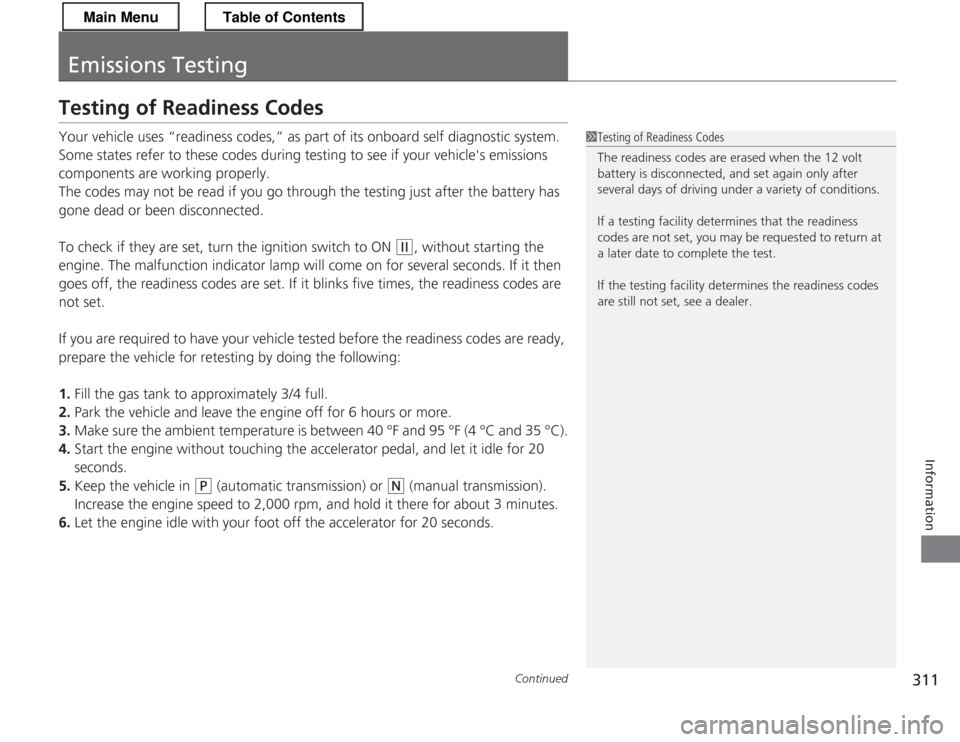
Testing of Readiness Codes
Your vehicle uses “readiness codes,” as part of its onboard self diagnostic system.
Some states refer to these codes during testing to see if your vehicle's emissions
components are working properly.
The codes may not be read if you go through the testing just after the battery has
gone dead or been disconnected.
To check if they are set, turn the ignition switch to ON
(w
, without starting the
engine. The malfunction indicator lamp will come on for several seconds. If it then
goes off, the readiness codes are set. If it blinks five times, the readiness codes are not set.
If you are required to have your vehicle tested before the readiness codes are ready,
prepare the vehicle for retesting by doing the following:
1. Fill the gas tank to approximately 3/4 full.
2. Park the vehicle and leave the engine off for 6 hours or more.
3. Make sure the ambient temperature is between 40 °F and 95 °F (4 °C and 35 °C).
4. Start the engine without touching the accelerator pedal, and let it idle for 20 seconds.
5. Keep the vehicle in
(P (automatic transmission) or (N (manual transmission).
Increase the engine speed to 2,000 rpm, and hold it there for about 3 minutes.
6. Let the engine idle with your foot off the accelerator for 20 seconds.
1Testing of Readiness Codes
The readiness codes are erased when the 12 volt
battery is disconnected, and set again only after
several days of driving under a variety of conditions.
If a testing facility dete rmines that the readiness
codes are not set, you may be requested to return at
a later date to complete the test.
If the testing faci lity determines the readiness codes
are still not set, see a dealer.
Main MenuTable of Contents
Page 313 of 325
312
uuEmissions TestinguTesting of Readiness Codes
Information
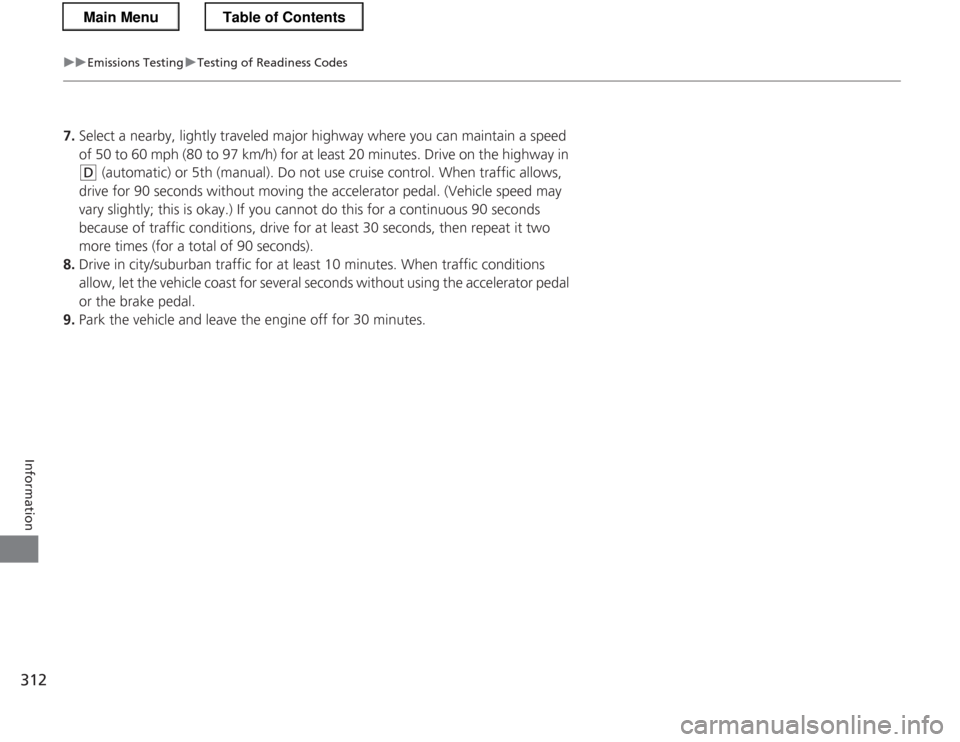
7.Select a nearby, lightly traveled major highway where you can maintain a speed
of 50 to 60 mph (80 to 97 km/h) for at least 20 minutes. Drive on the highway in
(D (automatic) or 5th (manual). Do not use cruise control. When traffic allows,
drive for 90 seconds without moving the accelerator pedal. (Vehicle speed may
vary slightly; this is okay.) If you cannot do this for a continuous 90 seconds
because of traffic conditions, drive for at least 30 seconds, then repeat it two
more times (for a total of 90 seconds).
8. Drive in city/suburban traffic for at least 10 minutes. When traffic conditions
allow, let the vehicle coast for several seconds without using the accelerator pedal
or the brake pedal.
9. Park the vehicle and leave the engine off for 30 minutes.
Main MenuTable of Contents