display HONDA CR-Z 2013 1.G Workshop Manual
[x] Cancel search | Manufacturer: HONDA, Model Year: 2013, Model line: CR-Z, Model: HONDA CR-Z 2013 1.GPages: 325, PDF Size: 11.73 MB
Page 166 of 325
Continued165
uuBluetooth® HandsFreeLink ®uHFL Menus
Features
Press the button to answer the call, or the button to hang up. When there
is an incoming call, a call notification (if activated) sounds and a message appears on the display.
You can transfer a call from HFL to your phone, or from your phone to HFL. Press the
button and say “Transfer.”
To mute or unmute your voice during a call, press and release the button and say “Mute.”
■Receiving a Call
■Transferring a Call
■Muting a Call
1Receiving a Call
Call Waiting
Press the button to put the current call on hold
to answer the incoming call.
Press the button again to return to the current call.
Ignore the incoming call if you do not want to answer
it.
Press the button if you want to hang up the
current call and answer the incoming call.
Main MenuTable of Contents
Page 186 of 325
Continued185
uuWhen DrivinguShifting
Driving
Use the paddle shifters to change between 1st and 7th speeds without removing
your hands from the steering wheel. The transmission switches to the 7-speed
manual shift mode when you pull a paddle shifter while driving. This mode is useful
when engine braking is needed.
You can cancel this mode by pressing any of the three driving mode buttons, or
pulling the
(+ paddle shifter for a few seconds.
■ When the driving mode is in ECON or NORMAL
The shift mode goes into the 7-speed manual shift mode temporarily, and the
number is displayed in the shift indicator.
The 7-speed manual shift mode is canceled automatically if you drive at constant
speed or accelerate, and the number in the shift indicator goes off.
The 7-speed manual shift mode is especially useful when reducing the vehicle speed
temporarily before making a turn. ■ When the driving mo de is in SPORT
The shift mode goes into the 7-speed manual shift mode. The M indicator and the
speed number are displayed in the shift indicat or. As the vehicle speed slows down,
the transmission automatically shifts down accordingly. When the vehicle comes to
a stop, it automatically shifts down into 1st.
If the vehicle speed increases and the engine speed reaches near the tachometer’s
red zone, the transmission automatically shifts up.
■7-Speed Manual Shift Mode17-Speed Manual Shift Mode
To improve fuel economy, the transmission may shift
up to a higher speed than the seventh under certain circumstances. In this case, the number in the shift
indicator remains as 7.
In the 7-speed manual shift mode, the transmission
shifts up or down by operating either paddle shifter
under the following conditions:
Shift Up: The engine speed reaches the lowest
threshold of the higher speed position.
Shift Down: The engine speed reaches the highest
threshold of the lower speed position.
When the engine speed reaches near the
tachometer’s red zone, the transmission shifts up
automatically.
When the engine speed reaches the lowest threshold
of the selected speed position, the transmission shifts down automatically.
Operating the paddle shifters on slippery surfaces
may cause the tires to lock up. In this case, the 7-
speed manual shift mode is canceled and goes back
to the normal D driving mode.
Main MenuTable of Contents
Page 188 of 325
187
uuWhen DrivinguShifting
Driving
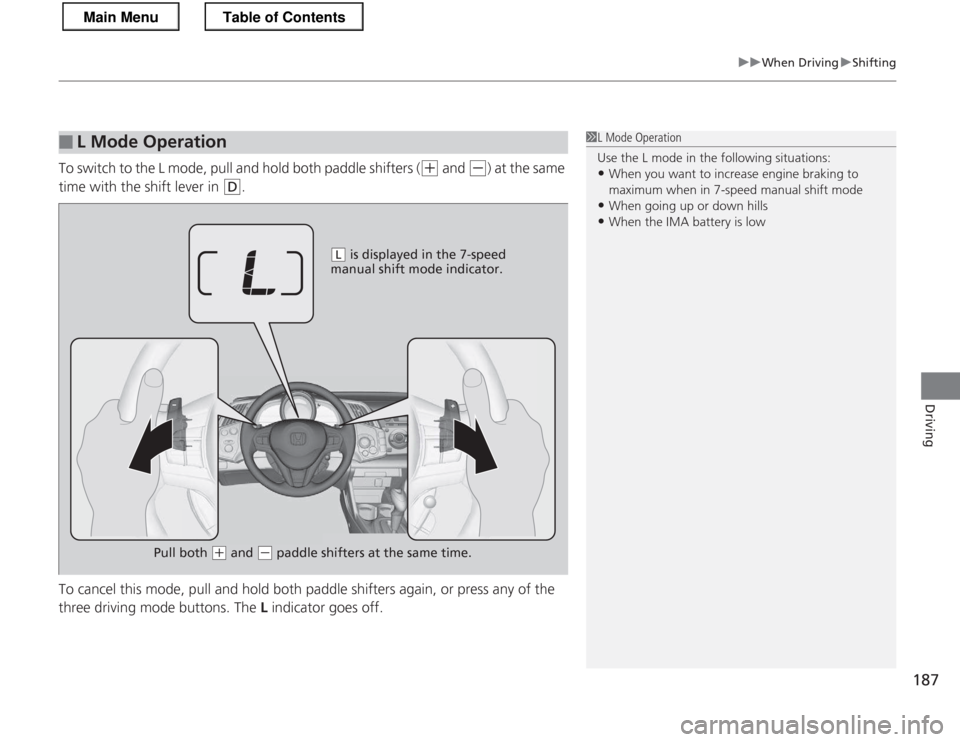
To switch to the L mode, pull and hold both paddle shifters ((+ and (- ) at the same
time with the shift lever in
(D .
To cancel this mode, pull and hold both paddle shifters again, or press any of the
three driving mode buttons. The L indicator goes off.
■L Mode Operation1L Mode Operation
Use the L mode in the following situations:
• When you want to increase engine braking to
maximum when in 7-speed manual shift mode
• When going up or down hills
• When the IMA battery is low
(L is displayed in the 7-speed
manual shift mode indicator.
Pull both
(+ and (- paddle shifters at the same time.
Main MenuTable of Contents
Page 193 of 325
uuWhen DrivinguAuto Idle Stop
192
Driving
The vehicle stops with the shift lever in (D and the brake pedal depressed.
■ Auto Idle Stop does not activate when:
• The low temperature indicator is on.
• The IMA battery charge is low.
• The bars of the ASST/CHRG indicators do not move when accelerating or
decelerating.
• The transmission fluid temperature is low.
• The vehicle comes to a stop again before the vehicle speed reaches 9 mph
(15 km/h) after the engine starts.
• Stopped on a steep incline.
• The shift lever is in a position other than
(D or (N .
• Airflow from the climate control system increases. (Except when in ECON mode)
uIf you have selected the fan speed manually:
The display shows more than five vertical bars.
• Shift mode is in the L mode.
• is on (the indicator is on).
■ Auto Idle Stop may not activate when:
• The climate control system is in use, and there is a significant difference between
the set temperature and the actual interior temperature. (Except when in ECON mode).
• When humidity in the interior is high.
• The vehicle is stopped by braking suddenly.
■Auto Idle Stop Activates When:1Auto Idle Stop Activates When:
The Auto Idle Stop may also activate when the brake
pedal is depressed, and the vehicle slows down to a
speed below 6 mph (10 km/h).
Main MenuTable of Contents
Page 196 of 325
Continued195
uuWhen DrivinguAuto Idle Stop
Driving
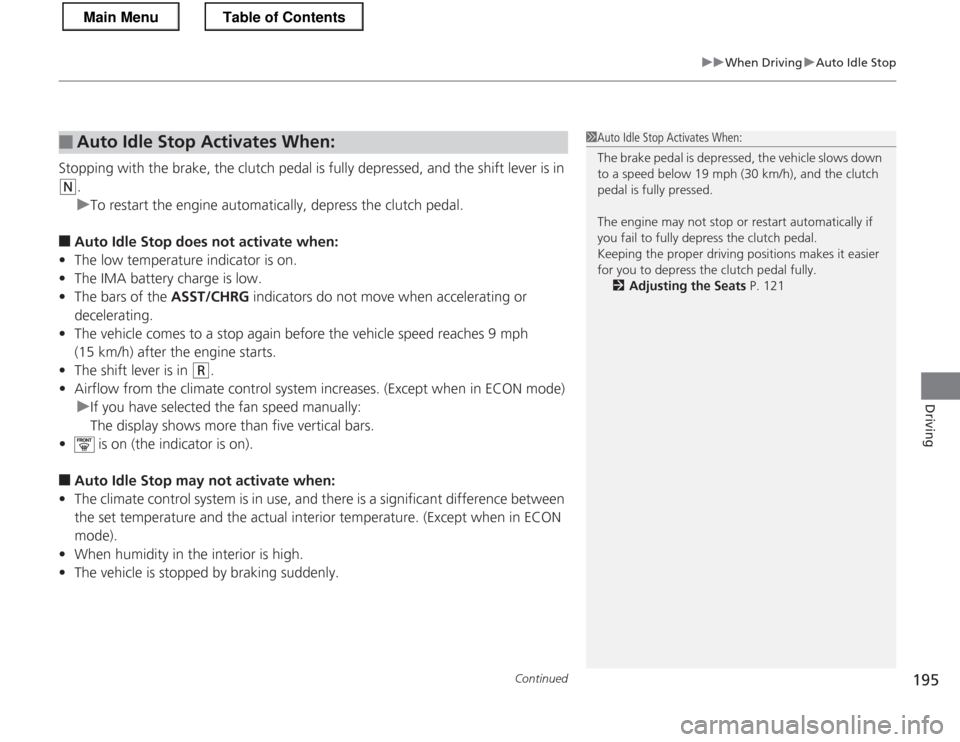
Stopping with the brake, the clutch pedal is fully depressed, and the shift lever is in
(N.
uTo restart the engine automatically, depress the clutch pedal.
■ Auto Idle Stop does not activate when:
• The low temperature indicator is on.
• The IMA battery charge is low.
• The bars of the ASST/CHRG indicators do not move when accelerating or
decelerating.
• The vehicle comes to a stop again before the vehicle speed reaches 9 mph
(15 km/h) after the engine starts.
• The shift lever is in
(R .
• Airflow from the climate control system increases. (Except when in ECON mode)
uIf you have selected the fan speed manually:
The display shows more than five vertical bars.
• is on (the indicator is on).
■ Auto Idle Stop may not activate when:
• The climate control system is in use, and there is a significant difference between
the set temperature and the actual interior temperature. (Except when in ECON
mode).
• When humidity in the interior is high.
• The vehicle is stopped by braking suddenly.
■Auto Idle Stop Activates When:1Auto Idle Stop Activates When:
The brake pedal is depressed, the vehicle slows down
to a speed below 19 mph (30 km/h), and the clutch
pedal is fully pressed.
The engine may not stop or restart automatically if
you fail to fully depress the clutch pedal.
Keeping the proper driving positions makes it easier
for you to depress the clutch pedal fully.
2 Adjusting the Seats P. 121
Main MenuTable of Contents
Page 198 of 325
197
uuWhen Drivingu3-Mode Drive System
Driving
3-Mode Drive System
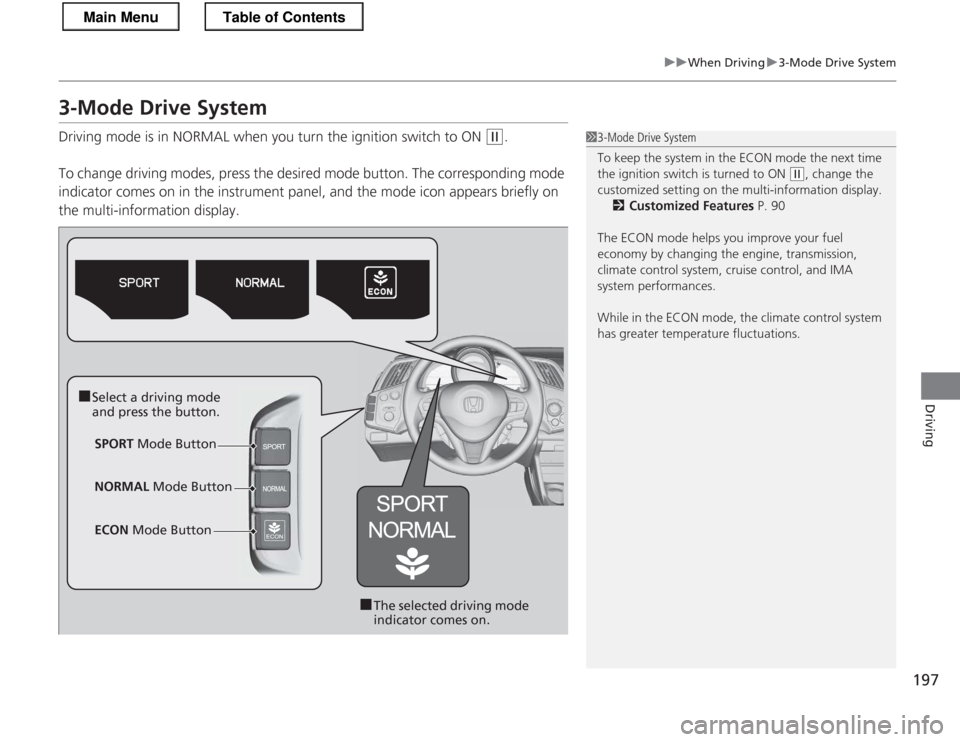
Driving mode is in NORMAL when you turn the ignition switch to ON
(w.
To change driving modes, press the de sired mode button. The corresponding mode
indicator comes on in the instrument panel, and the mode icon appears briefly on the multi-information display.13-Mode Drive System
To keep the system in the ECON mode the next time
the ignition switch is turned to ON
(w , change the
customized setting on the multi-information display.
2 Customized Features P. 90
The ECON mode helps you improve your fuel
economy by changing the engine, transmission,
climate control system, cruise control, and IMA
system performances.
While in the ECON mode, the climate control system
has greater temperature fluctuations.
■ Select a driving mode
and press the button.
SPORT Mode Button
■The selected driving mode
indicator comes on.
NORMAL
Mode Button
ECON Mode Button
Main MenuTable of Contents
Page 206 of 325
205
uuWhen DrivinguTPMS (Tire Pressure Monitoring System)
Driving
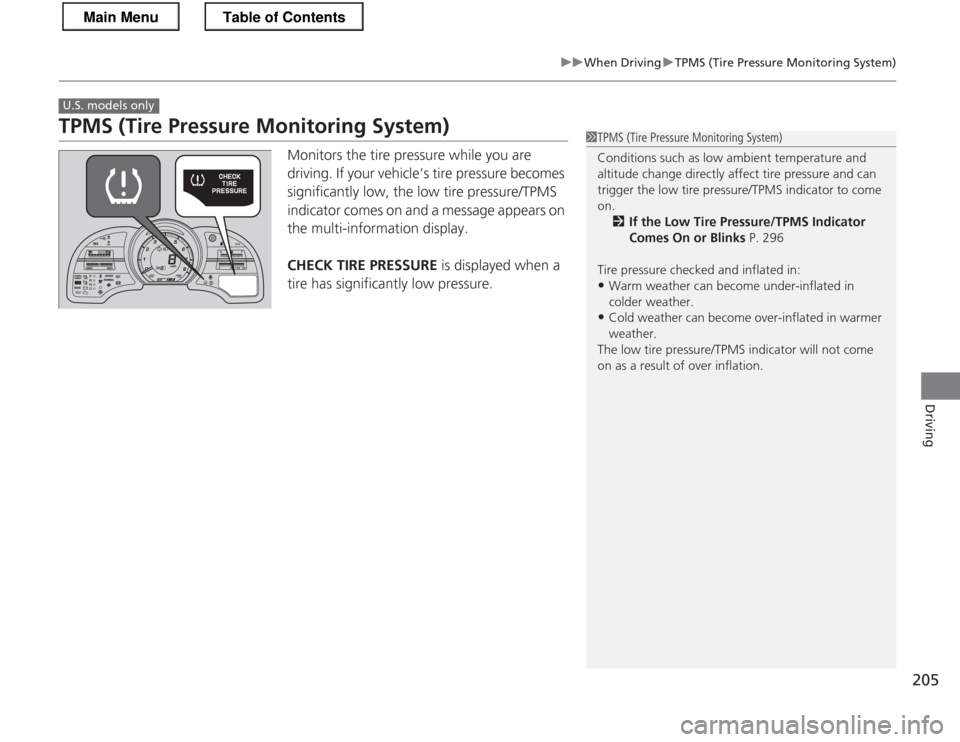
TPMS (Tire Pressure Monitoring System)Monitors the tire pressure while you are
driving. If your vehicle’s tire pressure becomes
significantly low, the low tire pressure/TPMS indicator comes on and a message appears on the multi-information display.
CHECK TIRE PRESSURE is displayed when a
tire has significantly low pressure.
U.S. models only
1TPMS (Tire Pressure Monitoring System)
Conditions such as low ambient temperature and
altitude change di rectly affect tire pressure and can
trigger the low tire pr essure/TPMS indicator to come
on. 2 If the Low Tire Pressure/TPMS Indicator
Comes On or Blinks P. 296
Tire pressure checked and inflated in: • Warm weather can become under-inflated in
colder weather.
• Cold weather can become over-inflated in warmer
weather.
The low tire pressure/TP MS indicator will not come
on as a result of over inflation.
READY
Main MenuTable of Contents
Page 209 of 325
208
Driving
Braking
Brake System
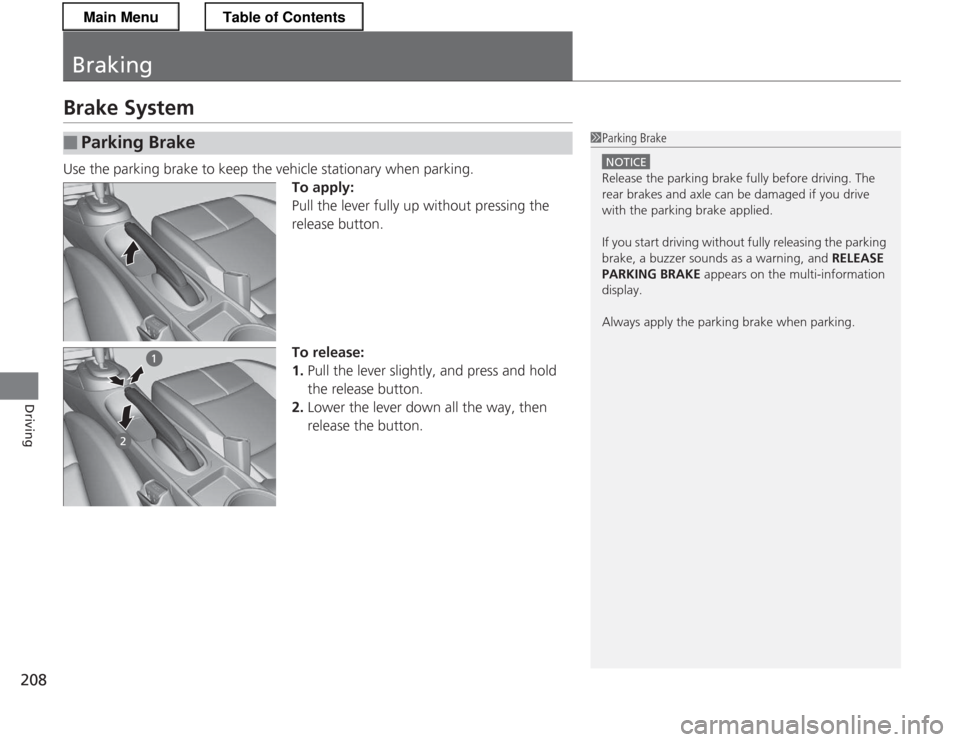
Use the parking brake to keep the vehicle stationary when parking.To apply:
Pull the lever fully up without pressing the release button.
To release: 1.Pull the lever slightly, and press and hold the release button.
2. Lower the lever down all the way, then release the button.
■Parking Brake1Parking Brake
NOTICE
Release the parking brake fully before driving. The
rear brakes and axle can be damaged if you drive
with the parking brake applied.
If you start driving without fully releasing the parking
brake, a buzzer sounds as a warning, and RELEASE
PARKING BRAKE appears on the multi-information
display.
Always apply the parking brake when parking.
Main MenuTable of Contents
Page 214 of 325
213
Driving
Multi-View Rear Camera
About Your Multi-View Rear Camera
For models with the navigation system, see the Navigation System Manual.
Models with navigation system1About Your Multi-View Rear Camera
The rear camera view is restricted. You cannot see
the corner ends of the bumper or what is underneath
the bumper. Its unique lens also makes objects
appear closer or farther than they actually are.
Visually confirm that it is safe to drive before backing
up. Certain conditions (such as weather, lighting, and
high temperatures) may also restrict the rear view. Do
not rely in the rearview display which does not give you all information about conditions at the back of
your vehicle.
If the camera lens is covered with dirt or moisture,
use a soft, moist cloth to keep the lens clean and free of debris.
Main MenuTable of Contents
Page 215 of 325
214
Driving
Rearview Camera
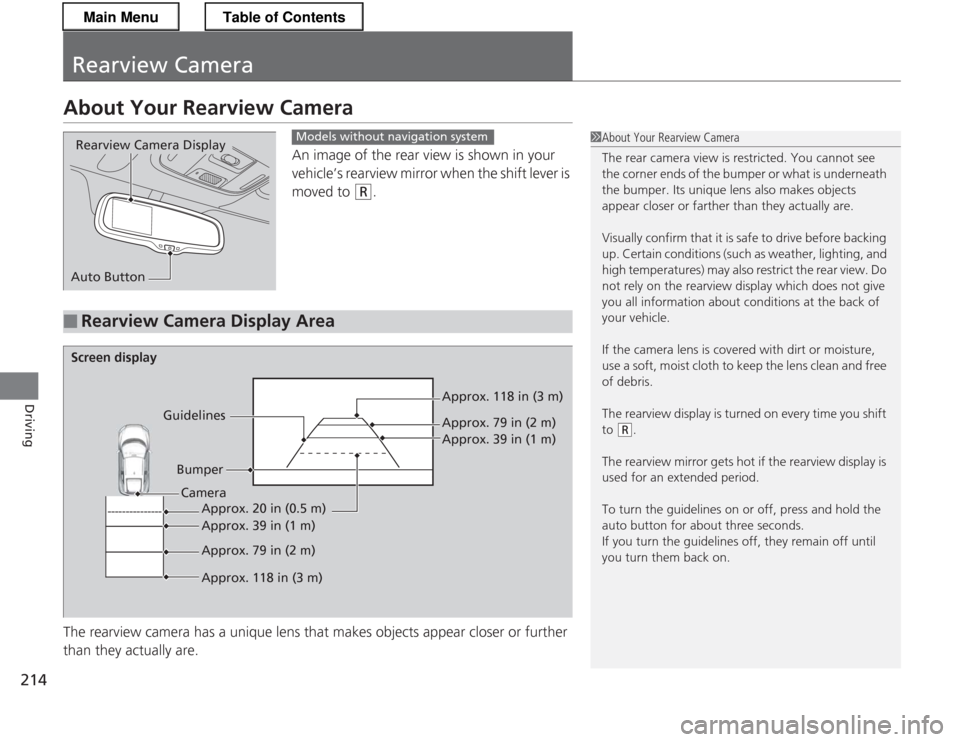
About Your Rearview CameraAn image of the rear view is shown in your
vehicle’s rearview mirror when the shift lever is moved to
(R.
The rearview camera has a unique lens that makes objects appear closer or further
than they actually are.
Rearview Camera Display
Auto ButtonModels without navigation system
■Rearview Camera Display Area
1About Your Rearview Camera
The rear camera view is restricted. You cannot see
the corner ends of the bumper or what is underneath
the bumper. Its unique lens also makes objects
appear closer or farther than they actually are.
Visually confirm that it is safe to drive before backing
up. Certain conditions (such as weather, lighting, and
high temperatures) may also restrict the rear view. Do
not rely on the rearview display which does not give you all information about conditions at the back of
your vehicle.
If the camera lens is covered with dirt or moisture,
use a soft, moist cloth to keep the lens clean and free of debris.
The rearview display is turned on every time you shift to
(R .
The rearview mirror gets hot if the rearview display is
used for an extended period.
To turn the guidelines on or off, press and hold the
auto button for about three seconds.
If you turn the guidelines off, they remain off until
you turn them back on.
Screen display
GuidelinesBumper Approx. 118 in (3 m)
Approx. 79 in (2 m)
Approx. 39 in (1 m)
Approx. 20 in (0.5 m)
Approx. 39 in (1 m)
Approx. 79 in (2 m)
Approx. 118 in (3 m)
Camera
Main MenuTable of Contents