ECU HONDA CR-Z 2013 1.G Owners Manual
[x] Cancel search | Manufacturer: HONDA, Model Year: 2013, Model line: CR-Z, Model: HONDA CR-Z 2013 1.GPages: 325, PDF Size: 11.73 MB
Page 2 of 325
Contents
Child Safety P. 54 Exhaust Gas Hazard P. 62 Safety Labels P. 63
Opening and Closing the Hatch P. 104 Security System P. 106 Opening and Closing the Windows P. 108
Adjusting the Mirrors P. 119Adjusting the Seats P. 121
Climate Control System P. 134
General Information on the Audio System P. 155 Bluetooth® HandsFreeLink ® P. 158
When Driving P. 178 Braking P. 208 Parking Your Vehicle P. 212
Rearview Camera P. 214
Accessories and Modifications P. 220
Maintenance Under the Hood P. 229 Replacing Light Bulbs P. 242
Checking and Maintaining Tires P. 253 12 Volt Battery P. 262 Remote Transmitter Care P. 263
Cleaning P. 265
Engine Does Not Start P. 286 Jump Starting P. 287 Shift Lever Does Not Move P. 289
Fuses P. 297 Emergency Towing P. 301 When You Cannot Open the Hatch P. 303
Devices that Emit Radio Waves P. 309 Reporting Safety Defects P. 310
Authorized Manuals P. 315 Customer Service Information P. 316
Quick Reference GuideP. 2
Safe DrivingP. 27
Instrument PanelP. 65
ControlsP. 97
FeaturesP. 137
DrivingP. 171
MaintenanceP. 221
Handling the UnexpectedP. 269
InformationP. 305
IndexP. 317
Note: All page numbers referenced in this document are hyperlinked.
2013 CR-Z Online Reference Owner's Manual
Page 15 of 325
14
Quick Reference Guide
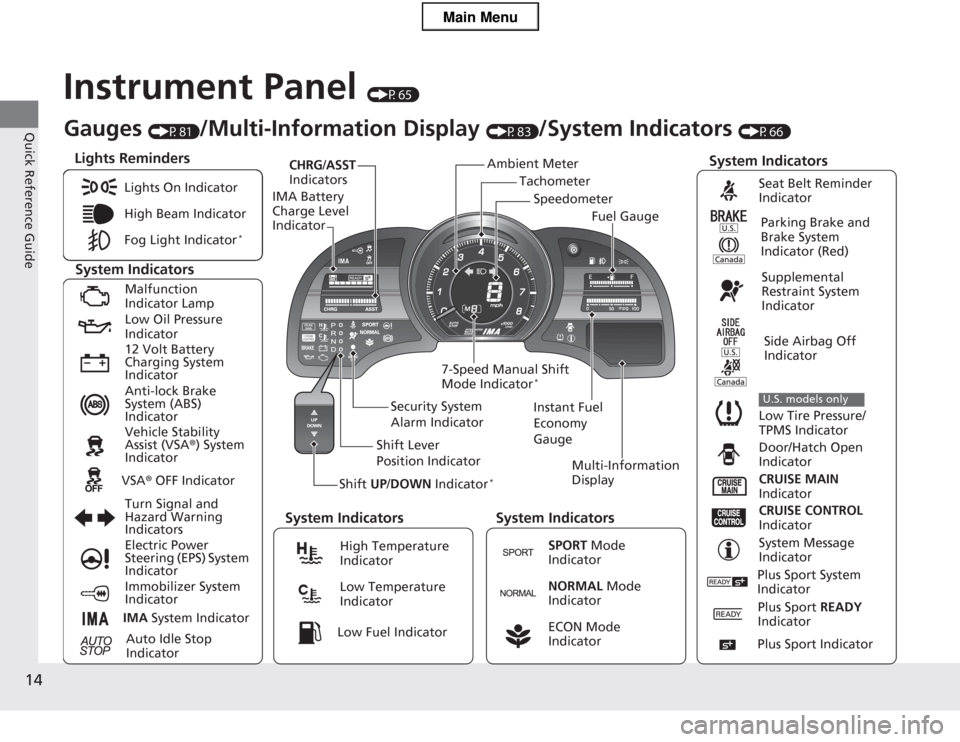
Instrument Panel (P65)
Tachometer
CHRG
/ASST
Indicators
IMA Battery Charge Level Indicator
Shift UP/DOWN Indicator * Multi-Information
Display
7-Speed Manual Shift Mode Indicator
*
System Indicators
Lights Reminders
Instant Fuel
Economy GaugeSpeedometer
Fuel Gauge
Security System
Alarm Indicator
Shift Lever
Position Indicator
Gauges
(P81)/Multi-Information Display (P83)/System Indicators (P66)
Ambient Meter
System Indicators System Indicators System Indicators
Lights On Indicator
High Beam Indicator
Fog Light Indicator
*
Malfunction
Indicator Lamp
Low Oil Pressure Indicator
12 Volt Battery
Charging System Indicator
Anti-lock Brake
System (ABS) Indicator
Vehicle Stability Assist (VSA
®) System
Indicator
VSA ® OFF Indicator
Turn Signal and
Hazard Warning
Indicators
Electric Power
Steering (EPS) System Indicator
Immobilizer System Indicator
IMA System Indicator
Auto Idle Stop
Indicator
Seat Belt Reminder
Indicator
Parking Brake and
Brake System Indicator (Red)
Supplemental
Restraint System
Indicator
Side Airbag Off
Indicator
Low Tire Pressure/
TPMS Indicator
U.S. models only
Door/Hatch Open
Indicator
CRUISE MAIN
Indicator
CRUISE CONTROL
Indicator
System Message
IndicatorHigh Temperature Indicator
Low Temperature Indicator
SPORT Mode
Indicator
NORMAL Mode
Indicator
ECON Mode
Indicator Low Fuel Indicator
Plus Sport System
Indicator
Plus Sport READY
Indicator
Plus Sport Indicator
Main Menu
Page 24 of 325
23
Quick Reference Guide
What to Do If
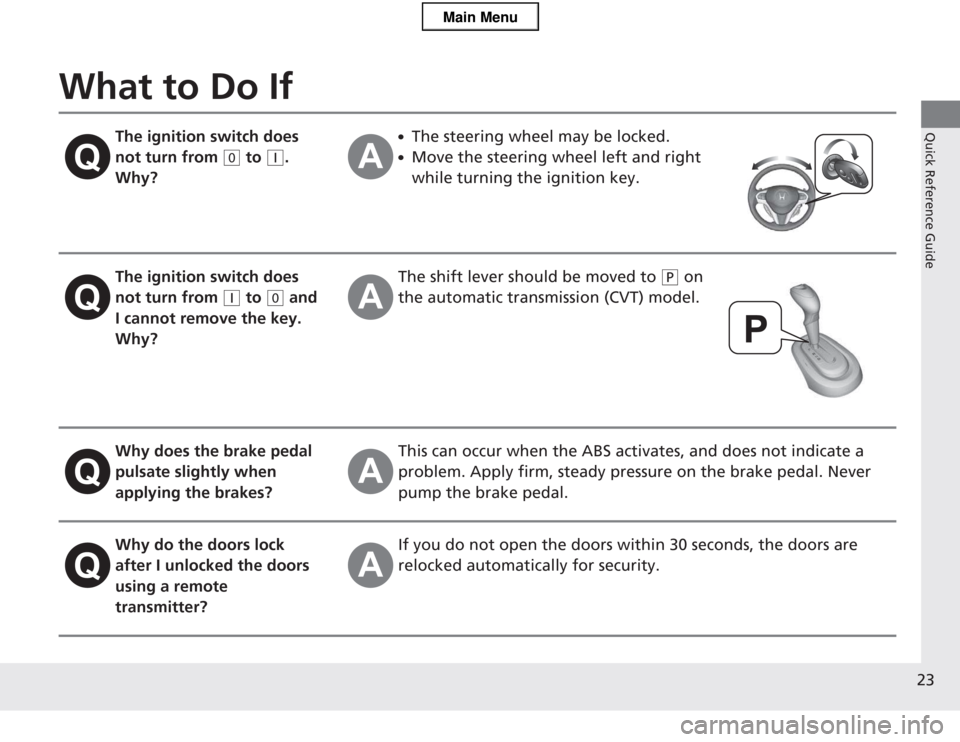
The ignition switch does
not turn from
(0 to (q.
Why?
● The steering wheel may be locked.
● Move the steering wheel left and right
while turning the ignition key.
The ignition switch does
not turn from
(q to (0 and
I cannot remove the key.
Why?
The shift lever should be moved to (P on
the automatic transmission (CVT) model.
Why does the brake pedal
pulsate slightly when
applying the brakes?This can occur when the ABS activates, and does not indicate a
problem. Apply firm, steady pressu re on the brake pedal. Never
pump the brake pedal.
Why do the doors lock
after I unlocked the doors using a remote
transmitter?If you do not open the doors within 30 seconds, the doors are
relocked automatically for security.
Main Menu
Page 36 of 325
35
uuSeat BeltsuFastening a Seat Belt
Continued
Safe Driving
Fastening a Seat Belt
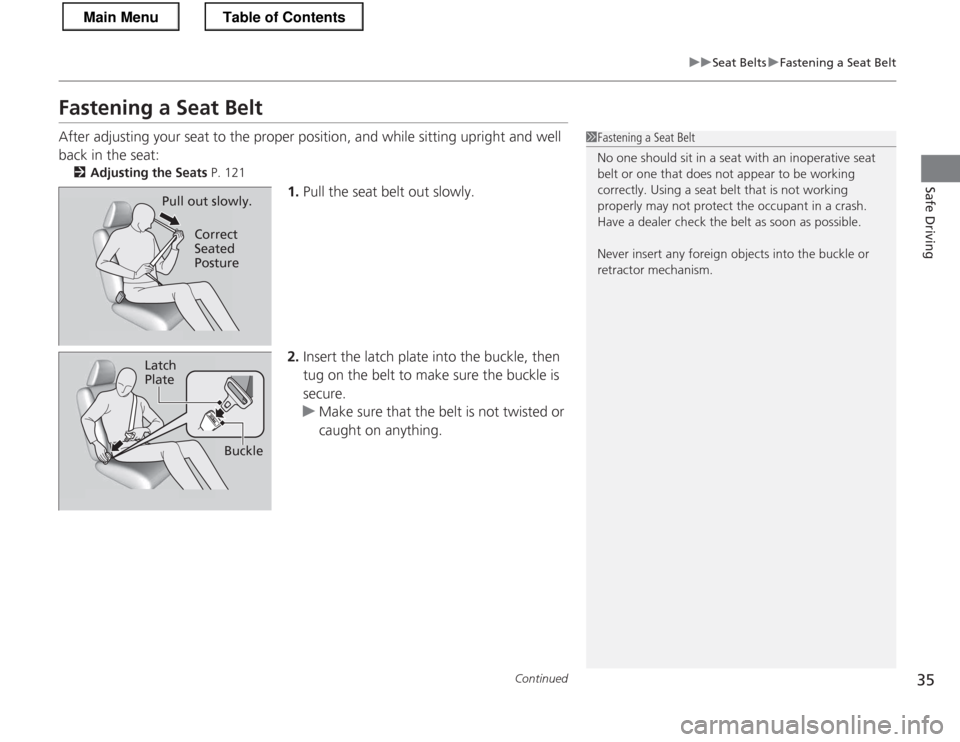
After adjusting your seat to the proper position, and while sitting upright and well back in the seat:2 Adjusting the Seats P. 121
1.Pull the seat belt out slowly.
2. Insert the latch plate into the buckle, then
tug on the belt to make sure the buckle is secure.
uMake sure that the belt is not twisted or
caught on anything.
1Fastening a Seat Belt
No one should sit in a seat with an inoperative seat
belt or one that does not appear to be working
correctly. Using a seat belt that is not working
properly may not protect the occupant in a crash.
Have a dealer check the belt as soon as possible.
Never insert any foreign objects into the buckle or
retractor mechanism.
Pull out slowly.
Correct Seated
Posture
Latch Plate
Buckle
Main MenuTable of Contents
Page 56 of 325
55
uuChild SafetyuProtecting Child Passengers
Safe Driving
•Any child who is too small to wear a seat belt correctly must be restrained in an
approved child seat that is properly secured to the vehicle using the lap belt
portion of the lap/shoulder belt.
• Never hold a child on your lap because it is impossible to protect them in the
event of a collision.
• Never put a seat belt over yourself and a child. During a crash, the belt would
likely press deep into the child and cause serious or fatal injuries.
• Never let two children use the same seat belt. Both children could be very
seriously injured in a crash.
• Do not allow children to operate the doors, windows or seat adjustments.
• Do not leave children in the vehic le unattended, especially in hot weather when
the inside of the vehicle can get hot enou gh to kill them. They could also activate
vehicle controls causing it to move unexpectedly.1Protecting Child Passengers
To deactivate a lockable retractor, release the buckle
and allow the seat belt to wind up all the way.
To remind you of the passenger's front airbag
hazards and child safety, your vehicle has warning
labels on the dashboard (U.S. models) and on the
front visors. Please read and follow the instructions
on these labels. 2 Safety Labels P. 63
3WARNING
Allowing a child to play with a seat belt or
wrap one around their neck can result in
serious injury or death.
Instruct children not to play with any seat
belt and make sure any unused seat belt a
child can reach is bu ckled, fully retracted,
and locked.
Main MenuTable of Contents
Page 58 of 325
Continued57
uuChild SafetyuSafety of Infants and Small Children
Safe Driving
Since this vehicle does not have a back seat, Honda recommends that you do not
carry a child, age 12 or under, as a passenger.
This is because placing a forward-facing child seat in the passenger’s seat can be
hazardous, even with advanced front airbags that automatically turn the
passenger’s front airbag off.
If you choose to ignore our warnings and transport a small child in this vehicle, be
sure to move the passenger seat as far to the rear as possible, and follow the
instructions and guidelines in the following pages.
■ Important consideration when selecting a child seat
Make sure the child seat meets the following three requirements:• The child seat is the correct type and size for the child.
• The child seat is the correct type for the seating position.
• The child seat is compliant with Federal Motor Vehicle Safety Standard 213 or
Canadian Motor Vehicle Safety Standard 213.
■Protecting Smaller Children
■Selecting a Forward-facing Child Seat
1Protecting Smaller Children
Educate yourself about the laws and regulations
regarding child seat use where you are driving, and
follow the child seat manufacturer's instructions.
All child seats must be secured to the vehicle with the lap part of a lap/shoulder belt. A child whose seat is
not properly secured to the vehicle can be
endangered in a crash.
3WARNING
Placing a forward-facing child seat in the
passenger’s seat can result in serious injury
or death if the front airbag inflates.
If you must place a forward-facing child
seat in the passenger’s seat, move the
vehicle seat as far back as possible, and
properly restrain the child.
Main MenuTable of Contents
Page 59 of 325
uuChild SafetyuSafety of Infants and Small Children
58
Safe Driving
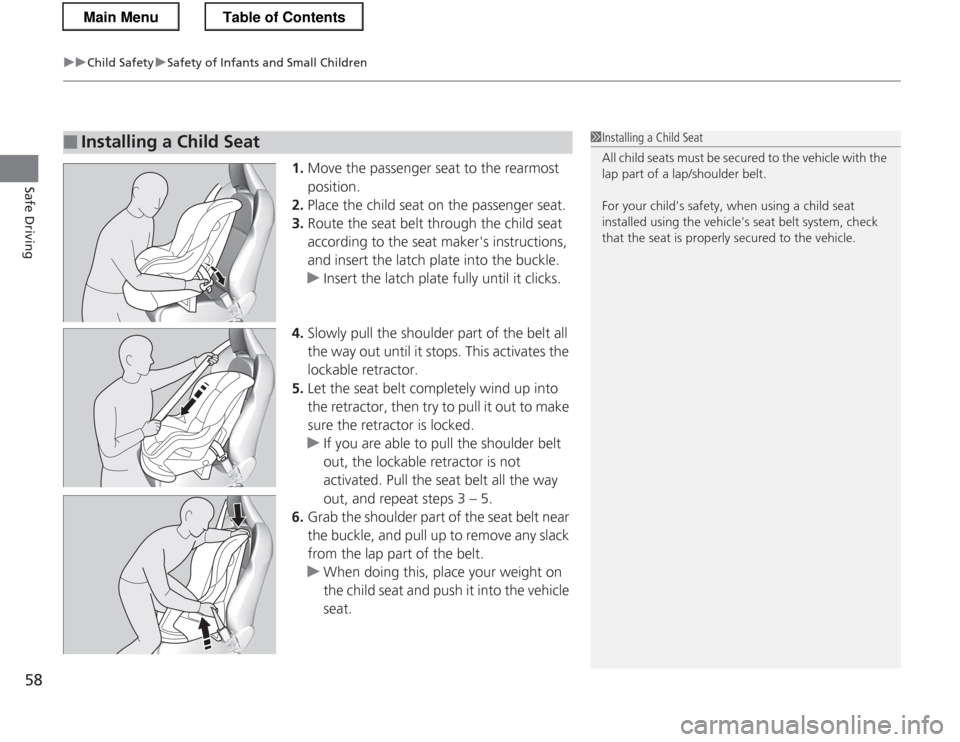
1. Move the passenger seat to the rearmost position.
2. Place the child seat on the passenger seat.
3. Route the seat belt through the child seat according to the seat maker's instructions,
and insert the latch plate into the buckle.
uInsert the latch plate fully until it clicks.
4. Slowly pull the shoulder part of the belt all
the way out until it stops. This activates the lockable retractor.
5. Let the seat belt completely wind up into
the retractor, then try to pull it out to make
sure the retractor is locked.
uIf you are able to pull the shoulder belt
out, the lockable retractor is not
activated. Pull the seat belt all the way
out, and repeat steps 3 – 5.
6. Grab the shoulder part of the seat belt near
the buckle, and pull up to remove any slack
from the lap part of the belt.
uWhen doing this, place your weight on
the child seat and push it into the vehicle seat.
■Installing a Child Seat1Installing a Child Seat
All child seats must be secured to the vehicle with the
lap part of a lap/shoulder belt.
For your child's safety, when using a child seat
installed using the vehicle's seat belt system, check
that the seat is properly secured to the vehicle.
Main MenuTable of Contents
Page 60 of 325
59
uuChild SafetyuSafety of Infants and Small Children
Safe Driving
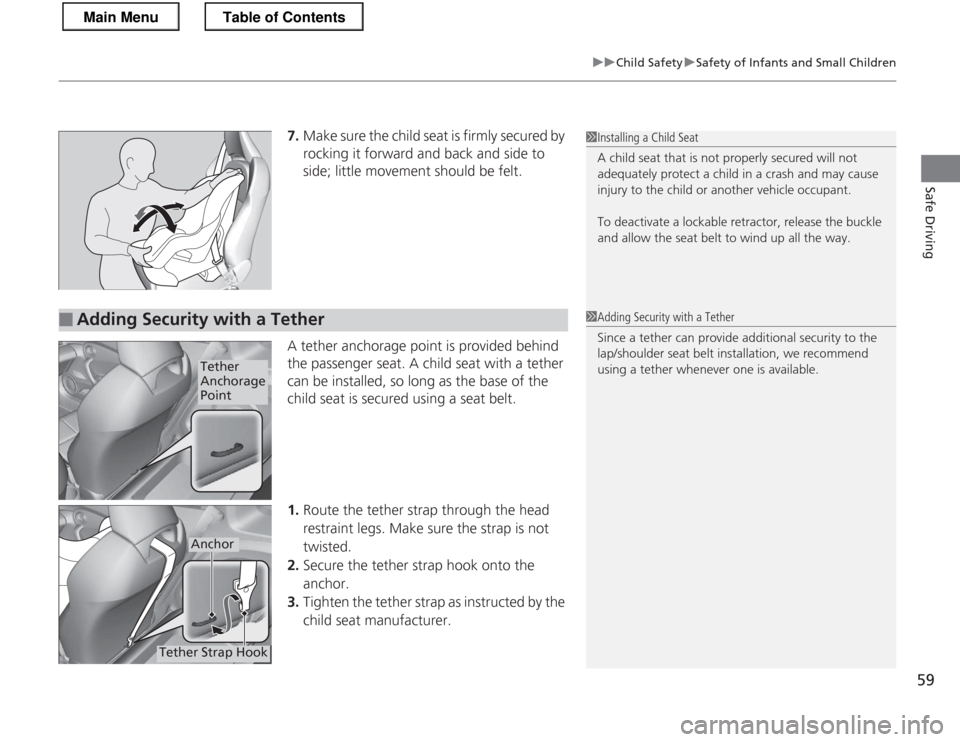
7.Make sure the child seat is firmly secured by
rocking it forward and back and side to
side; little movement should be felt.
A tether anchorage point is provided behind
the passenger seat. A child seat with a tether
can be installed, so long as the base of the
child seat is secured using a seat belt. 1. Route the tether strap through the head
restraint legs. Make sure the strap is not twisted.
2. Secure the tether strap hook onto the anchor.
3. Tighten the tether strap as instructed by the
child seat manufacturer.1Installing a Child Seat
A child seat that is not properly secured will not
adequately protect a child in a crash and may cause
injury to the child or another vehicle occupant.
To deactivate a lockable retractor, release the buckle
and allow the seat belt to wind up all the way.
■Adding Security with a Tether1Adding Security with a Tether
Since a tether can provide additional security to the
lap/shoulder seat belt installation, we recommend
using a tether wheneve r one is available.
Tether
Anchorage
Point
Tether Strap Hook
Anchor
Main MenuTable of Contents
Page 61 of 325
60
uuChild SafetyuSafety of Larger Children
Safe Driving
Safety of Larger Children
Since this vehicle does not have a back seat, Honda recommends that you do
not carry a child age 12 or under as a passenger. This is because children
who have outgrown child seats are also at risk of being injured or killed by
an inflating passen ger’s front airbag. If a larger child must ride in this vehicle,
the information in the following pages provides guidelines to help you decide when
a given child may ride in this vehicle, and how to properly protect the child.
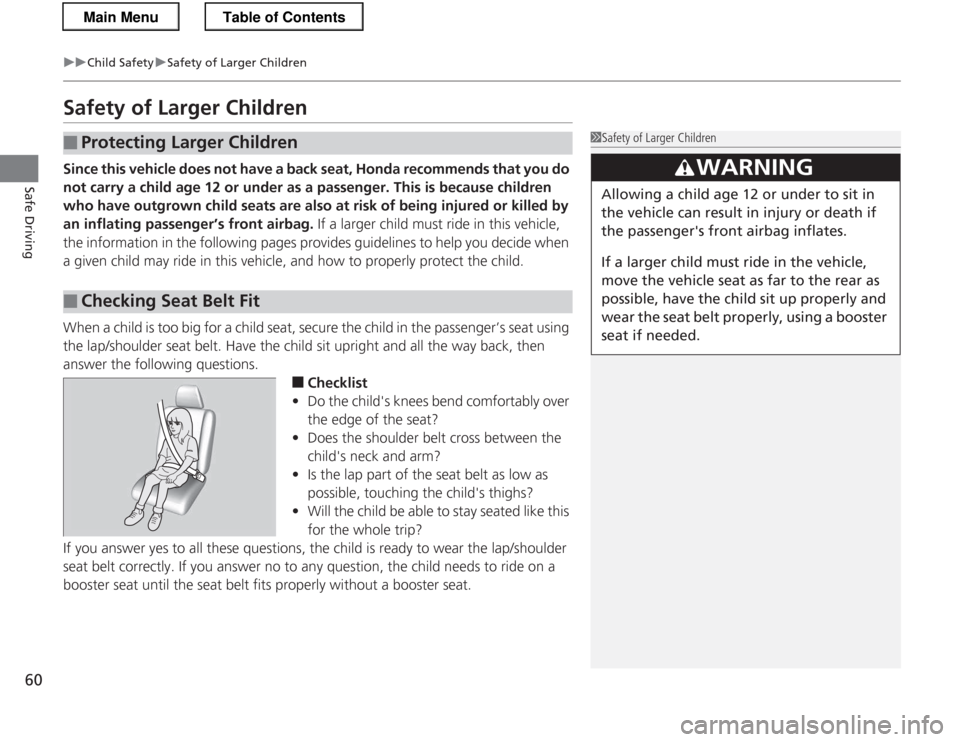
When a child is too big for a child seat, secure the child in the passenger’s seat using
the lap/shoulder seat belt. Have the child sit upright and all the way back, then
answer the following questions.
■Checklist
• Do the child's knees bend comfortably over
the edge of the seat?
• Does the shoulder belt cross between the
child's neck and arm?
• Is the lap part of the seat belt as low as
possible, touching the child's thighs?
• Will the child be able to stay seated like this
for the whole trip?
If you answer yes to all these questions, the child is ready to wear the lap/shoulder
seat belt correctly. If you answer no to any question, the child needs to ride on a
booster seat until the seat belt fits properly without a booster seat.
■Protecting Larger Children
■Checking Seat Belt Fit
1Safety of Larger Children
3WARNING
Allowing a child age 12 or under to sit in
the vehicle can result in injury or death if
the passenger's front airbag inflates.
If a larger child must ride in the vehicle,
move the vehicle seat as far to the rear as
possible, have the child sit up properly and
wear the seat belt properly, using a booster seat if needed.
Main MenuTable of Contents
Page 62 of 325
61
uuChild SafetyuSafety of Larger Children
Safe Driving
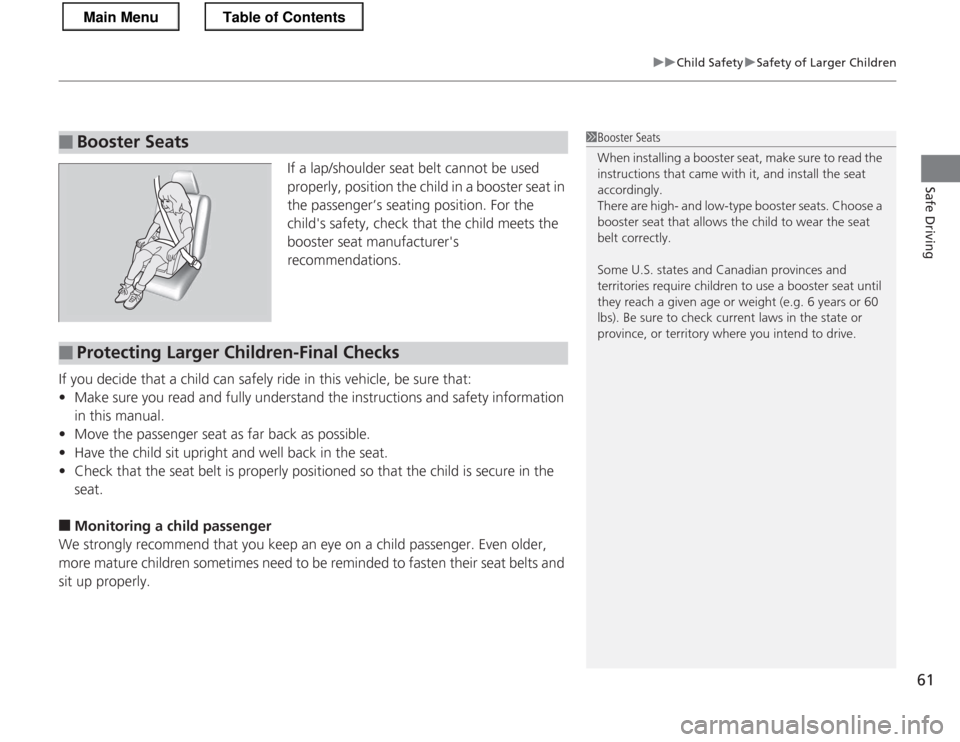
If a lap/shoulder seat belt cannot be used
properly, position the child in a booster seat in
the passenger’s seating position. For the
child's safety, check that the child meets the
booster seat manufacturer's
recommendations.
If you decide that a child can safely ride in this vehicle, be sure that:
• Make sure you read and fully understand the instructions and safety information
in this manual.
• Move the passenger seat as far back as possible.
• Have the child sit upright and well back in the seat.
• Check that the seat belt is properly positioned so that the child is secure in the seat.
■ Monitoring a child passenger
We strongly recommend that you keep an eye on a child passenger. Even older,
more mature children sometimes need to be reminded to fasten their seat belts and
sit up properly.
■Booster Seats1Booster Seats
When installing a booster seat, make sure to read the
instructions that came with it, and install the seat
accordingly.
There are high- and low-type booster seats. Choose a booster seat that allows the child to wear the seat
belt correctly.
Some U.S. states and Canadian provinces and
territories require children to use a booster seat until
they reach a given age or weight (e.g. 6 years or 60
lbs). Be sure to check current laws in the state or
province, or territory where you intend to drive.
■Protecting Larger Children-Final Checks
Main MenuTable of Contents