check engine HONDA CROSSTOUR 2014 1.G Service Manual
[x] Cancel search | Manufacturer: HONDA, Model Year: 2014, Model line: CROSSTOUR, Model: HONDA CROSSTOUR 2014 1.GPages: 573, PDF Size: 21.2 MB
Page 484 of 573
483
uuMaintenance Under the HooduRefilling Window Washer Fluid
Maintenance
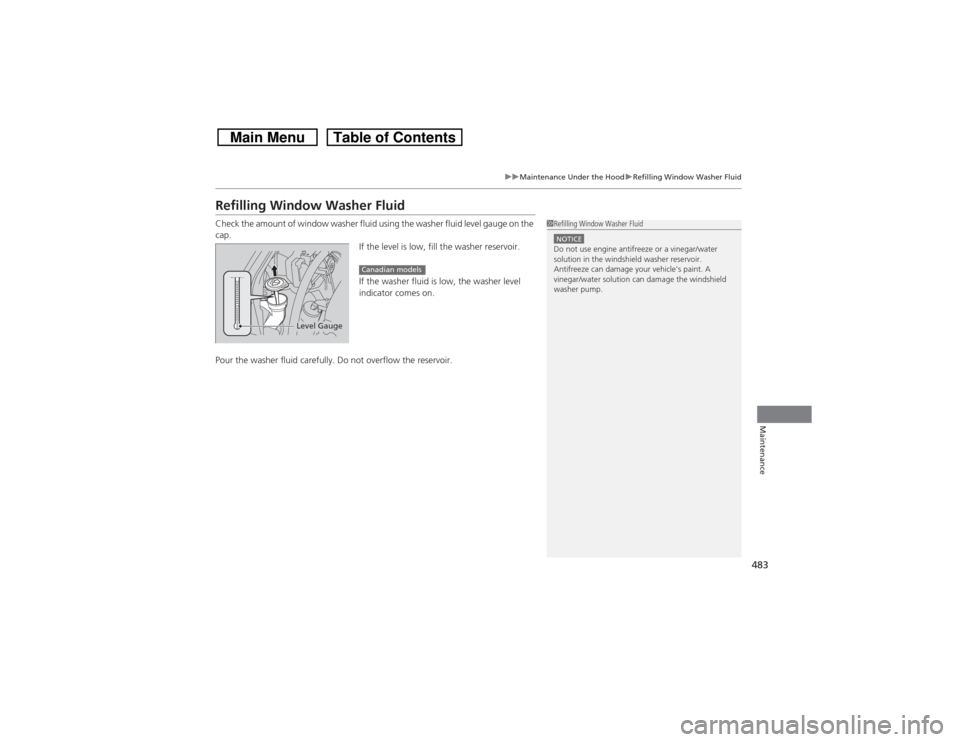
Refilling Window Washer FluidCheck the amount of window washer fluid using the washer fluid level gauge on the
cap.
If the level is low, fill the washer reservoir.
If the washer fluid is low, the washer level
indicator comes on.
Pour the washer fluid carefully. Do not overflow the reservoir.
1Refilling Window Washer FluidNOTICEDo not use engine antifreeze or a vinegar/water
solution in the windshield washer reservoir.
Antifreeze can damage your vehicle’s paint. A
vinegar/water solution can damage the windshield
washer pump.
Level Gauge
Canadian models
Page 516 of 573

515
Handling the Unexpected
This chapter explains how to handle unexpected troubles.
Tools
Types of Tools .................................. 516
If a Tire Goes Flat
Changing a Flat Tire ......................... 517
Engine Does Not Start
Checking the Engine ........................ 525If the Smart Entry Remote Battery is
Weak ..........................................526Emergency Engine Stop ................... 527
Jump Starting.................................... 528
Shift Lever Does Not Move.............. 531Overheating
How to Handle Overheating............. 532
Indicator, Coming On/Blinking
If the Low Oil Pressure Indicator Comes
On................................................ 534If the Charging System Indicator Comes
On ................................................. 534
If the Malfunction Indicator Lamp Comes
On or Blinks ................................... 535
If the Brake System Indicator (Red) Comes
On ................................................... 536If the Electric Power Steering (EPS) System
Indicator Comes On .............................536
If the Low Tire Pressure Indicator Comes
On ................................................. 537
If the TPMS Indicator Comes On ...... 537
Fuses
Fuse Locations ................................. 538
Inspecting and Changing Fuses ........ 541
Emergency Towing........................... 542
When You Cannot Unlock the Fuel Fill
Door................................................. 543
When You Cannot Open the Tailgate.. 544
Page 518 of 573
517
Continued
Handling the Unexpected
If a Tire Goes FlatChanging a Flat TireIf a tire goes flat while driving, grasp the steering wheel firmly, and brake gradually
to reduce speed. Then, stop in a safe place. Replace the flat tire with a compact
spare tire. Go to a dealer as soon as possible to have the full-size tire repaired or
replaced.
1.Park the vehicle on firm, level, and non-slippery surface and apply the parking
brake.
2.Move the shift lever to
(P.
3.Turn on the hazard warning lights and turn the ignition switch to LOCK
(0*1.
*1: Models with the smart entry system have an ENGINE START/STOP button instead of an
ignition switch.
1Changing a Flat Tire
Periodically check the tire pressure of the compact
spare. It should be set to the specified pressure.
Specified Pressure: 60 psi (420 kPa, 4.2 kgf/cm
2)
When driving with the compact spare tire, keep the
vehicle speed under 50 mph (80 km/h). Replace with
a full-size tire as soon as possible.
The compact spare tire and wheel in your vehicle are
specifically for this model.
Do not use them with another vehicle.
Do not use another type of compact spare tire or
wheel with your vehicle.
Do not mount tire chains on a compact spare tire.
If a chain-mounted front tire goes flat, remove one of
the full-size rear tires and replace it with the compact
spare tire. Remove the flat front tire and replace it
with the full-size tire that was removed from the rear.
Mount the tire chains on the front tire.
Do not use a puncture-repairing agent on a flat tire,
as it can damage the tire pressure sensor.
Page 526 of 573
525Handling the Unexpected
Engine Does Not StartChecking the EngineIf the engine does not start, check the starter.*1: Models with the smart entry system have an ENGINE START/STOP button instead of an
ignition switch.
Starter condition
Checklist
Starter doesn’t turn or turns
over slowly.
The battery may be dead. Check
each of the items on the right and
respond accordingly.
Check brightness of the interior light.
Turn on interior lights and check brightness.●If the interior lights are dim or do not come on at all
2Battery P. 506
●If the interior lights come on normally
2 Fuses P. 538
The starter turns over normally
but the engine doesn’t start.
There may be a problem with the
fuse. Check each of the items on
the right and respond accordingly.
Review the engine start procedure.
Follow its instructions, and try to start the engine again.
2 Starting the Engine P. 420, 422
Check the immobilizer system indicator.
When the immobilizer system indicator is blinking, the engine cannot be started.2Immobilizer System P. 107Check the fuel level.
There should be enough fuel in the tank.
2 Fuel Gauge P. 83
Check the fuse.
Check all fuses, or have the vehicle checked by a dealer.2Inspecting and Changing Fuses P. 541If the problem continues:2Emergency Towing P. 542
1Checking the Engine
If you must start the vehicle immediately, use an
assisting vehicle to jump start it.
2Jump Starting P. 528
Page 530 of 573
Continued
529
uuJump Startingu
Handling the Unexpected
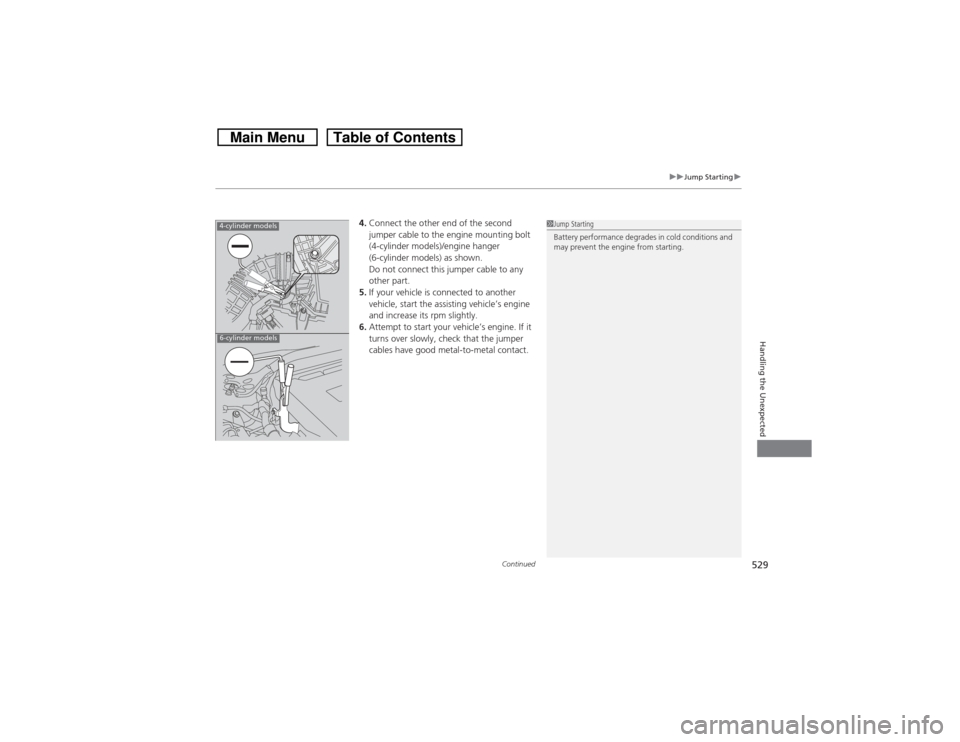
4.Connect the other end of the second
jumper cable to the engine mounting bolt
(4-cylinder models)/engine hanger
(6-cylinder models) as shown.
Do not connect this jumper cable to any
other part.
5.If your vehicle is connected to another
vehicle, start the assisting vehicle’s engine
and increase its rpm slightly.
6.Attempt to start your vehicle’s engine. If it
turns over slowly, check that the jumper
cables have good metal-to-metal contact.
1Jump Starting
Battery performance degrades in cold conditions and
may prevent the engine from starting.
4-cylinder models6-cylinder models
Page 534 of 573
533
uuOverheatinguHow to Handle Overheating
Handling the Unexpected
■Next thing to do
1.Check that the cooling fan is operating and
stop the engine once the temperature
gauge needle comes down.
uIf the cooling fan is not operating,
immediately stop the engine.
2.Once the engine has cooled down, inspect
the coolant level and check the coolant
system components for leaks.
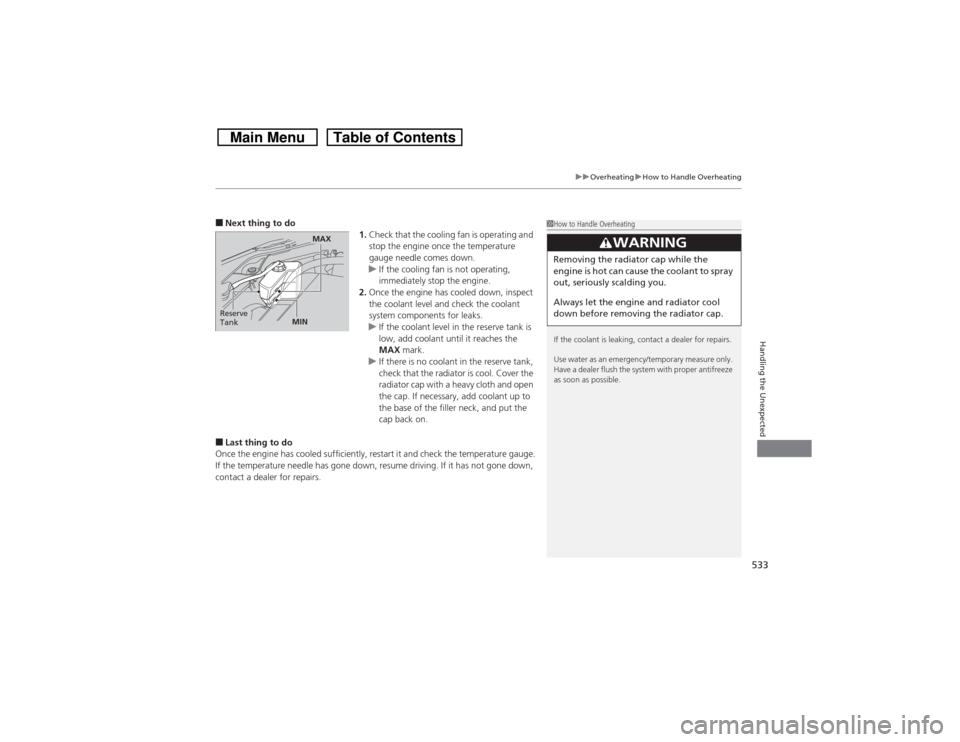
uIf the coolant level in the reserve tank is
low, add coolant until it reaches the
MAX mark.
uIf there is no coolant in the reserve tank,
check that the radiator is cool. Cover the
radiator cap with a heavy cloth and open
the cap. If necessary, add coolant up to
the base of the filler neck, and put the
cap back on.■Last thing to do
Once the engine has cooled sufficiently, restart it and check the temperature gauge.
If the temperature needle has gone down, resume driving. If it has not gone down,
contact a dealer for repairs.
1How to Handle Overheating
If the coolant is leaking, contact a dealer for repairs.
Use water as an emergency/temporary measure only.
Have a dealer flush the system with proper antifreeze
as soon as possible.
3
WARNING
Removing the radiator cap while the
engine is hot can cause the coolant to spray
out, seriously scalding you.
Always let the engine and radiator cool
down before removing the radiator cap.
Reserve
Tank
MAX
MIN
Page 535 of 573
534Handling the Unexpected
Indicator, Coming On/BlinkingIf the Low Oil Pressure Indicator Comes On
■Reasons for the indicator to come on
Comes on when the engine oil pressure is low.■What to do as soon as the indicator comes on
1.Immediately park the vehicle on level ground in a safe place.
2.If necessary, turn the hazard warning lights on.■What to do after parking the vehicle
1.Stop the engine and let it sit for about three minute.
2.Open the hood and check the oil level.2Oil Check P. 473
3.Start the engine and check the low oil pressure indicator.
uThe light goes out: Start driving again.
uThe light does not go out within 10 seconds: Stop the engine and
contact a dealer for repairs immediately.
If the Charging System Indicator Comes On
■Reasons for the indicator to come on
Comes on when the battery is not being charged.■What to do when the indicator comes on
Turn off the heating and cooling system
*/climate control system
*, rear
defogger, and other electrical systems, and immediately contact a dealer
for repairs.
1If the Low Oil Pressure Indicator Comes OnNOTICERunning the engine with low oil pressure can cause
serious mechanical damage almost immediately.1If the Charging System Indicator Comes On
If you need to stop temporarily, do not turn off the
engine. Restarting the engine may rapidly discharge
the battery.
* Not available on all models
Page 536 of 573
535
uuIndicator, Coming On/BlinkinguIf the Malfunction Indicator Lamp Comes On or Blinks
Handling the Unexpected
If the Malfunction Indicator Lamp Comes On or Blinks
■Reasons for the indicator lamp to come on or blink
•Comes on when there is a problem with the engine emissions control
system, or the fuel fill cap is missing, or loose.
•Blinks when engine misfiring is detected.■What to do when the indicator lamp comes on
Avoid high speeds and immediately get your vehicle inspected at a
dealer.■What to do when the indicator lamp blinks
Park the vehicle in a safe place with no flammable items and wait at least
ten minutes or more with the engine stopped until it cools.
■The message appears on when:
An evaporative system leak is detected. This may be caused by the fuel fill cap being
loose or not being installed.■What to do when the message appears:
1.Stop the engine.
2.Check that the fuel fill cap is fully installed.
uIf not, loosen the cap, and then retighten it until it clicks at least once.
3.Drive for several days of normal driving.
uThe message should go off.■When the malfunction indicator lamp comes on
Malfunction indicator lamp comes on if the system continues to detect a leak of
gasoline vapor. If this happens, check the fuel fill cap using the procedures described
above.■Check Fuel Cap Message
1If the Malfunction Indicator Lamp Comes On or BlinksNOTICEIf you drive with the malfunction indicator lamp on,
the emissions control system and the engine could be
damaged.
If the malfunction indicator lamp blinks again when
restarting the engine, drive to the nearest dealer at
31 mph (50 km/h) or less. Have your vehicle
inspected.
Page 537 of 573
536
uuIndicator, Coming On/BlinkinguIf the Brake System Indicator (Red) Comes On
Handling the Unexpected
If the Brake System Indicator (Red) Comes On
■Reasons for the indicator to come on
•The brake fluid is low.
•There is a malfunction in the brake system.■What to do when the indicator comes on while driving
Press the brake pedal lightly to check pedal pressure.
•If normal, check the brake fluid level the next time you stop.
•If abnormal, take immediate action. If necessary, downshift the
transmission to slow the vehicle using engine braking.
If the Electric Power Steering (EPS) System Indicator Comes On
■Reasons for the indicator to come on
•Comes on when there is a problem with EPS system.
•If you depress the accelerator pedal repeatedly to increase the engine
speed while the engine is idling, the indicator comes on, and
sometimes the steering wheel becomes harder to operate.■What to do when the indicator comes on
Stop the vehicle in a safe place and restart the engine.
If the indicator comes on and stays on, immediately have your vehicle
inspected by a dealer.
1If the Brake System Indicator (Red) Comes On
Have your vehicle repaired immediately.
It is dangerous to drive with low brake fluid. If there
is no resistance from the brake pedal, stop
immediately in a safe place. If necessary downshift
the gears.
If the brake system indicator and ABS indicator come
on simultaneously, the electronic brake distribution
system is not working. This can result in vehicle
instability under sudden braking.
Have your vehicle inspected by a dealer immediately.
U.S.
Canada
6-cylinder models
Page 539 of 573
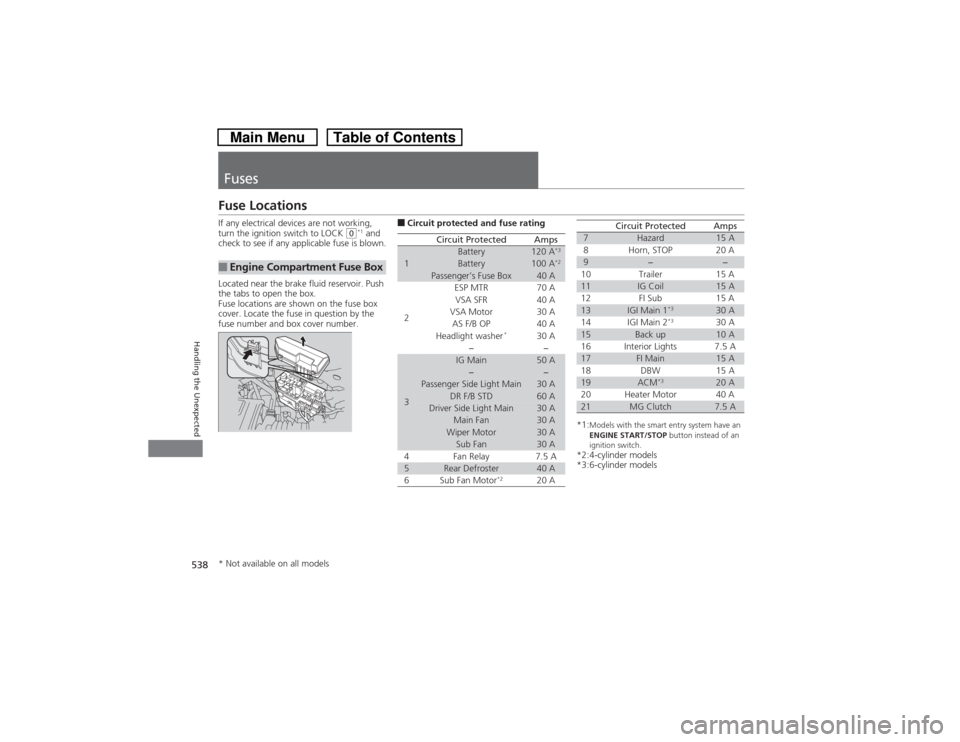
538Handling the Unexpected
FusesFuse LocationsIf any electrical devices are not working,
turn the ignition switch to LOCK
(0*1 and
check to see if any applicable fuse is blown.
Located near the brake fluid reservoir. Push
the tabs to open the box.
Fuse locations are shown on the fuse box
cover. Locate the fuse in question by the
fuse number and box cover number.
■Engine Compartment Fuse Box
■Circuit protected and fuse rating
Circuit Protected
Amps
1
Battery
120 A
*3
Battery
100 A
*2
Passenger’s Fuse Box
40 A
2
ESP MTR
70 A
VSA SFR
40 A
VSA Motor
30 A
AS F/B OP
40 A
Headlight washer
*
30 A
−
−
3
IG Main
50 A
−
−
Passenger Side Light Main
30 A
DR F/B STD
60 A
Driver Side Light Main
30 A
Main Fan
30 A
Wiper Motor
30 A
Sub Fan
30 A
4 Fan Relay 7.5 A
5
Rear Defroster
40 A
6 Sub Fan Motor
*2
20 A
*1:
Models with the smart entry system have an
ENGINE START/STOP button instead of an
ignition switch.
*2:4-cylinder models
*3:6-cylinder models7
Hazard
15 A
8 Horn, STOP 20 A
9
−
−
10 Trailer 15 A
11
IG Coil
15 A
12 FI Sub 15 A
13
IGI Main 1
*3
30 A
14 IGI Main 2
*3
30 A
15
Back up
10 A
16 Interior Lights 7.5 A
17
FI Main
15 A
18 DBW 15 A
19
ACM
*3
20 A
20 Heater Motor 40 A
21
MG Clutch
7.5 A
Circuit Protected
Amps
* Not available on all models