seats HONDA ELEMENT 2003 1.G User Guide
[x] Cancel search | Manufacturer: HONDA, Model Year: 2003, Model line: ELEMENT, Model: HONDA ELEMENT 2003 1.GPages: 338, PDF Size: 4.08 MB
Page 35 of 338

CONT INUED
Due to variations in the design of
child seats, vehicle seats, and seat
belts, all child seats will not f it all
vehicle seating positions.
However, Honda is conf ident that
one or more child seat models can f it
andbeproperlyinstalledinall
recommended seating positions in
your vehicle.Bef ore purchasing a child seat, we
recommend that parents test the
child seat in the specif ic vehicle
seating position (or positions) where
they intend to use the seat. If a
previously purchased child seat does
not f it, you may need to buy a
different one that will fit.
Your vehicle has lower anchors
installed f or use with LATCH
(Lower Anchors and Tethers f or
Children) - compatible child seats.
For more inf ormation, see page .
48
Protecting Children
Driver and Passenger Saf ety
T he child seat should f it the
vehicle seat ing posit ion (orposit ions) where it will be used.
3.
31
Page 36 of 338
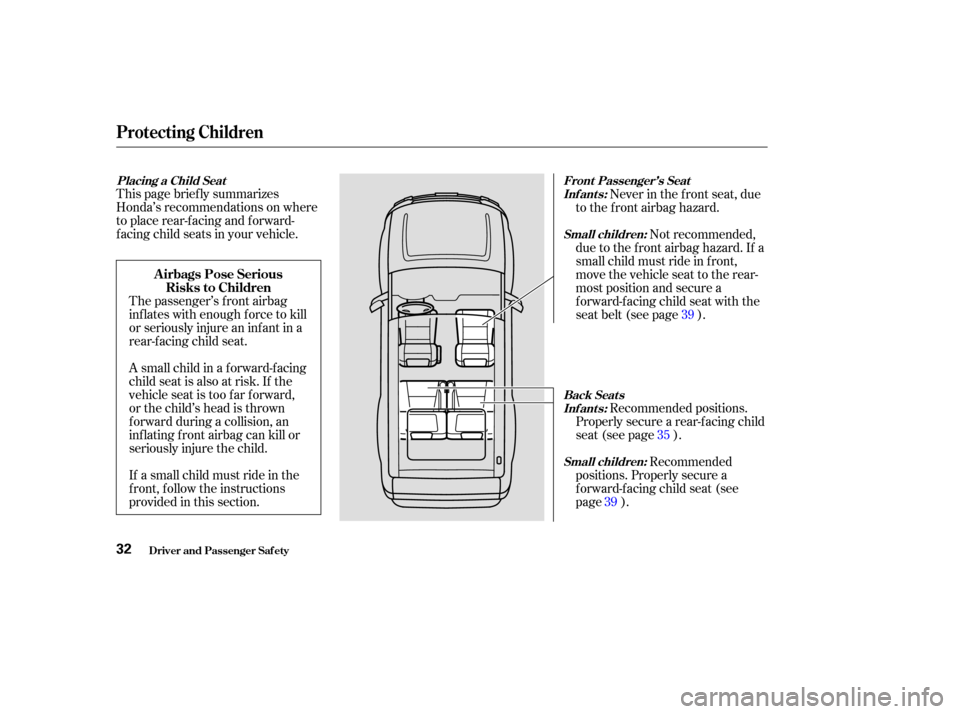
If a small child must ride in the
f ront, f ollow the instructions
provided in this section.
This page brief ly summarizes
Honda’s recommendations on where
to place rear-facing and forward-
f acing child seats in your vehicle.
The passenger’s f ront airbag
inf lates with enough f orce to kill
or seriously injure an inf ant in a
rear-facing child seat.
A small child in a f orward-f acing
child seat is also at risk. If the
vehicle seat is too f ar f orward,
or the child’s head is thrown
f orward during a collision, an
inf lating f ront airbag can kill or
seriously injure the child. Never in the f ront seat, due
to the f ront airbag hazard.
Not recommended,
due to the f ront airbag hazard. If a
small child must ride in f ront,
move the vehicle seat to the rear-
most position and secure a
forward-facing child seat with the
seat belt (see page ).
Recommended positions.
Properlysecurearear-facingchild
seat (see page ).
Recommended
positions. Properly secure a
forward-facing child seat (see
page ). 39
35
39
Placing a Child Seat Front Passenger’s Seat
Inf ant s:
Small children:
Back Seat sInf ant s:
Small children:
Airbags Pose SeriousRisks to Children
Protecting Children
Driver and Passenger Saf ety32
Page 37 of 338
Af ter selecting a proper child seat,
and a good position to install the seat,
there are three main steps in
installing the seat:Make sure the child is properly
strappedinthechildseat
according to the child seat maker’s
instructions. A child who is not
properly secured in a child seat
canbethrownoutof theseatina
crash and be seriously injured.
To provide security during normal
driving maneuvers as well as during
a collision, we recommend that
parents secure a child seat as f irmly
as possible.
When you are not using a child seat,
either remove it and store it in a saf e
place, or make sure it is properly
secured. An unsecured child seat can
be thrown around the vehicle during
a crash or sudden stop and injure
someone.
However, a child seat does not need
to be ‘‘rock solid.’’ In some vehicles
or seating positions, it may be
dif f icult to install a child seat so that
it does not move at all. Some side-to-
side or back-and-f orth movement can
be expected and should not reduce
the child seat’s ef f ectiveness.
If the child seat is not secure, try
installing it in a dif f erent seating
position, or use a dif f erent style of
child seat that can be f irmly secured
in the desired seating position.
All child seats are
designed to be secured to the
vehicle with the lap part of a lap/
shoulder belt. Some child seats
can be secured to the vehicle’s
LATCH anchorage system instead.
A child whose seat is not properly
secured to the vehicle can be
endangered in a crash. See pages , and f or instructions on
howtoproperlysecurechildseats
in this vehicle.
Af ter installing a child
seat, push and pull the seat
f orward and f rom side to side to
verif y that it is secure. 483935
Inst alling a Child Seat
Secure t he child in t he child seat .
Storing a Child Seat
Properly secure t he child seat t o
the vehicle.
Make sure t he child seat is f irmlysecured.
1.
2. 3.
Protecting Children
Driver and Passenger Saf ety33
Page 38 of 338
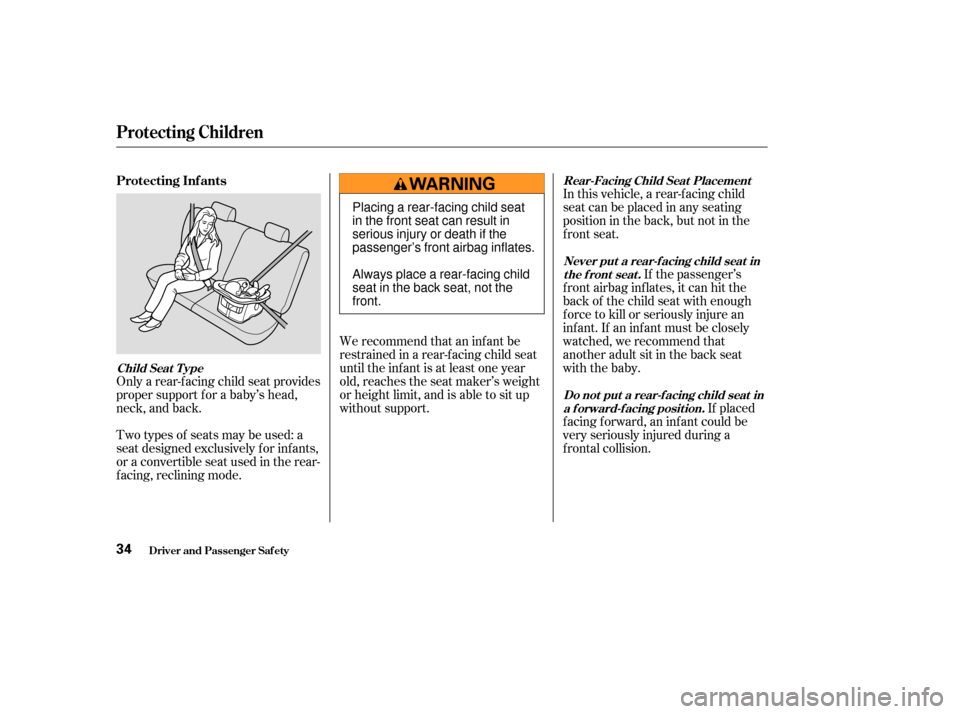
In this vehicle, a rear-f acing child
seatcanbeplacedinanyseating
position in the back, but not in the
front seat.If the passenger’s
f ront airbag inf lates, it can hit the
back of the child seat with enough
f orce to kill or seriously injure an
inf ant. If an inf ant must be closely
watched, we recommend that
another adult sit in the back seat
with the baby.
If placed
f acing f orward, an inf ant could be
very seriously injured during a
f rontal collision.
Only a rear-f acing child seat provides
proper support f or a baby’s head,
neck, and back. We recommend that an inf ant be
restrained in a rear-f acing child seat
until the inf ant is at least one year
old, reaches the seat maker’s weight
or height limit, and is able to sit up
without support.
Two types of seats may be used: a
seat designed exclusively f or inf ants,
or a convertible seat used in the rear-
f acing, reclining mode. Protecting Inf ants
Child Seat T ype Rear-Facing Child Seat Placement
Never put a rear-f acing child seat inthe front seat.
Do not put a rear-f acing child seat ina f orward-f acing position.
Protecting Children
Driver and Passenger Saf ety34
Placing a rear-facing child seat
in the front seat can result in
serious injury or death if the
passenger’s front airbag inflates.
Always place a rear-facing child
seat in the back seat, not the
front.
Page 39 of 338
CONT INUED
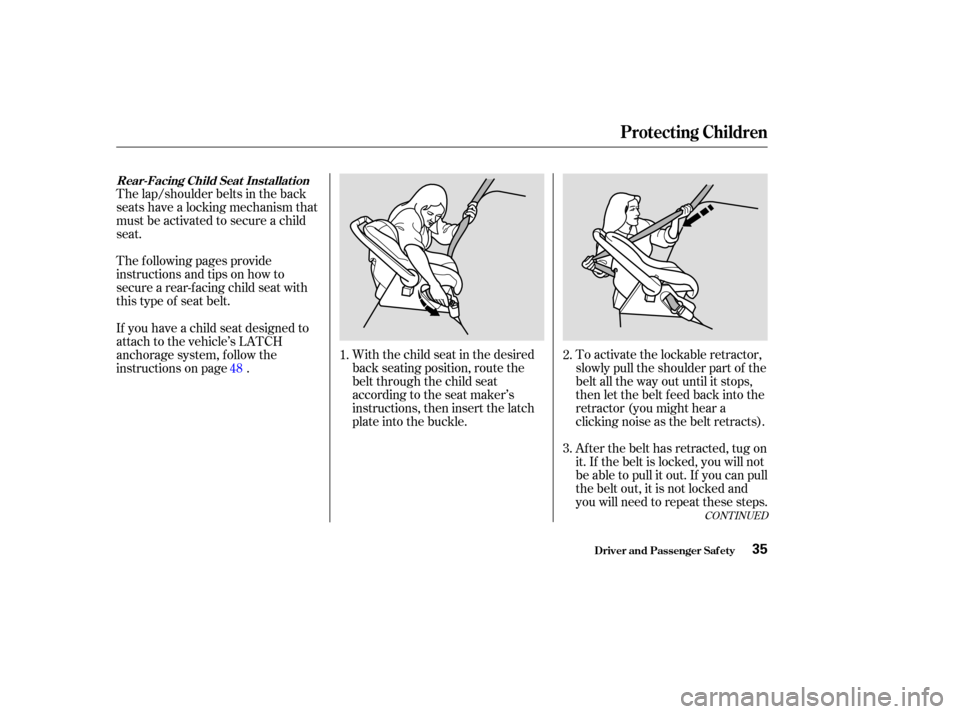
The lap/shoulder belts in the back
seats have a locking mechanism that
must be activated to secure a child
seat.
The f ollowing pages provide
instructions and tips on how to
secure a rear-f acing child seat with
this type of seat belt.With the child seat in the desired
back seating position, route the
belt through the child seat
according to the seat maker’s
instructions, then insert the latch
plate into the buckle.To activate the lockable retractor,
slowly pull the shoulder part of the
belt all the way out until it stops,
then let the belt f eed back into the
retractor (you might hear a
clicking noise as the belt retracts).
Af ter the belt has retracted, tug on
it. If the belt is locked, you will not
be able to pull it out. If you can pull
the belt out, it is not locked and
you will need to repeat these steps.
If you have a child seat designed to
attach to the vehicle’s LATCH
anchorage system, follow the
instructions on page .
481.
2.
3.
Protecting Children
Driver and Passenger Saf ety
Rear-Facing Child Seat Inst allat ion
35
Page 42 of 338
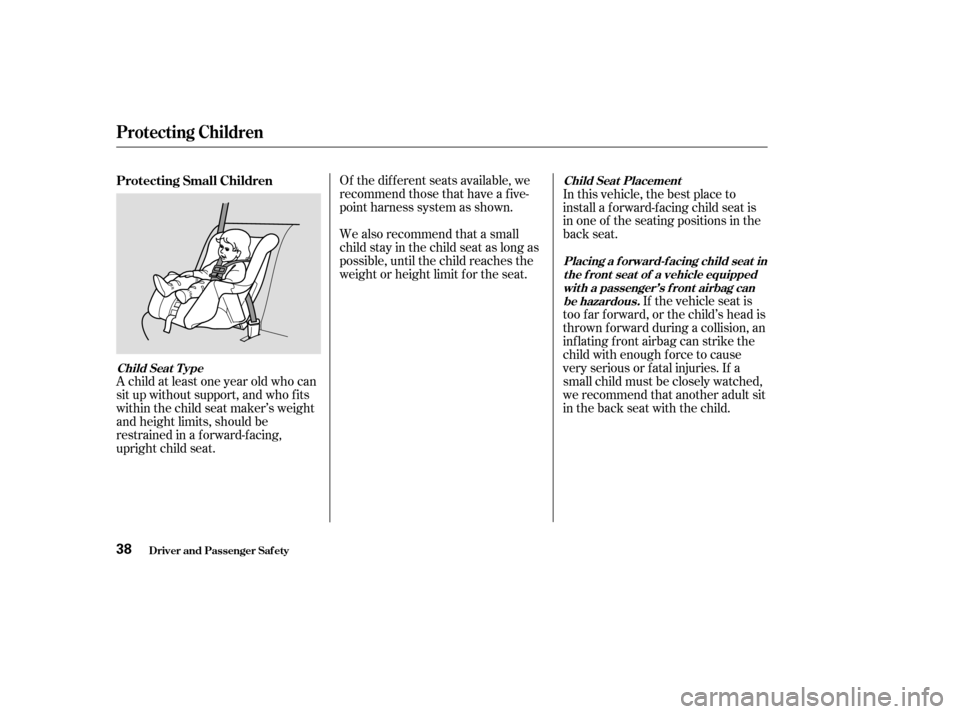
Of the different seats available, we
recommend those that have a f ive-
point harness system as shown.
We also recommend that a small
child stay in the child seat as long as
possible, until the child reaches the
weight or height limit f or the seat.In this vehicle, the best place to
install a f orward-f acing child seat is
in one of the seating positions in the
back seat.
If the vehicle seat is
too far forward, or the child’s head is
thrown f orward during a collision, an
inflating front airbag can strike the
child with enough f orce to cause
very serious or f atal injuries. If a
small child must be closely watched,
we recommend that another adult sit
in the back seat with the child.
A child at least one year old who can
sit up without support, and who f its
within the child seat maker’s weight
and height limits, should be
restrained in a f orward-f acing,
upright child seat. Protecting Small Children
Child Seat T ype Child Seat Placement
Placing a f orward-f acing child seat int he f ront seat of a vehicle equippedwit h a passenger’s f ront airbag canbe hazardous.
Protecting Children
Driver and Passenger Saf ety38
Page 50 of 338
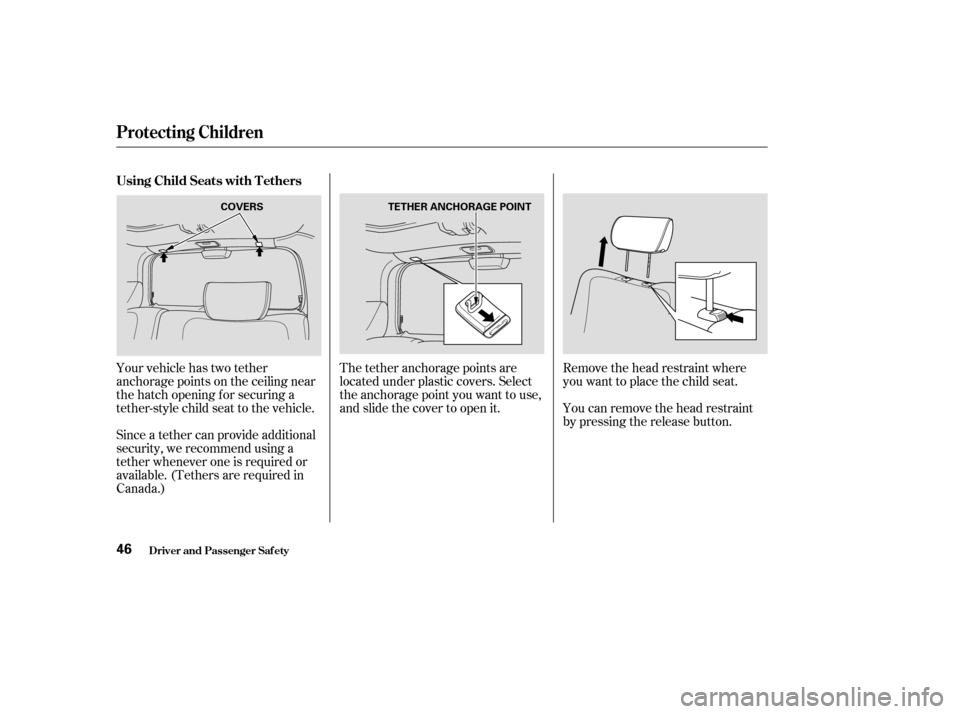
Since a tether can provide additional
security, we recommend using a
tether whenever one is required or
available. (Tethers are required in
Canada.)Remove the head restraint where
you want to place the child seat.
Your vehicle has two tether
anchorage points on the ceiling near
the hatch opening f or securing a
tether-style child seat to the vehicle. The tether anchorage points are
located under plastic covers. Select
the anchorage point you want to use,
and slide the cover to open it. You can remove the head restraint
by pressing the release button.
Using Child Seats with T ethers
Protecting Children
Driver and Passenger Saf ety46
COVERS
TETHER ANCHORAGE POINT
Page 51 of 338
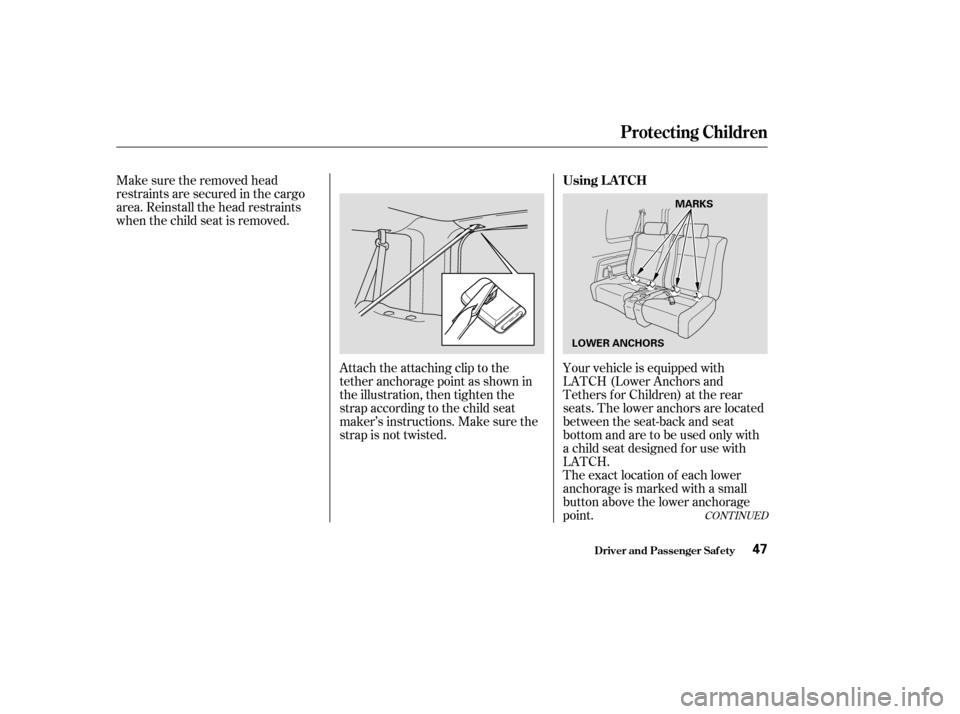
Make sure the removed head
restraints are secured in the cargo
area. Reinstall the head restraints
when the child seat is removed.Attach the attaching clip to the
tether anchorage point as shown in
the illustration, then tighten the
strap according to the child seat
maker’s instructions. Make sure the
strap is not twisted.Your vehicle is equipped with
LATCH (Lower Anchors and
Tethers f or Children) at the rear
seats. The lower anchors are located
between the seat-back and seat
bottom and are to be used only with
a child seat designed f or use with
LATCH.
The exact location of each lower
anchorage is marked with a small
button above the lower anchorage
point.
CONT INUED
Driver and Passenger Saf ety
Protecting Children
Using L A T CH
47
LOWER ANCHORSMARKS
Page 53 of 338
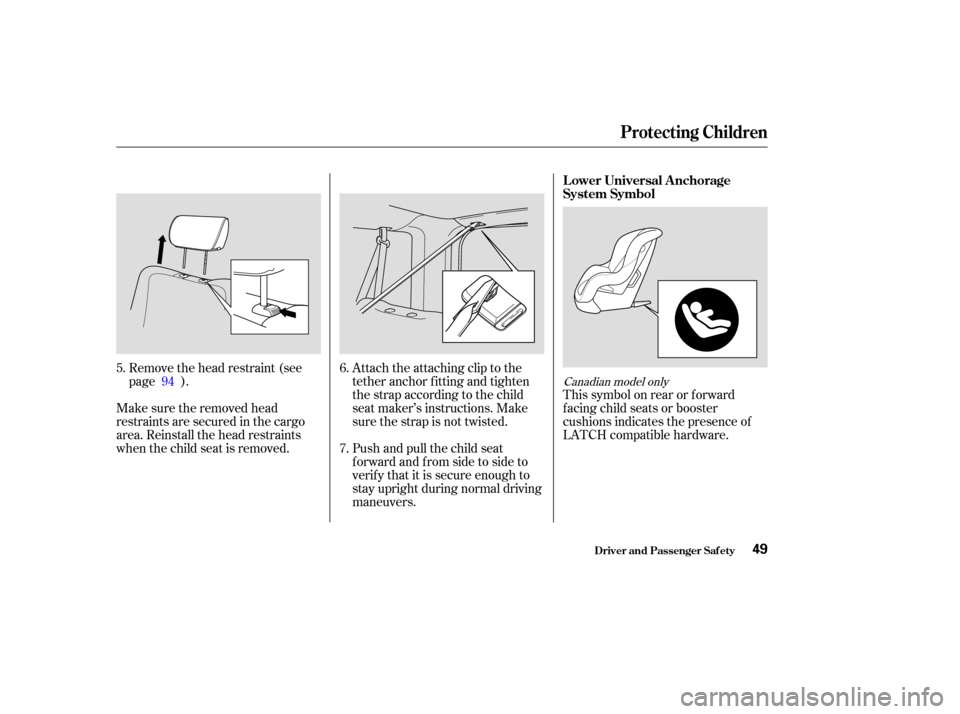
Remove the head restraint (see
page ).
Make sure the removed head
restraints are secured in the cargo
area. Reinstall the head restraints
when the child seat is removed. Attach the attaching clip to the
tether anchor fitting and tighten
the strap according to the child
seat maker’s instructions. Make
sure the strap is not twisted.
Push and pull the child seat
f orward and f rom side to side to
verif y that it is secure enough to
stay upright during normal driving
maneuvers.This symbol on rear or f orward
f acing child seats or booster
cushions indicates the presence of
LATCH compatible hardware.
5.
6.
7.
94
Canadian model only
Protecting Children
Driver and Passenger Saf ety
L ower Universal Anchorage
System Symbol
49
Page 55 of 338
The seat belts in all seating positions
except the driver’s have an additional
locking mechanism that must be
activated to secure a child seat. (See
pages and f or instructions on
how to secure child seats with this
type of seat belt.)
If the shoulder part of the belt is
pulled all the way out, the locking
mechanism will activate. The belt
will retract, but it will not allow the
passenger to move f reely.
To deactivate the locking
mechanism, unlatch the buckle and
let the seat belt f ully retract. To
ref asten the belt, pull it out only as
f ar as needed.
See page f or instructions on how
to wear the lap/shoulder belt
properly.35
39
17
Additional Inf ormation About Your Seat Belts
Driver and Passenger Saf ety51