wheel HONDA ELEMENT 2007 1.G Owner's Manual
[x] Cancel search | Manufacturer: HONDA, Model Year: 2007, Model line: ELEMENT, Model: HONDA ELEMENT 2007 1.GPages: 275, PDF Size: 4.16 MB
Page 165 of 275

If this indicator comes on, the anti-
lock function of the braking system
has shut down. The brakes still work
like a conven tional system, but
without anti-lock. You should have
your dealer inspect your vehic le as
soon as possible.
If the indicator comes on while
driving, test the brakes as instructed
on page .
If the ABS indicator and the brake
system indicator come on together
and the parking brake is fully
released, the front-to-rear braking
distribution system may also shut
down. Test
your brakes as instructed on
page . If the brakes f eel normal,
drive slowly and have your vehicle
repaired by your dealer as soon as
possible. Avoid sudden hard braking
which could cause the rear wheels to
lock up and possibly lead to a loss of
control.
The VSA indicator will come on
alongwiththeABSindicator.
It only helps with steering
control during braking. such as trying to take a
corner too f ast or making a sudden
lane change. Always drive at a safe
speed f or the road and weather
conditions.
Always steer moderately
when you are braking hard. Severe
or sharp steering wheel movement
can still cause your vehicle to veer
into oncoming traffic or off the road.
on loose or
uneven surf aces, such as gravel or
snow, than a vehicle without anti-
lock.
233
233
Anti-lock Brakes (ABS)
ABS Indicator
Important Saf ety Reminders
A BS does not reduce the time or
distance it takes to stop the
vehicle. A BS will not prevent a skid that
results f rom changing direction
abruptly,
A BS cannot prevent a loss of
stability.
A vehicle with A BS may require a
longer distance to stop
162
Page 167 of 275

Each wheel is equipped with a tire
pressure sensor mounted inside the
tire behind the valve stem. You must
use TPMS specific wheels. It is
recommended that you always have
your tires serviced by your dealer or
qualified technician.
After you replace the flat tire, the
low tire pressu re indicator stays on.
This is norm al; the system is not
monitoring the spare tire pressure.
Manually check the spare tire
pressure to be sure it is correct.
Never use a puncture-repairing agent
in a flat tire. If used, you will have to
replace the tire pressure sensor.
Havetheflattirerepairedbyyour
dealer as soon as possible.
This
indicator comes on and stays on
if there is a problem with the tire
pressure monitoring system.
If you see this message, the system
is off and is not monitoring the tire
pressures. Have the system checked
by your dealer as soon as possible.
If you have a f lat tire, the low tire
pressure indicator will come on.
Replace the flat tire with the
compact spare tire (see page ). 218As required by the FCC:
This device complies with Part 15 of theFCC rules. Operation is subject to thef ollowing two conditions: (1) This devicemay not cause harmf ul interf erence, and(2) this device must accept anyinterf erence received, includinginterf erence that may cause undesiredoperation.
Changes or modif ications not expresslyapproved by the party responsible f orcompliance could void the user’sauthority to operate the equipment.
This device complies with IndustryCanada Standard RSS-210.Operation is subject to the f ollowing twoconditions: (1) this device may not causeinterf erence, and (2) this device mustaccept any interf erence that may causeundesired operation of the device.
Tire Pressure Monitoring System (TPMS)
Tire Pressure Monitoring
System (T PMS) Indicator
Changing a T ire with T PMS
164
Page 169 of 275
VSA is turned on every time you
start the engine, even if you turn ed it
off the last time you drove the
vehicle.
Driving with varying tire or wheel
sizes may cause the VSA to
malfunction. When replacing tires,
make sure they are the same size
and type as your original tires (see
page ).
If you install winter tires, make sure
they are the same size as those that
were originally supplied with your
vehicle. Exercise the same caution
during winter driving as you would if
your vehicle was not equipped with
VSA.
Immediately af ter f reeing your
vehicle, be sure to switch the VSA on
again. We do not recommend driving
your vehicle with the VSA and
traction control systems switched off. In certain unusual conditions when
your vehicle gets stuck in shallow
mud or f resh snow, it may be easier
to free it with the VSA temporarily
switched of f . When the VSA system
is of f , the traction control system is
alsooff.Youshouldonlyattemptto
f ree your vehicle with the VSA of f if
you are not able to f ree it when the
VSA is on.
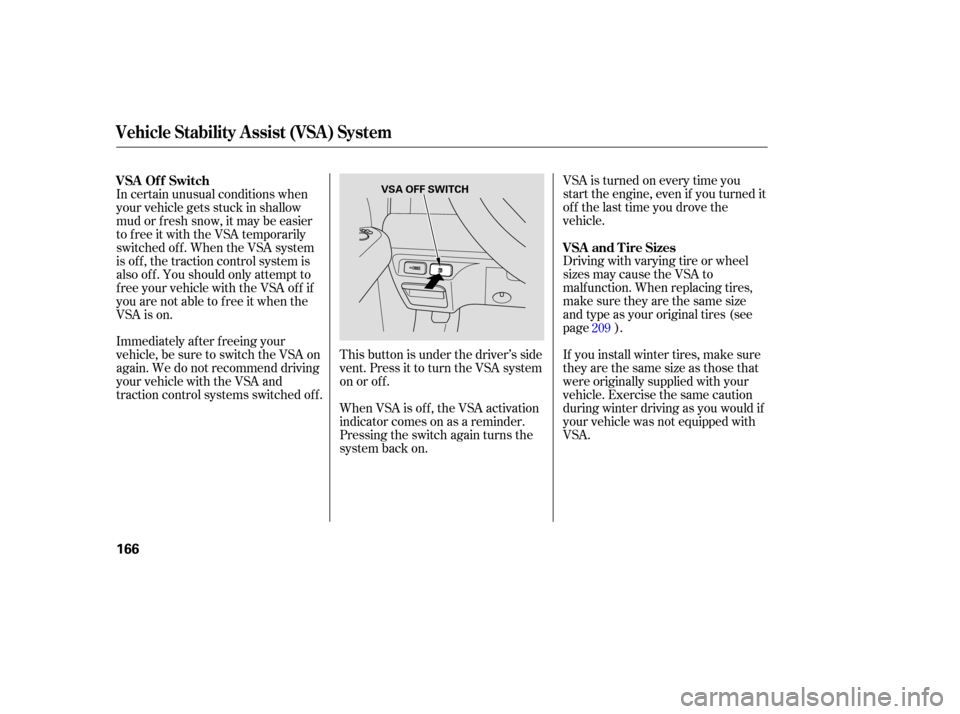
This button is under the driver’s side
vent. Press it to turn the VSA system
on or of f .
When VSA is off, the VSA activation
indicator comes on as a reminder.
Pressing the switch again turns the
system back on. 209
VSA and Tire Sizes
VSA Of f Switch
Vehicle Stability Assist (VSA) System
166
VSA OFF SWITCH
Page 175 of 275

Maketurnsmoreslowlyandwider
than normal. The trailer tracks a
smaller arc than your vehicle, and it
canhitorrunoversomethingthe
vehicle misses. Allow more time and
distance f or braking. Do not brake or
turn suddenly as this could cause the
trailer to jackknif e or turn over.
When climbing hills, closely watch
your temperature gauge. If it nears
the red (Hot) mark, turn the air
conditioning of f , reduce speed and, if
necessary, pull to the side of the
road to let the engine cool.If you must stop when f acing uphill,
use the f oot brake or parking brake.
Do not try to hold the vehicle in
placebypressingontheaccelerator,
as this can cause the automatic
transmission to overheat.
Always drive slowly and have
someone guide you when backing up.
Grip the of the steering
wheel; then turn the wheel to the lef t
to get the trailer to move to the lef t,
andturnthewheelrighttomovethe
trailer to the right.
Follow all normal precautions when
parking, including f irmly setting the
parking brake and putting the
transmission in Park (automatic) or
in 1st or reverse (manual). Also,
place wheel chocks at each of the
trailer’s tires.
If the automatic transmission shif ts
f requently while going up a hill, shif t
to D . When driving down hills, reduce
your speed, and shif t down to second
gear. Do not ‘‘ride’’ the brakes, and
remember, it will take longer to slow
downandstopwhentowingatrailer.
Crosswinds and air turbulence
caused by passing trucks can disrupt
your steering and cause trailer to
sway. When being passed by a large
vehicle, keep a constant speed, and
steer straight ahead. Do not try to
make quick steering or braking
corrections.
bottom
3
Towing a Trailer
Making T urns and Braking
Driving on Hills Backing Up
Parking
Handling Crosswinds and Buf f et ing
172
Page 177 of 275

Before you leave the pavement, be
sure to do all scheduled maintenance
and service, and inspect your vehicle
f or any problems. Pay special
attention to the condition of the tires,
and check the tire pressures.
After you return to the pavement,
caref ully inspect your vehicle to
make sure there is no damage that
could make driving it unsaf e.
Recheck the condition of the tires
and the tire pressures.
The route presents limits (too steep
or bumpy roads). You have limits
(driving skill and comfort). And your
vehicle has limits (traction, stability,
and power).
Driving of f -highway can be
hazardous if you f ail to recognize
limits and take the proper
precautions.Forbettertractiononallsurfaces,
accelerate slowly and gradually build
up speed. If you try to start too fast
on wet soil, mud, snow, or ice, you
might not have enough traction to
get underway, and you may dig
yourself a hole. Starting with the
shif t lever in second (2) gear will
help you have a smoother start on
snow or ice.
Keep in mind that you will usually
need more time and distance to
brake to a stop on unpaved surf aces.
Avoid hard braking. Do not ‘‘pump’’
the brakes; let the anti-lock braking
system pump them f or you.
Debris in the road can damage your
suspension or other components.
Because your vehicle has a high
center of gravity, driving over a large
obstacle, or allowing a wheel to drop
into a deep hole can cause your
vehicle to tip or roll over.
If you can’t clearly see all conditions
or obstacles on a slope, walk the
slope bef ore you drive on it. If you
have any doubt whether or not you
can saf ely drive on the slope, don’t
do it. Find another route.
If you are driving up a hill and f ind
that you cannot continue,
. Your vehicle could roll
over. Slowly back down the hill,
f ollowing the same route you took up
the hill.
do not try to
turn around
Of f -Highway Driving Guidelines
Check Out Your Vehicle
Remember A ccelerating and Braking A voiding Obstacles
Driving on Slopes
174
Page 178 of 275

Avoid driving through deep water. If
you encounter water in your route (a
small stream or large puddle, f or
example), evaluate it carefully before
going ahead. Make sure it is shallow,
f lowing slowly, and has f irm ground
underneath. If you are not sure of
the depth or the ground, turn around
andfindanotherroute.
Driving through deep water can also
damage your vehicle. The water can
get into the transmission and
dif f erential, diluting the lubricant
and causing an eventual failure. It
can also wash the grease out of the
wheel bearings.Avoid driving on sof t sand, deep mud,
or other surf aces where you could
get stuck. If you do happen to get
stuck because of inclement weather
or other conditions, choose a saf e
and appropriate course of action.
You should never use a jack to try
getting unstuck. A jack only works
on f irm, level ground. Also, your
vehicle could easily slip of f the jack
and hurt you or someone else.
If you spin the wheels excessively
trying to get unstuck, you may
overheat the components of the
4-wheel drive system. If this happens,
the 4-wheel drive system shuts off
and only the f ront wheels receive
power. If this happens, stop and
allow everything to cool down. The
4-wheel drive system will work again
after its temperature drops.
If you slip the clutch f or a long time
while trying to get unstuck, you may
overheat and damage it.
Of f -Highway Driving Guidelines
If You Get Stuck
Crossing a Stream4-Wheel Drive Vehicles
Driving
175
Page 180 of 275

This section explains why it is
important to keep your vehicle well
maintained and how to follow basic
maintenance safety precautions.
If you have the skills and tools to
perform more complex maintenance
tasks on your vehicle, you may want
to purchase the service manual. See
page f or inf ormation on how to
obtain a copy, or see your dealer. This section also includes
instructions on how to read the
maintenance minder messages on
the information display, a
maintenance record, and instructions
for simple maintenance tasks you
may want to take care of yourself. ......................
Maintenance Saf ety .178
....................
Maintenance Minder .179
....................
Maintenance Record .186
..............................
Fluid Locations .188
........................
Adding Engine Oil .189
Changing the Engine Oil and
...........................................
Filter .190
..............................
Engine Coolant .192
....................
Windshield Washers .193
.......................
Transmission Fluid .194
Automatic Transmission .......................................
Fluid .194
...
Manual Transsmission Fluid .195
.................
Rear Dif f erential Fluid .196
................
Brake and Clutch Fluid .196
....................
Power Steering Fluid .197
............
Cleaning the Body Panels .197
.............................................
Lights .198
................
Cleaning the Seat Belts .205
.....................................
Floor Mats .205
..................
Dust and Pollen Filter .206
.................................
Wiper Blades .206
...........................................
Wheels .208
...............................................
Tires .208
...................
Checking the Battery .214
.............................
Vehicle Storage .215
261
Maintenance
Maint enance
177
Page 200 of 275
A low power steering f luid level can
indicate a leak in the system. Check
the f luid level f requently, and have
the system inspected as soon as
possible.
To clean the gray composite body
panels, wash them with soap and
water only. Do not apply wax to the
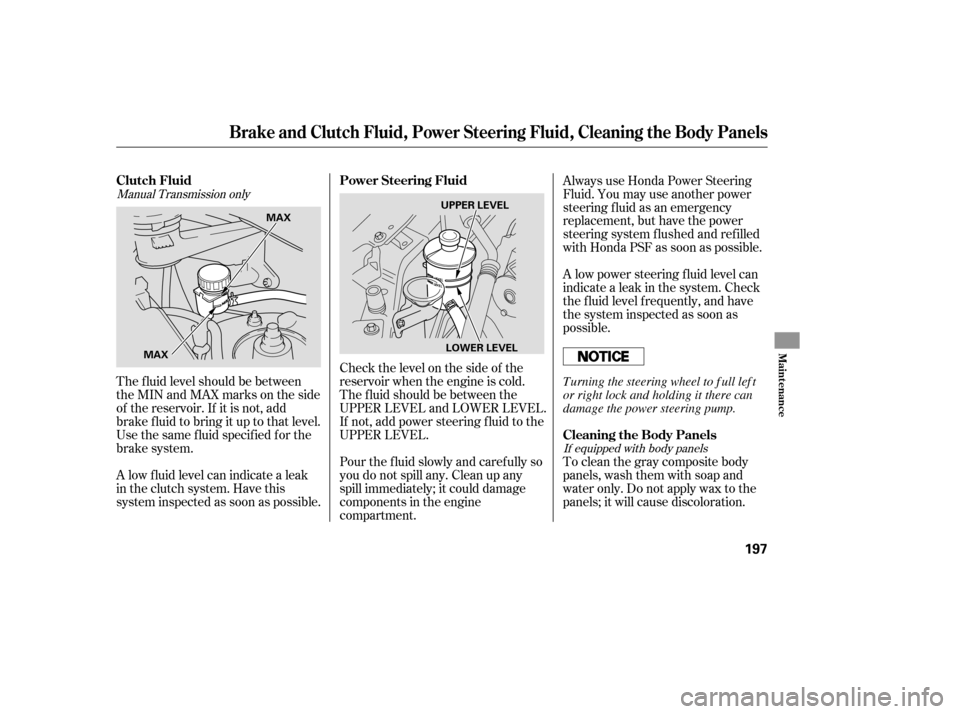
panels; it will cause discoloration. Always use Honda Power Steering
Fluid. You may use another power
steering f luid as an emergency
replacement, but have the power
steering system f lushed and ref illed
with Honda PSF as soon as possible.
Check the level on the side of the
reservoir when the engine is cold.
The f luid should be between the
UPPER LEVEL and LOWER LEVEL.
If not, add power steering f luid to the
UPPER LEVEL.
Pour the f luid slowly and caref ully so
you do not spill any. Clean up any
spill immediately; it could damage
components in the engine
compartment.
The f luid level should be between
theMINandMAXmarksontheside
of the reservoir. If it is not, add
brake f luid to bring it up to that level.
Use the same fluid specified for the
brake system.
A low f luid level can indicate a leak
in the clutch system. Have this
system inspected as soon as possible.
If equipped with body panels
Manual Transmission only
Cleaning the Body Panels
Power Steering Fluid
Clutch Fluid
Brake and Clutch Fluid, Power Steering Fluid, Cleaning the Body Panels
Maint enance
197
UPPER LEVEL
LOWER LEVEL
MAX
MAX
Turning the steering wheel to f ull lef t
or right lock and holding it there can
damage the power steering pump.
Page 211 of 275

Keeping the tires properly inf lated
provides the best combination of
handling, tread lif e, and riding
comf ort.Underinf lated tires wear unevenly,
adversely affect handling and fuel
economy, and are more likely to
fail from being overheated.
Overinf lated tires can make your
vehicleridemoreharshly,are
more prone to damage f rom road
hazards, and wear unevenly.
To saf ely operate your vehicle, your
tires must be the proper type and
size, in good condition with adequate
tread, and correctly inf lated.
The f ollowing pages give more
detailed inf ormation on how to take
care of your tires and what to do
when they need to be replaced.
Clean the wheels as you would the
rest of the exterior. Wash them with
thesamesolution,andrinsethem
thoroughly.
Aluminum alloy wheels have a
protective clear-coat that keeps the
aluminum f rom corroding and
tarnishing. Cleaning the wheels with
harsh chemicals (including some
commercial wheel cleaners) or a stif f
brush can damage the clear-coat. To
clean the wheels, use a mild
detergent and a sof t brush or sponge.
We recommend that you visually
check your tires every day. If you
think a tire might be low, check it
immediately with a tire gauge.
If equipped
T iresInf lation Guidelines
Wheels
Wheels, Tires
208
Using tires that are excessively
worn or improperly inflated can
cause a crash in which you can
be seriously hurt or killed.
Follow all instructions in this
owner’s manual regarding tire
inflation and maintenance.
Page 214 of 275
Replace your tires with radial tires of
the same size, load range, speed
rating, and maximum cold tire
pressure rating (as shown on the
tire’s sidewall).
Mixing radial and bias-ply tires on
your vehicle can reduce braking
ability, traction, and steering
accuracy. Using tires of a dif f erent
size or construction can cause the
ABS to work inconsistently.
TheABSworksbycomparingthe
speed of the wheels. When replacing
tires, use the same size originally
supplied with the vehicle. Tire size
and construction can affect wheel
speed and may cause the system to
activate.
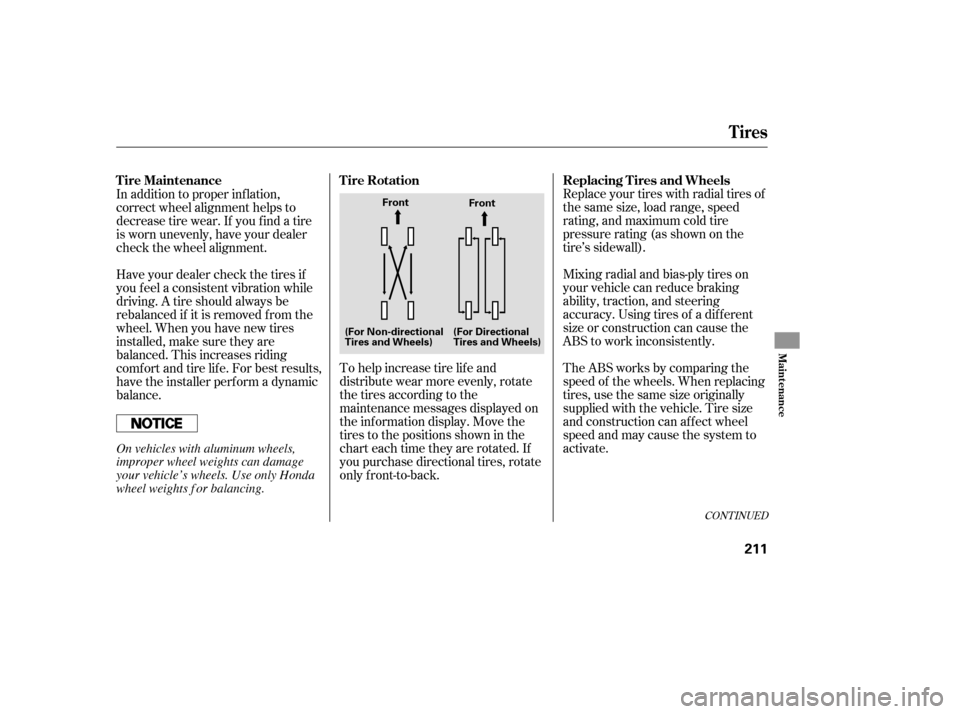
To help increase tire lif e and
distribute wear more evenly, rotate
the tires according to the
maintenance messages displayed on
the information display. Move the
tires to the positions shown in the
chart each time they are rotated. If
you purchase directional tires, rotate
only f ront-to-back.
In addition to proper inf lation,
correct wheel alignment helps to
decrease tire wear. If you f ind a tire
is worn unevenly, have your dealer
check the wheel alignment.
Have your dealer check the tires if
you f eel a consistent vibration while
driving. A tire should always be
rebalanced if it is removed f rom the
wheel. When you have new tires
installed, make sure they are
balanced. This increases riding
comf ort and tire lif e. For best results,
have the installer perform a dynamic
balance.
CONT INUED
Replacing T ires and Wheels
Tire Rotation
T ire Maintenance
Tires
Maint enance
211
Front
Front
(For Non-directional
Tires and Wheels) (For Directional
Tires and Wheels)
On vehicles with aluminum wheels,
improper wheel weights can damage
your vehicle’s wheels. Use only Honda
wheel weights f or balancing.