flat tire HONDA ELEMENT 2009 1.G User Guide
[x] Cancel search | Manufacturer: HONDA, Model Year: 2009, Model line: ELEMENT, Model: HONDA ELEMENT 2009 1.GPages: 345, PDF Size: 18.9 MB
Page 278 of 345
Tire Maintenance
In addition to proper inflation, correct
wheel alignment helps to decrease
tire wear. If you find a tire is worn
unevenly, have your dealer check the
wheel alignment.
Have your dealer check the tires if
you feel a consistent vibration while
driving. A tire should always be
rebalanced if it is removed from the
wheel. When you have new tires
installed, make sure they are
balanced. This increases riding
comfort and tire life. For best results,
have the installer perform a dynamic
balance.On vehicles with aluminum wheels,
improper wheel weights can damage
your vehicle's aluminum wheels. Use
only Honda wheel weights for
balancing.Tire Rotation
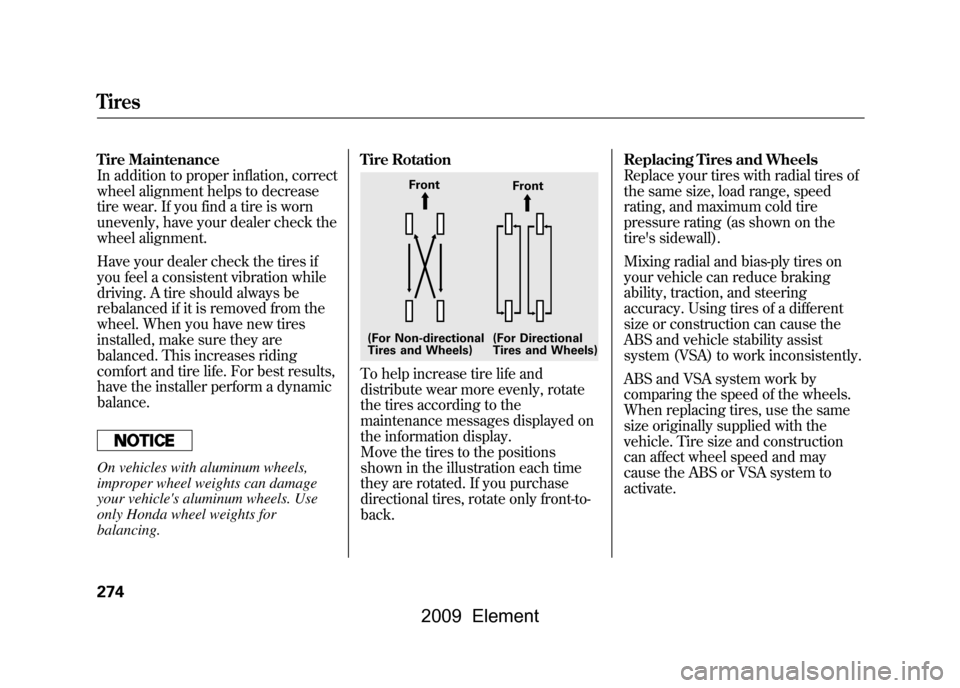
To help increase tire life and
distribute wear more evenly, rotate
the tires according to the
maintenance messages displayed on
the information display.
Move the tires to the positions
shown in the illustration each time
they are rotated. If you purchase
directional tires, rotate only front-to-
back.
Replacing Tires and Wheels
Replace your tires with radial tires of
the same size, load range, speed
rating, and maximum cold tire
pressure rating (as shown on the
tire's sidewall).
Mixing radial and bias-ply tires on
your vehicle can reduce braking
ability, traction, and steering
accuracy. Using tires of a different
size or construction can cause the
ABS and vehicle stability assist
system (VSA) to work inconsistently.
ABS and VSA system work by
comparing the speed of the wheels.
When replacing tires, use the same
size originally supplied with the
vehicle. Tire size and construction
can affect wheel speed and may
cause the ABS or VSA system to
activate.
Front
Front
(For Non-directional
Tires and Wheels) (For Directional
Tires and Wheels)
Tires274
2009 Element
Page 285 of 345

This section covers the more
common problems that motorists
experience with their vehicles. It
gives you information about how to
safely evaluate the problem and what
to do to correct it. If the problem has
stranded you on the side of the road,
you may be able to get going again. If
not, you will also find instructions on
getting your vehicle towed.Compact Spare Tire
....................
282
Changing a Flat Tire
...................
283
If the Engine Won't Start
.............
289
Jump Starting
..............................
291
If the Engine Overheats
..............
293
Low Oil Pressure Indicator
.........
295
Charging System Indicator
.........
295
Malfunction Indicator Lamp
........
296
Brake System Indicator
...............
297
Fuses
..........................................
298
Fuse Locations
............................
301
Emergency Towing
.....................
303
Taking Care of the Unexpected
281
Taking Care of the Unexpected
2009 Element
Page 286 of 345
Use the compact spare tire as a
temporary replacement only. Get
your regular tire repaired or
replaced, and put it back on your
vehicle as soon as you can.
Check the inflation pressure of the
compact spare tire every time you
check the other tires. It should be
inflated to:
60 psi (420 kPa, 4.2 kgf/cm
2)
Follow these precautions:
●Never exceed 50 mph (80 km/h).●This tire gives a harsher ride and
less traction on some road
surfaces. Use greater caution while
driving.●Do not mount snow chains on the
compact spare tire.
●Do not use your compact spare tire
on another vehicle unless it is the
same make and model.●The low tire pressure indicator
comes on and stays on after you
replace the flat tire with the
compact spare tire. After several
miles (kilometers) driving with the
compact spare tire, the TPMS
indicator comes on and the low tire
pressure indicator goes off.
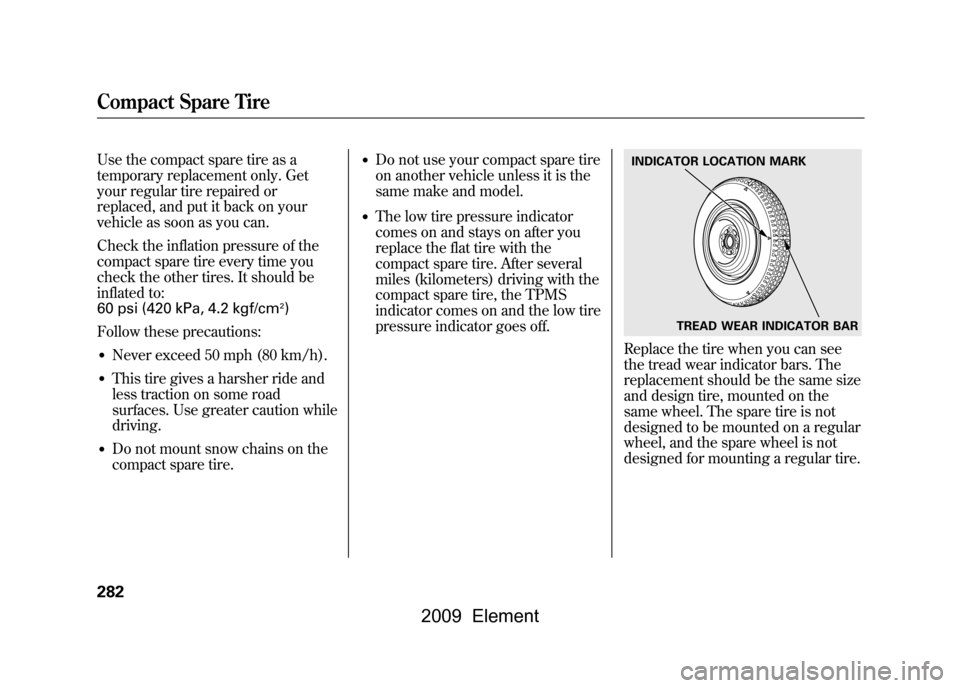
Replace the tire when you can see
the tread wear indicator bars. The
replacement should be the same size
and design tire, mounted on the
same wheel. The spare tire is not
designed to be mounted on a regular
wheel, and the spare wheel is not
designed for mounting a regular tire.INDICATOR LOCATION MARK
TREAD WEAR INDICATOR BAR
Compact Spare Tire282
2009 Element
Page 287 of 345
If you have a flat tire while driving,
stop in a safe place to change it.
Drive slowly along the shoulder until
you get to an exit or an area to stop
that is far away from the traffic lanes.
The vehicle can easily roll off
the jack, seriously injuring
anyone underneath.
Follow the directions for
changing a tire exactly, and
never get under the vehicle
when it is supported only by the
jack.1. Park the vehicle on firm, level, and
non-slippery ground. Put the
transmission in Park (automatic)
or reverse (manual). Apply the
parking brake.
If you are towing a trailer, unhitch
the trailer.
2. Turn on the hazard warning lights, and turn the ignition switch to the
LOCK (0) position. Have all
passengers get out of the vehicle
while you change the tire.
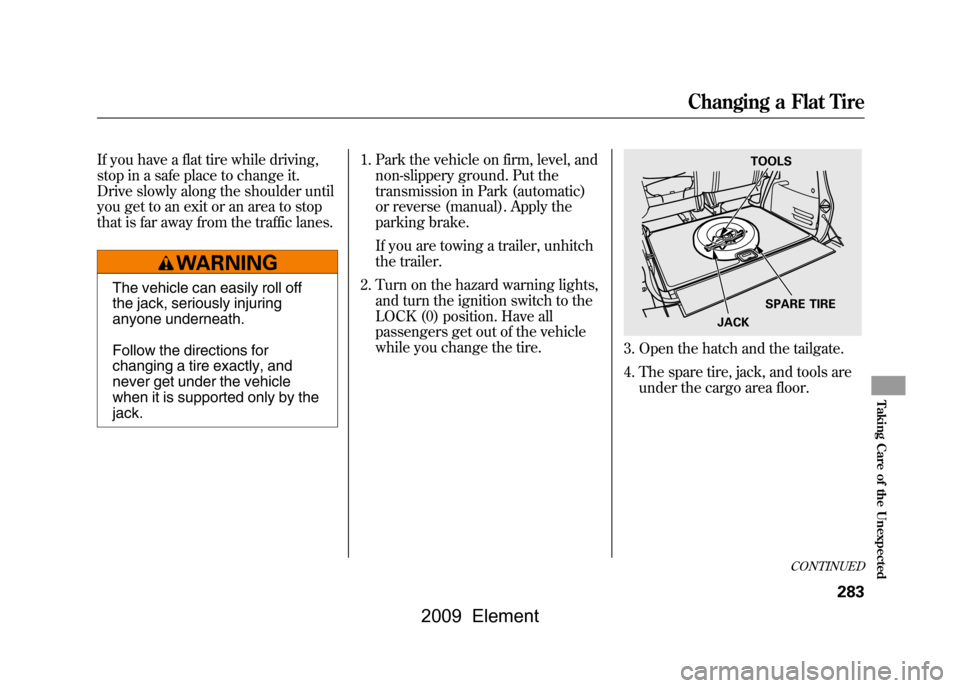
3. Open the hatch and the tailgate.
4. The spare tire, jack, and tools areunder the cargo area floor.
TOOLS
SPARE TIRE
JACK
CONTINUED
Changing a Flat Tire
283
Taking Care of the Unexpected
2009 Element
Page 288 of 345
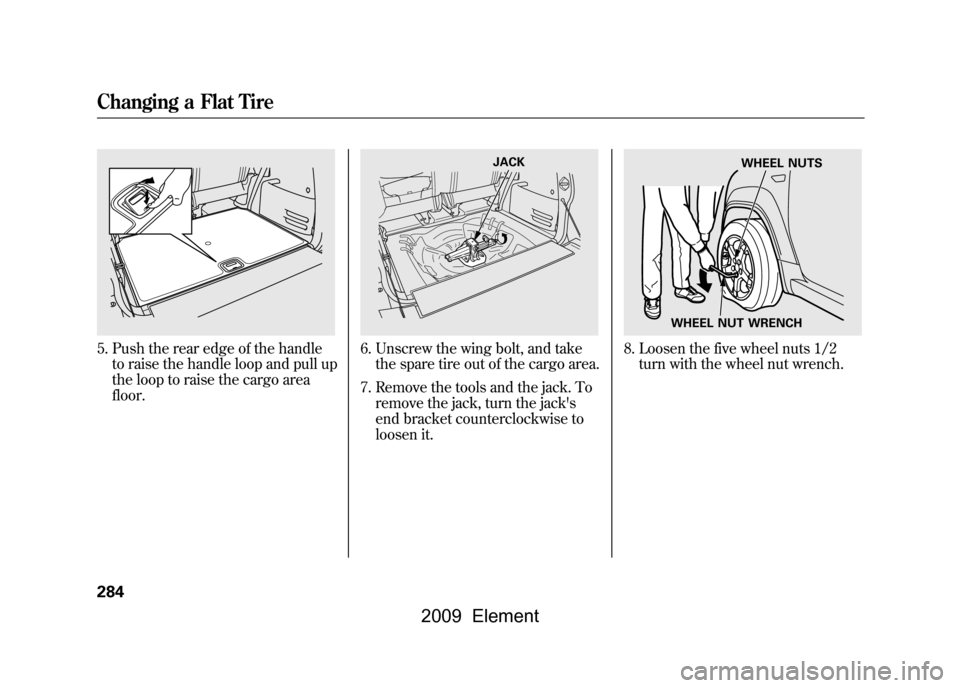
5. Push the rear edge of the handleto raise the handle loop and pull up
the loop to raise the cargo area
floor.
6. Unscrew the wing bolt, and takethe spare tire out of the cargo area.
7. Remove the tools and the jack. To remove the jack, turn the jack's
end bracket counterclockwise to
loosen it.
8. Loosen the five wheel nuts 1/2turn with the wheel nut wrench.
JACK
WHEEL NUTS
WHEEL NUT WRENCH
Changing a Flat Tire284
2009 Element
Page 289 of 345
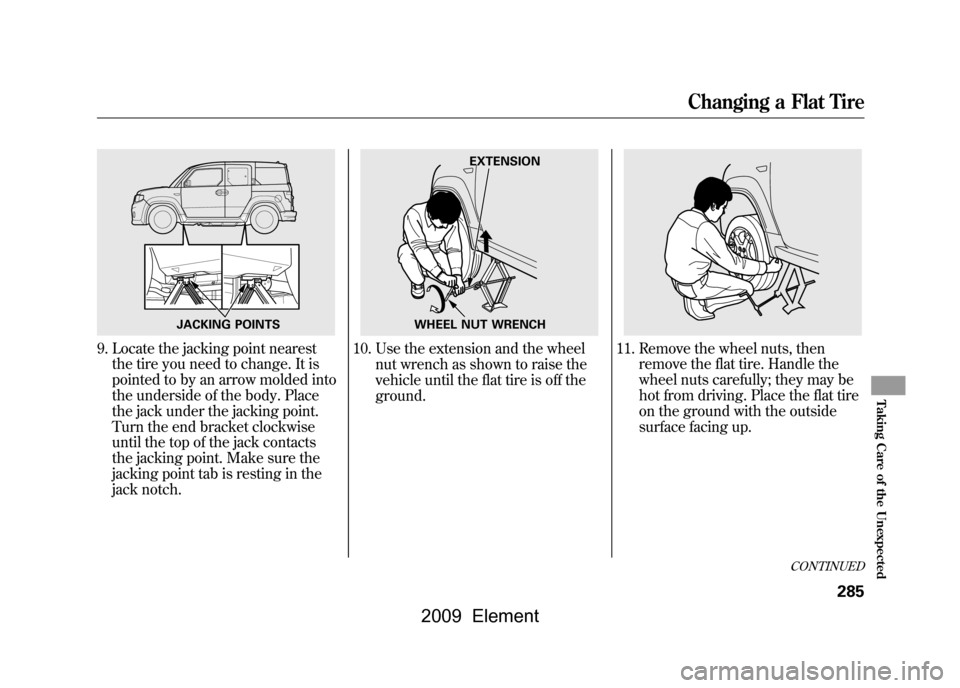
9. Locate the jacking point nearestthe tire you need to change. It is
pointed to by an arrow molded into
the underside of the body. Place
the jack under the jacking point.
Turn the end bracket clockwise
until the top of the jack contacts
the jacking point. Make sure the
jacking point tab is resting in the
jack notch.
10. Use the extension and the wheel nut wrench as shown to raise the
vehicle until the flat tire is off the
ground.
11. Remove the wheel nuts, thenremove the flat tire. Handle the
wheel nuts carefully; they may be
hot from driving. Place the flat tire
on the ground with the outside
surface facing up.
JACKING POINTS
EXTENSION
WHEEL NUT WRENCH
CONTINUED
Changing a Flat Tire
285
Taking Care of the Unexpected
2009 Element
Page 290 of 345
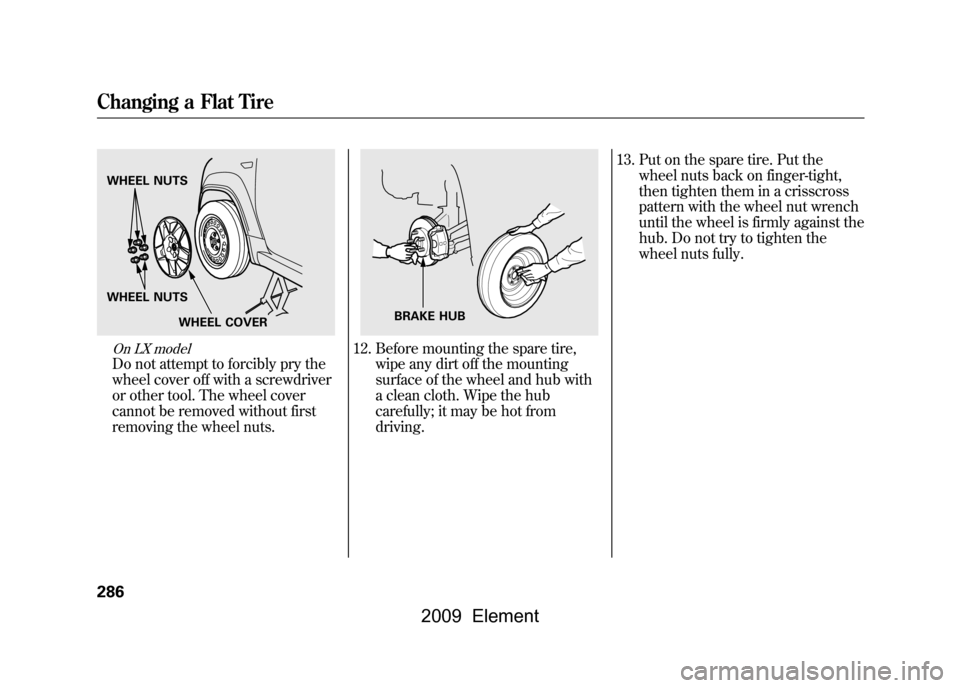
On LX modelDo not attempt to forcibly pry the
wheel cover off with a screwdriver
or other tool. The wheel cover
cannot be removed without first
removing the wheel nuts.
12. Before mounting the spare tire,wipe any dirt off the mounting
surface of the wheel and hub with
a clean cloth. Wipe the hub
carefully; it may be hot from
driving. 13. Put on the spare tire. Put the
wheel nuts back on finger-tight,
then tighten them in a crisscross
pattern with the wheel nut wrench
until the wheel is firmly against the
hub. Do not try to tighten the
wheel nuts fully.
WHEEL NUTS
WHEEL NUTS
WHEEL COVER
BRAKE HUB
Changing a Flat Tire286
2009 Element
Page 291 of 345
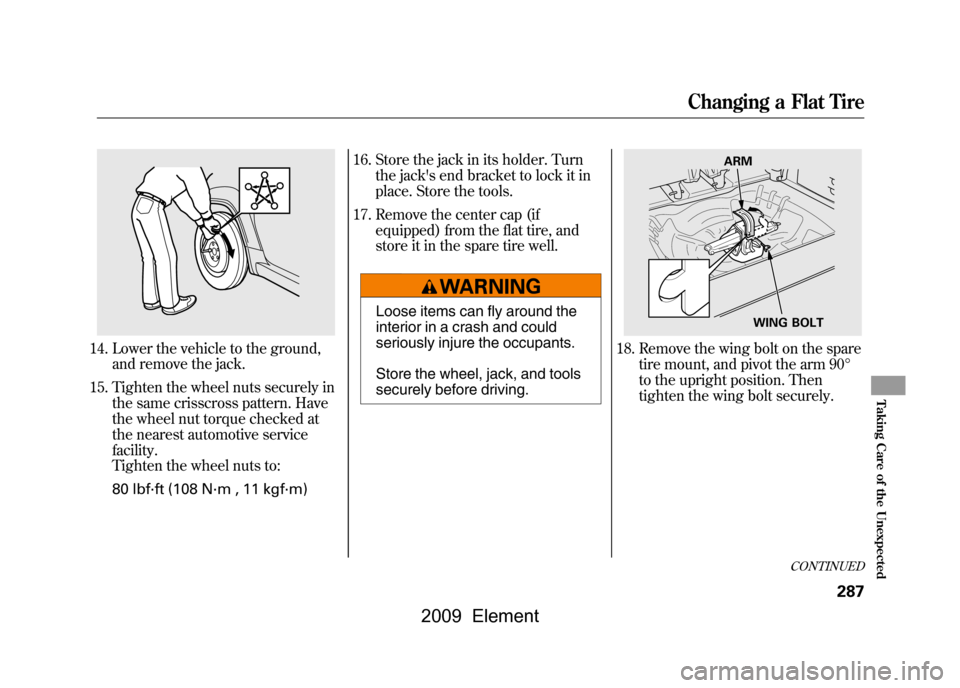
14. Lower the vehicle to the ground,and remove the jack.
15. Tighten the wheel nuts securely in the same crisscross pattern. Have
the wheel nut torque checked at
the nearest automotive service
facility.
Tighten the wheel nuts to:
80 lbf·ft (108 N·m , 11 kgf·m) 16. Store the jack in its holder. Turn
the jack's end bracket to lock it in
place. Store the tools.
17. Remove the center cap (if equipped) from the flat tire, and
store it in the spare tire well.
Loose items can fly around the
interior in a crash and could
seriously injure the occupants.
Store the wheel, jack, and tools
securely before driving.
18. Remove the wing bolt on the sparetire mount, and pivot the arm 90°
to the upright position. Then
tighten the wing bolt securely.
ARM
WING BOLT
CONTINUED
Changing a Flat Tire
287
Taking Care of the Unexpected
2009 Element
Page 292 of 345
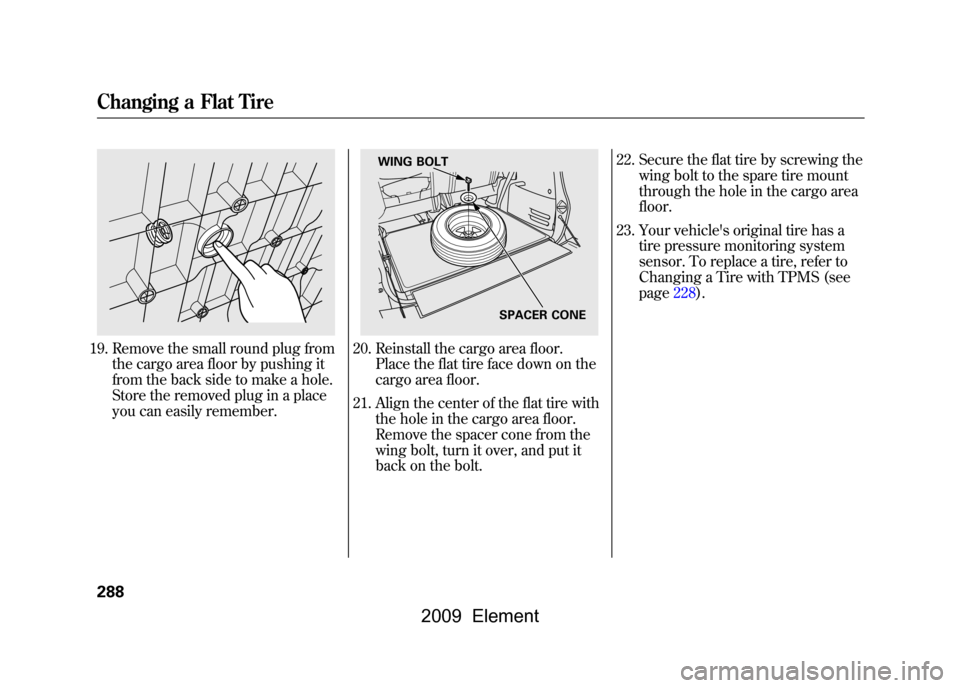
19. Remove the small round plug fromthe cargo area floor by pushing it
from the back side to make a hole.
Store the removed plug in a place
you can easily remember.
20. Reinstall the cargo area floor.Place the flat tire face down on the
cargo area floor.
21. Align the center of the flat tire with the hole in the cargo area floor.
Remove the spacer cone from the
wing bolt, turn it over, and put it
back on the bolt. 22. Secure the flat tire by screwing the
wing bolt to the spare tire mount
through the hole in the cargo area
floor.
23. Your vehicle's original tire has a tire pressure monitoring system
sensor. To replace a tire, refer to
Changing a Tire with TPMS (see
page228).
SPACER CONE
WING BOLT
Changing a Flat Tire288
2009 Element
Page 307 of 345
If your vehicle needs to be towed,
call a professional towing service or
organization. Never tow your vehicle
with just a rope or chain. It is very
dangerous.
The only way you can safely tow
your vehicle is with flat-bed
equipment.The operator will load
your vehicle on the back of a truck.
Any other method of towing will
damage the drive system. When you
contact the towing agency, inform
them a flat-bed is required.
4WD models onlyTowing with only two tires on the
ground will damage parts of the 4WD
system. It should be transported on a
flat-bed truck or trailer.
Emergency Towing
303
Taking Care of the Unexpected
2009 Element