fuel cap HONDA ELEMENT 2009 1.G User Guide
[x] Cancel search | Manufacturer: HONDA, Model Year: 2009, Model line: ELEMENT, Model: HONDA ELEMENT 2009 1.GPages: 345, PDF Size: 18.9 MB
Page 313 of 345

CapacitiesFuel tank Approx.
15.9 US gal (60 L)
Engine oil Change
ꭧ 1
Including filter 4.4 US qt (4.2 L)
Without filter 4.2 US qt (4.0 L)
Total 5.6 US qt (5.3 L)
Capacities
Engine
coolant Automatic
Transmission
Change
ꭧ2
1.35 US gal (5.1 L)
Total 1.90 US gal (7.2 L)
Manual
Transmission Change
ꭧ2
1.37 US gal (5.2 L)
Total 1.93 US gal (7.3 L)
Automatic
transmission
fluid Change
4WD 2.6 US qt (2.5 L)
2WD 2.7 US qt (2.6 L)
Total 4WD 7.6 US qt (7.2 L)
2WD 7.4 US qt (7.0 L)
Manual
transmission
fluid Change
2.0 US qt (1.9 L)
Total
4WD 2.4 US qt (2.3 L)
2WD 2.3 US qt (2.2 L)
Rear
differential
fluid (4WD) Change
1.1 US qt (1.0 L)
Total 1.3 US qt (1.2 L)
Windshield washer reservoir 4.8 US qt (4.5 L)
ꭧ1: Excluding the oil remaining in the engine
ꭧ2: Including the coolant in the reserve tank and that remaining in the engine
Reserve tank capacity:
0.15 US gal (0.55 L)
Specifications
309
Technical Information
2009 Element
Page 320 of 345

The burning of gasoline in your
vehicle's engine produces several by-
products. Some of these are carbon
monoxide (CO), oxides of nitrogen
(NOx), and hydrocarbons (HC).
Gasoline evaporating from the tank
also produces hydrocarbons.
Controlling the production of NOx,
CO, and HC is important to the
environment. Under certain
conditions of sunlight and climate,
NOx and HC react to form
photochemical‘‘smog. ’’Carbon
monoxide does not contribute to
smog creation, but it is a poisonous
gas. The Clean Air Act
The United States Clean Air Act
ꭧsets
standards for automobile emissions. It
also requires that automobile
manufacturers explain to owners how
their emissions controls work and
what to do to maintain them. This
section summarizes how the
emissions controls work.
ꭧIn Canada, Honda vehicles comply
with the Canadian emission
requirements, as specified in an
agreement with Environment Canada,
at the time they are manufactured.Crankcase Emissions Control
SystemYour vehicle has a positive crankcase
ventilation system. This keeps gasses
that build up in the engine's crankcase
from going into the atmosphere. The
positive crankcase ventilation valve
routes them from the crankcase back
to the intake manifold. They are then
drawn into the engine and burned.
Evaporative Emissions Control
System
As gasoline evaporates in the fuel
tank, an evaporative emissions
control canister filled with charcoal
adsorbs the vapor. It is stored in this
canister while the engine is off. After
the engine is started and warmed up,
the vapor is drawn into the engine
and burned during driving.
Onboard Refueling Vapor
Recovery
The onboard refueling vapor
recovery (ORVR) system captures
the fuel vapors during refueling. The
vapors are adsorbed in a canister
filled with activated carbon. While
driving, the fuel vapors are drawn
into the engine and burned off.
Emissions Controls316
2009 Element
Page 332 of 345
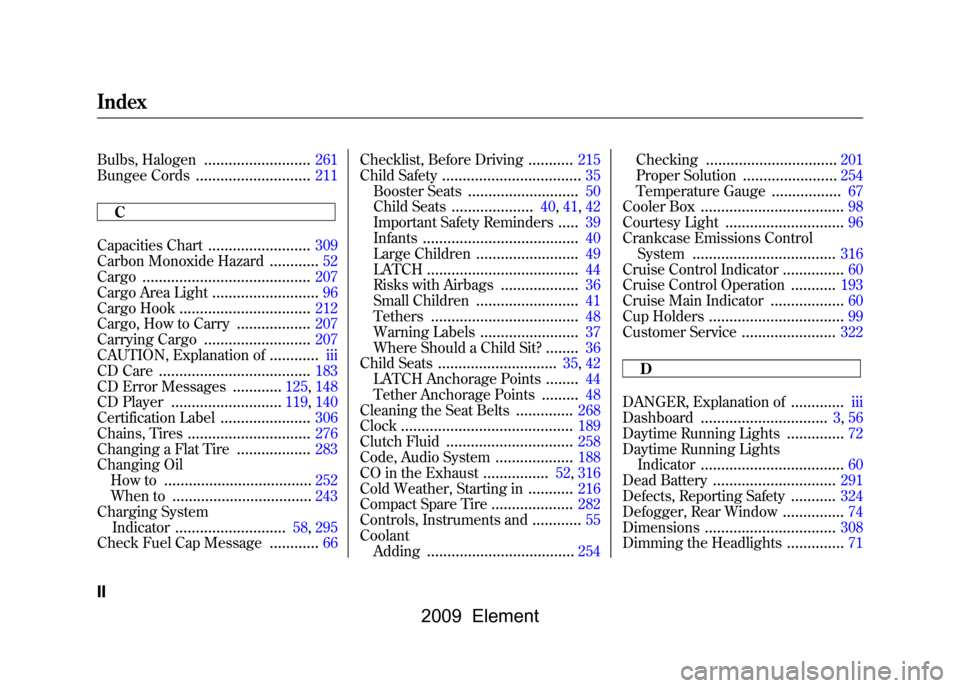
Bulbs, Halogen
..........................
261
Bungee Cords
............................
211
C
Capacities Chart
.........................
309
Carbon Monoxide Hazard
............
52
Cargo
.........................................
207
Cargo Area Light
..........................
96
Cargo Hook
................................
212
Cargo, How to Carry
..................
207
Carrying Cargo
..........................
207
CAUTION, Explanation of
............
iii
CD Care
.....................................
183
CD Error Messages
............
125,148
CD Player
...........................
119,140
Certification Label
......................
306
Chains, Tires
..............................
276
Changing a Flat Tire
..................
283
Changing Oil How to
....................................
252
When to
..................................
243
Charging System
Indicator
...........................
58,295
Check Fuel Cap Message
............
66 Checklist, Before Driving
...........
215
Child Safety
..................................
35
Booster Seats
...........................
50
Child Seats
....................
40,41, 42
Important Safety Reminders
.....
39
Infants
......................................
40
Large Children
.........................
49
LATCH
.....................................
44
Risks with Airbags
...................
36
Small Children
.........................
41
Tethers
....................................
48
Warning Labels
........................
37
Where Should a Child Sit?
........
36
Child Seats
.............................
35,42
LATCH Anchorage Points
........
44
Tether Anchorage Points
.........
48
Cleaning the Seat Belts
..............
268
Clock
..........................................
189
Clutch Fluid
...............................
258
Code, Audio System
...................
188
CO in the Exhaust
................
52,316
Cold Weather, Starting in
...........
216
Compact Spare Tire
....................
282
Controls, Instruments and
............
55
Coolant Adding
....................................
254 Checking
................................
201
Proper Solution
.......................
254
Temperature Gauge
.................
67
Cooler Box
...................................
98
Courtesy Light
.............................
96
Crankcase Emissions Control System
...................................
316
Cruise Control Indicator
...............
60
Cruise Control Operation
...........
193
Cruise Main Indicator
..................
60
Cup Holders
.................................
99
Customer Service
.......................
322
D
DANGER, Explanation of
.............
iii
Dashboard
...............................
3,56
Daytime Running Lights
..............
72
Daytime Running Lights Indicator
...................................
60
Dead Battery
..............................
291
Defects, Reporting Safety
...........
324
Defogger, Rear Window
...............
74
Dimensions
................................
308
Dimming the Headlights
..............
71
IndexII
2009 Element
Page 334 of 345
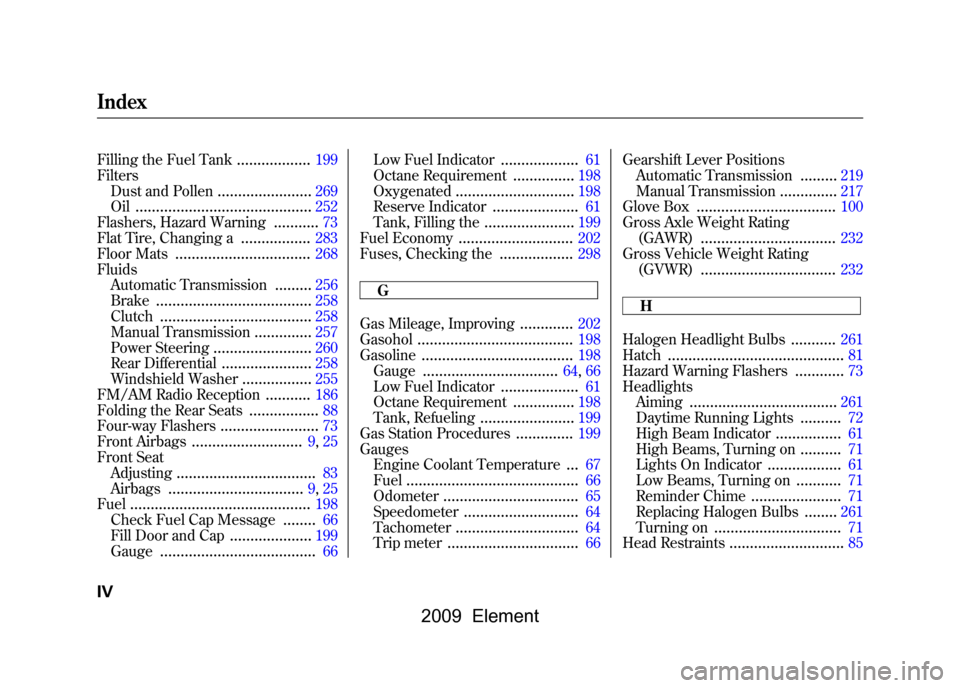
Filling the Fuel Tank
..................
199
Filters Dust and Pollen
.......................
269
Oil
...........................................
252
Flashers, Hazard Warning
...........
73
Flat Tire, Changing a
.................
283
Floor Mats
.................................
268
Fluids Automatic Transmission
.........
256
Brake
......................................
258
Clutch
.....................................
258
Manual Transmission
..............
257
Power Steering
........................
260
Rear Differential
......................
258
Windshield Washer
.................
255
FM/AM Radio Reception
...........
186
Folding the Rear Seats
.................
88
Four-way Flashers
........................
73
Front Airbags
...........................
9,25
Front Seat Adjusting
..................................
83
Airbags
.................................
9,25
Fuel
............................................
198
Check Fuel Cap Message
........
66
Fill Door and Cap
....................
199
Gauge
......................................
66 Low Fuel Indicator
...................
61
Octane Requirement
...............
198
Oxygenated
.............................
198
Reserve Indicator
.....................
61
Tank, Filling the
......................
199
Fuel Economy
............................
202
Fuses, Checking the
..................
298
G
Gas Mileage, Improving
.............
202
Gasohol
......................................
198
Gasoline
.....................................
198
Gauge
.................................
64,66
Low Fuel Indicator
...................
61
Octane Requirement
...............
198
Tank, Refueling
.......................
199
Gas Station Procedures
..............
199
Gauges Engine Coolant Temperature...
67
Fuel
..........................................
66
Odometer
.................................
65
Speedometer
............................
64
Tachometer
..............................
64
Trip meter
................................
66 Gearshift Lever Positions
Automatic Transmission
.........
219
Manual Transmission
..............
217
Glove Box
..................................
100
Gross Axle Weight Rating (GAWR)
.................................
232
Gross Vehicle Weight Rating (GVWR)
.................................
232
H
Halogen Headlight Bulbs
...........
261
Hatch
...........................................
81
Hazard Warning Flashers
............
73
Headlights Aiming
....................................
261
Daytime Running Lights
..........
72
High Beam Indicator
................
61
High Beams, Turning on
..........
71
Lights On Indicator
..................
61
Low Beams, Turning on
...........
71
Reminder Chime
......................
71
Replacing Halogen Bulbs
........
261
Turning on
...............................
71
Head Restraints
............................
85
IndexIV
2009 Element
Page 344 of 345
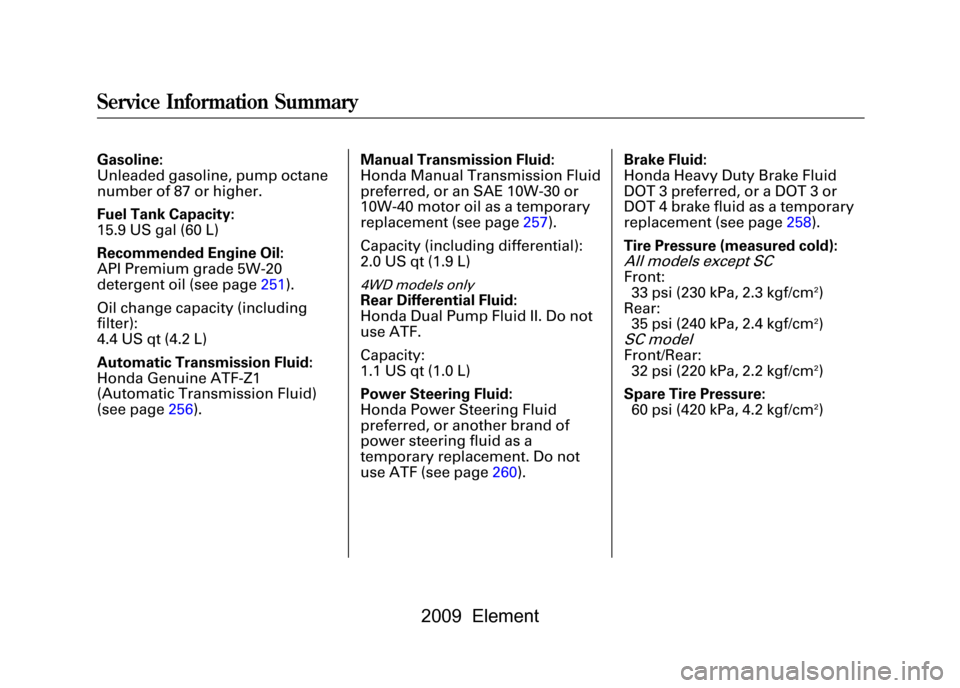
Gasoline:
Unleaded gasoline, pump octane
number of 87 or higher.
Fuel Tank Capacity:
15.9 US gal (60 L)
Recommended Engine Oil:
API Premium grade 5W-20
detergent oil (see page251).
Oil change capacity (including
filter):
4.4 US qt (4.2 L)
Automatic Transmission Fluid:
Honda Genuine ATF-Z1
(Automatic Transmission Fluid)
(see page256).Manual Transmission Fluid:
Honda Manual Transmission Fluid
preferred, or an SAE 10W-30 or
10W-40 motor oil as a temporary
replacement (see page257).
Capacity (including differential):
2.0 US qt (1.9 L)
4WD models onlyRear Differential Fluid:
Honda Dual Pump Fluid II. Do not
use ATF.
Capacity:
1.1 US qt (1.0 L)
Power Steering Fluid:
Honda Power Steering Fluid
preferred, or another brand of
power steering fluid as a
temporary replacement. Do not
use ATF (see page260).Brake Fluid:
Honda Heavy Duty Brake Fluid
DOT 3 preferred, or a DOT 3 or
DOT 4 brake fluid as a temporary
replacement (see page258).
Tire Pressure (measured cold):
All models except SCFront:
33 psi (230 kPa, 2.3 kgf/cm
2)
Rear: 35 psi (240 kPa, 2.4 kgf/cm2)
SC modelFront/Rear:32 psi (220 kPa, 2.2 kgf/cm
2)
Spare Tire Pressure: 60 psi (420 kPa, 4.2 kgf/cm2)
Service Information Summary
2009 Element