air condition HONDA ELEMENT 2009 1.G Owner's Manual
[x] Cancel search | Manufacturer: HONDA, Model Year: 2009, Model line: ELEMENT, Model: HONDA ELEMENT 2009 1.GPages: 345, PDF Size: 18.9 MB
Page 300 of 345
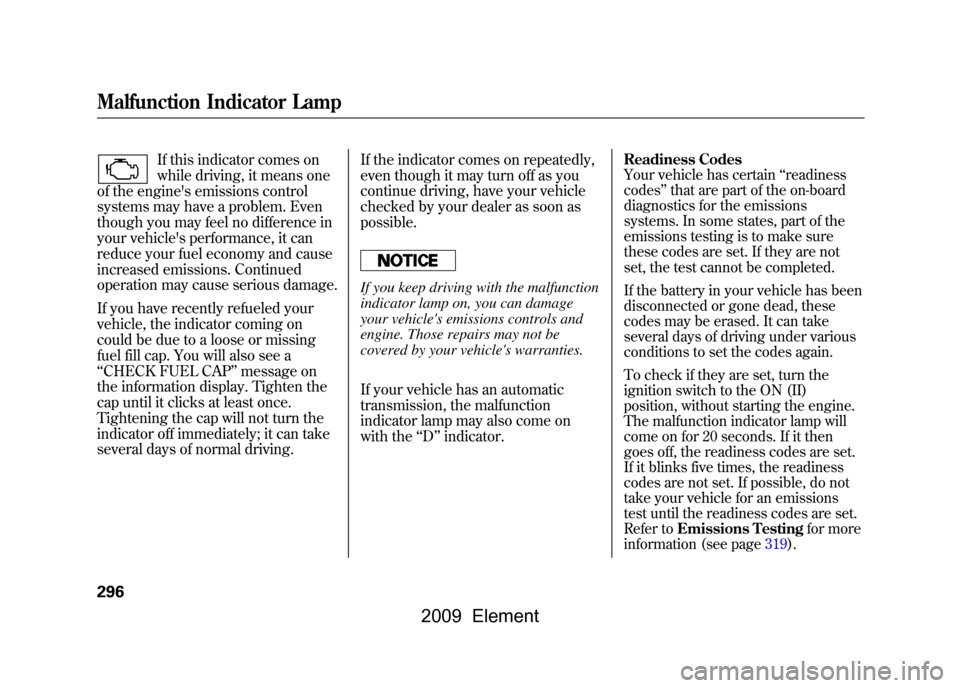
If this indicator comes on
while driving, it means one
of the engine's emissions control
systems may have a problem. Even
though you may feel no difference in
your vehicle's performance, it can
reduce your fuel economy and cause
increased emissions. Continued
operation may cause serious damage.
If you have recently refueled your
vehicle, the indicator coming on
could be due to a loose or missing
fuel fill cap. You will also see a
‘‘ CHECK FUEL CAP ’’message on
the information display. Tighten the
cap until it clicks at least once.
Tightening the cap will not turn the
indicator off immediately; it can take
several days of normal driving. If the indicator comes on repeatedly,
even though it may turn off as you
continue driving, have your vehicle
checked by your dealer as soon as
possible.
If you keep driving with the malfunction
indicator lamp on, you can damage
your vehicle's emissions controls and
engine. Those repairs may not be
covered by your vehicle's warranties.
If your vehicle has an automatic
transmission, the malfunction
indicator lamp may also come on
with the
‘‘D ’’indicator.
Readiness CodesYour vehicle has certain ‘‘readiness
codes ’’that are part of the on-board
diagnostics for the emissions
systems. In some states, part of the
emissions testing is to make sure
these codes are set. If they are not
set, the test cannot be completed.
If the battery in your vehicle has been
disconnected or gone dead, these
codes may be erased. It can take
several days of driving under various
conditions to set the codes again.
To check if they are set, turn the
ignition switch to the ON (II)
position, without starting the engine.
The malfunction indicator lamp will
come on for 20 seconds. If it then
goes off, the readiness codes are set.
If it blinks five times, the readiness
codes are not set. If possible, do not
take your vehicle for an emissions
test until the readiness codes are set.
Refer to Emissions Testing for more
information (see page319).
Malfunction Indicator Lamp296
2009 Element
Page 301 of 345
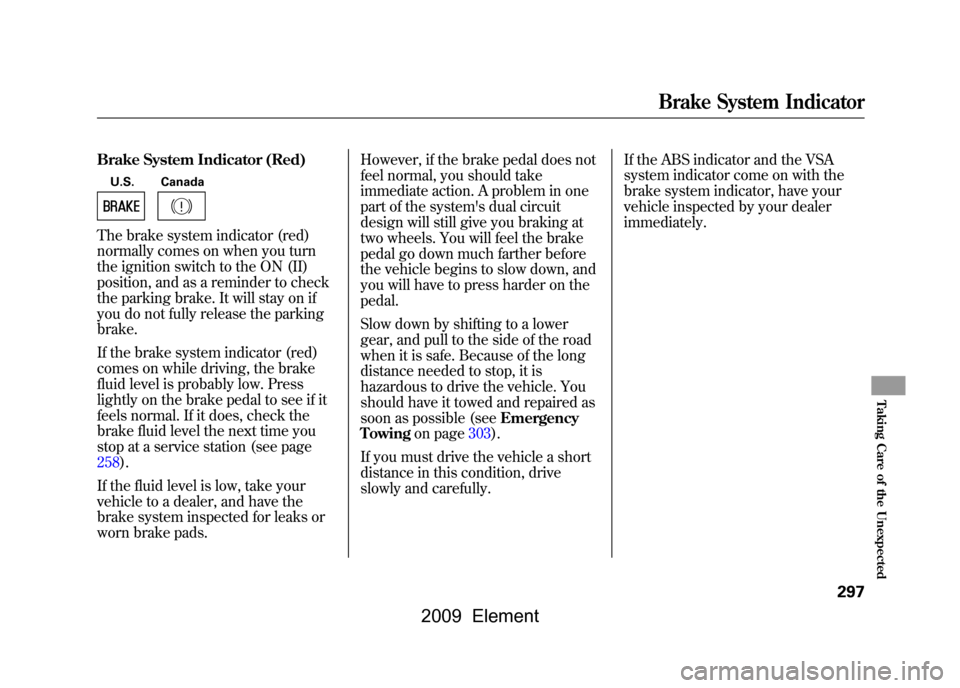
Brake System Indicator (Red)U.S. CanadaThe brake system indicator (red)
normally comes on when you turn
the ignition switch to the ON (II)
position, and as a reminder to check
the parking brake. It will stay on if
you do not fully release the parking
brake.
If the brake system indicator (red)
comes on while driving, the brake
fluid level is probably low. Press
lightly on the brake pedal to see if it
feels normal. If it does, check the
brake fluid level the next time you
stop at a service station (see page
258).
If the fluid level is low, take your
vehicle to a dealer, and have the
brake system inspected for leaks or
worn brake pads.However, if the brake pedal does not
feel normal, you should take
immediate action. A problem in one
part of the system's dual circuit
design will still give you braking at
two wheels. You will feel the brake
pedal go down much farther before
the vehicle begins to slow down, and
you will have to press harder on the
pedal.
Slow down by shifting to a lower
gear, and pull to the side of the road
when it is safe. Because of the long
distance needed to stop, it is
hazardous to drive the vehicle. You
should have it towed and repaired as
soon as possible (see
Emergency
Towing on page303).
If you must drive the vehicle a short
distance in this condition, drive
slowly and carefully. If the ABS indicator and the VSA
system indicator come on with the
brake system indicator, have your
vehicle inspected by your dealer
immediately.
Brake System Indicator
297
Taking Care of the Unexpected
2009 Element
Page 314 of 345

Air ConditioningRefrigerant type HFC-134a (R-134a)
Charge quantity 17.6-19.4 oz (500 -550 g)
Lubricant type ND-OIL8
Lights Headlights 12 V-60/55 W (H4/HB2)
Daytime running lights 12 V-60 W (HB3)
Front turn signal/parking lights 12 V -27/8 W (Amber)
Front side marker lights 12 V-3CP
Side turn signal lights 12 V-3CP
Rear turn signal lights 12 V-21 W (Amber)
Rear side marker lights 12 V-3CP
Brake/Taillights 12 V-21/5 W
Back-up lights 12 V-21CP
License plate lights 12 V-5W
Ceiling light 12 V-8W
ꭧ1
12 V -5W
ꭧ2, ꭧ3
Spotlights 12 V-8W
ꭧ2, ꭧ3
Cargo area light 12 V-8W
High-mount brake light 12 V-21 W
Battery Capacity 12 V-47 AH/20 HR
12 V -38 AH/5 HR Fuses
Interior See page301or the fuse label
attached to the inside of the fuse
box door under the steering
column.
Under-hood See page302or the fuse box cover.
Alignment Toe-in Front 0.0 in (0 mm)
Rear 0.08 in (2.0 mm)
Camber Front -0°13 ’
ꭧ1, ꭧ2
- 0°24 ’
ꭧ3
Rear -1°00 ’
ꭧ1, ꭧ2
- 1°06 ’
ꭧ3
Caster Front 1°50’
Tires Size Front/Rear P215/70R16 99S
ꭧ1, ꭧ2
P225/55R18 97H
ꭧ3
Pressure Front 33 psi (230 kPa, 2.3 kgf/cm
2)ꭧ1, ꭧ2
32 psi (220 kPa, 2.2 kgf/cm
2)ꭧ3
Rear 35 psi (240 kPa, 2.4 kgf/cm
2)ꭧ1, ꭧ2
32 psi (220 kPa, 2.2 kgf/cm
2)ꭧ3
Spare 60 psi (420 kPa, 4.2 kgf/cm
2)
ꭧ 1: LX model
ꭧ 2: EX model
ꭧ 3: SC model
Specifications310
2009 Element
Page 320 of 345

The burning of gasoline in your
vehicle's engine produces several by-
products. Some of these are carbon
monoxide (CO), oxides of nitrogen
(NOx), and hydrocarbons (HC).
Gasoline evaporating from the tank
also produces hydrocarbons.
Controlling the production of NOx,
CO, and HC is important to the
environment. Under certain
conditions of sunlight and climate,
NOx and HC react to form
photochemical‘‘smog. ’’Carbon
monoxide does not contribute to
smog creation, but it is a poisonous
gas. The Clean Air Act
The United States Clean Air Act
ꭧsets
standards for automobile emissions. It
also requires that automobile
manufacturers explain to owners how
their emissions controls work and
what to do to maintain them. This
section summarizes how the
emissions controls work.
ꭧIn Canada, Honda vehicles comply
with the Canadian emission
requirements, as specified in an
agreement with Environment Canada,
at the time they are manufactured.Crankcase Emissions Control
SystemYour vehicle has a positive crankcase
ventilation system. This keeps gasses
that build up in the engine's crankcase
from going into the atmosphere. The
positive crankcase ventilation valve
routes them from the crankcase back
to the intake manifold. They are then
drawn into the engine and burned.
Evaporative Emissions Control
System
As gasoline evaporates in the fuel
tank, an evaporative emissions
control canister filled with charcoal
adsorbs the vapor. It is stored in this
canister while the engine is off. After
the engine is started and warmed up,
the vapor is drawn into the engine
and burned during driving.
Onboard Refueling Vapor
Recovery
The onboard refueling vapor
recovery (ORVR) system captures
the fuel vapors during refueling. The
vapors are adsorbed in a canister
filled with activated carbon. While
driving, the fuel vapors are drawn
into the engine and burned off.
Emissions Controls316
2009 Element
Page 321 of 345

Exhaust Emissions Controls
The exhaust emissions controls
include three systems: PGM-FI,
ignition timing control, and three
way catalytic converter. These three
systems work together to control the
engine's combustion and minimize
the amount of HC, CO, and NOx that
comes out the tailpipe. The exhaust
emissions control systems are
separate from the crankcase and
evaporative emissions control
systems.
PGM-FI SystemThe PGM-FI system uses sequential
multiport fuel injection. It has three
subsystems: air intake, engine
control, and fuel control. The
powertrain control module (PCM) in
automatic transmission vehicles or
the engine control module (ECM) in
manual transmission vehicles uses
various sensors to determine how
much air is going into the engine. It
then controls how much fuel to inject
under all operating conditions.Ignition Timing Control SystemThis system constantly adjusts the
ignition timing, reducing the amount
of HC, CO, and NOx produced.Three Way Catalytic ConverterThe three way catalytic converter is
in the exhaust system. Through
chemical reactions, it converts HC,
CO, and NOx in the engine's exhaust
to carbon dioxide (CO
2), nitrogen
(N
2), and water vapor. Replacement Parts
The emissions control systems are
designed and certified to work
together in reducing emissions to
levels that comply with the Clean Air
Act. To make sure the emissions
remain low, you should use only new
Honda replacement parts or their
equivalent for repairs. Using lower
quality parts may increase the
emissions from your vehicle.
The emissions control systems are
covered by warranties separate from
the rest of your vehicle. Read your
warranty manual for more
information.
Emissions Controls
317
Technical Information
2009 Element
Page 331 of 345
A
Accessories andModifications
..........................
205
ACCESSORY (Ignition Key Position)
...................................
79
Accessory Power Sockets
..........
100
Additives, Engine Oil
.................
252
Adjusting the Steering Wheel
......
74
Advanced Airbags
........................
27
Airbag (SRS)
............................
9,22
Air Conditioning System
............
104
Air Pressure, Tires
..............
271,272
Alcohol in Gasoline
....................
198
Antifreeze
...................................
254
Anti-lock Brakes (ABS) Indicator Light
..................
59,225
Operation
................................
225
Anti-theft, Audio System
.............
188
Anti-theft Steering Column Lock
.........................................
79
Audio System
.............................
109
Automatic Seat Belt Tensioners...
20
Automatic Speed Control
...........
193 Automatic Transmission
............
219
Capacity, Fluid
........................
309
Checking Fluid Level
..............
256
Shifting
...................................
219
Shift Lever Position Indicators
............................
219
Shift Lock Release
...................
221
Automatic Transmission Fluid
...
256
Auxiliary Input Jack
...................
192
B
Battery Charging System
Indicator
........................
58,295
Jump Starting
..........................
291
Maintenance
...........................
277
Specifications
..........................
310
Before Driving
...........................
197
Belts, Seat
................................
8,18
Beverage Holders
........................
99
Booster Seats
...............................
50
Brakes
Anti-lock Brakes (ABS)
...........
225
Break-in, New Linings
.............
198 Bulb Replacement
...................
266
Fluid
.......................................
258
Parking
....................................
94
System Design
........................
224
System Indicator
...............
58,297
Wear Indicators
.......................
225
Braking System
..........................
224
Break-in, New Vehicle
................
198
Brightness Control, Instruments
..............................
72
Bulb Replacement Back-up Lights
........................
266
Brake Lights
...........................
266
Daytime Running Lights
.........
262
Front Parking/Turn Signal Lights
..................................
263
Front Side Marker Lights
........
265
Headlights
..............................
261
High-mount Brake Lights
........
267
Rear Bulbs
..............................
266
Rear License Plate Lights
........
267
Side Turn Signal Lights
...........
264
Specifications
..........................
310
Taillights
.................................
266
Turn Signal Lights
..................
266
CONTINUED
Index
I
INDEX
2009 Element