weight HONDA ELEMENT 2009 1.G Owner's Manual
[x] Cancel search | Manufacturer: HONDA, Model Year: 2009, Model line: ELEMENT, Model: HONDA ELEMENT 2009 1.GPages: 345, PDF Size: 18.9 MB
Page 236 of 345
Your vehicle has been designed
primarily to carry passengers and
their cargo. You can also use it to tow
a trailer if you carefully observe the
load limits, use the proper
equipment, and follow the guidelines
in this section.Break-In PeriodAvoid towing a trailer during your
vehicle's first 600 miles (1,000 km)
(see page198).
Be sure to read theOff-Highway
Driving Guidelines section on page
238if you plan to tow off paved
surfaces.
Exceeding any load limit or
improperly loading your vehicle
and trailer can cause a crash in
which you can be seriously hurt
or killed.
Check the loading of your
vehicle and trailer carefully
before starting to drive. Load Limits
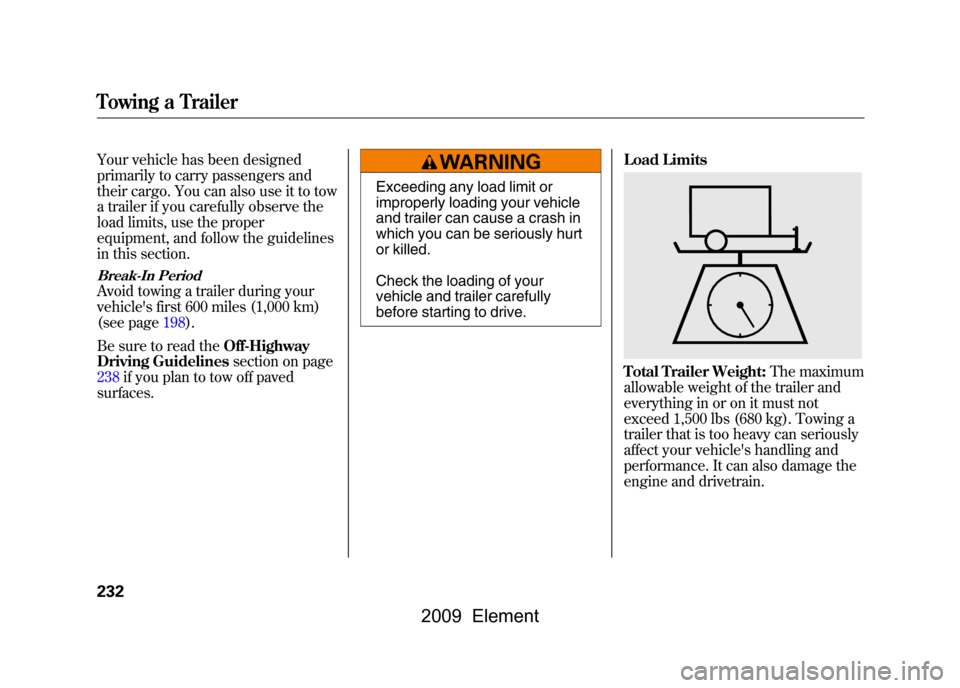
Total Trailer Weight:
The maximum
allowable weight of the trailer and
everything in or on it must not
exceed 1,500 lbs (680 kg). Towing a
trailer that is too heavy can seriously
affect your vehicle's handling and
performance. It can also damage the
engine and drivetrain.
Towing a Trailer232
2009 Element
Page 237 of 345
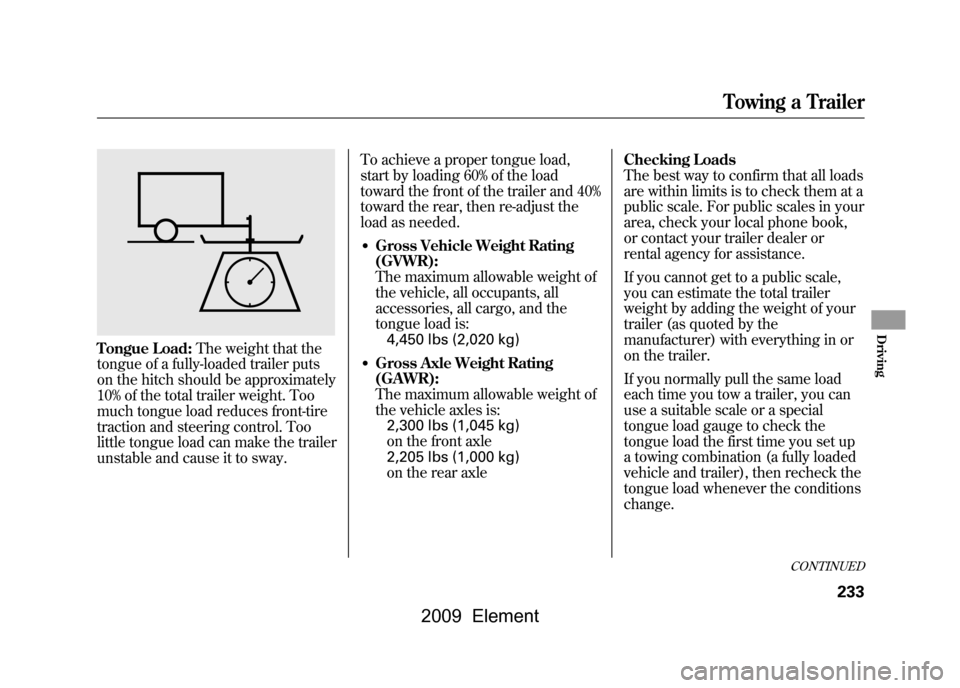
Tongue Load:The weight that the
tongue of a fully-loaded trailer puts
on the hitch should be approximately
10% of the total trailer weight. Too
much tongue load reduces front-tire
traction and steering control. Too
little tongue load can make the trailer
unstable and cause it to sway. To achieve a proper tongue load,
start by loading 60% of the load
toward the front of the trailer and 40%
toward the rear, then re-adjust the
load as needed.
●Gross Vehicle Weight Rating
(GVWR):
The maximum allowable weight of
the vehicle, all occupants, all
accessories, all cargo, and the
tongue load is:
4,450 lbs (2,020 kg)●Gross Axle Weight Rating
(GAWR):
The maximum allowable weight of
the vehicle axles is:2,300 lbs (1,045 kg)
on the front axle
2,205 lbs (1,000 kg)
on the rear axle Checking Loads
The best way to confirm that all loads
are within limits is to check them at a
public scale. For public scales in your
area, check your local phone book,
or contact your trailer dealer or
rental agency for assistance.
If you cannot get to a public scale,
you can estimate the total trailer
weight by adding the weight of your
trailer (as quoted by the
manufacturer) with everything in or
on the trailer.
If you normally pull the same load
each time you tow a trailer, you can
use a suitable scale or a special
tongue load gauge to check the
tongue load the first time you set up
a towing combination (a fully loaded
vehicle and trailer), then recheck the
tongue load whenever the conditions
change.
CONTINUED
Towing a Trailer
233
Driving
2009 Element
Page 238 of 345

Towing Equipment and
Accessories
Towing can require a variety of
equipment, depending on the size of
your trailer, how it will be used, how
much load you are towing, and
where you tow. To ensure the
highest quality equipment, purchase
Honda equipment whenever
possible.
Discuss your needs with your trailer
sales or rental agency, and follow the
guidelines in the rest of this section.
Also make sure that all equipment is
properly installed and that it meets
federal, state, provincial, territorial
and local regulations.
HitchesAny hitch used on your vehicle must
be properly bolted to the underbody.Safety ChainsAlways use safety chains when you
tow a trailer. Make sure the chains
are secured to the trailer and hitch,
and that they cross under the tongue
and can catch the trailer if it becomes
unhitched. Leave enough slack to
allow the trailer to turn corners
easily, but do not let the chains drag
on the ground.
Trailer BrakesHonda recommends that any trailer
with a total weight of 1,000 lbs (450
kg) or more has its own brake.
There are two common types of
trailer brakes; surge and electric.
Surge brakes are common for boat
trailers, since the brakes will get wet.
If you choose electric brakes, be sure
they are electronically actuated. Do
not attempt to tap into your vehicle's
hydraulic system. No matter how
successful it may seem, any attempt
to attach trailer brakes to your
vehicle's hydraulic system will lower
braking effectiveness and create a
potential hazard.
See your trailer dealer or rental
agency for more information on
installing electric brakes.
Towing a Trailer234
2009 Element
Page 240 of 345

Pre-Tow Checklist
When preparing to tow, and before
driving away, be sure to check the
following:●The vehicle has been properly
serviced, and the tires, brakes,
suspension, cooling system, and
lights are in good operating
condition.●The trailer has been properly
serviced and is in good condition.●All weights and loads are within
limits (see pages232and233).●The hitch, safety chains, and any
other attachments are secure.●All items in or on the trailer are
properly secured and cannot shift
while you drive.
●Your vehicle tires and spare are
properly inflated (see page271),
and the trailer tires and spare are
inflated as recommended by the
trailer maker.Driving Safely With a Trailer
The added weight, length, and
height of a trailer will affect your
vehicle's handling and performance,
so driving with a trailer requires
some special driving skills and
techniques.
For your safety and the safety of
others, take time to practice driving
maneuvers before heading for the
open road, and follow the guidelines
below.
Towing Speeds and GearsDrive slower than normal in all
driving situations, and obey posted
speed limits for vehicles with trailers.
If you have an automatic
transmission, use the D position
when towing a trailer on level roads.
D3 is the proper shift lever position
to use when towing a trailer in hilly
terrain. (See
‘‘
Driving on Hills
’’on the
next page for additional gear
information.)
Towing a Trailer236
2009 Element
Page 255 of 345
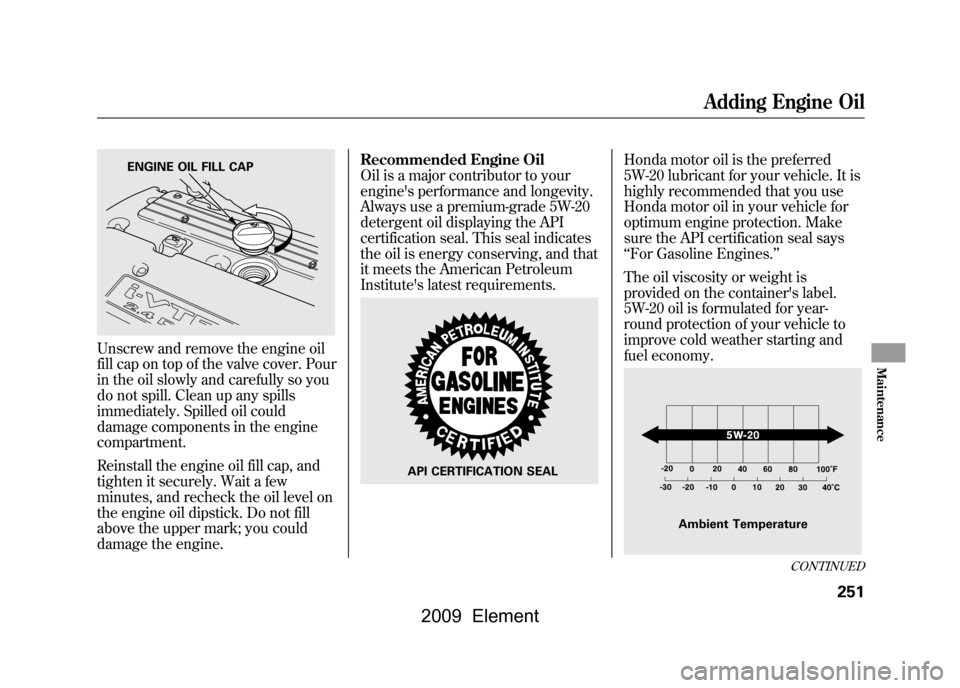
Unscrew and remove the engine oil
fill cap on top of the valve cover. Pour
in the oil slowly and carefully so you
do not spill. Clean up any spills
immediately. Spilled oil could
damage components in the engine
compartment.
Reinstall the engine oil fill cap, and
tighten it securely. Wait a few
minutes, and recheck the oil level on
the engine oil dipstick. Do not fill
above the upper mark; you could
damage the engine.Recommended Engine Oil
Oil is a major contributor to your
engine's performance and longevity.
Always use a premium-grade 5W-20
detergent oil displaying the API
certification seal. This seal indicates
the oil is energy conserving, and that
it meets the American Petroleum
Institute's latest requirements.
Honda motor oil is the preferred
5W-20 lubricant for your vehicle. It is
highly recommended that you use
Honda motor oil in your vehicle for
optimum engine protection. Make
sure the API certification seal says
‘‘
For Gasoline Engines. ’’
The oil viscosity or weight is
provided on the container's label.
5W-20 oil is formulated for year-
round protection of your vehicle to
improve cold weather starting and
fuel economy.
ENGINE OIL FILL CAP
API CERTIFICATION SEAL
Ambient Temperature
CONTINUED
Adding Engine Oil
251
Maintenance
2009 Element
Page 256 of 345
Synthetic Oil
You may use a synthetic motor oil if
it meets the same requirements
given for a conventional motor oil, it
displays the API certification seal,
and it is the proper weight. You must
follow the oil and filter change
intervals shown on the maintenance
minder display.
Engine Oil Additives
Your vehicle does not require any oil
additives. Additives may adversely
affect the engine or transmission
performance and durability.Changing the Engine Oil and
Filter
Always change the oil and filter
according to the maintenance
messages shown on the information
display. The oil and filter collect
contaminants that can damage your
engine if they are not removed
regularly.
Changing the oil and filter requires
special tools and access from
underneath the vehicle. The vehicle
should be raised on a service station-
type hydraulic lift for this service.
Unless you have the knowledge and
proper equipment, you should have
this maintenance done by a skilled
technician.
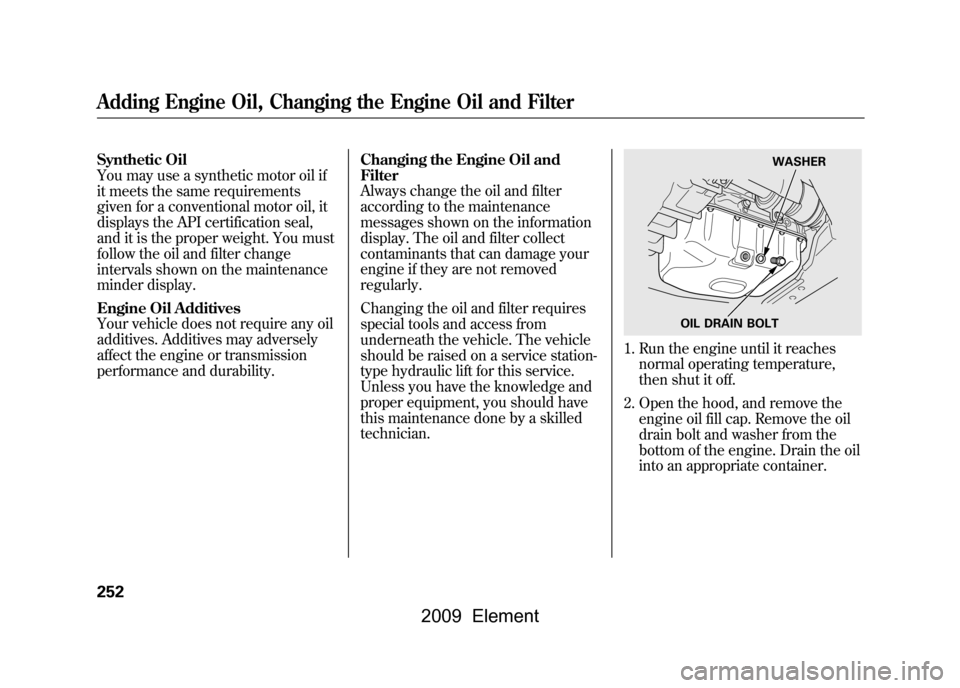
1. Run the engine until it reaches
normal operating temperature,
then shut it off.
2. Open the hood, and remove the engine oil fill cap. Remove the oil
drain bolt and washer from the
bottom of the engine. Drain the oil
into an appropriate container.
OIL DRAIN BOLT WASHER
Adding Engine Oil, Changing the Engine Oil and Filter252
2009 Element
Page 272 of 345
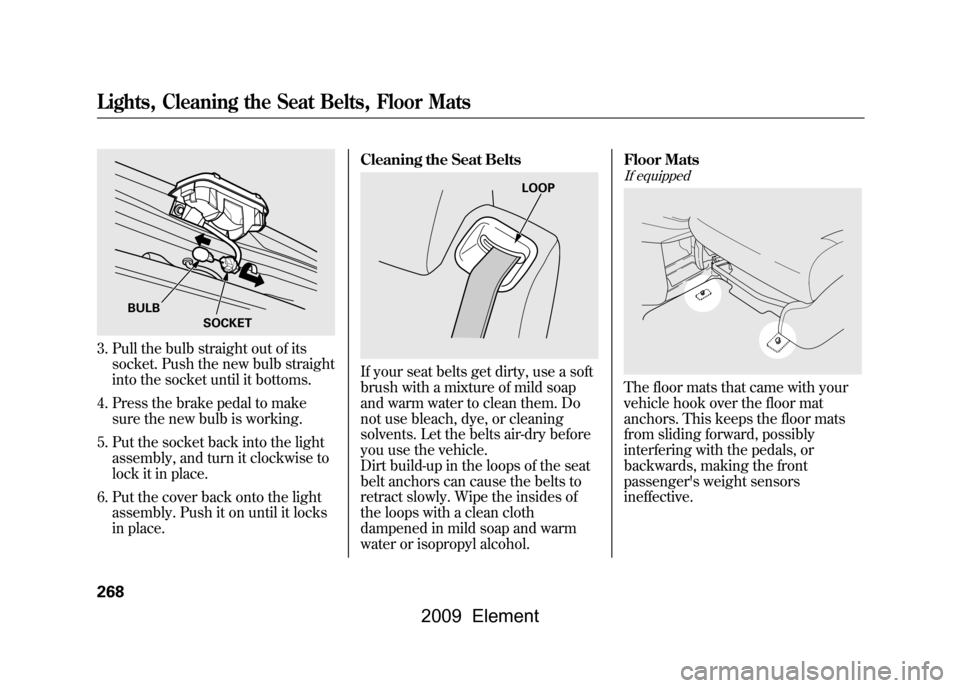
3. Pull the bulb straight out of itssocket. Push the new bulb straight
into the socket until it bottoms.
4. Press the brake pedal to make sure the new bulb is working.
5. Put the socket back into the light assembly, and turn it clockwise to
lock it in place.
6. Put the cover back onto the light assembly. Push it on until it locks
in place. Cleaning the Seat Belts
If your seat belts get dirty, use a soft
brush with a mixture of mild soap
and warm water to clean them. Do
not use bleach, dye, or cleaning
solvents. Let the belts air-dry before
you use the vehicle.
Dirt build-up in the loops of the seat
belt anchors can cause the belts to
retract slowly. Wipe the insides of
the loops with a clean cloth
dampened in mild soap and warm
water or isopropyl alcohol. Floor Mats
If equippedThe floor mats that came with your
vehicle hook over the floor mat
anchors. This keeps the floor mats
from sliding forward, possibly
interfering with the pedals, or
backwards, making the front
passenger's weight sensors
ineffective.
BULB
SOCKET
LOOP
Lights, Cleaning the Seat Belts, Floor Mats268
2009 Element
Page 278 of 345
Tire Maintenance
In addition to proper inflation, correct
wheel alignment helps to decrease
tire wear. If you find a tire is worn
unevenly, have your dealer check the
wheel alignment.
Have your dealer check the tires if
you feel a consistent vibration while
driving. A tire should always be
rebalanced if it is removed from the
wheel. When you have new tires
installed, make sure they are
balanced. This increases riding
comfort and tire life. For best results,
have the installer perform a dynamic
balance.On vehicles with aluminum wheels,
improper wheel weights can damage
your vehicle's aluminum wheels. Use
only Honda wheel weights for
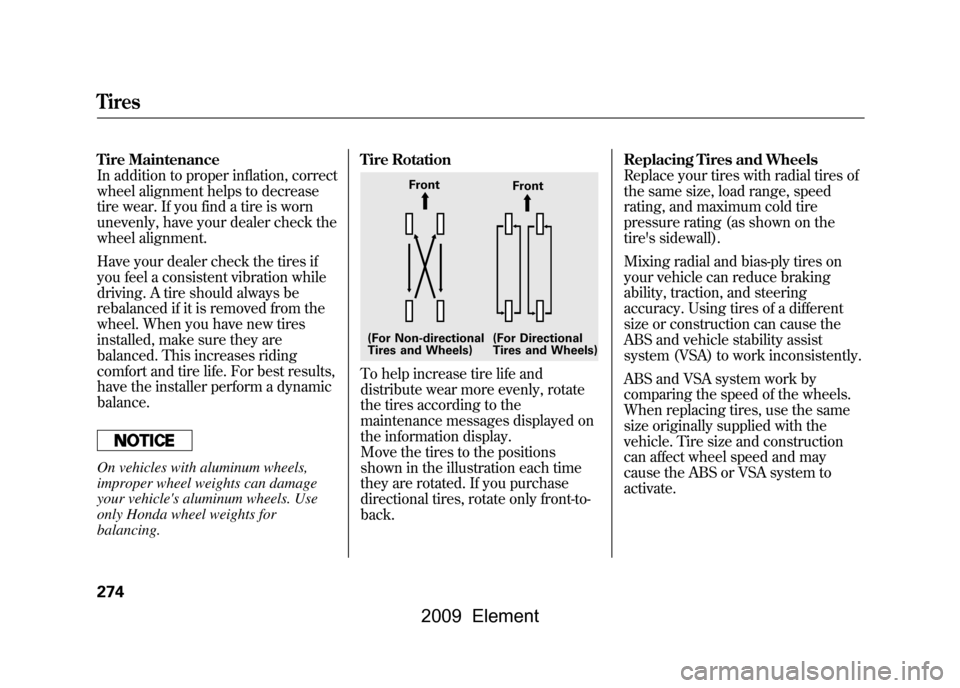
balancing.Tire Rotation
To help increase tire life and
distribute wear more evenly, rotate
the tires according to the
maintenance messages displayed on
the information display.
Move the tires to the positions
shown in the illustration each time
they are rotated. If you purchase
directional tires, rotate only front-to-
back.
Replacing Tires and Wheels
Replace your tires with radial tires of
the same size, load range, speed
rating, and maximum cold tire
pressure rating (as shown on the
tire's sidewall).
Mixing radial and bias-ply tires on
your vehicle can reduce braking
ability, traction, and steering
accuracy. Using tires of a different
size or construction can cause the
ABS and vehicle stability assist
system (VSA) to work inconsistently.
ABS and VSA system work by
comparing the speed of the wheels.
When replacing tires, use the same
size originally supplied with the
vehicle. Tire size and construction
can affect wheel speed and may
cause the ABS or VSA system to
activate.
Front
Front
(For Non-directional
Tires and Wheels) (For Directional
Tires and Wheels)
Tires274
2009 Element
Page 312 of 345

DimensionsLength 169.9 in (4,316 mm)
ꭧ1ꭧ 2
170.4 in (4,328 mm)
ꭧ 3
Width 71.6 in (1,819 mm)
Height 70.4 in (1,788 mm)
ꭧ1,ꭧ 2
69.6 in (1,768 mm)
ꭧ3
Wheelbase 101.4 in (2,575 mm)
Track Front 62.1 in (1,577 mm)
ꭧ1,ꭧ 2
62.1 in (1,578 mm)
ꭧ3
Rear 62.3 in (1,582 mm)
ꭧ1,ꭧ 2
62.5 in (1,587 mm)
ꭧ3
Weights
Gross vehicle weight rating See the certification label attached
to the driver's doorjamb (front edge
of rear door). Seating Capacities
Total 4
Front 2
Rear 2
Engine Type Water cooled 4-stroke DOHC
i-VTEC 4-cylinder gasoline engine
Bore x Stroke 3.43 x 3.90 in (87.0 x 99.0 mm)
Displacement 144 cu-in (2,354 cm
3)
Compression ratio 9.7 : 1
Spark plugs NGK: IZFR6K-11
DENSO: SKJ20DR-M11
ꭧ 1: LX model
ꭧ 2: EX model
ꭧ 3: SC model
Specifications308
2009 Element
Page 334 of 345
Filling the Fuel Tank
..................
199
Filters Dust and Pollen
.......................
269
Oil
...........................................
252
Flashers, Hazard Warning
...........
73
Flat Tire, Changing a
.................
283
Floor Mats
.................................
268
Fluids Automatic Transmission
.........
256
Brake
......................................
258
Clutch
.....................................
258
Manual Transmission
..............
257
Power Steering
........................
260
Rear Differential
......................
258
Windshield Washer
.................
255
FM/AM Radio Reception
...........
186
Folding the Rear Seats
.................
88
Four-way Flashers
........................
73
Front Airbags
...........................
9,25
Front Seat Adjusting
..................................
83
Airbags
.................................
9,25
Fuel
............................................
198
Check Fuel Cap Message
........
66
Fill Door and Cap
....................
199
Gauge
......................................
66 Low Fuel Indicator
...................
61
Octane Requirement
...............
198
Oxygenated
.............................
198
Reserve Indicator
.....................
61
Tank, Filling the
......................
199
Fuel Economy
............................
202
Fuses, Checking the
..................
298
G
Gas Mileage, Improving
.............
202
Gasohol
......................................
198
Gasoline
.....................................
198
Gauge
.................................
64,66
Low Fuel Indicator
...................
61
Octane Requirement
...............
198
Tank, Refueling
.......................
199
Gas Station Procedures
..............
199
Gauges Engine Coolant Temperature...
67
Fuel
..........................................
66
Odometer
.................................
65
Speedometer
............................
64
Tachometer
..............................
64
Trip meter
................................
66 Gearshift Lever Positions
Automatic Transmission
.........
219
Manual Transmission
..............
217
Glove Box
..................................
100
Gross Axle Weight Rating (GAWR)
.................................
232
Gross Vehicle Weight Rating (GVWR)
.................................
232
H
Halogen Headlight Bulbs
...........
261
Hatch
...........................................
81
Hazard Warning Flashers
............
73
Headlights Aiming
....................................
261
Daytime Running Lights
..........
72
High Beam Indicator
................
61
High Beams, Turning on
..........
71
Lights On Indicator
..................
61
Low Beams, Turning on
...........
71
Reminder Chime
......................
71
Replacing Halogen Bulbs
........
261
Turning on
...............................
71
Head Restraints
............................
85
IndexIV
2009 Element