clutch HONDA ELEMENT 2010 1.G User Guide
[x] Cancel search | Manufacturer: HONDA, Model Year: 2010, Model line: ELEMENT, Model: HONDA ELEMENT 2010 1.GPages: 342, PDF Size: 5.76 MB
Page 266 of 342
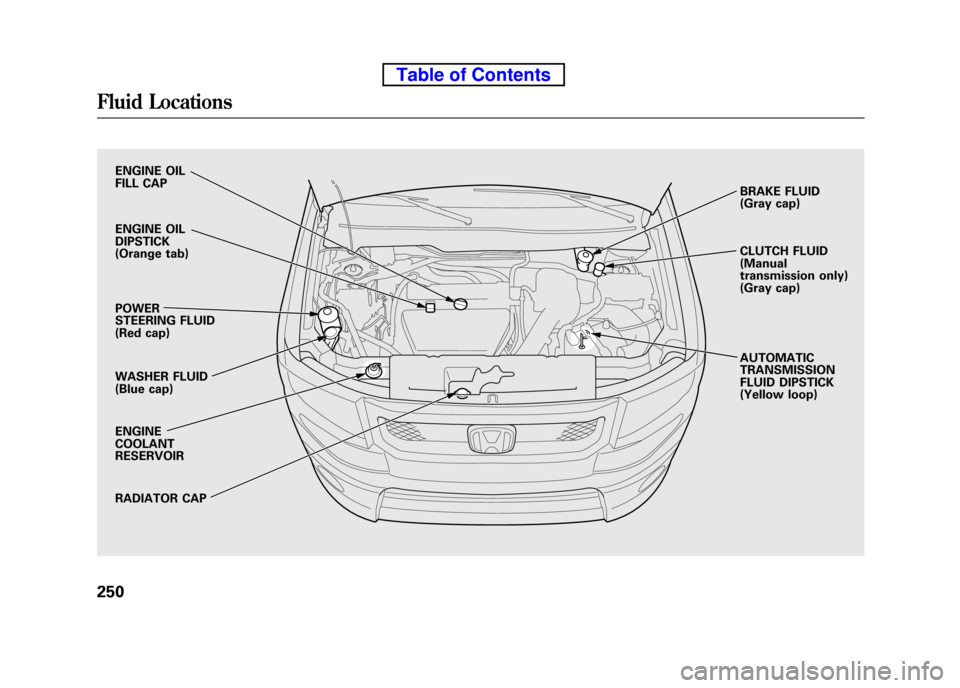
ENGINE OIL
FILL CAP
ENGINE OIL DIPSTICK
(Orange tab) POWER
STEERING FLUID
(Red cap)
WASHER FLUID
(Blue cap) ENGINE COOLANTRESERVOIR
RADIATOR CAPBRAKE FLUID
(Gray cap)
CLUTCH FLUID (Manual
transmission only)
(Gray cap) AUTOMATIC TRANSMISSION
FLUID DIPSTICK
(Yellow loop)
Fluid Locations
250
Table of Contents
Page 274 of 342

Put a new washer on the filler bolt,
then reinstall the filler bolt and
tighten it securely.
If Honda MTF is not available, you
may use an SAE 10W-30 or 10W-40
viscosity motor oil with the API
Certification Seal that says‘‘FOR
GASOLINE ENGINES ’’as a
temporary replacement. However,
motor oil does not contain the proper
additives, and continued use can
cause stiffer shifting. Replace as soon
as it is convenient.
The transmission should be drained
and refilled with new fluid according
to the maintenance minder (see page243).
If you are not sure how to check and
add fluid, contact your dealer. Rear Differential Fluid
4WD models only
The rear differential should be
drained and refilled with new fluid
according to the time and distance
recommendations shown on the
maintenance minder display. Have
your dealer replace the rear
differential fluid.
Use Honda Dual Pump Fluid II only.
Do not use automatic transmission
fluid (ATF).
Brake and Clutch Fluid
Check the fluid level in the
reservoirs monthly.
There are up to two reservoirs,
depending on the model. They are:
● Brake fluid reservoir (all models)
● Clutch fluid reservoir (manual
transmission only)
Replace the brake fluid according to
the time recommendation in the
maintenance minder schedule.
Always use Honda Heavy Duty
Brake Fluid DOT 3. If it is not
available, you should use only DOT 3
or DOT 4 fluid, from a sealed
container, as a temporaryreplacement.
Transmission Fluid, Rear Differential Fluid, Brake and Clutch Fluid
258
Table of Contents
Page 275 of 342
Using any non-Honda brake fluid can
cause corrosion and decrease the life
of the system. Have the brake
system flushed and refilled with
Honda Heavy Duty Brake Fluid DOT
3 as soon as possible.
Brake fluid marked DOT 5 is not
compatible with your vehicle's
braking system and can cause
extensive damage.Brake Fluid
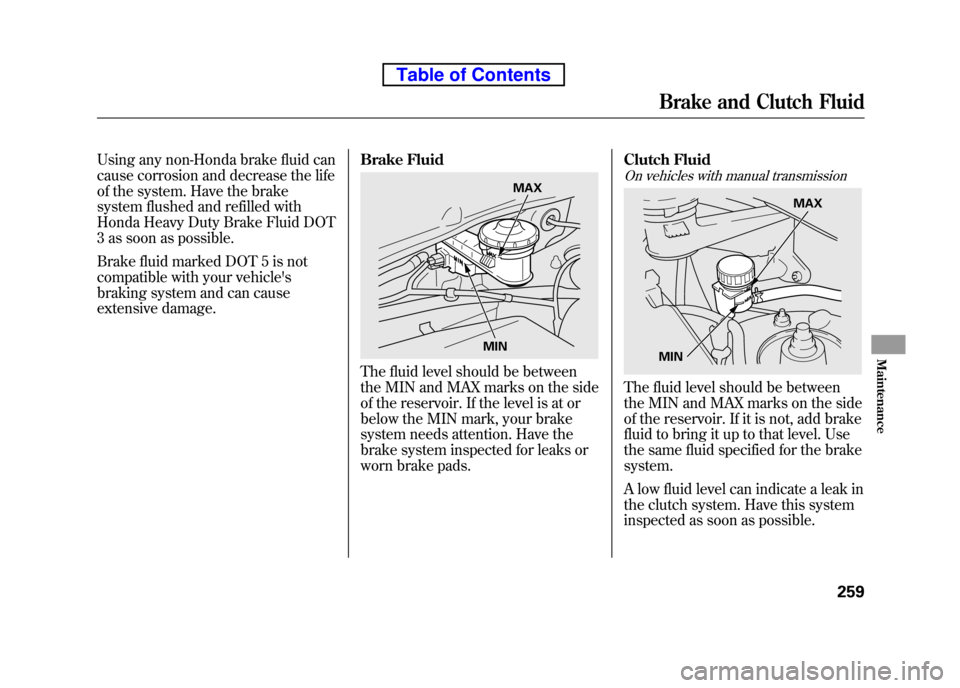
The fluid level should be between
the MIN and MAX marks on the side
of the reservoir. If the level is at or
below the MIN mark, your brake
system needs attention. Have the
brake system inspected for leaks or
worn brake pads.Clutch Fluid
On vehicles with manual transmission
The fluid level should be between
the MIN and MAX marks on the side
of the reservoir. If it is not, add brake
fluid to bring it up to that level. Use
the same fluid specified for the brakesystem.
A low fluid level can indicate a leak in
the clutch system. Have this system
inspected as soon as possible.
MAX
MIN
MAX
MIN
Brake and Clutch Fluid
259
Maintenance
Table of Contents
Page 305 of 342
Diagnosing why the engine won't
start falls into two areas, depending
on what you hear when you turn the
ignition switch to the START (III) position:● You hear nothing, or almost
nothing. The engine's starter
motor does not operate at all, or
operates very slowly.
● You can hear the starter motor
operating normally, or the starter
motor sounds like it is spinning
faster than normal, but the engine
does not start up and run. Nothing Happens or the Starter
Motor Operates Very Slowly
When you turn the ignition switch to
the START (III) position, you do not
hear the normal noise of the engine
trying to start. You may hear a
clicking sound, a series of clicks, or
nothing at all.
Check these things:
● Check the transmission interlock.
If you have a manual transmission,
the clutch pedal must be pushed
all the way to the floor or the
starter will not operate. With an
automatic transmission, the shift
lever must be in Park or neutral.
● Turn the ignition switch to the ON
(II) position. Turn on the
headlights, and check their
brightness. If the headlights are
very dim or do not come on at all,
the battery is discharged (see
Jump Starting on page 291). ●
Turn the ignition switch to the
START (III) position. If the
headlights do not dim, check the
condition of the fuses. If the fuses
are OK, there is probably
something wrong with the
electrical circuit for the ignition
switch or starter motor. You will
need a qualified technician to
determine the problem. See
Emergency Towing on page 303.
If the headlights dim noticeably or go
out when you try to start the engine,
either the battery is discharged or
the connections are corroded. Check
the condition of the battery and
terminal connections (see page 277).
You can then try jump starting the
vehicle from a booster battery (see
page 291).
CONTINUED
If the Engine Won't Start
289
Taking Care of the Unexpected
Table of Contents