fuel HONDA ELEMENT 2010 1.G User Guide
[x] Cancel search | Manufacturer: HONDA, Model Year: 2010, Model line: ELEMENT, Model: HONDA ELEMENT 2010 1.GPages: 342, PDF Size: 5.76 MB
Page 73 of 342
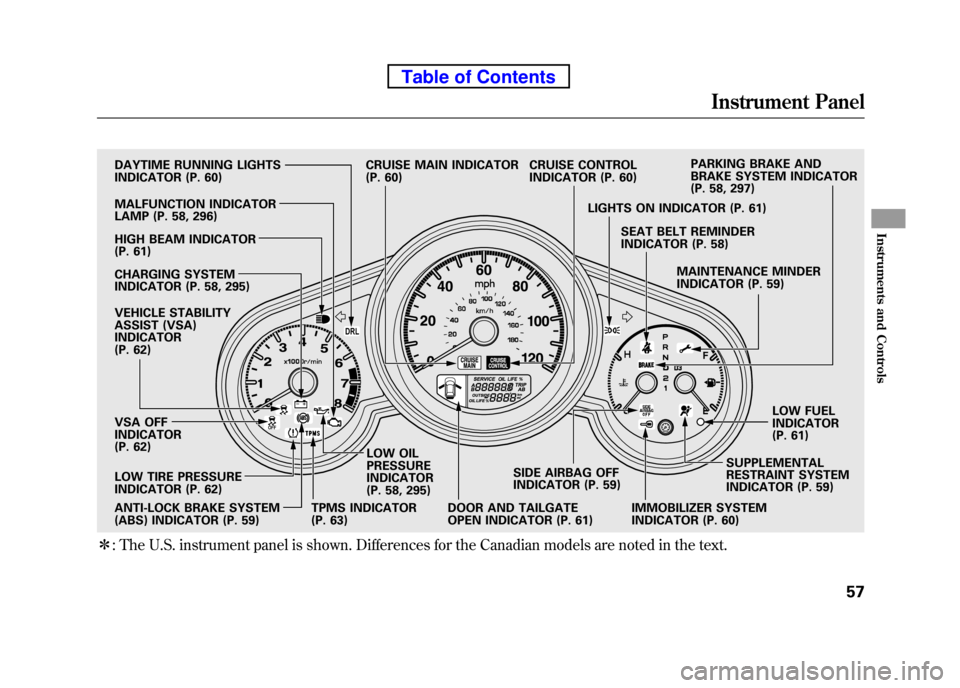
ꭧ: The U.S. instrument panel is shown. Differences for the Canadian models are noted in the text.
DRL
DAYTIME RUNNING LIGHTS
INDICATOR (P. 60)
HIGH BEAM INDICATOR
(P. 61)
CHARGING SYSTEM
INDICATOR (P. 58, 295)
VEHICLE STABILITY
ASSIST (VSA)
INDICATOR
(P. 62)
VSA OFF
INDICATOR
(P. 62)
ANTI-LOCK BRAKE SYSTEM
(ABS) INDICATOR (P. 59) LOW OIL PRESSURE
INDICATOR
(P. 58, 295)
DOOR AND TAILGATE
OPEN INDICATOR (P. 61)SIDE AIRBAG OFF
INDICATOR (P. 59)
IMMOBILIZER SYSTEM
INDICATOR (P. 60)SUPPLEMENTAL
RESTRAINT SYSTEM
INDICATOR (P. 59)LOW FUELINDICATOR
(P. 61)
MAINTENANCE MINDER
INDICATOR (P. 59)
SEAT BELT REMINDER
INDICATOR (P. 58)
LIGHTS ON INDICATOR (P. 61) PARKING BRAKE AND
BRAKE SYSTEM INDICATOR
(P. 58, 297)
CRUISE CONTROL
INDICATOR (P. 60)
TPMS INDICATOR
(P. 63) CRUISE MAIN INDICATOR
(P. 60)
MALFUNCTION INDICATOR
LAMP (P. 58, 296)
LOW TIRE PRESSURE
INDICATOR (P. 62)
Instrument Panel
57
Instruments and Controls
Table of Contents
Page 77 of 342
Lights On Indicator
This indicator reminds you that the
exterior lights are on. It comes on
when the light switch is in either the
orposition. If you turn the
ignition switch to the ACCESSORY
(I) or LOCK (0) position without
turning off the light switch, this
indicator will stay on. A reminder
chime will also sound when you open
the driver's door.
High Beam Indicator
This indicator comes on with the
high beam headlights. For more
information, see page 71.
Washer Level Indicator
Canadian models only
This indicator comes on when the
washer fluid level is low. Add washer
fluid when you see this indicator
come on (see page 255).
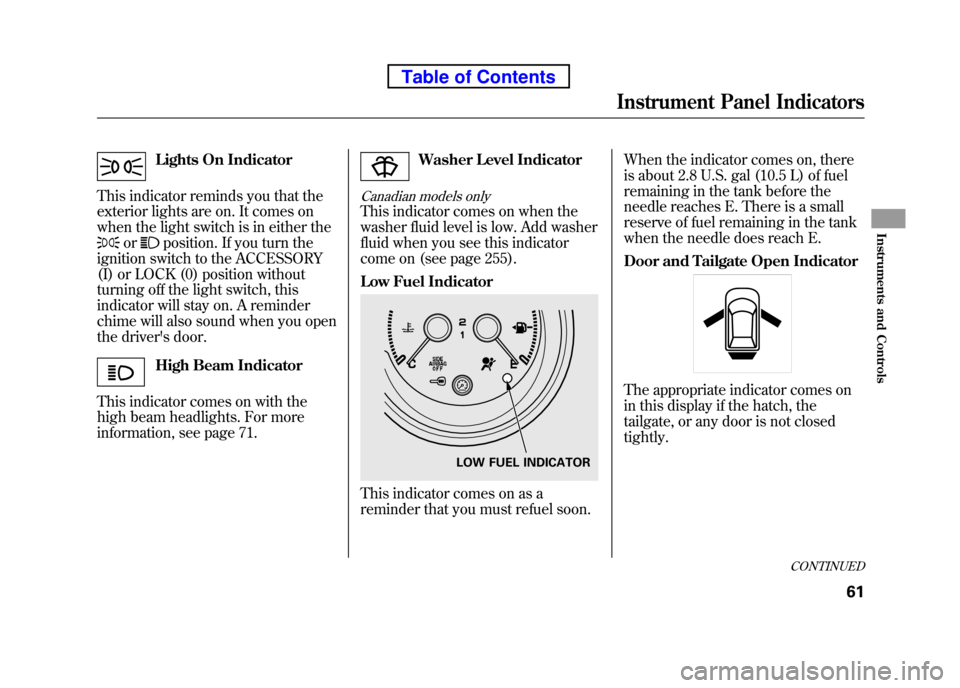
Low Fuel Indicator
This indicator comes on as a
reminder that you must refuel soon. When the indicator comes on, there
is about 2.8 U.S. gal (10.5 L) of fuel
remaining in the tank before the
needle reaches E. There is a small
reserve of fuel remaining in the tank
when the needle does reach E.
Door and Tailgate Open Indicator
The appropriate indicator comes on
in this display if the hatch, the
tailgate, or any door is not closedtightly.
LOW FUEL INDICATOR
CONTINUED
Instrument Panel Indicators
61
Instruments and Controls
Table of Contents
Page 80 of 342
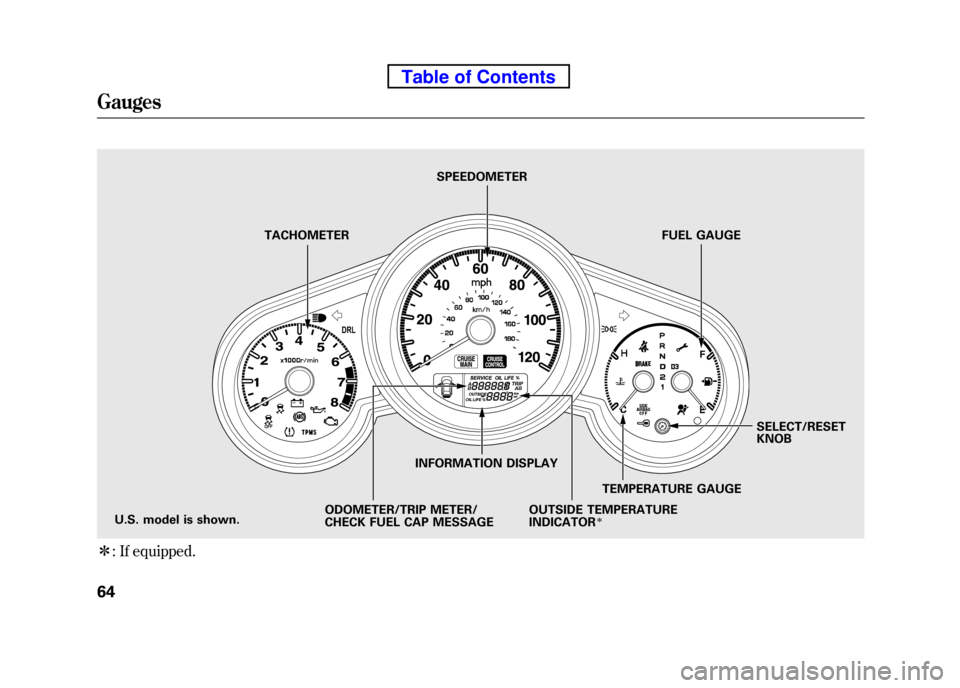
ꭧ: If equipped.
DRL
TACHOMETER SPEEDOMETER
FUEL GAUGE
U.S. model is shown. INFORMATION DISPLAY
ODOMETER/TRIP METER/
CHECK FUEL CAP MESSAGE TEMPERATURE GAUGESELECT/RESETKNOB
OUTSIDE TEMPERATUREINDICATOR
ꭧ
Gauges
64
Table of Contents
Page 82 of 342
Trip Meter
This shows the number of miles
(U.S.) or kilometers (Canada) driven
since you last reset it.
There are two trip meters: Trip A and
Trip B. Switch between these
displays by pressing the select/reset
knob repeatedly.
Each trip meter works
independently, so you can keep track
of two different distances.
When you turn the ignition switch to
the ON (II) position, the last
selection is displayed.
To reset a trip meter, display it, and
then press and hold the select/reset
knob until the number resets to‘‘0.0 ’’. Fuel Gauge
This shows how much fuel you have.
It may show slightly more or less
than the actual amount. The needle
returns to the bottom after you turn
off the ignition.
Avoid driving with an extremely low
fuel level. Running out of fuel could
cause the engine to misfire, damaging
the catalytic converter.
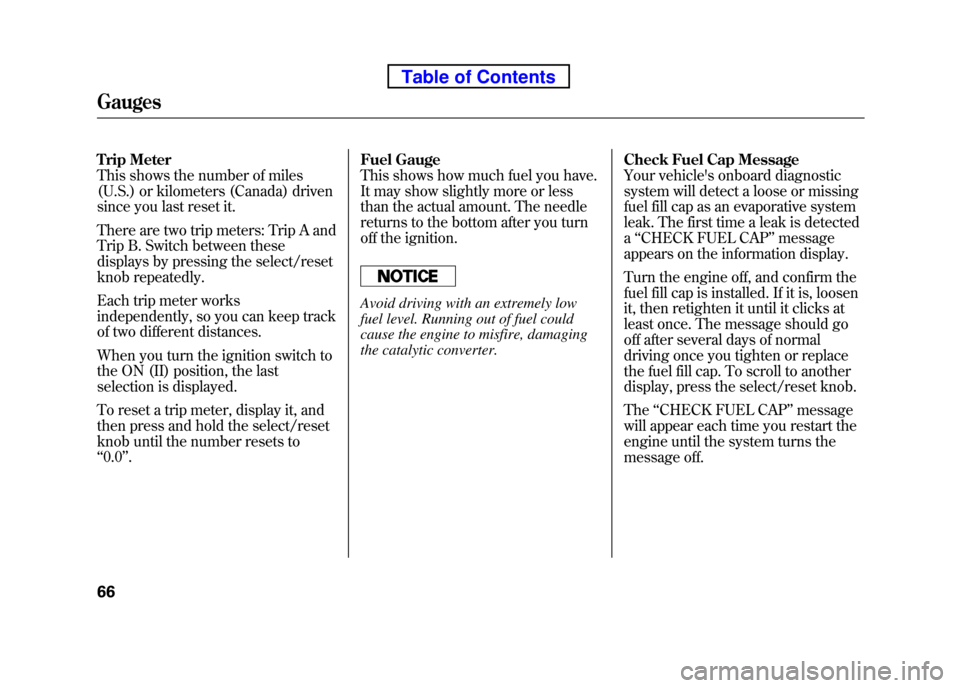
Check Fuel Cap Message
Your vehicle's onboard diagnostic
system will detect a loose or missing
fuel fill cap as an evaporative system
leak. The first time a leak is detected a
‘‘CHECK FUEL CAP ’’message
appears on the information display.
Turn the engine off, and confirm the
fuel fill cap is installed. If it is, loosen
it, then retighten it until it clicks at
least once. The message should go
off after several days of normal
driving once you tighten or replace
the fuel fill cap. To scroll to another
display, press the select/reset knob. The ‘‘CHECK FUEL CAP ’’message
will appear each time you restart the
engine until the system turns the
message off.
Gauges
66
Table of Contents
Page 83 of 342

If the system still detects a leak in
your vehicle's evaporative emissions
system, the malfunction indicator
lamp (MIL) comes on. If the fuel fill
cap was not already tightened, turn
the engine off, and check or
retighten the fuel fill cap until it
clicks at least once. The MIL should
go off after several days of normal
driving once the cap is tightened or
replaced. If the MIL does not go off,
have your vehicle inspected by a
dealer. For more information, see
page 296.Temperature Gauge
This shows the temperature of the
engine's coolant. During normal
operation, the pointer should rise to
about the middle of the gauge. In
severe driving conditions, the pointer
may rise to the upper zone. If it
reaches the red (hot) mark, pull
safely to the side of the road. Turn to
page 293 for instructions and
precautions on checking the engine's
cooling system.
Maintenance Minder
The information display in the
instrument panel shows you the
engine oil life and maintenance
service items when the ignition
switch is in the ON (II) position. This
information helps to keep you aware
of the periodic maintenance your
vehicle needs for continued trouble-
free driving. Refer to page 243 for
more information.
Gauges
67
Instruments and Controls
Table of Contents
Page 92 of 342

You should have received a key
number tag with your set of keys.
You will need this key number if you
ever have to get a key replaced. Use
only Honda-approved key blanks.These keys contain electronic
circuits that are activated by the
immobilizer system. They will not
work to start the engine if the circuits
are damaged.
● Protect the keys from direct
sunlight, high temperature, and
high humidity.
● Do not drop the keys or set heavy
objects on them.
● Keep the keys away from liquids.
If they get wet, dry them
immediately with a soft cloth.
The keys do not contain batteries.
Do not try to take them apart.
See page 77 for an explanation of the
remote transmitter's operation. Immobilizer System
The immobilizer system protects
your vehicle from theft. If an
improperly coded key (or other
device) is used, the engine's fuel
system is disabled.
When you turn the ignition switch to
the ON (II) position, the immobilizer
system indicator should come on for
a few seconds, then go off. If the
indicator starts to blink, it means the
system does not recognize the
coding of the key. Turn the ignition
switch to the LOCK (0) position,
remove the key, reinsert it, and turn
the ignition switch to the ON (II)
position again.
The system may not recognize your
key's coding if another immobilizer
key or other metal object (i.e. key
chain) is near the ignition switch
when you insert the key.
Keys and Locks, Immobilizer System
76
Table of Contents
Page 213 of 342
Before you begin driving your
vehicle, you should know what
gasoline to use and how to check the
levels of important fluids. You also
need to know how to properly store
luggage or packages. The
information in this section will help
you. If you plan to add any
accessories to your vehicle, please
read the information in this section first.Break-in Period........................... 198
Fuel Recommendation ................
198
Service Station Procedures .........199
Refueling .................................
199
Opening and Closing the Hood ................................... 200
Oil Check ................................ 201
Engine Coolant Check ............201
Fuel Economy .............................
202
Accessories and Modifications .......................... 205
Carrying Cargo ........................... 207
Before Driving
197
Before Driving
Page 214 of 342

Break-in Period
Help assure your vehicle's future
reliability and performance by paying
extra attention to how you drive
during the first 600 miles (1,000 km).
During this period:● Avoid full-throttle starts and rapidacceleration.
● Do not change the oil until the
scheduled maintenance time.
● Avoid hard braking for the first 200
miles (300 km).
● Do not tow a trailer.
You should also follow these
recommendations with an
overhauled or exchanged engine, or
when the brakes are replaced. Fuel Recommendation
Your vehicle is designed to operate
on unleaded gasoline with a pump
octane number of 87 or higher. Use
of a lower octane gasoline can cause
a persistent, heavy metallic rapping
noise that can lead to enginedamage.
On vehicles with manual transmission
You may hear a knocking noise from
the engine if you drive the vehicle at
low engine speed (below about 1,000
rpm) in a higher gear. To stop this,
raise the engine speed by shifting to
a lower gear.
We recommend using quality
gasoline containing detergent
additives that help prevent fuel
system and engine deposits.In addition, in order to maintain good
performance, fuel economy, and
emissions control, we strongly
recommend, in areas where it is
available, the use of gasoline that
does NOT contain manganese-based
fuel additives such as MMT.
Use of gasoline with these additives
may adversely affect performance,
and cause the malfunction indicator
lamp on your instrument panel to
come on. If this happens, contact
your authorized dealer for service.
Some gasoline today is blended with
oxygenates such as ethanol or
MTBE. Your vehicle is designed to
operate on oxygenated gasoline
containing up to 10% ethanol by
volume and up to 15% MTBE by
volume. Do not use gasoline
containing methanol.
Break-in Period, Fuel Recommendation
198
Table of Contents
Page 215 of 342
If you notice any undesirable
operating symptoms, try another
service station or switch to another
brand of gasoline.
For further important fuel-related
information for your vehicle, or
information on gasoline that does not
contain MMT, visit Owner Link at
owners.honda.com. In Canada, visit
www.honda.cafor additional
information on gasoline. Refueling
1. Park with the driver's side closest to
the service station pump.
2. Outside of the vehicle, open the fuel fill door by pulling its notched edge.
Gasoline is highly flammable and
explosive. You can be burned or
seriously injured when handling fuel.
● Stop the engine and keep heat,
sparks, and flame away.
● Handle fuel only outdoors.
● Wipe up spills immediately.
3. Remove the fuel fill cap slowly. You may hear a hissing sound as
pressure inside the tank escapes.
Place the cap in the holder on the
fuel fill door. 4. Stop filling the tank after the fuel
nozzle automatically clicks off. Do
not try to ‘‘top off ’’the tank. This
leaves some room in the fuel tank for
the fuel to expand with temperature changes.
If the fuel nozzle keeps clicking offeven though the tank is not full,
there may be a problem with your
vehicle's fuel vapor recovery system.
The system helps keep fuel vapor
from going into the atmosphere. Try
filling at another pump. If this does
not fix the problem, consult your dealer.
5. Screw the fuel fill cap back on until it clicks at least once. If you do not
properly tighten the cap, the
malfunction indicator lamp may
come on (see page 296). You will
also see a ‘‘CHECK FUEL CAP ’’
message on the information display.
6. Close the fuel fill door.
Fuel Recommendation, Service Station Procedures
199
Before Driving
Table of Contents
Page 218 of 342
Actual Mileage and EPA Fuel
Economy Estimates Comparison.
Fuel economy is not a fixed number.
It varies based on driving conditions,
driving habits and vehicle condition.
Therefore, it is not possible for one
set of estimates to predict fuel
economy precisely for all drivers in
all environments.
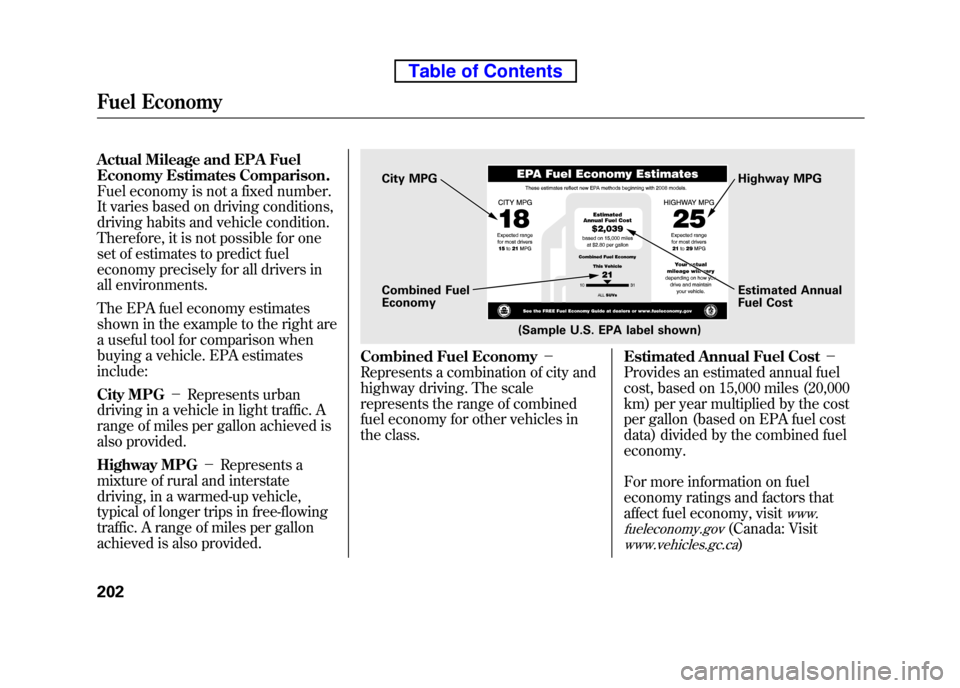
The EPA fuel economy estimates
shown in the example to the right are
a useful tool for comparison when
buying a vehicle. EPA estimates include:
City MPG-Represents urban
driving in a vehicle in light traffic. A
range of miles per gallon achieved is
also provided.
Highway MPG -Represents a
mixture of rural and interstate
driving, in a warmed-up vehicle,
typical of longer trips in free-flowing
traffic. A range of miles per gallon
achieved is also provided.
Combined Fuel Economy -
Represents a combination of city and
highway driving. The scale
represents the range of combined
fuel economy for other vehicles in
the class. Estimated Annual Fuel Cost
-
Provides an estimated annual fuel
cost, based on 15,000 miles (20,000
km) per year multiplied by the cost
per gallon (based on EPA fuel cost
data) divided by the combined fueleconomy.
For more information on fuel
economy ratings and factors that
affect fuel economy, visit
www.
fueleconomy.gov
(Canada: Visit
www.vehicles.gc.ca)
City MPG
Combined Fuel Economy Highway MPG
Estimated Annual
Fuel Cost
(Sample U.S. EPA label shown)
Fuel Economy
202
Table of Contents