fuel pressure HONDA ELEMENT 2010 1.G User Guide
[x] Cancel search | Manufacturer: HONDA, Model Year: 2010, Model line: ELEMENT, Model: HONDA ELEMENT 2010 1.GPages: 342, PDF Size: 5.76 MB
Page 287 of 342

Wheels
Clean the wheels as you would the
rest of the exterior. Wash them with
the same solution, and rinse them thoroughly.
If equipped
Aluminum alloy wheels have a
protective clear-coat that keeps the
aluminum from corroding and
tarnishing. Cleaning the wheels with
harsh chemicals (including some
commercial wheel cleaners) or a stiff
brush can damage the clear-coat. To
clean the wheels, use a mild
detergent and a soft brush or sponge.Tires
To safely operate your vehicle, your
tires must be the proper type and
size, in good condition with adequate
tread, and correctly inflated.
The following pages give more
detailed information on how to take
care of your tires and what to do
when they need to be replaced.
Using tires that are excessively
worn or improperly inflated can
cause a crash in which you can
be seriously hurt or killed.
Follow all instructions in this
owner's manual regarding tire
inflation and maintenance.Inflation Guidelines
Keeping the tires properly inflated
provides the best combination of
handling, tread life, and riding comfort.
● Underinflated tires wear unevenly,
adversely affect handling and fuel
economy, and are more likely to
fail from being overheated.
● Overinflated tires can make your
vehicle ride more harshly, are
more prone to damage from road
hazards, and wear unevenly.
The tire pressure monitoring system
(TPMS) will warn you when a tire
pressure is low. See page 227 for
more information on the TPMS.
CONTINUED
Wheels, Tires
271
Maintenance
Table of Contents
Page 321 of 342
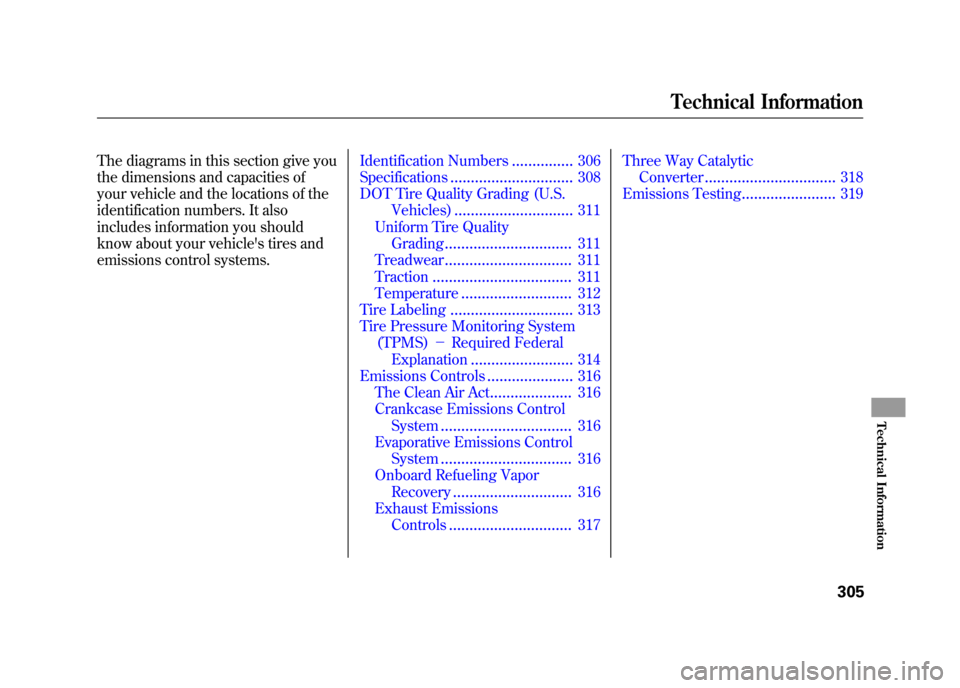
The diagrams in this section give you
the dimensions and capacities of
your vehicle and the locations of the
identification numbers. It also
includes information you should
know about your vehicle's tires and
emissions control systems.Identification Numbers...............306
Specifications ..............................
308
DOT Tire Quality Grading (U.S. Vehicles) ............................. 311
Uniform Tire Quality Grading ............................... 311
Treadwear ............................... 311
Traction .................................. 311
Temperature ...........................
312
Tire Labeling .............................. 313
Tire Pressure Monitoring System
(TPMS) -Required Federal
Explanation ......................... 314
Emissions Controls .....................316
The Clean Air Act ....................
316
Crankcase Emissions Control System ................................ 316
Evaporative Emissions Control
System ................................ 316
Onboard Refueling Vapor
Recovery ............................. 316
Exhaust Emissions
Controls .............................. 317Three Way Catalytic
Converter ................................ 318
Emissions Testing .......................319
Technical Information
305
Technical Information
Page 331 of 342

Driving on a significantly under-
inflated tire causes the tire to
overheat and can lead to tire failure.
Under-inflation also reduces fuel
efficiency and tire tread life, and may
affect the vehicle's handling and
stopping ability.
Please note that the TPMS is not a
substitute for proper tire
maintenance, and it is the driver's
responsibility to maintain correct tire
pressure, even if under-inflation has
not reached the level to trigger
illumination of the TPMS low tire
pressure telltale.Your vehicle has also been equipped
with a TPMS malfunction indicator to
indicate when the system is not
operating properly. The TPMS
malfunction indicator is provided by
a separate telltale, which displays thesymbol
‘‘TPMS ’’when illuminated.
When the malfunction indicator isilluminated,
the system may not be able to detect
or signal low tire pressure asintended.
TPMS malfunctions may occur for a
variety of reasons, including the
installation of replacement or
alternate tires or wheels on the
vehicle that prevent the TPMS from
functioning properly. Always check the TPMS malfunction
telltale after replacing one or more
tires or wheels on your vehicle to
ensure that the replacement or
alternate tires and wheels allow the
TPMS to continue to functionproperly.
Tire Pressure Monitoring System (TPMS)
-Required Federal Explanation
315
Technical Information
Table of Contents
Page 342 of 342

Gasoline:
Unleaded gasoline, pump octane
number of 87 or higher.
Fuel Tank Capacity:
15.9 US gal (60 L)
Recommended Engine Oil:
API Premium grade 5W-20
detergent oil (see page 251).
Oil change capacity (including filter):
4.4 US qt (4.2 L)
Automatic Transmission Fluid:
Honda Genuine ATF-Z1
(Automatic Transmission Fluid)
(see page 256).Manual Transmission Fluid:
Honda Manual Transmission Fluid
preferred, or an SAE 10W-30 or
10W-40 motor oil as a temporary
replacement (see page 257).
Capacity (including differential):
2.0 US qt (1.9 L)
4WD models only
Rear Differential Fluid:
Honda Dual Pump Fluid II. Do not
use ATF. Capacity:
1.1 US qt (1.0 L)
Power Steering Fluid:
Honda Power Steering Fluid
preferred, or another brand of
power steering fluid as a
temporary replacement. Do not
use ATF (see page 260).Brake Fluid:
Honda Heavy Duty Brake Fluid
DOT 3 preferred, or a DOT 3 or
DOT 4 brake fluid as a temporary
replacement (see page 258).
Tire Pressure (measured cold):
All models except SC
Front:
33 psi (230 kPa, 2.3 kgf/cm2)
Rear: 35 psi (240 kPa, 2.4 kgf/cm
2)
SC model
Front/Rear: 32 psi (220 kPa, 2.2 kgf/cm2)
Spare Tire Pressure: 60 psi (420 kPa, 4.2 kgf/cm
2)
Service Information Summary