trailer HONDA ELEMENT 2010 1.G User Guide
[x] Cancel search | Manufacturer: HONDA, Model Year: 2010, Model line: ELEMENT, Model: HONDA ELEMENT 2010 1.GPages: 342, PDF Size: 5.76 MB
Page 249 of 342
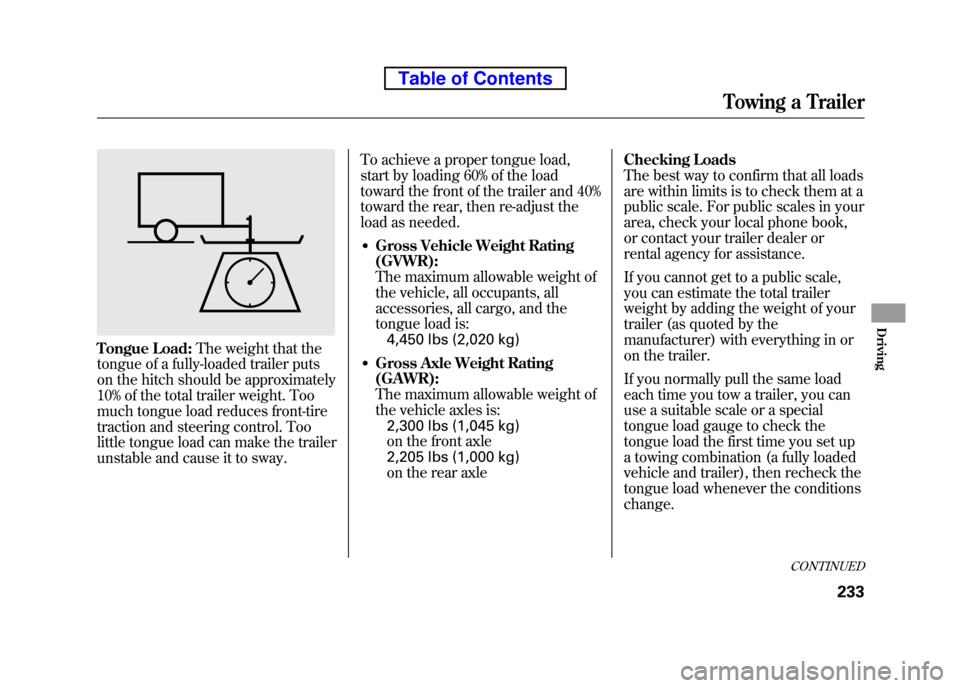
Tongue Load:The weight that the
tongue of a fully-loaded trailer puts
on the hitch should be approximately
10% of the total trailer weight. Too
much tongue load reduces front-tire
traction and steering control. Too
little tongue load can make the trailer
unstable and cause it to sway. To achieve a proper tongue load,
start by loading 60% of the load
toward the front of the trailer and 40%
toward the rear, then re-adjust the
load as needed.
● Gross Vehicle Weight Rating (GVWR):
The maximum allowable weight of
the vehicle, all occupants, all
accessories, all cargo, and the
tongue load is:
4,450 lbs (2,020 kg)
● Gross Axle Weight Rating(GAWR):
The maximum allowable weight of
the vehicle axles is:
2,300 lbs (1,045 kg)
on the front axle
2,205 lbs (1,000 kg)
on the rear axle Checking Loads
The best way to confirm that all loads
are within limits is to check them at a
public scale. For public scales in your
area, check your local phone book,
or contact your trailer dealer or
rental agency for assistance.
If you cannot get to a public scale,
you can estimate the total trailer
weight by adding the weight of your
trailer (as quoted by the
manufacturer) with everything in or
on the trailer.
If you normally pull the same load
each time you tow a trailer, you can
use a suitable scale or a special
tongue load gauge to check the
tongue load the first time you set up
a towing combination (a fully loaded
vehicle and trailer), then recheck the
tongue load whenever the conditions change.
CONTINUED
Towing a Trailer
233
Driving
Table of Contents
Page 250 of 342

Towing Equipment and Accessories
Towing can require a variety of
equipment, depending on the size of
your trailer, how it will be used, how
much load you are towing, and
where you tow. To ensure the
highest quality equipment, purchase
Honda equipment wheneverpossible.
Discuss your needs with your trailer
sales or rental agency, and follow the
guidelines in the rest of this section.
Also make sure that all equipment is
properly installed and that it meets
federal, state, provincial, territorial
and local regulations.Hitches
Any hitch used on your vehicle must
be properly bolted to the underbody.
Safety Chains
Always use safety chains when you
tow a trailer. Make sure the chains
are secured to the trailer and hitch,
and that they cross under the tongue
and can catch the trailer if it becomes
unhitched. Leave enough slack to
allow the trailer to turn corners
easily, but do not let the chains drag
on the ground.
Trailer Brakes
Honda recommends that any trailer
with a total weight of 1,000 lbs (450
kg) or more has its own brake.
There are two common types of
trailer brakes; surge and electric.
Surge brakes are common for boat
trailers, since the brakes will get wet.
If you choose electric brakes, be sure
they are electronically actuated. Do
not attempt to tap into your vehicle's
hydraulic system. No matter how
successful it may seem, any attempt
to attach trailer brakes to your
vehicle's hydraulic system will lower
braking effectiveness and create a
potential hazard.
See your trailer dealer or rental
agency for more information on
installing electric brakes.
Towing a Trailer
234
Table of Contents
Page 251 of 342

Trailer Lights
Trailer lights and equipment must
comply with federal, state, provincial,
territorial, and local regulations.
Check with your local trailer dealer
or rental agency for the requirements
in the area where you plan to tow,
and use only equipment designed for
your vehicle.
Since lighting and wiring vary by
trailer type and brand, you should
have a qualified technician install a
suitable connector between the
vehicle and the trailer. Improper
equipment or installation can cause
damage to your vehicle's electrical
system and affect your vehicle warranty.
Additional Towing Equipment
Many states, Canadian provinces and
territories require special outside
mirrors when towing a trailer. Even if
they don't, you should install special
mirrors if you cannot clearly see
behind you, or if the trailer creates a
blind spot.Ask your trailer sales or rental
agency if any other items are
recommended or required for your
towing situation.
CONTINUED
Towing a Trailer
235
Driving
Table of Contents
Page 252 of 342

Pre-Tow Checklist
When preparing to tow, and before
driving away, be sure to check thefollowing:● The vehicle has been properly
serviced, and the tires, brakes,
suspension, cooling system, and
lights are in good operatingcondition.
● The trailer has been properly
serviced and is in good condition.
● All weights and loads are within
limits (see pages 232 and 233).
● The hitch, safety chains, and any
other attachments are secure.
● All items in or on the trailer are
properly secured and cannot shift
while you drive. ●
Your vehicle tires and spare are
properly inflated (see page 271),
and the trailer tires and spare are
inflated as recommended by the
trailer maker. Driving Safely With a Trailer
The added weight, length, and
height of a trailer will affect your
vehicle's handling and performance,
so driving with a trailer requires
some special driving skills andtechniques.
For your safety and the safety of
others, take time to practice driving
maneuvers before heading for the
open road, and follow the guidelinesbelow.
Towing Speeds and Gears
Drive slower than normal in all
driving situations, and obey posted
speed limits for vehicles with trailers.
If you have an automatic
transmission, use the D position
when towing a trailer on level roads.
D3 is the proper shift lever position
to use when towing a trailer in hilly
terrain. (See
‘‘
Driving on Hills’’on the
next page for additional gearinformation.)
Towing a Trailer
236
Table of Contents
Page 253 of 342

Making Turns and Braking
Make turns more slowly and wider
than normal. The trailer tracks a
smaller arc than your vehicle, and it
can hit or run over something the
vehicle misses. Allow more time and
distance for braking. Do not brake or
turn suddenly as this could cause the
trailer to jackknife or turn over.
Driving on Hills
When climbing hills, closely watch
your temperature gauge. If it nears
the red (Hot) mark, turn the air
conditioning off, reduce speed and, if
necessary, pull to the side of the road
to let the engine cool.
If the automatic transmission shifts
frequently while going up a hill, shift
to D3.If you must stop when facing uphill,
use the foot brake or parking brake.
Do not try to hold the vehicle in place
by pressing on the accelerator, as
this can cause the automatic
transmission to overheat.
When driving down hills, reduce
your speed, and shift down to second
gear. Do not
‘‘ride ’’the brakes, and
remember, it will take longer to slow
down and stop when towing a trailer.
Handling Crosswinds and Buffeting
Crosswinds and air turbulence
caused by passing trucks can disrupt
your steering and cause the trailer to
sway. When being passed by a large
vehicle, keep a constant speed, and
steer straight ahead. Do not try to
make quick steering or brakingcorrections.
Backing Up
Always drive slowly and have
someone guide you when backing
up. Grip the
bottomof the steering
wheel, then turn the wheel to the left
to get the trailer to move to the left,
and turn the wheel right to move the
trailer to the right.
Parking
Follow all normal precautions when
parking, including firmly setting the
parking brake and putting the
transmission in Park (automatic) or
in 1st or reverse (manual). Also,
place wheel chocks at each of the
trailer's tires.
Towing Your Vehicle
Your vehicle is not designed to be
towed behind a motor home. If your
vehicle needs to be towed in an
emergency, see page 303.
Towing a Trailer
237
Driving
Table of Contents
Page 265 of 342

Symbol Maintenance Main ItemsA ●
Replace engine oilꭧ1
B ●
Replace engine oilꭧ1and oil filter
● Inspect front and rear brakes
● Check parking brake adjustment
● Inspect these items:
● Tie rod ends, steering gear box, and boots
● Suspension components
● Driveshaft boots
● Brake hoses and lines (including ABS/VSA)
● All fluid levels and condition of fluids
● Exhaust system
#
●Fuel lines and connections#
ꭧ1: If the message ‘‘SERVICE ’’does not appear more than 12 months after the
display is reset, change the engine oil every year.
# : See information on maintenance and emissions warranty on page 248.
NOTE: ●
Independent of the maintenance message in the information display,
replace the brake fluid every 3 years.
● Inspect idle speed every 160,000 miles (256,000 km).
● Adjust the valves during services A, B, 1, 2, or 3 if they are noisy. Symbol Maintenance Sub Items
1 ●
Rotate tires
2 ●
Replace air cleaner element
If you drive in dusty conditions, replace
every 15,000 miles (24,000 km).
● Replace dust and pollen filter
If you drive primarily in urban areas that have high
concentrations of soot in the air from industry and
from diesel-powered vehicles, replace every
15,000 miles (24,000 km).
● Inspect drive belt
3 ●
Replace transmission fluid
Driving in mountainous areas at very low vehicle
speeds or trailer towing results in higher transmission
and transfer temperatures. This requires transmission
and transfer fluid changes more frequently than
recommended by the maintenance minder. If you
regularly drive your vehicle under these conditions,
have the transmission and transfer fluid changed at
60,000 miles (100,000 km), then every 30,000 miles
(48,000 km) (For A/T only).
4 ●
Replace spark plugs
● Inspect valve clearance
5 ●
Replace engine coolant
6 ●
Replace rear differential fluid (4WD model only)
Maintenance Minder
Maintenance Minder
249
Table of Contents
Page 277 of 342
Headlight Aiming
The headlights were properly aimed
when your vehicle was new. If you
regularly carry heavy items in the
cargo area or pull a trailer,
readjustment may be required.
Adjustments should be done by your
dealer or another qualifiedtechnician.Replacing a Headlight Bulb
Your vehicle has halogen headlight
bulbs. Handle it by its steel base and
protect the glass from contact with
your skin or hard objects. If you
touch the glass, clean it with
denatured alcohol and a clean cloth.
Halogen headlight bulbs get very hot
when lit. Oil, perspiration, or a scratch
on the glass can cause the bulb to
overheat and shatter.
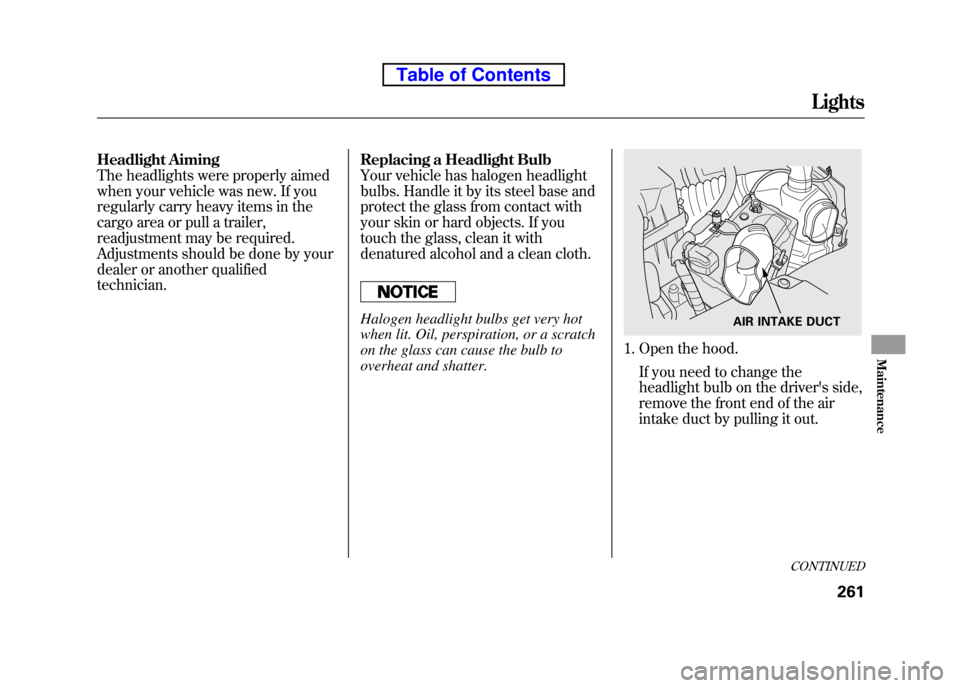
1. Open the hood.
If you need to change the
headlight bulb on the driver's side,
remove the front end of the air
intake duct by pulling it out.
AIR INTAKE DUCT
CONTINUED
Lights
261
Maintenance
Table of Contents
Page 299 of 342
If you have a flat tire while driving,
stop in a safe place to change it.
Drive slowly along the shoulder until
you get to an exit or an area to stop
that is far away from the traffic lanes.
The vehicle can easily roll off
the jack, seriously injuring
anyone underneath.
Follow the directions for
changing a tire exactly, and
never get under the vehicle
when it is supported only by thejack.1. Park the vehicle on firm, level, and
non-slippery ground. Put the
transmission in Park (automatic)
or reverse (manual). Apply the
parking brake.
If you are towing a trailer, unhitch
the trailer.
2. Turn on the hazard warning lights, and turn the ignition switch to the
LOCK (0) position. Have all
passengers get out of the vehicle
while you change the tire.
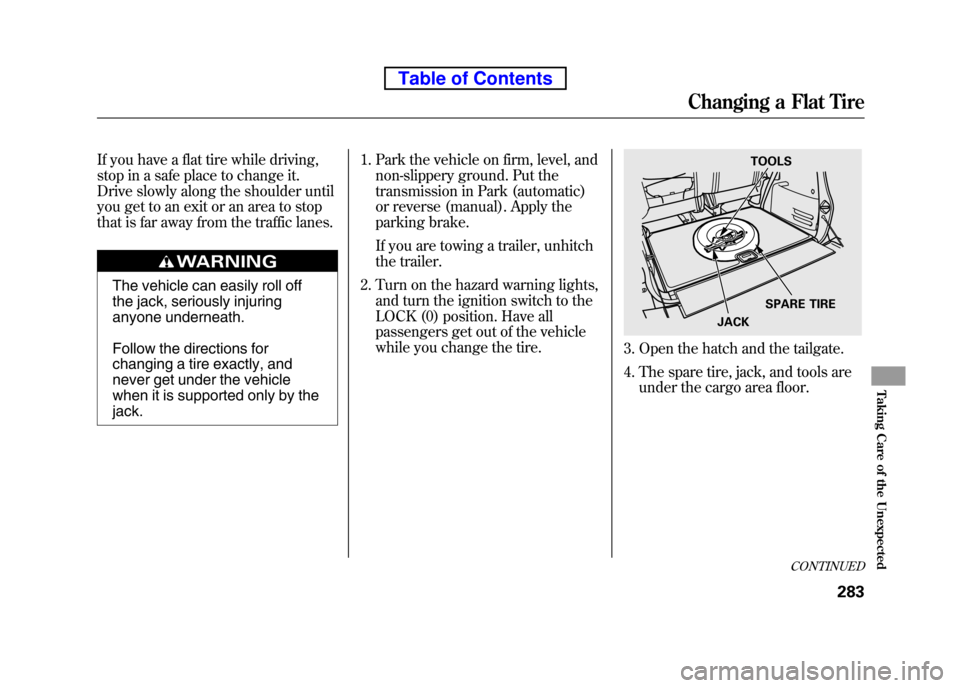
3. Open the hatch and the tailgate.
4. The spare tire, jack, and tools are
under the cargo area floor.
TOOLS
SPARE TIRE
JACK
CONTINUED
Changing a Flat Tire
283
Taking Care of the Unexpected
Table of Contents
Page 319 of 342

If your vehicle needs to be towed,
call a professional towing service or
organization. Never tow your vehicle
with just a rope or chain. It is very dangerous.
The only way you can safely tow
your vehicle is with flat-bedequipment.The operator will load
your vehicle on the back of a truck.
Any other method of towing will
damage the drive system. When you
contact the towing agency, inform
them a flat-bed is required.4WD models only
Towing with only two tires on the
ground will damage parts of the 4WD
system. It should be transported on a
flat-bed truck or trailer.
Emergency Towing
303
Taking Care of the Unexpected
Table of Contents