flat tire HONDA ELEMENT 2010 1.G Owner's Manual
[x] Cancel search | Manufacturer: HONDA, Model Year: 2010, Model line: ELEMENT, Model: HONDA ELEMENT 2010 1.GPages: 342, PDF Size: 5.76 MB
Page 300 of 342
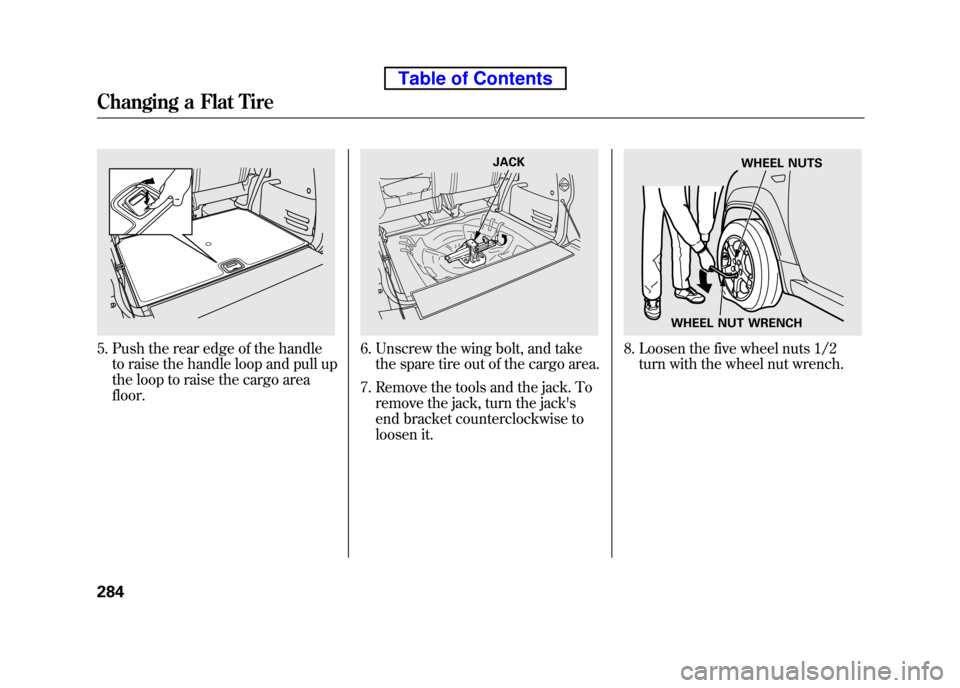
5. Push the rear edge of the handleto raise the handle loop and pull up
the loop to raise the cargo areafloor.6. Unscrew the wing bolt, and takethe spare tire out of the cargo area.
7. Remove the tools and the jack. To remove the jack, turn the jack's
end bracket counterclockwise to
loosen it.8. Loosen the five wheel nuts 1/2turn with the wheel nut wrench.
JACKWHEEL NUTS
WHEEL NUT WRENCH
Changing a Flat Tire
284
Table of Contents
Page 301 of 342
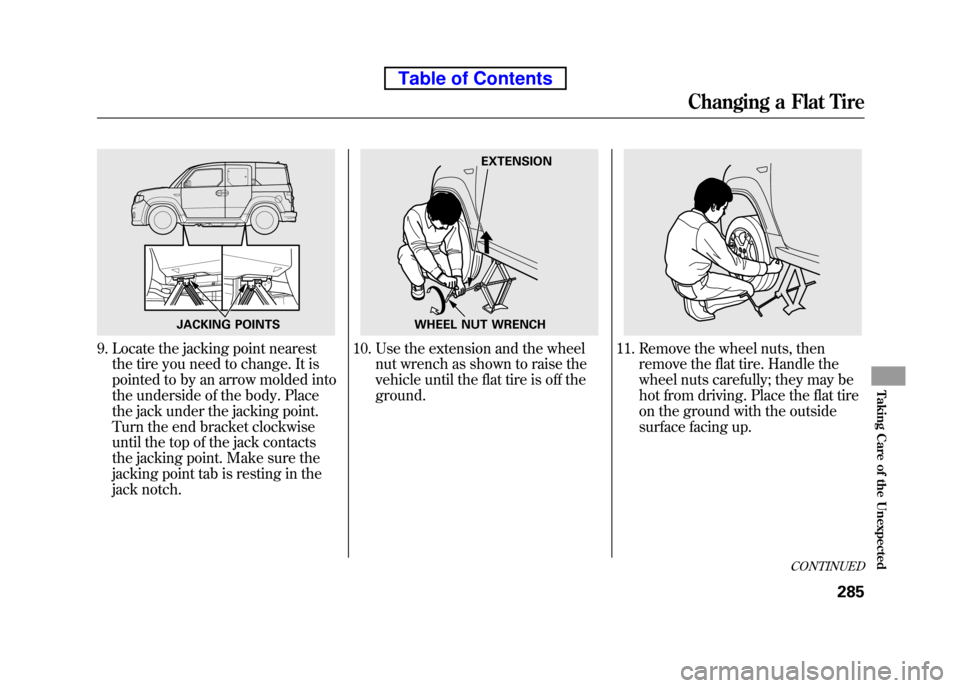
9. Locate the jacking point nearestthe tire you need to change. It is
pointed to by an arrow molded into
the underside of the body. Place
the jack under the jacking point.
Turn the end bracket clockwise
until the top of the jack contacts
the jacking point. Make sure the
jacking point tab is resting in the
jack notch.10. Use the extension and the wheel nut wrench as shown to raise the
vehicle until the flat tire is off theground.11. Remove the wheel nuts, thenremove the flat tire. Handle the
wheel nuts carefully; they may be
hot from driving. Place the flat tire
on the ground with the outside
surface facing up.
JACKING POINTS
EXTENSION
WHEEL NUT WRENCH
CONTINUED
Changing a Flat Tire
285
Taking Care of the Unexpected
Table of Contents
Page 302 of 342
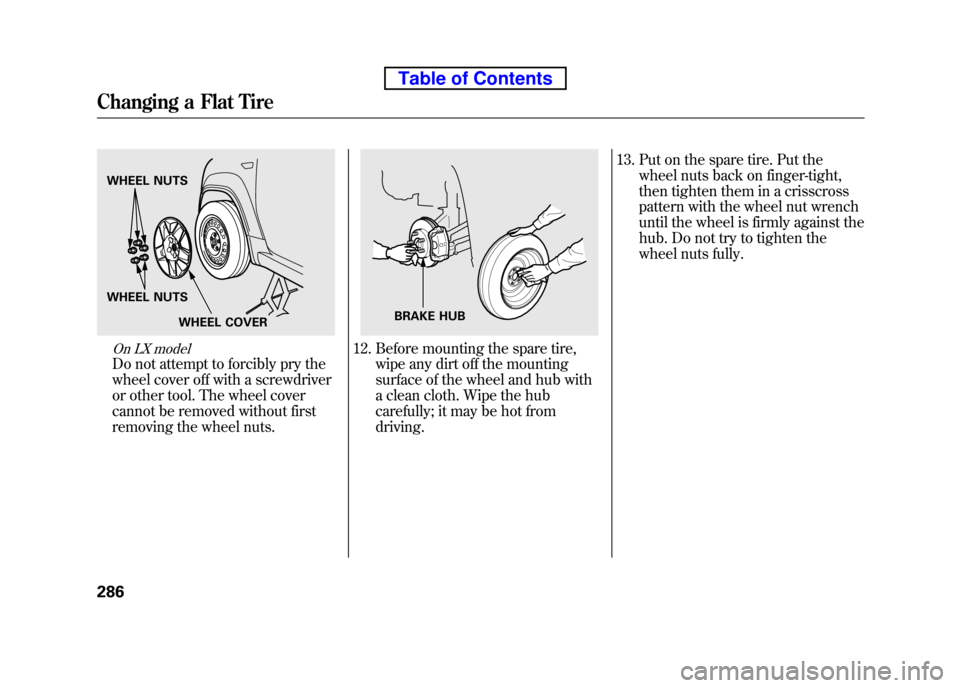
On LX model
Do not attempt to forcibly pry the
wheel cover off with a screwdriver
or other tool. The wheel cover
cannot be removed without first
removing the wheel nuts.
12. Before mounting the spare tire,wipe any dirt off the mounting
surface of the wheel and hub with
a clean cloth. Wipe the hub
carefully; it may be hot from driving. 13. Put on the spare tire. Put the
wheel nuts back on finger-tight,
then tighten them in a crisscross
pattern with the wheel nut wrench
until the wheel is firmly against the
hub. Do not try to tighten the
wheel nuts fully.
WHEEL NUTS
WHEEL NUTS
WHEEL COVER
BRAKE HUB
Changing a Flat Tire
286
Table of Contents
Page 303 of 342
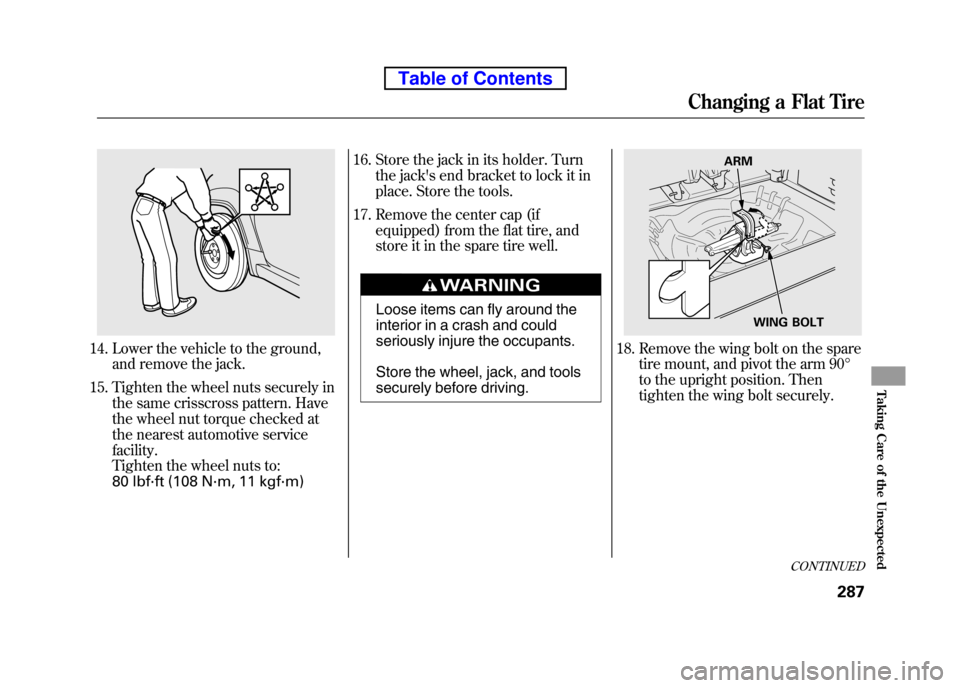
14. Lower the vehicle to the ground,and remove the jack.
15. Tighten the wheel nuts securely in the same crisscross pattern. Have
the wheel nut torque checked at
the nearest automotive servicefacility.
Tighten the wheel nuts to:
80 lbf·ft (108 N·m, 11 kgf·m) 16. Store the jack in its holder. Turn
the jack's end bracket to lock it in
place. Store the tools.
17. Remove the center cap (if equipped) from the flat tire, and
store it in the spare tire well.
Loose items can fly around the
interior in a crash and could
seriously injure the occupants.
Store the wheel, jack, and tools
securely before driving.
18. Remove the wing bolt on the spare tire mount, and pivot the arm 90°
to the upright position. Then
tighten the wing bolt securely.
ARM
WING BOLT
CONTINUED
Changing a Flat Tire
287
Taking Care of the Unexpected
Table of Contents
Page 304 of 342
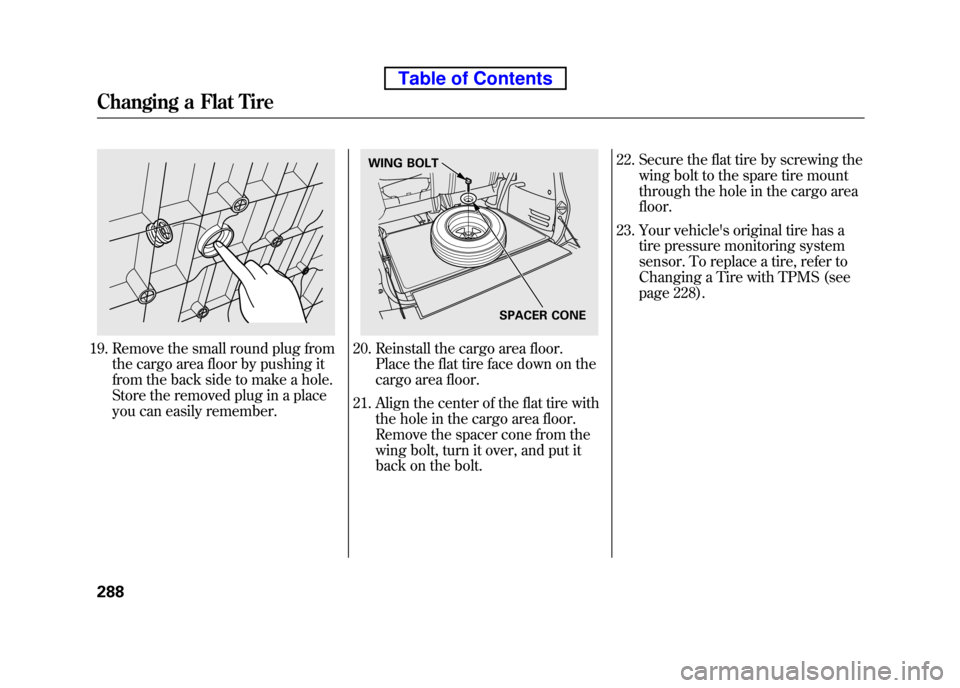
19. Remove the small round plug fromthe cargo area floor by pushing it
from the back side to make a hole.
Store the removed plug in a place
you can easily remember.20. Reinstall the cargo area floor. Place the flat tire face down on the
cargo area floor.
21. Align the center of the flat tire with the hole in the cargo area floor.
Remove the spacer cone from the
wing bolt, turn it over, and put it
back on the bolt. 22. Secure the flat tire by screwing the
wing bolt to the spare tire mount
through the hole in the cargo areafloor.
23. Your vehicle's original tire has a tire pressure monitoring system
sensor. To replace a tire, refer to
Changing a Tire with TPMS (see
page 228).
SPACER CONE
WING BOLT
Changing a Flat Tire
288
Table of Contents
Page 319 of 342

If your vehicle needs to be towed,
call a professional towing service or
organization. Never tow your vehicle
with just a rope or chain. It is very dangerous.
The only way you can safely tow
your vehicle is with flat-bedequipment.The operator will load
your vehicle on the back of a truck.
Any other method of towing will
damage the drive system. When you
contact the towing agency, inform
them a flat-bed is required.4WD models only
Towing with only two tires on the
ground will damage parts of the 4WD
system. It should be transported on a
flat-bed truck or trailer.
Emergency Towing
303
Taking Care of the Unexpected
Table of Contents
Page 328 of 342

Temperature
The temperature grades are A (the
highest), B, and C, representing the
tire's resistance to the generation of
heat and its ability to dissipate heat
when tested under controlled
conditions on a specified indoor
laboratory test wheel. Sustained high
temperature can cause the material
of the tire to degenerate and reduce
tire life, and excessive temperature
can lead to sudden tire failure. The
grade C corresponds to a level of
performance which all passenger car
tires must meet under the Federal
Motor Vehicle Safety Standard No.
109. Grades B and A represent
higher levels of performance on the
laboratory test wheel than the
minimum required by law.Warning: The temperature grade for
this tire is established for a tire that
is properly inflated and not
overloaded. Excessive speed,
underinflation, or excessive loading,
either separately or in combination,
can cause heat buildup and possible
tire failure.
DOT Tire Quality Grading (U.S. Vehicles)
312
Table of Contents
Page 330 of 342

Glossary of Tire Terminology
Cold Tire Pressure - The tire air
pressure when the vehicle has been
parked for at least three hours or
driven less than 1 mile (1.6km).
Load Rating - Means the maximum
load that a tire is rated to carry for a
given inflation presure.
Maximum Inflation Pressure - the
maximum tire air pressure that the
tire can hold.
Maximum Load Rating - Means the
load rating for a tire at the maximum
permissible inflation pressure for thattire.
Recommended Inflation Pressure -
The cold tire inflation pressure
recommended by the manufacturer.
Treadwear Indicators (TWI) - Means
the projections within the principal
grooves designed to give a visual
indication of the degrees of wear of
the tread.Tire Pressure Monitoring System(TPMS)
Each tire, including the spare (if
provided), should be checked
monthly when cold and inflated to
the inflation pressure recommended
by the vehicle manufacturer on the
vehicle placard or tire inflation
pressure label.
(If your vehicle has tires of a different
size than the size indicated on the
vehicle placard or tire inflation
pressure label, you should determine
the proper tire inflation pressure for
those tires.)
As an added safety feature, your
vehicle has been equipped with a tire
pressure monitoring system (TPMS)
that illuminates a low tire pressure telltale
when one or more of your tires is
significantly under-inflated.
Accordingly, when the low tire
pressure telltale illuminates, you
should stop and check your tires as
soon as possible, and inflate them to
the proper pressure.
Tire Labeling, Tire Pressure Monitoring System (TPMS)
-Required Federal Explanation
314
Table of Contents
Page 331 of 342

Driving on a significantly under-
inflated tire causes the tire to
overheat and can lead to tire failure.
Under-inflation also reduces fuel
efficiency and tire tread life, and may
affect the vehicle's handling and
stopping ability.
Please note that the TPMS is not a
substitute for proper tire
maintenance, and it is the driver's
responsibility to maintain correct tire
pressure, even if under-inflation has
not reached the level to trigger
illumination of the TPMS low tire
pressure telltale.Your vehicle has also been equipped
with a TPMS malfunction indicator to
indicate when the system is not
operating properly. The TPMS
malfunction indicator is provided by
a separate telltale, which displays thesymbol
‘‘TPMS ’’when illuminated.
When the malfunction indicator isilluminated,
the system may not be able to detect
or signal low tire pressure asintended.
TPMS malfunctions may occur for a
variety of reasons, including the
installation of replacement or
alternate tires or wheels on the
vehicle that prevent the TPMS from
functioning properly. Always check the TPMS malfunction
telltale after replacing one or more
tires or wheels on your vehicle to
ensure that the replacement or
alternate tires and wheels allow the
TPMS to continue to functionproperly.
Tire Pressure Monitoring System (TPMS)
-Required Federal Explanation
315
Technical Information
Table of Contents