child seat HONDA ELEMENT 2010 1.G Owner's Guide
[x] Cancel search | Manufacturer: HONDA, Model Year: 2010, Model line: ELEMENT, Model: HONDA ELEMENT 2010 1.GPages: 342, PDF Size: 5.76 MB
Page 65 of 342
When a child reaches the
recommended weight or height limit
for a forward-facing child seat, the
child should sit in a back seat on a
booster seat and wear the lap/
shoulder belt.
The following pages give instructions
on how to check proper seat belt fit,
what kind of booster seat to use if one
is needed, and important precautions
for a child who must sit in front.
Allowing a child age 12 or under
to sit in front can result in injury
or death if the passenger's front
airbag inflates.
If a child must ride in front, move
the vehicle seat as far back as
possible, use a booster seat if
needed, have the child sit up
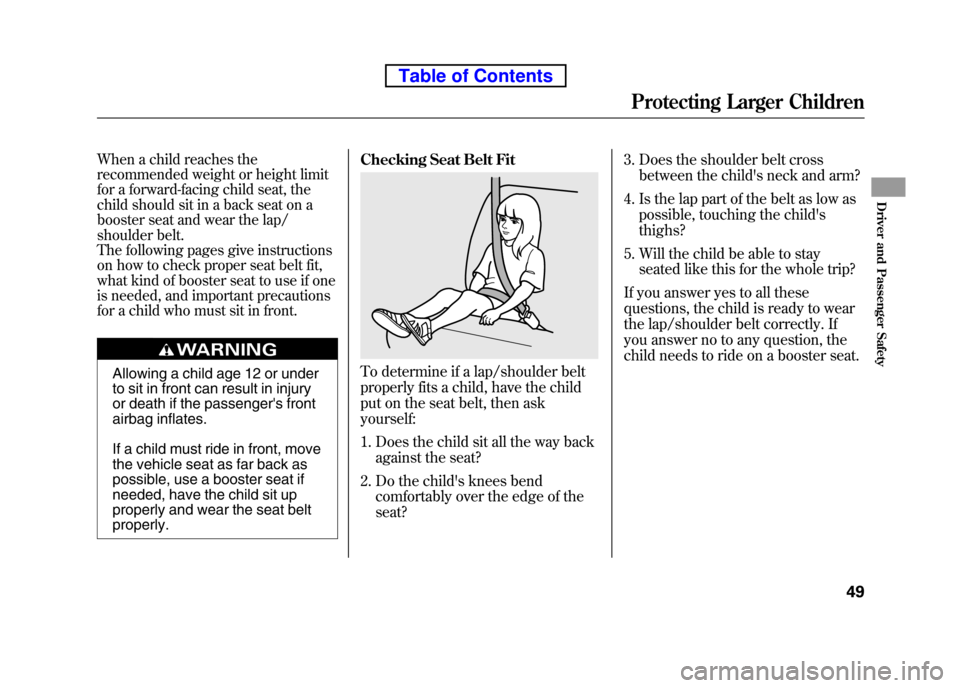
properly and wear the seat beltproperly.Checking Seat Belt FitTo determine if a lap/shoulder belt
properly fits a child, have the child
put on the seat belt, then ask yourself:
1. Does the child sit all the way back
against the seat?
2. Do the child's knees bend comfortably over the edge of the seat? 3. Does the shoulder belt cross
between the child's neck and arm?
4. Is the lap part of the belt as low as possible, touching the child'sthighs?
5. Will the child be able to stay seated like this for the whole trip?
If you answer yes to all these
questions, the child is ready to wear
the lap/shoulder belt correctly. If
you answer no to any question, the
child needs to ride on a booster seat.
Protecting Larger Children
49
Driver and Passenger Safety
Table of Contents
Page 66 of 342
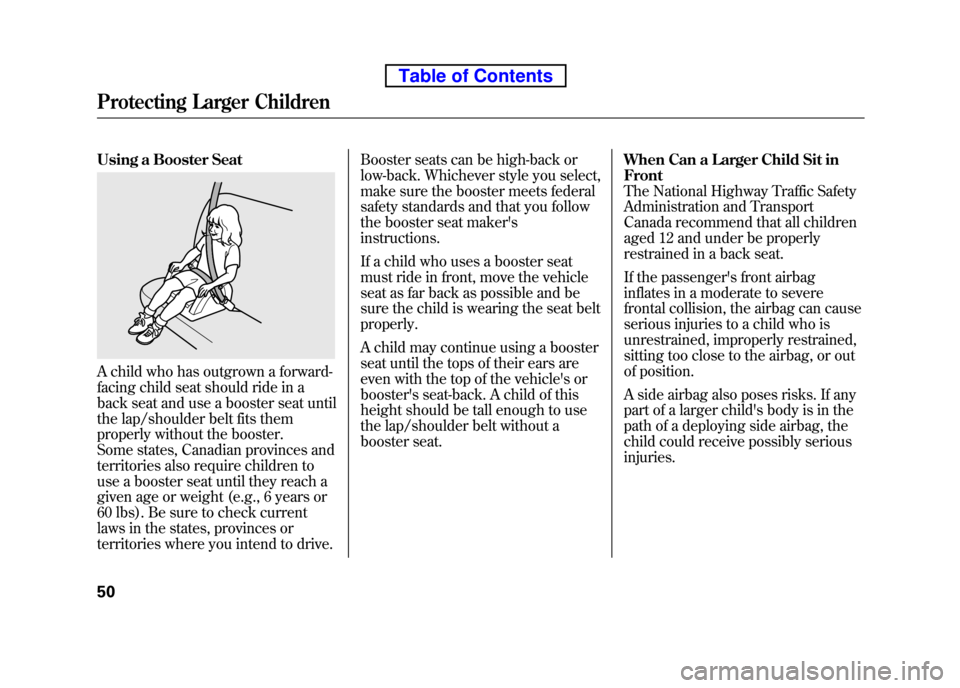
Using a Booster Seat
A child who has outgrown a forward-
facing child seat should ride in a
back seat and use a booster seat until
the lap/shoulder belt fits them
properly without the booster.
Some states, Canadian provinces and
territories also require children to
use a booster seat until they reach a
given age or weight (e.g., 6 years or
60 lbs). Be sure to check current
laws in the states, provinces or
territories where you intend to drive.Booster seats can be high-back or
low-back. Whichever style you select,
make sure the booster meets federal
safety standards and that you follow
the booster seat maker's instructions.
If a child who uses a booster seat
must ride in front, move the vehicle
seat as far back as possible and be
sure the child is wearing the seat beltproperly.
A child may continue using a booster
seat until the tops of their ears are
even with the top of the vehicle's or
booster's seat-back. A child of this
height should be tall enough to use
the lap/shoulder belt without a
booster seat.
When Can a Larger Child Sit inFront
The National Highway Traffic Safety
Administration and Transport
Canada recommend that all children
aged 12 and under be properly
restrained in a back seat.
If the passenger's front airbag
inflates in a moderate to severe
frontal collision, the airbag can cause
serious injuries to a child who is
unrestrained, improperly restrained,
sitting too close to the airbag, or out
of position.
A side airbag also poses risks. If any
part of a larger child's body is in the
path of a deploying side airbag, the
child could receive possibly seriousinjuries.
Protecting Larger Children
50
Table of Contents
Page 67 of 342
Of course, children vary widely. And
while age may be one indicator of
when a child can safely ride in front,
there are other important factors you
should consider.
Maturity
To safely ride in front, a child must
be able to follow the rules, including
sitting properly, and wearing the seat
belt properly throughout a ride.
Physical Size
Physically, a child must be large
enough for the lap/shoulder belt to
properly fit (see pages 14 and 49). If
the seat belt does not fit properly,
with or without the child sitting on a
booster seat, the child should not sit
in front.If you decide that a child can safely
ride up front, be sure to:
● Carefully read the owner's manual,
and make sure you understand all
seat belt instructions and all safetyinformation.
● Move the vehicle seat to the rear-
most position.
● Have the child sit up straight, back
against the seat, and feet on or
near the floor.
● Check that the child's seat belt is
properly and securely positioned.
● Supervise the child. Even mature
children sometimes need to be
reminded to fasten the seat belts
or sit properly. Additional Safety Precautions
●
Do not let a child wear a seat belt
across the neck.
This could result
in serious neck injuries during acrash.
●
Do not let a child put the shoulder part of a seat belt behind the back
or under the arm.
This could cause
very serious injuries during a
crash. It also increases the chance
that the child will slide under the
belt in a crash and be injured.
●
Two children should never use the same seat belt.If they do, they
could be very seriously injured in acrash.
●
Do not put any accessories on a seat belt.Devices intended to
improve a child's comfort or
reposition the shoulder part of a
seat belt can make the belt less
effective and increase the chance
of serious injury in a crash.
Protecting Larger Children
51
Driver and Passenger Safety
Table of Contents