tire pressure HONDA ELEMENT 2010 1.G Owner's Guide
[x] Cancel search | Manufacturer: HONDA, Model Year: 2010, Model line: ELEMENT, Model: HONDA ELEMENT 2010 1.GPages: 342, PDF Size: 5.76 MB
Page 326 of 342

Air ConditioningRefrigerant type HFC-134a (R-134a)
Charge quantity 17.6 -19.4 oz (500 -550 g)
Lubricant type ND-OIL8
Lights Headlights 12 V -60/55 W (H4/HB2)
Daytime running lights 12 V -60 W (HB3)
Front turn signal/parking lights 12 V -27/8 W (Amber)
Front side marker lights 12 V -3CP
Side turn signal lights 12 V -3CP
Rear turn signal lights 12 V -21 W (Amber)
Rear side marker lights 12 V -3CP
Brake/Taillights 12 V -21/5 W
Back-up lights 12 V -21 CP
License plate lights 12 V -5W
Ceiling light 12 V -8W
ꭧ1
12 V -5Wꭧ2, ꭧ3
Spotlights 12 V -8Wꭧ2, ꭧ3
Cargo area light 12 V -8W
High-mount brake light 12 V -21 W
Battery Capacity 12 V -47 AH/20 HR
12 V -38 AH/5 HR Fuses
Interior See page 301 or the fuse label attached to the inside of the fuse
box door under the steering column.
Under-hood See page 302 or the fuse box cover.
Alignment Toe-in Front 0.0 in (0 mm)
Rear 0.08 in (2.0 mm)
Camber Front -0°13 ’
ꭧ1, ꭧ2
- 0°24 ’ꭧ3
Rear -1°00 ’ꭧ1, ꭧ2
- 1°06 ’ꭧ3
Caster Front 1°50 ’
Tires Size Front/Rear P215/70R16 99S
ꭧ 1, ꭧ2
P225/55R18 97Hꭧ3
Pressure Front 33 psi (230 kPa, 2.3 kgf/cm2)ꭧ 1, ꭧ2
32 psi (220 kPa, 2.2 kgf/cm2)ꭧ 3
Rear 35 psi (240 kPa, 2.4 kgf/cm2)ꭧ1, ꭧ2
32 psi (220 kPa, 2.2 kgf/cm2)ꭧ 3
Spare 60 psi (420 kPa, 4.2 kgf/cm2)
ꭧ 1: LX model
ꭧ 2: EX model
ꭧ 3: SC model
Specifications
310
Table of Contents
Page 329 of 342
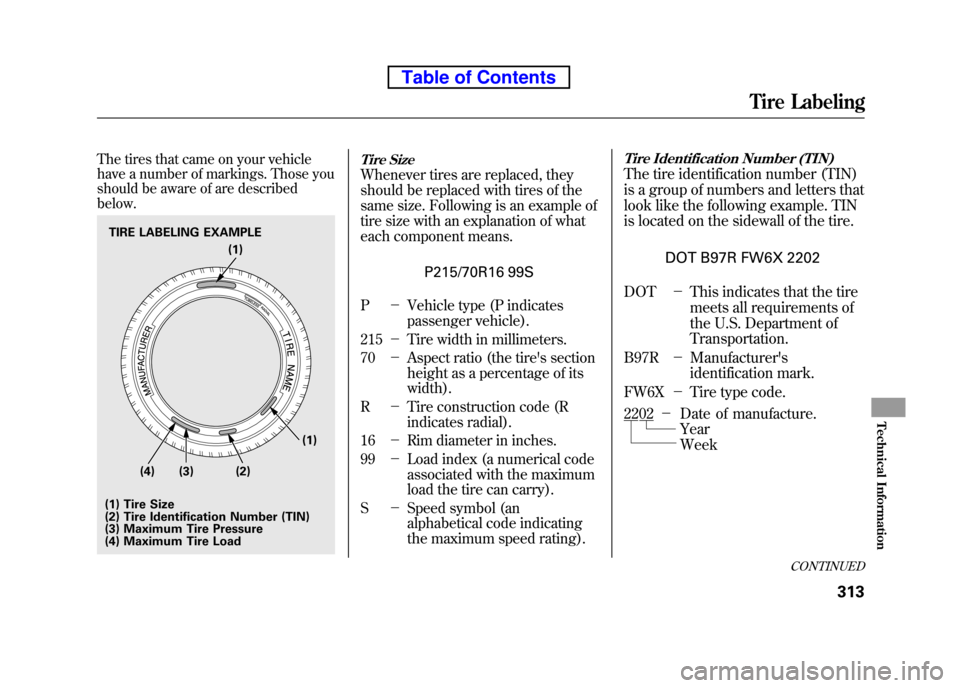
The tires that came on your vehicle
have a number of markings. Those you
should be aware of are described below.Tire Size
Whenever tires are replaced, they
should be replaced with tires of the
same size. Following is an example of
tire size with an explanation of what
each component means.P215/70R16 99S
P -Vehicle type (P indicates
passenger vehicle).
215 -Tire width in millimeters.
70 -Aspect ratio (the tire's section
height as a percentage of itswidth).
R -Tire construction code (R
indicates radial).
16 -Rim diameter in inches.
99 -Load index (a numerical code
associated with the maximum
load the tire can carry).
S -Speed symbol (an
alphabetical code indicating
the maximum speed rating).
Tire Identification Number (TIN)
The tire identification number (TIN)
is a group of numbers and letters that
look like the following example. TIN
is located on the sidewall of the tire.
DOT B97R FW6X 2202
DOT -This indicates that the tire
meets all requirements of
the U.S. Department ofTransportation.
B97R -Manufacturer's
identification mark.
FW6X -Tire type code.
TIRE LABELING EXAMPLE
(1) Tire Size
(2) Tire Identification Number (TIN)
(3) Maximum Tire Pressure
(4) Maximum Tire Load (1)
(2) (1)
(3)
(4)
2202 -
Year Week
Date of manufacture.
CONTINUED
Tire Labeling
313
Technical Information
Table of Contents
Page 330 of 342

Glossary of Tire Terminology
Cold Tire Pressure - The tire air
pressure when the vehicle has been
parked for at least three hours or
driven less than 1 mile (1.6km).
Load Rating - Means the maximum
load that a tire is rated to carry for a
given inflation presure.
Maximum Inflation Pressure - the
maximum tire air pressure that the
tire can hold.
Maximum Load Rating - Means the
load rating for a tire at the maximum
permissible inflation pressure for thattire.
Recommended Inflation Pressure -
The cold tire inflation pressure
recommended by the manufacturer.
Treadwear Indicators (TWI) - Means
the projections within the principal
grooves designed to give a visual
indication of the degrees of wear of
the tread.Tire Pressure Monitoring System(TPMS)
Each tire, including the spare (if
provided), should be checked
monthly when cold and inflated to
the inflation pressure recommended
by the vehicle manufacturer on the
vehicle placard or tire inflation
pressure label.
(If your vehicle has tires of a different
size than the size indicated on the
vehicle placard or tire inflation
pressure label, you should determine
the proper tire inflation pressure for
those tires.)
As an added safety feature, your
vehicle has been equipped with a tire
pressure monitoring system (TPMS)
that illuminates a low tire pressure telltale
when one or more of your tires is
significantly under-inflated.
Accordingly, when the low tire
pressure telltale illuminates, you
should stop and check your tires as
soon as possible, and inflate them to
the proper pressure.
Tire Labeling, Tire Pressure Monitoring System (TPMS)
-Required Federal Explanation
314
Table of Contents
Page 331 of 342

Driving on a significantly under-
inflated tire causes the tire to
overheat and can lead to tire failure.
Under-inflation also reduces fuel
efficiency and tire tread life, and may
affect the vehicle's handling and
stopping ability.
Please note that the TPMS is not a
substitute for proper tire
maintenance, and it is the driver's
responsibility to maintain correct tire
pressure, even if under-inflation has
not reached the level to trigger
illumination of the TPMS low tire
pressure telltale.Your vehicle has also been equipped
with a TPMS malfunction indicator to
indicate when the system is not
operating properly. The TPMS
malfunction indicator is provided by
a separate telltale, which displays thesymbol
‘‘TPMS ’’when illuminated.
When the malfunction indicator isilluminated,
the system may not be able to detect
or signal low tire pressure asintended.
TPMS malfunctions may occur for a
variety of reasons, including the
installation of replacement or
alternate tires or wheels on the
vehicle that prevent the TPMS from
functioning properly. Always check the TPMS malfunction
telltale after replacing one or more
tires or wheels on your vehicle to
ensure that the replacement or
alternate tires and wheels allow the
TPMS to continue to functionproperly.
Tire Pressure Monitoring System (TPMS)
-Required Federal Explanation
315
Technical Information
Table of Contents
Page 342 of 342

Gasoline:
Unleaded gasoline, pump octane
number of 87 or higher.
Fuel Tank Capacity:
15.9 US gal (60 L)
Recommended Engine Oil:
API Premium grade 5W-20
detergent oil (see page 251).
Oil change capacity (including filter):
4.4 US qt (4.2 L)
Automatic Transmission Fluid:
Honda Genuine ATF-Z1
(Automatic Transmission Fluid)
(see page 256).Manual Transmission Fluid:
Honda Manual Transmission Fluid
preferred, or an SAE 10W-30 or
10W-40 motor oil as a temporary
replacement (see page 257).
Capacity (including differential):
2.0 US qt (1.9 L)
4WD models only
Rear Differential Fluid:
Honda Dual Pump Fluid II. Do not
use ATF. Capacity:
1.1 US qt (1.0 L)
Power Steering Fluid:
Honda Power Steering Fluid
preferred, or another brand of
power steering fluid as a
temporary replacement. Do not
use ATF (see page 260).Brake Fluid:
Honda Heavy Duty Brake Fluid
DOT 3 preferred, or a DOT 3 or
DOT 4 brake fluid as a temporary
replacement (see page 258).
Tire Pressure (measured cold):
All models except SC
Front:
33 psi (230 kPa, 2.3 kgf/cm2)
Rear: 35 psi (240 kPa, 2.4 kgf/cm
2)
SC model
Front/Rear: 32 psi (220 kPa, 2.2 kgf/cm2)
Spare Tire Pressure: 60 psi (420 kPa, 4.2 kgf/cm
2)
Service Information Summary