trailer HONDA ELEMENT 2011 1.G User Guide
[x] Cancel search | Manufacturer: HONDA, Model Year: 2011, Model line: ELEMENT, Model: HONDA ELEMENT 2011 1.GPages: 286, PDF Size: 14.07 MB
Page 182 of 286

Towing Equipment and
Accessories
Towing can require a variety of
equipment, depending on the size of
your trailer, how it will be used, how
much load you are towing, and
where you tow. To ensure the
highest quality equipment, purchase
Honda equipment whenever
possible.
Discuss your needs with your trailer
sales or rental agency, and follow the
guidelines in the rest of this section.
Also make sure that all equipment is
properly installed and that it meets
federal, state, provincial, territorial
and local regulations.
HitchesAny hitch used on your vehicle must
be properly bolted to the underbody.Safety ChainsAlways use safety chains when you
tow a trailer. Make sure the chains
are secured to the trailer and hitch,
and that they cross under the tongue
and can catch the trailer if it becomes
unhitched. Leave enough slack to
allow the trailer to turn corners
easily, but do not let the chains drag
on the ground.
Trailer BrakesHonda recommends that any trailer
with a total weight of 1,000 lbs (450
kg) or more has its own brake.
There are two common types of
trailer brakes; surge and electric.
Surge brakes are common for boat
trailers, since the brakes will get wet.
If you choose electric brakes, be sure
they are electronically actuated. Do
not attempt to tap into your vehicle's
hydraulic system. No matter how
successful it may seem, any attempt
to attach trailer brakes to your
vehicle's hydraulic system will lower
braking effectiveness and create a
potential hazard.
See your trailer dealer or rental
agency for more information on
installing electric brakes.
Towing a Trailer17610/08/06 08:34:41 11 ELEMENT MMC North America Owner's Man 50 31SCV680 enu
Page 183 of 286

Trailer LightsTrailer lights and equipment must
comply with federal, state, provincial,
territorial, and local regulations.
Check with your local trailer dealer
or rental agency for the requirements
in the area where you plan to tow,
and use only equipment designed for
your vehicle.
Since lighting and wiring vary by
trailer type and brand, you should
have a qualified technician install a
suitable connector between the
vehicle and the trailer. Improper
equipment or installation can cause
damage to your vehicle's electrical
system and affect your vehicle
warranty.
Additional Towing EquipmentMany states require special outside
mirrors when towing a trailer. Even if
they don't, you should install special
mirrors if you cannot clearly see
behind you, or if the trailer creates a
blind spot.Ask your trailer sales or rental
agency if any other items are
recommended or required for your
towing situation.
CONTINUED
Towing a Trailer
177
Driving
10/08/06 08:34:41 11 ELEMENT MMC North America Owner's Man 50 31SCV680 enu
Page 184 of 286

Pre-Tow Checklist
When preparing to tow, and before
driving away, be sure to check the
following:●The vehicle has been properly
serviced, and the tires, brakes,
suspension, cooling system, and
lights are in good operating
condition.●The trailer has been properly
serviced and is in good condition.●All weights and loads are within
limits (see pages 174 and 175).●The hitch, safety chains, and any
other attachments are secure.●All items in or on the trailer are
properly secured and cannot shift
while you drive.
●Your vehicle tires and spare are
properly inflated (see page 212),
and the trailer tires and spare are
inflated as recommended by the
trailer maker.Driving Safely With a Trailer
The added weight, length, and
height of a trailer will affect your
vehicle's handling and performance,
so driving with a trailer requires
some special driving skills and
techniques.
For your safety and the safety of
others, take time to practice driving
maneuvers before heading for the
open road, and follow the guidelines
below.
Towing Speeds and GearsDrive slower than normal in all
driving situations, and obey posted
speed limits for vehicles with trailers.
Use the D position when towing a
trailer on level roads. D3 is the
proper shift lever position to use
when towing a trailer in hilly terrain.
(See
‘‘
Driving on Hills
’’on the next
page for additional gear information.)
Towing a Trailer17810/08/06 08:34:41 11 ELEMENT MMC North America Owner's Man 50 31SCV680 enu
Page 185 of 286

Making Turns and BrakingMake turns more slowly and wider
than normal. The trailer tracks a
smaller arc than your vehicle, and it
can hit or run over something the
vehicle misses. Allow more time and
distance for braking. Do not brake or
turn suddenly as this could cause the
trailer to jackknife or turn over.Driving on HillsWhen climbing hills, closely watch
your temperature gauge. If it nears
the red (Hot) mark, turn the air
conditioning off, reduce speed and, if
necessary, pull to the side of the road
to let the engine cool.
If the automatic transmission shifts
frequently while going up a hill, shift
to D3.If you must stop when facing uphill,
use the foot brake or parking brake.
Do not try to hold the vehicle in place
by pressing on the accelerator, as
this can cause the automatic
transmission to overheat.
When driving down hills, reduce
your speed, and shift down to second
gear. Do not
‘‘ride ’’the brakes, and
remember, it will take longer to slow
down and stop when towing a trailer.
Handling Crosswinds and BuffetingCrosswinds and air turbulence
caused by passing trucks can disrupt
your steering and cause the trailer to
sway. When being passed by a large
vehicle, keep a constant speed, and
steer straight ahead. Do not try to
make quick steering or braking
corrections.
Backing UpAlways drive slowly and have
someone guide you when backing
up. Grip the
bottom
of the steering
wheel, then turn the wheel to the left
to get the trailer to move to the left,
and turn the wheel right to move the
trailer to the right.
ParkingFollow all normal precautions when
parking, including firmly setting the
parking brake and putting the
transmission in Park. Also, place
wheel chocks at each of the trailer's
tires.
Towing Your Vehicle
Your vehicle is not designed to be
towed behind a motor home. If your
vehicle needs to be towed in an
emergency, see page 244.
Towing a Trailer
179
Driving
10/08/06 08:34:41 11 ELEMENT MMC North America Owner's Man 50 31SCV680 enu
Page 197 of 286

SymbolMaintenance Main Items
A
●Replace engine oil
ꭧ 1
B
●Replace engine oil
ꭧ1and oil filter
●Inspect front and rear brakes●Check parking brake adjustment●Inspect these items:●Tie rod ends, steering gear box, and boots●Suspension components●Driveshaft boots●Brake hoses and lines (including ABS/VSA)●All fluid levels and condition of fluids●Exhaust system
#
●Fuel lines and connections
#
ꭧ 1: If the message ‘‘SERVICE ’’does not appear more than 12 months after the
display is reset, change the engine oil every year.
# : See information on maintenance and emissions warranty on page 190.
NOTE:
●Independent of the maintenance message in the information display,
replace the brake fluid every 3 years.●Inspect idle speed every 160,000 miles (256,000 km).●Adjust the valves during services A, B, 1, 2, or 3 if they are noisy.
Symbol Maintenance Sub Items
1
●Rotate tires
2●Replace air cleaner element
If you drive in dusty conditions, replace
every 15,000 miles (24,000 km).●Replace dust and pollen filterIf you drive primarily in urban areas that have high
concentrations of soot in the air from industry and
from diesel-powered vehicles, replace every
15,000 miles (24,000 km).●Inspect drive belt
3●Replace transmission fluid Driving in mountainous areas at very low vehicle
speeds or trailer towing results in higher transmission
and transfer temperatures. This requires transmission
and transfer fluid changes more frequently than
recommended by the Maintenance Minder. If you
regularly drive your vehicle under these conditions,
have the transmission and transfer fluid changed at
60,000 miles (100,000 km), then every 30,000 miles
(48,000 km).
4●Replace spark plugs●Inspect valve clearance
5●Replace engine coolant
6●Replace rear differential fluid (4WD model only)
Maintenance Minder
TM
Maintenance Minder
191
10/08/06 08:34:41 11 ELEMENT MMC North America Owner's Man 50 31SCV680 enu
Page 207 of 286
A low power steering fluid level can
indicate a leak in the system. Check
the fluid level frequently, and have
the system inspected as soon as
possible.
If you are not sure how to add fluid,
contact your dealer.
Turning the steering wheel to full left or
right lock and holding it there can
damage the power steering pump.
Cleaning the Body PanelsIf equipped with body panelsTo clean the gray composite body
panels, wash them with soap and
water only. Do not apply wax to the
panels; it will cause discoloration.Headlight Aiming
The headlights were properly aimed
when your vehicle was new. If you
regularly carry heavy items in the
cargo area or pull a trailer,
readjustment may be required.
Adjustments should be done by your
dealer or another qualified
technician.
CONTINUED
Power Steering Fluid, Cleaning the Body Panels, Lights
201
Maintenance
10/08/06 08:34:41 11 ELEMENT MMC North America Owner's Man 50 31SCV680 enu
Page 229 of 286
If you have a flat tire while driving,
stop in a safe place to change it.
Drive slowly along the shoulder until
you get to an exit or an area to stop
that is far away from the traffic lanes.
The vehicle can easily roll off
the jack, seriously injuring
anyone underneath.
Follow the directions for
changing a tire exactly, and
never get under the vehicle
when it is supported only by the
jack.1. Park the vehicle on firm, level, and
non-slippery ground. Put the
transmission in Park. Apply the
parking brake.
If you are towing a trailer, unhitch
the trailer.
2. Turn on the hazard warning lights, and turn the ignition switch to the
LOCK (0) position. Have all
passengers get out of the vehicle
while you change the tire.
3. Open the hatch and the tailgate.
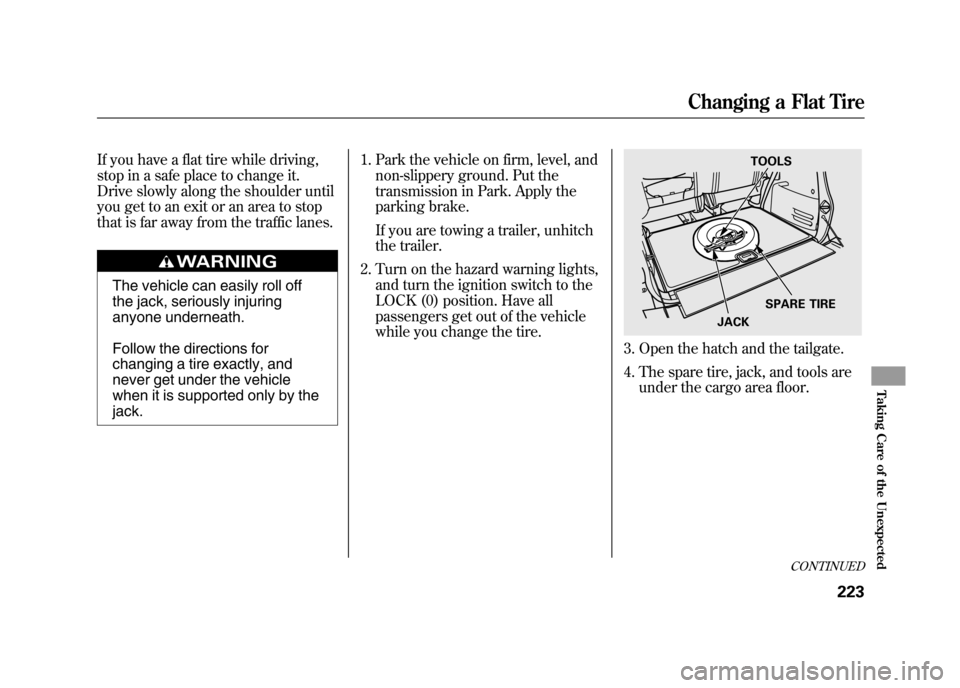
4. The spare tire, jack, and tools areunder the cargo area floor.
TOOLS
SPARE TIRE
JACK
CONTINUED
Changing a Flat Tire
223
Taking Care of the Unexpected
10/08/06 08:34:41 11 ELEMENT MMC North America Owner's Man 50 31SCV680 enu
Page 250 of 286
If your vehicle needs to be towed, call
a professional towing service or
organization. Never tow your vehicle
with just a rope or chain. It is very
dangerous.On 4WD modelsThe only way you can safely tow
your vehicle is with flat-bed
equipment.The operator will load
your vehicle on the back of a truck.
Any other method of towing will
damage the drive system. When you
contact the towing agency, inform
them a flat-bed is required.Towing with only two tires on the
ground will damage parts of the 4WD
system. It should be transported on a f
lat-bed truck or trailer.
On 2WD modelsThere are two ways to tow your
vehicle:Flat-bed Equipment
- The operator
loads your vehicle on the back of a
truck. This is the best way to
transport your vehicle.
Wheel-lift Equipment
- The tow
truck uses two pivoting arms that go
under the front tires and lift them off
the ground. The rear tires remain on
the ground. This is an acceptable
way to tow your vehicle. If, due to damage, your vehicle must
be towed with the front wheels on
the ground, do this:
●Start the engine.●Shift to D position and hold for 5
seconds, then to N.●Turn off the engine.●Leave the ignition switch in the
ACCESSORY (I) position so the
steering wheel does not lock.●Release the parking brake.Improper towing preparation will
damage the transmission. Follow the
above procedure exactly. If you cannot
shift the transmission or start the
engine, your vehicle must be
transported with the all four wheels off
the ground.
Emergency Towing24410/08/06 08:34:41 11 ELEMENT MMC North America Owner's Man 50 31SCV680 enu
Page 283 of 286

Sun Visor
...................................
100
Supplemental Restraint System
..............................
9, 22
Servicing
..................................
33
SRS Indicator
......................
30, 59
System Components
................
22
Synthetic Oil
..............................
194
T
Tachometer
..................................
64
Tailgate
........................................
82
Open Indicator
.........................
61
Opening the
.............................
82
Taillights, Changing Bulbs in
.....
206
Taking Care of the Unexpected
............................
221
Technical Descriptions DOT Tire Quality Grading (U.S. Vehicles)
.............................
253
Emissions Control Systems
.....
258
Three Way Catalytic Converter
............................
260
Tire Labeling
...........................
255 Tire Pressure Monitoring System
(TPMS) -Required Federal
Explanation
......................
256
Temperature Gauge
.....................
67
Tensioners, Seat Belts
..................
20
Tether Anchorage Points
.............
48
Theft Protection, Radio
..............
132
Three Way Catalytic Converter
...............................
260
Tilt the Steering Wheel
................
74
Time, Setting the
........................
133
Tire Chains
................................
217
Tire, How to Change a Flat
........
223
Tire Information
.........................
255
Tire Labeling
..............................
255
Tire Pressure Monitoring System (TPMS)
...........................
169, 256
Tires
..........................................
212
Air Pressure
............................
213
Chains
.....................................
217
Checking Wear
.......................
214
Compact Spare
........................
222
DOT Tire Quality Grading (U.S. Vehicles)
.............................
253
Inflation
...................................
212
Inspection
...............................
214 Labeling
..................................
255
Low Tire Pressure Indicator
........................
62, 169
Maintenance
...........................
215
Pressure Monitoring System
...
169
Replacing
................................
215
Rotating
..................................
215
Snow
.......................................
217
Specifications
..........................
252
Tools, Tire Changing
.................
223
Towing A Trailer
..................................
174
Emergency Wrecker
...............
244
TPMS (Tire Pressure Monitoring System)
..............................
169
Indicator
............................
63, 170
Required Federal Explanation
.........................
256
Transmission Checking Fluid Level
..............
198
Fluid Selection
........................
198
Identification Number
.............
248
Shifting the Automatic
.............
161
Treadwear
..................................
253
Trip Meter
...................................
66
CONTINUED
Index
IX
INDEX
10/08/06 08:34:41 11 ELEMENT MMC North America Owner's Man 50 31SCV680 enu