warning HONDA FIT 2009 2.G User Guide
[x] Cancel search | Manufacturer: HONDA, Model Year: 2009, Model line: FIT, Model: HONDA FIT 2009 2.GPages: 352, PDF Size: 17.67 MB
Page 96 of 352
Front Seat AdjustmentsSee pages11 -12for important safety
information and warnings about how to properly position the seats and seat-
backs.Make all seat adjustments before you
start driving.
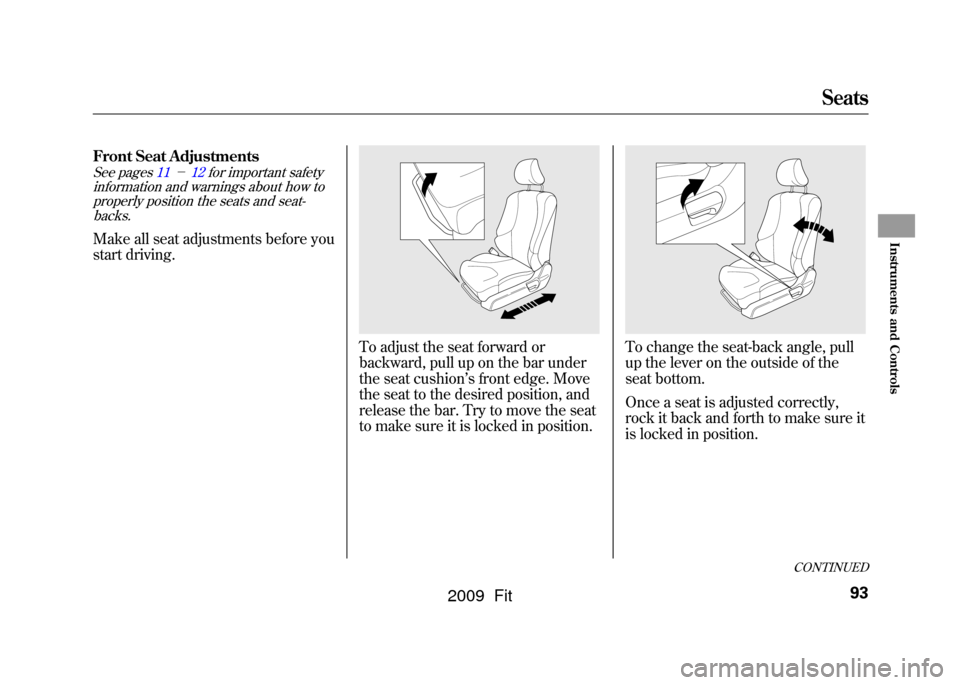
To adjust the seat forward or
backward, pull up on the bar under
the seat cushion ’s front edge. Move
the seat to the desired position, and
release the bar. Try to move the seat
to make sure it is locked in position.
To change the seat-back angle, pull
up the lever on the outside of the
seat bottom.
Once a seat is adjusted correctly,
rock it back and forth to make sure it
is locked in position.
CONTINUED
Seats
93
Instruments and Controls
2009 Fit
Page 97 of 352
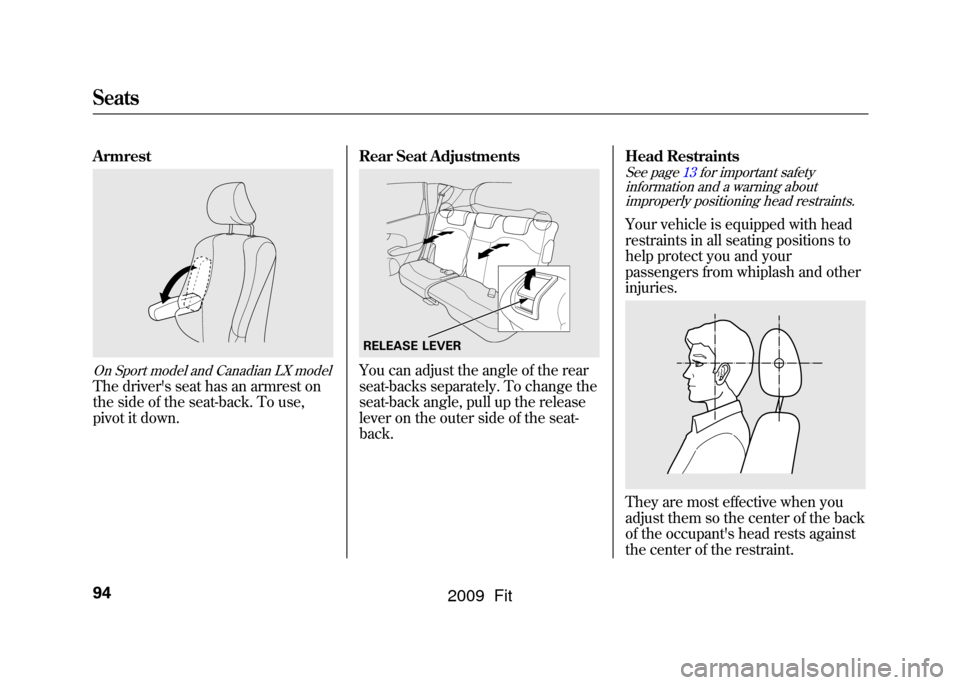
ArmrestOn Sport model and Canadian LX modelThe driver's seat has an armrest on
the side of the seat-back. To use,
pivot it down.Rear Seat Adjustments
You can adjust the angle of the rear
seat-backs separately. To change the
seat-back angle, pull up the release
lever on the outer side of the seat-
back.Head Restraints
See
page 13for important safety
information and a warning about improperly positioning head restraints.Your vehicle is equipped with head
restraints in all seating positions to
help protect you and your
passengers from whiplash and other
injuries.They are most effective when you
adjust them so the center of the back
of the occupant's head rests against
the center of the restraint.
RELEASE LEVER
Seats94
2009 Fit
Page 283 of 352

WARNING:Battery posts,
terminals, and related accessories
contain lead and lead compounds.
Wash your hands after handling.
If you need to connect the battery to
a charger, disconnect both cables to
prevent damaging your vehicle's
electrical system. Always disconnect
the negative ( -) cable first, and
reconnect it last.On vehicles without navigation systemIf your vehicle's battery is
disconnected, or goes dead, the time
setting is lost. To reset the time, see
page192.
If your vehicle's battery is
disconnected, or goes dead, the
audio system may disable itself. The
next time you turn on the radio, you
will see ‘‘ENTER CODE ’’in the
frequency display. Use the preset
buttons to enter the code (see page
191).
The battery gives off explosive
hydrogen gas during normal
operation.
A spark or flame can cause the
battery to explode with enough
force to kill or seriously hurt
you.
Wear protective clothing and a
face shield, or have a skilled
technician do the battery
maintenance.
On vehicles with navigation systemThe navigation system will also
disable itself. The next time you turn
on the ignition switch, the system
will require you to enter ‘‘ENTER
CODE ’’before it can be used. Refer
to the navigation system manual.
Checking the Battery280
2009 Fit
Page 288 of 352
Except all Canadian models withautomatic transmissionIf you have a flat tire while driving,
stop in a safe place to change it.
Drive slowly along the shoulder until
you get to an exit or an area to stop
that is far away from the traffic lanes.
The vehicle can easily roll off
the jack, seriously injuring
anyone underneath.
Follow the directions for
changing a tire exactly, and
never get under the vehicle
when it is supported only by the
jack.
1. Park the vehicle on firm, level, and non-slippery ground. Put the
transmission in Park (automatic)
or reverse (manual). Apply the
parking brake.
2. Turn on the hazard warning lights, and turn the ignition switch to the
LOCK (0) position. Have all
passengers get out of the vehicle
while you change the tire.
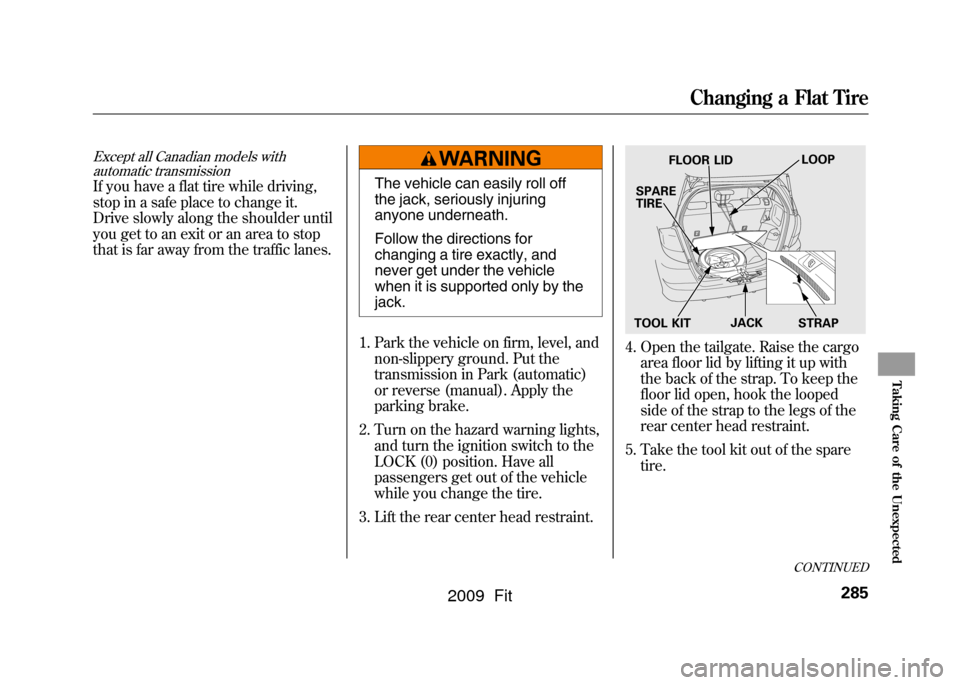
3. Lift the rear center head restraint.
4. Open the tailgate. Raise the cargo area floor lid by lifting it up with
the back of the strap. To keep the
floor lid open, hook the looped
side of the strap to the legs of the
rear center head restraint.
5. Take the tool kit out of the spare tire.
FLOOR LID LOOP
SPARE
TIRE
TOOL KIT JACK
STRAP
CONTINUED
Changing a Flat Tire
285
Taking Care of the Unexpected
2009 Fit
Page 304 of 352
The high temperature indicator
should be off under most conditions.
If the engine coolant temperature
gets higher than normal, the
indicator will blink. If it stays on, you
should determine the reason (hot
day, driving up a steep hill, etc.).
If the vehicle overheats, you should
take immediate action. The only
indication may be the high
temperature indicator blinking or
remaining on. Or you may see steam
or spray coming from under the
hood.Driving with the high temperature
indicator on can cause serious damage
to your engine.
Steam and spray from an
overheated engine can
seriously scald you.
Do not open the hood if steam
is coming out.
1. Safely pull to the side of the road. Put the transmission in neutral
(manual) or Park (automatic), and
set the parking brake. Turn off all
accessories, and turn on the
hazard warning lights.
2. If you see steam and/or spray coming from under the hood, turn
off the engine. Wait until you see
no more signs of steam or spray,
then open the hood. 3. If you do not see steam or spray,
leave the engine running, and
check the high temperature
indicator. If the high heat is due to
overloading, the engine should
start to cool down almost
immediately. If it does, wait until
the high temperature indicator
goes off, then continue driving.
4. If the high temperature indicator stays on, turn off the engine.
CONTINUED
If the Engine Overheats
301
Taking Care of the Unexpected
2009 Fit
Page 306 of 352

Low Oil Pressure Indicator
This indicator should never
come on when the engine is
running. If it starts flashing or stays
on, the oil pressure has dropped very
low or lost pressure. Serious engine
damage is possible, and you should
take immediate action.
Running the engine with low oil
pressure can cause serious mechanical
damage almost immediately. Turn off
the engine as soon as you can safely get
the vehicle stopped. 1. Safely pull off the road, and shut
off the engine. Turn on the hazard
warning lights.
2. Let the vehicle sit for a minute. Open the hood, and check the oil
level (see page201).An engine
very low on oil can lose pressure
during cornering and other driving
maneuvers.
3. If necessary, add oil to bring the level back to the full mark on the
dipstick (see page253).
4. Start the engine, and watch the oil pressure indicator. If it does not go
out within 10 seconds, turn off the
engine. There is a mechanical
problem that needs to be repaired
before you can continue driving
(see Emergency Towing on page
311). Charging System Indicator
If the charging system
indicator comes on brightly
when the engine is running, the
battery is not being charged.
Immediately turn off all electrical
accessories. Try not to use other
electrically operated controls such as
the power windows. Keep the engine
running; starting the engine will
discharge the battery rapidly.
Go to a service station or garage
where you can get technical
assistance.
Low Oil Pressure Indicator, Charging System Indicator
303
Taking Care of the Unexpected
2009 Fit
Page 324 of 352

The tires on your vehicle meet all
U.S. Federal Safety Requirements.
All tires are also graded for
treadwear, traction, and temperature
performance according to
Department of Transportation (DOT)
standards. The following explains
these gradings.
Uniform Tire Quality Grading
Quality grades can be found where
applicable on the tire sidewall
between tread shoulder and
maximum section width. For
example:Treadwear 200
Traction AA
Temperature A
All passenger car tires must conform
to Federal Safety Requirements in
addition to these grades. Treadwear
The treadwear grade is a
comparative rating based on the wear
rate of the tire when tested under
controlled conditions on a specified
government test course. For
example, a tire graded 150 would
wear one and one-half (1 1/2) times
as well on the government course as
a tire graded 100. The relative
performance of tires depends upon
the actual conditions of their use,
however, and may depart
significantly from the norm due to
variations in driving habits, service
practices and differences in road
characteristics and climate.
Traction
The traction grades, from highest to
lowest, are AA, A, B, and C. Those
grades represent the tire's ability to
stop on wet pavement as measured
under controlled conditions on
specified government test surfaces of
asphalt and concrete. A tire marked
C may have poor traction
performance.
Warning: The traction grade
assigned to this tire is based on
straight-ahead braking traction tests,
and does not include acceleration,
cornering, hydroplaning, or peak
traction characteristics.
DOT Tire Quality Grading (U.S. Vehicles)
321
Technical Information
2009 Fit
Page 325 of 352

Temperature
The temperature grades are A (the
highest), B, and C, representing the
tire's resistance to the generation of
heat and its ability to dissipate heat
when tested under controlled
conditions on a specified indoor
laboratory test wheel. Sustained high
temperature can cause the material
of the tire to degenerate and reduce
tire life, and excessive temperature
can lead to sudden tire failure. The
grade C corresponds to a level of
performance which all passenger car
tires must meet under the Federal
Motor Vehicle Safety Standard No.
109. Grades B and A represent
higher levels of performance on the
laboratory test wheel than the
minimum required by law.Warning: The temperature grade for
this tire is established for a tire that
is properly inflated and not
overloaded. Excessive speed,
underinflation, or excessive loading,
either separately or in combination,
can cause heat buildup and possible
tire failure.DOT Tire Quality Grading (U.S. Vehicles)322
2009 Fit
Page 341 of 352

Bulb ReplacementBack-up Lights
........................
266
Brake Lights
...........................
266
Fog Lights
...............................
265
Front Parking Lights
...............
263
Front Side Marker Lights
........
263
Headlights
..............................
262
Rear Bulbs
..............................
266
Specifications
..........................
319
Taillights
.................................
266
Turn Signal Lights
..........
263, 266
Bulbs, Halogen
..........................
262
C
Cancel Button
............................
196
Capacities Chart
.........................
318
Carbon Monoxide Hazard
............
53
Cargo
.........................................
208
Cargo Hook
................................
212
Cargo, How to Carry
..................
208
Carrying Cargo
..........................
208
CAUTION, Explanation of
............
iii
CD Care
.....................................
186
CD Error Messages
............
128, 157 CD Player
...........................
122,
149
Certification Label
......................
316
Chains, Tires
..............................
278
Changing a Flat Tire
..................
285
Changing Oil How to
....................................
254
When to
..................................
245
Charging System Indicator
...........................
60, 303
Check Fuel Cap Indicator
.............
70
Checklist, Before Driving
...........
215
Childproof Door Locks
.................
82
Child Safety
..................................
34
Booster Seats
...........................
50
Child Seats
..........................
39, 41
Important Safety Reminders.....
38
Infants
......................................
39
Large Children
.........................
49
LATCH
.....................................
43
Risks with Airbags
...................
35
Small Children
.........................
40
Tethers
....................................
47
Warning Labels
........................
36
Where Should a Child Sit?
........
35
Child Seats
.............................
34, 41
LATCH Anchorage Points
........
43 Tether Anchorage Points
.........
47
Cleaning the Seat Belts
..............
267
Clock
..........................................
192
Clutch Fluid
...............................
261
Code, Audio System
...................
191
CO in the Exhaust
................
53, 326
Cold Weather, Starting in
...........
216
Compact Spare Tire
....................
284
Consumer Information (U.S. only)
.......................................
332
Controls, Instruments and
............
57
Coolant Adding
....................................
256
Checking
................................
202
Proper Solution
.......................
256
Temperature Indicator
.............
63
Crankcase Emissions Control System
...................................
326
Cruise Control Indicator
...............
65
Cruise Control Operation
...........
194
Cup Holders
...............................
106
Current Fuel Mileage
...................
70
Customer Service Office
............
332
IndexII
2009 Fit
Page 342 of 352
D
DANGER, Explanation of
.............
iii
Dashboard
...............................
3, 58
Daytime Running Lights (Canada only)
.........................................
75
Daytime Running Lights Indicator (Canada only)
...........................
65
Dead Battery
..............................
299
Defects, Reporting Safety
...........
334
Defogger, Rear Window
...............
76
Defrosting the Windows
............
113
Detachable Anchor
......................
99
Dimensions
................................
318
Dimming the Headlights
..............
74
Dipstick Automatic Transmission
.........
259
Engine Oil
...............................
201
Directional Signals
.......................
63
Disc Brake Wear Indicators
.......
230
Disc Care
...................................
186
Disc Player Error Messages
........................
128, 157
Disposal of Used Oil
...................
255 Doors
Childproof Door Locks
.............
82
Locking and Unlocking
............
81
Power Door Locks
...................
81
DOT Tire Quality Grading (U.S. Vehicles)
................................
321
Downshifting, Manual Transmission
..........................
217
Driver and Passenger Safety
..........
5
Driving
.......................................
213
Economy
.................................
203
Driving Guidelines
.....................
214
Driving with the Paddle Shifters (Sport only)
............................
224
Dust and Pollen Filter
................
268
E
Economy, Fuel
...........................
203
Electric Power Steering (EPS) Indicator
...................................
62
Emergencies on the Road
..........
283
Battery, Jump Starting
.............
299
Brake System Indicator
...........
305
Changing a Flat Tire
...............
285 Charging System Indicator
.....
303
Checking the Fuses
................
307
Driving with a Flat Tire
...........
284
Hazard Warning Flashers
........
76
Jump Starting
..........................
299
Low Oil Pressure Indicator
.....
303
Malfunction Indicator Lamp
....
304
Overheated Engine
.................
301
Towing
....................................
311
Emergency Brake
......................
102
Emergency Flashers
....................
76
Emergency Towing
....................
311
Emissions Controls
....................
326
Emissions Testing
......................
329
CONTINUED
Index
III
INDEX
2009 Fit