transmission HONDA FIT 2009 2.G Owner's Manual
[x] Cancel search | Manufacturer: HONDA, Model Year: 2009, Model line: FIT, Model: HONDA FIT 2009 2.GPages: 352, PDF Size: 17.67 MB
Page 228 of 352

Downshifting with the paddle shifter
allows you to increase the engine
braking when going down steep or
long hills, and provides more power
when climbing uphills. You can
upshift the transmission manually to
reduce the rpm. Driving in the
higher gear helps fuel economy.
The transmission control system
monitors the accelerator pedal use
and your driving conditions. When
you press the accelerator pedal as in
normal driving, the system judges
that you are driving at a constant
cruising speed without using the
paddle shifters. Under these
conditions, D-paddle shift mode is
canceled, and the transmission
automatically returns to drive mode
(D).The transmission remains in the
selected gear if you do not
accelerate.
Each time you pull either paddle
shifter, the transmission shifts one
gear up or down. If you want to shift
up or down more than two gears, pull
the paddle shifter twice, pause, and
then pull it again.
The automatic transmission will not
allow you to shift up or down if:
●You downshift before the engine
speed falls below the upper limit of
the lower gear.
If you try to do this, the gear position
indicator will flash the number of the
lower gear several times, then return
to a higher gear.
Here are the speed ranges for
downshifting. To shift
from Speed range
5 → 4 under 112 mph
(181 km/h)
4 → 3 under 79 mph (127 km/h)
3 → 2 under 51 mph (82 km/h)
2 → 1 under 20 mph (32 km/h)
●You upshift before the engine
speed rises above the lower limit
of the higher gear.●You pull both paddle shifters at the
same time.
The transmission downshifts to first
gear and returns to drive mode (D)
when the vehicle comes to a
complete stop or the vehicle speed is
about 6 mph (10 km/h).
CONTINUED
Driving with the Paddle Shifters (Sport only)
225
Driving
2009 Fit
Page 229 of 352
When you pull and hold the+
(right) paddle shifter, the
transmission automatically returns to
drive mode (D).
If there is a problem in the
transmission while you are driving
with the paddle shifters, the D
indicator flashes, the D-paddle shift
mode is canceled, and the
transmission returns to drive mode
(D). Using the Paddle Shift in S
position (Sequential Shift Mode)
U.S. models onlyWith the shift lever in the S position,
you can manually shift up or down
with the paddle shifters. The
transmission goes into the sequential
shift mode and holds the selected
gear.
To enter the sequential shift mode,
press the release button on the front
of the shift lever, move the lever to
the S position, then pull either paddle
shifter. To return to drive mode (D),
move the shift lever to the D
position. While you are driving in the
sequential shift mode, the
transmission will not automatically
return to drive mode (D).
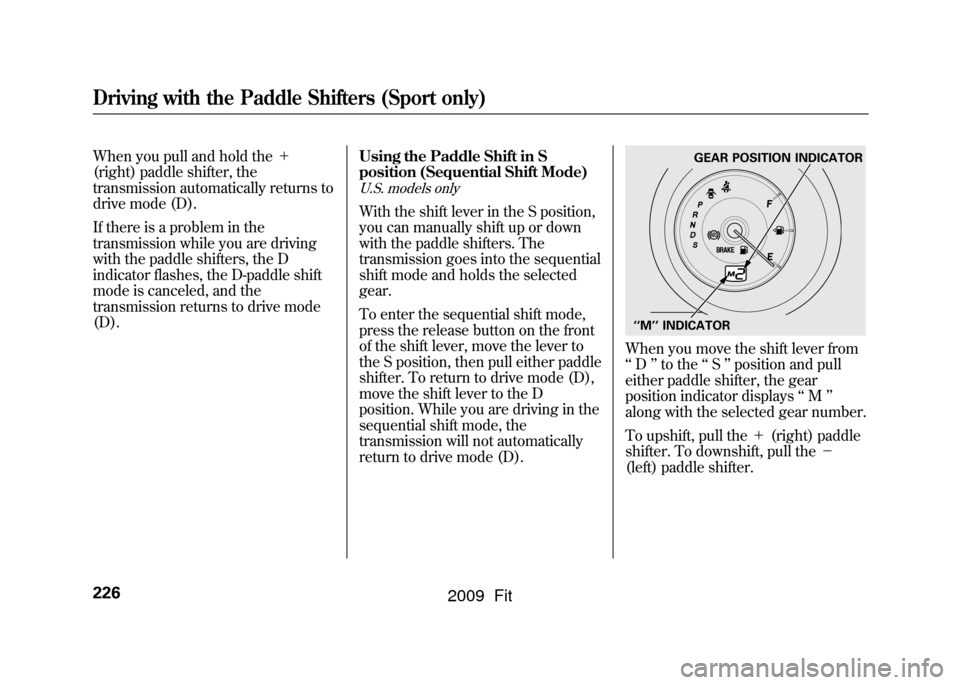
When you move the shift lever from
‘‘
D ’’to the ‘‘S ’’position and pull
either paddle shifter, the gear
position indicator displays ‘‘M ’’
along with the selected gear number.
To upshift, pull the +(right) paddle
shifter. To downshift, pull the -
(left) paddle shifter.
GEAR POSITION INDICATOR
‘‘M ’’INDICATOR
Driving with the Paddle Shifters (Sport only)226
2009 Fit
Page 230 of 352

When you accelerate from a stop, the
transmission starts in first gear, and
you must manually upshift between
first and fifth gears. Make sure you
upshift before the engine speed
reaches the tachometer's red zone.
The transmission remains in the
selected gear (5, 4, 3, 2, or 1). There
is no automatic downshift when you
push the accelerator pedal to the
floor.
When you are driving in 4th or 5th
gear, the transmission downshifts to
the lower gear under the following
conditions:●The vehicle slows down to a
certain speed.●You press the brake pedal.Downshifting with the paddle shifter
allows you to increase the engine
braking when going down steep or
long hills, and provides more power
when climbing uphills. You can
upshift the transmission manually to
reduce the rpm. Driving in the
higher gear helps fuel economy.
The transmission also shifts
automatically as the vehicle comes to
a complete stop. It downshifts to first
gear when the vehicle speed reaches
6 mph (10 km/h) or less.
The automatic transmission will not
allow you to shift up or down if:
●You downshift before the engine
speed falls below the upper limit of
the lower gear.
If you try to do this, the gear position
indicator will flash the number of the
lower gear several times, then return
to a higher gear. If the vehicle speed decreases below
the redline of the selected lower gear
while the indicator is flashing, the
transmission downshifts, and the
indicator displays the selected gear.
●You upshift before the engine
speed rises above the lower limit
of the higher gear.●You pull both paddle shifters at the
same time.
CONTINUED
Driving with the Paddle Shifters (Sport only)
227
Driving
2009 Fit
Page 232 of 352

Always use the parking brake when
you park your vehicle. Make sure the
parking brake is set firmly, or your
vehicle may roll if it is parked on an
incline.
If your vehicle has an automatic
transmission, set the parking brake
before you put the transmission in
Park. This keeps the vehicle from
moving and putting pressure on the
parking mechanism in the
transmission.Parking Tips
●Make sure the windows are
closed.●Turn off the lights.●Place any packages, valuables, etc.
in the cargo area or take them with
you.●Lock the doors and the tailgate.On Sport modelCheck the indicator on the
instrument panel to verify that the
security system is set.●Never park over dry leaves, tall
grass, or other flammable
materials. The hot three way
catalytic converter could cause
these materials to catch on fire.
●If the vehicle is facing uphill, turn
the front wheels away from the
curb. If your vehicle has a manual
transmission, put it in first gear
and set the parking brake.●If the vehicle is facing downhill,
turn the front wheels toward the
curb. If your vehicle has a manual
transmission, put it in reverse gear
and set the parking brake.●Make sure the parking brake is
fully released before driving away.
Driving with the parking brake
partially set can overheat or
damage the rear brakes.
Parking
229
Driving
2009 Fit
Page 241 of 352
Towing a Trailer
Your vehicle is not designed to tow a
trailer. Attempting to do so can void
your warranties.Towing Your Vehicle Behind a
Motorhome
Your vehicle can be towed behind a
motorhome at legal highway speeds
up to 65 mph (100 km/h). Do not
exceed 65 mph (100 km/h).
Otherwise, severe transmission
damage will occur.
When purchasing a tow bar, make
sure you select a reputable
manufacturer and installer. Follow
the manufacturer's attachment
instructions carefully.
The steering system can be damaged if
the steering wheel is locked. Leave the
ignition switch in the ACCESSORY (I)
position, and make sure the steering
wheel turns freely before you begin
towing.
Automatic transmission:Perform the following procedure
every day immediately before you
begin towing. Otherwise severe
automatic transmission damage will
occur.
1. Check the transmission fluid level
(see page259).
Do not overfill.
2. Start the engine.
3. Press on the brake pedal. Movethe shift lever through all its
positions.
4. Shift to the D position and hold for 5 seconds, then to N. Let the
engine run for 3 minutes, then turn
it off.Severe transmission damage will occur
if the vehicle is shifted from reverse to
neutral and then towed with the drive
wheels on the ground.
Towing a Trailer, Towing Your Vehicle Behind a Motorhome238
2009 Fit
Page 242 of 352
5. Release the parking brake.Manual transmission:1. Move the shifter into the Neutralposition.
2. Release the parking brake.
Leave the ignition switch in the
ACCESSORY (I) position so the
steering wheel does not lock. Make
sure the radio and any items plugged
into the accessory power sockets are
turned off so you do not run down
the battery.
When you stop towing your vehicle
and shift out of the neutral position,
you may not be able to move the shift
lever from neutral to reverse or Park.
If this happens, press the brake pedal
and turn the ignition switch to the
ON (II) position, then shift out of
neutral.
Extended TowingIf you tow more than 8 hours in one
day, you should repeat the above
procedure at least every 8 hours
(when you stop for fuel, etc.)Failure to follow the recommended
instructions exactly will result in severe
automatic transmission damage. If you
cannot shift the transmission or start
the engine, your vehicle must be
transported on a flat-bed truck or
trailer. When towing your vehicle for long
periods, remove the 20A Accessory
Socket and 30A Radio fuses to
reduce drain on battery. These fuses
are located in the interior fuse box
and are shown as number 13 and 61
below.
CONTINUED
Towing Your Vehicle Behind a Motorhome
239
Driving
2009 Fit
Page 243 of 352
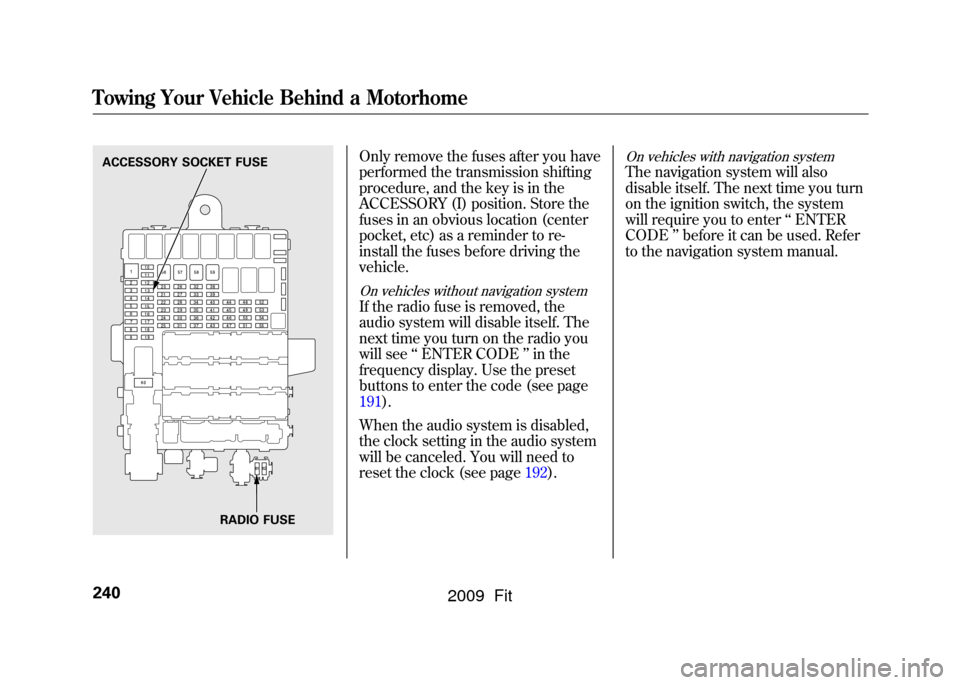
Only remove the fuses after you have
performed the transmission shifting
procedure, and the key is in the
ACCESSORY (I) position. Store the
fuses in an obvious location (center
pocket, etc) as a reminder to re-
install the fuses before driving the
vehicle.On vehicles without navigation systemIf the radio fuse is removed, the
audio system will disable itself. The
next time you turn on the radio you
will see‘‘ENTER CODE ’’in the
frequency display. Use the preset
buttons to enter the code (see page
191).
When the audio system is disabled,
the clock setting in the audio system
will be canceled. You will need to
reset the clock (see page 192).
On vehicles with navigation systemThe navigation system will also
disable itself. The next time you turn
on the ignition switch, the system
will require you to enter‘‘ENTER
CODE ’’before it can be used. Refer
to the navigation system manual.
ACCESSORY SOCKET FUSE
RADIO FUSETowing Your Vehicle Behind a Motorhome240
2009 Fit
Page 244 of 352

Automatic transmissionIf you tow a Fit behind a motorhome,
the transmission fluid must be
changed every 2 years or 30,000
miles (48,000 km), whichever comes
first.
Towing Your Vehicle Behind a Motorhome
241
Driving
2009 Fit
Page 246 of 352

This section explains why it is
important to keep your vehicle well
maintained and how to follow basic
maintenance safety precautions.
This section also includes
instructions on how to read the
maintenance minder messages on
the information display, and
instructions for simple maintenance
tasks you may want to take care of
yourself.
If you have the skills and tools to
perform more complex maintenance
tasks on your vehicle, you may want
to purchase the service manual. See
page335for information on how to
obtain a copy, or see your dealer.Maintenance Safety
.....................
244
Maintenance Minder
..................
245
Fluid Locations
...........................
252
Adding Engine Oil
......................
253
Changing the Engine Oil and Filter
.......................................
254
Engine Coolant
...........................
256
Windshield Washers
...................
258
Transmission Fluid
.....................
259
Automatic Transmission Fluid
...................................
259
Manual Transmission Fluid
....
260
Brake and Clutch Fluid
...............
261
Lights
..........................................
262
Cleaning the Seat Belts
...............
267
Floor Mats
..................................
267
Audio Antenna
............................
268
Dust and Pollen Filter
.................
268
Wiper Blades
..............................
269
Tires
...........................................
273
Checking the Battery
..................
279
Vehicle Storage
...........................
281
Maintenance
243
Maintenance
2009 Fit
Page 253 of 352

However, service at a dealer is not
mandatory to keep your warranties in
effect. Maintenance may be done by
any qualified service facility or
person who is skilled in this type of
automotive service. Make sure to
have the service facility or person
reset the display as previously
described. Keep all receipts as proof
of completion, and have the person
who does the work fill out your
Honda Service History or Canadian
Maintenance Log. Check your
warranty booklet for more
information.
We recommend using Honda parts
and fluids whenever you have
maintenance done. These are
manufactured to the same high
quality standards as the original
components, so you can be confident
of their performance and durability.U.S. Vehicles:
Maintenance,
replacement, or repair of
emissions control devices and
systems may be done by any
automotive repair establishment
or individual using parts that are
‘‘ certified ’’to EPA standards.
According to state and federal
regulations, failure to perform
maintenance on the items marked
with# will not void your emissions
warranties. However, all
maintenance services should be
performed in accordance with the
intervals indicated by the information
display.
Owner's Maintenance Checks
You should check the following
items at the specified intervals. If you
are unsure of how to perform any
check, turn to the appropriate page
listed.
●Engine oil level -Check every
time you fill the fuel tank. See page
201.●Engine coolant level -Check the
radiator reserve tank every time
you fill the fuel tank. See page202.●Automatic transmission -Check
the fluid level monthly. See page
259.●Brakes -Check the fluid level
monthly. See page 261.●Tires-Check the tire pressure
monthly. Examine the tread for
wear and foreign objects. See page
274.●Lights -Check the operation of
the headlights, parking lights,
taillights, high-mount brake light,
and license plate lights monthly.
See page 262.
Maintenance Minder250
2009 Fit