automatic transmission HONDA FIT 2009 2.G Owner's Guide
[x] Cancel search | Manufacturer: HONDA, Model Year: 2009, Model line: FIT, Model: HONDA FIT 2009 2.GPages: 352, PDF Size: 17.67 MB
Page 300 of 352

If the pressure is lower than 32 psi
(220 kPa) and higher than 19 psi
(130 kPa), use the air pump to
bring air to the desired level as
described in step 11. Then drive to
the nearest service station at no
more than 50 mph (80 km/h).
If the pressure is below 19 psi, do
not continue. Have the vehicle
towed (see page311).
In any case, be sure to have the
damaged tire permanently repaired
as soon as possible.
Remember to return the tire sealant
bottle to your Honda service center
for proper disposal. If the Engine Won't Start
Diagnosing why the engine won't
start falls into two areas, depending
on what you hear when you turn the
ignition switch to the START (III)
position:
●You hear nothing, or almost
nothing. The engine's starter
motor does not operate at all, or
operates very slowly.●You can hear the starter motor
operating normally, or the starter
motor sounds like it is spinning
faster than normal, but the engine
does not start up and run.
Nothing Happens or the Starter
Motor Operates Very Slowly
When you turn the ignition switch to
the START (III) position, you do not
hear the normal noise of the engine
trying to start. You may hear a
clicking sound, a series of clicks, or
nothing at all.
Check these things:
●Check the transmission interlock.
If you have a manual transmission,
the clutch pedal must be pushed
all the way to the floor or the
starter will not operate. With an
automatic transmission, it must be
in Park or neutral.●Turn the ignition switch to the ON
(II) position. Turn on the
headlights, and check their
brightness. If the headlights are
very dim or do not come on at all,
the battery is discharged. See
Jump Starting
on page299.
CONTINUED
Temporarily Repairing a Flat Tire, If the Engine Won't Start
297
Taking Care of the Unexpected
2009 Fit
Page 302 of 352
Although this seems like a simple
procedure, you should take several
precautions.
A battery can explode if you do
not follow the correct
procedure, seriously injuring
anyone nearby.
Keep all sparks, open flames,
and smoking materials away
from the battery.
You cannot start your vehicle with an
automatic transmission by pushing
or pulling it.
To Jump Start Your Vehicle:1. Open the hood, and check the physical condition of the battery.
In very cold weather, check the
condition of the electrolyte. If it
seems slushy or frozen, do not try
jump starting until it thaws.If a battery sits in extreme cold, the
electrolyte inside can freeze. Attempting
to jump start with a frozen battery can
cause it to rupture.
2. Turn off all the electricalaccessories: heater, A/C (if
equipped), audio system, lights,
etc. Put the transmission in neutral
(manual) or Park (automatic), and
set the parking brake.
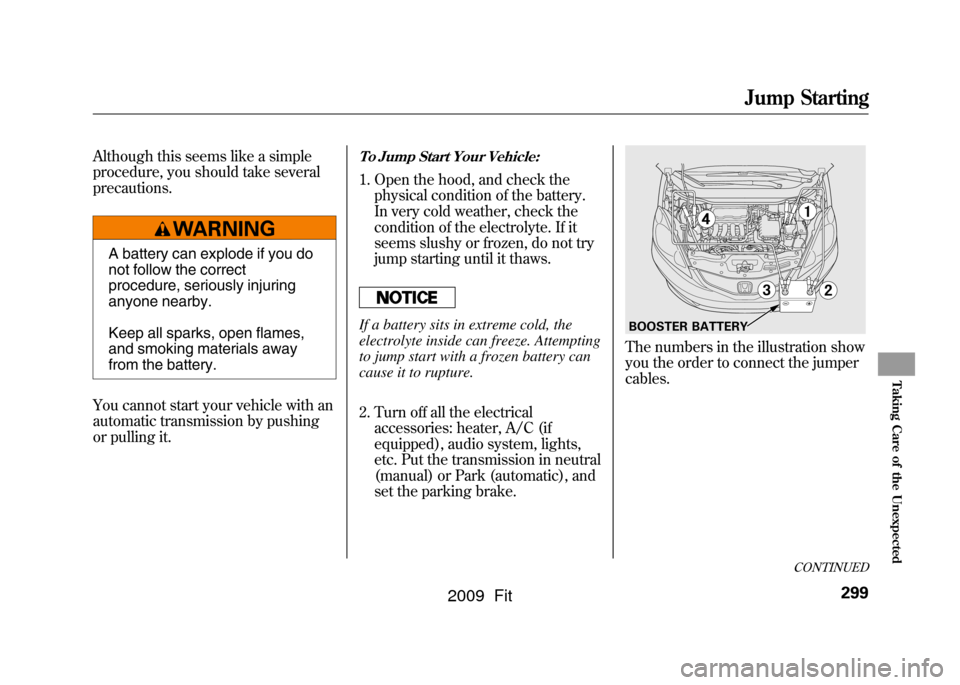
The numbers in the illustration show
you the order to connect the jumper
cables.BOOSTER BATTERY
CONTINUED
Jump Starting
299
Taking Care of the Unexpected
2009 Fit
Page 304 of 352
The high temperature indicator
should be off under most conditions.
If the engine coolant temperature
gets higher than normal, the
indicator will blink. If it stays on, you
should determine the reason (hot
day, driving up a steep hill, etc.).
If the vehicle overheats, you should
take immediate action. The only
indication may be the high
temperature indicator blinking or
remaining on. Or you may see steam
or spray coming from under the
hood.Driving with the high temperature
indicator on can cause serious damage
to your engine.
Steam and spray from an
overheated engine can
seriously scald you.
Do not open the hood if steam
is coming out.
1. Safely pull to the side of the road. Put the transmission in neutral
(manual) or Park (automatic), and
set the parking brake. Turn off all
accessories, and turn on the
hazard warning lights.
2. If you see steam and/or spray coming from under the hood, turn
off the engine. Wait until you see
no more signs of steam or spray,
then open the hood. 3. If you do not see steam or spray,
leave the engine running, and
check the high temperature
indicator. If the high heat is due to
overloading, the engine should
start to cool down almost
immediately. If it does, wait until
the high temperature indicator
goes off, then continue driving.
4. If the high temperature indicator stays on, turn off the engine.
CONTINUED
If the Engine Overheats
301
Taking Care of the Unexpected
2009 Fit
Page 307 of 352
If this indicator comes on
while driving, it means one
of the engine's emissions control
systems may have a problem. Even
though you may feel no difference in
your vehicle's performance, it can
reduce your fuel economy and cause
increased emissions. Continued
operation may cause serious damage.
If you have recently refueled your
vehicle, the indicator coming on
could be due to a loose or missing
fuel fill cap. You will also see a
‘‘ CHECK FUEL CAP ’’message on
the information display. Tighten the
cap until it clicks at least once.
Tightening the cap will not turn the
indicator off immediately; it can take
several days of normal driving. If the indicator comes on repeatedly,
even though it may go off as you
continue driving, have your vehicle
checked by a dealer as soon as
possible.
If you keep driving with the malfunction
indicator lamp on, you can damage
your vehicle's emissions controls and
engine. Those repairs may not be
covered by your vehicle's warranties.
If your vehicle has an automatic
transmission, the malfunction
indicator lamp may also come on
with the
‘‘D ’’indicator. Readiness Codes
Your vehicle has certain
‘‘readiness
codes ’’that are part of the on-board
diagnostics for the emissions
systems. In some states, part of the
emissions testing is to make sure
these codes are set. If they are not
set, the test cannot be completed.
If the battery in your vehicle has
been disconnected or gone dead,
these codes are erased. It can take
several days of driving under various
conditions to set the codes again.
To check if they are set, turn the
ignition switch to the ON (II)
position, without starting the engine.
The malfunction indicator lamp will
come on for 20 seconds. If it then
goes off, the readiness codes are set.
If it blinks five times, the readiness
codes are not set. If possible, do not
take your vehicle for an emissions
test until the readiness codes are set.
Refer to Emissions Testing for
more information (see page329).
Malfunction Indicator Lamp304
2009 Fit
Page 314 of 352
If your vehicle needs to be towed,
call a professional towing service or
organization. Never tow your vehicle
with just a rope or chain. It is very
dangerous.
There are two ways to tow your
vehicle:Flat-bed Equipment
-The operator
loads your vehicle on the back of a
truck. This is the best way to
transport your vehicle.
Wheel-lift Equipment
- The tow
truck uses two pivoting arms that go
under the front tires and lift them off
the ground. The rear tires remain on
the ground. This is an acceptable
way to tow your vehicle. If, due to damage, your vehicle must
be towed with the front wheels on
the ground, do this:
Manual transmission:●Release the parking brake.●Shift the transmission to neutral.●Leave the ignition switch in the
ACCESSORY (I) position so the
steering wheel does not lock.
Automatic transmission:●Release the parking brake.●Start the engine.●Shift to D position and hold for 5
seconds, then to N. Let the engine
run for 3 minutes, then turn it off.●Turn off the engine.●Leave the ignition switch in the
ACCESSORY (I) position so the
steering wheel does not lock.
Improper towing preparation will
damage the transmission. Follow the
above procedure exactly. If you cannot
shift the transmission or start the
engine (automatic transmission), your
vehicle must be transported with the
front wheels off the ground.
With the front wheels on the ground,
it is best to tow the vehicle no farther
than 50 miles (80 km), and keep the
speed below 35 mph (55 km/h).
CONTINUED
Emergency Towing
311
Taking Care of the Unexpected
2009 Fit
Page 322 of 352

CapacitiesFuel tank Approx.
10.6 US gal (40 L)
Engine oil Change
ꭧ1Including
filter 3.8 US qt (3.6 L)
Without filter 3.6 US qt (3.4 L)
Total 4.4 US qt (4.2 L)
Engine
coolant Automatic
transmission
Changeꭧ2
1.19 US gal (4.5 L)
Total 1.32 US gal (5.0 L)
Manual transmission
Change
ꭧ2
1.16 US gal (4.4 L)
Total 1.29 US gal (4.9 L)
Automatic
transmission
fluid Change
2.6 US qt (2.5 L)
Total 6.18 US qt (5.85 L)
Manual
transmisson fluid Change
1.6 US qt (1.5 L)
Total 1.7 US qt (1.6 L)
Windshield
washer reservoir U.S. Vehicles 2.6 US qt (2.5 L)
Canada Vehicles 4.8 US qt (4.5 L)
ꭧ 1: Excluding the oil remaining in the engine
ꭧ 2: Including the coolant in the reserve tank and that remaining in the engine
Reserve tank capacity:
0.116 US gal (0.44 L)
Air Conditioning
Refrigerant type HFC-134a (R-134a)
Charge quantity 13.1-14.8 oz
(370 -420 g)
Lubricant type SP-10
Lights Headlights High/Low 12 V -60/55W (HB2)
Front turn signal lights 12 V-21W (Amber)
Parking lights/side marker
lights 12 V
-3.8W (Amber)
Fog lights
ꭧ
12 V -55W (H11)
Rear turn signal lights 12 V-21W (Amber)
Stop/Taillights 12 V-21/5W
Back-up lights 12 V-16W
License plate lights 12 V-5W
Ceiling light 12 V-8W
Cargo area light 12 V-5W
Map light
ꭧ
12 V -8W
High-mount brake light LED
ꭧ : For some types
Specifications
319
Technical Information
2009 Fit
Page 330 of 352

Exhaust Emissions Controls
The exhaust emissions controls
include four systems: PGM-FI,
ignition timing control, exhaust gas
recirculation, and three way catalytic
converter. These four systems work
together to control the engine's
combustion and minimize the
amount of HC, CO, and NOx that
come out the tailpipe. The exhaust
emissions control systems are
separate from the crankcase and
evaporative emissions control
systems.
PGM-FI SystemThe PGM-FI system uses sequential
multiport fuel injection. It has three
subsystems: air intake, engine
control, and fuel control. The
powertrain control module (PCM) in
automatic transmission vehicles or
the engine control module (ECM) in
manual transmission vehicles uses
various sensors to determine how
much air is going into the engine. It
then controls how much fuel to inject
under all operating conditions.Ignition Timing Control SystemThis system constantly adjusts the
ignition timing, reducing the amount
of HC, CO, and NOx produced.Exhaust Gas Recirculation (EGR)SystemThe exhaust gas recirculation (EGR)
system takes some of the exhaust gas
and routes it back into the intake
manifold. Adding exhaust gas to the
air/fuel mixture reduces the amount
of NOx produced when the fuel is
burned.
Three Way Catalytic ConverterThe three way catalytic converter is
in the exhaust system. Through
chemical reactions, it converts HC,
CO, and NOx in the engine's exhaust
to carbon dioxide (CO
2), nitrogen
(N
2), and water vapor.
Replacement Parts
The emissions control systems are
designed and certified to work
together in reducing emissions to
levels that comply with the Clean Air
Act. To make sure the emissions
remain low, you should use only new
Honda replacement parts or their
equivalent for repairs. Using lower
quality parts may increase the
emissions from your vehicle.
The emissions control systems are
covered by warranties separate from
the rest of your vehicle. Read your
warranty manual for more
information.
Emissions Controls
327
Technical Information
2009 Fit
Page 332 of 352

Testing of Readiness Codes
If you take your vehicle for an
emissions test shortly after the
battery has been disconnected or
gone dead, it may not pass the test.
This is because of certain‘‘readiness
codes ’’that must be set in the on-
board diagnostics for the emissions
systems. These codes are erased
when the battery is disconnected,
and set again only after several days
of driving under a variety of
conditions. If the testing facility determines that
the readiness codes are not set, you
will be requested to return at a later
date to complete the test. If you must
get the vehicle retested within the
next two or three days, you can
condition the vehicle for retesting by
doing the following.
1. Make sure the gas tank is nearly,
but not completely, full (around
3/4).
2. Make sure the vehicle has been parked with the engine off for 6
hours or more.
3. Make sure the ambient temperature is between 40° and
95°F. 4. Without touching the accelerator
pedal, start the engine, and let it
idle for 20 seconds.
5. Keep the vehicle in Park (automatic transmission) or
neutral (manual transmission).
Increase the engine speed to 2,000
rpm, and hold it there until the
temperature gauge rises to at least
1/4 of the scale (about 3 minutes).
6. Without touching the accelerator pedal, let the engine idle for 20
seconds.
CONTINUED
Emissions Testing
329
Technical Information
2009 Fit
Page 340 of 352
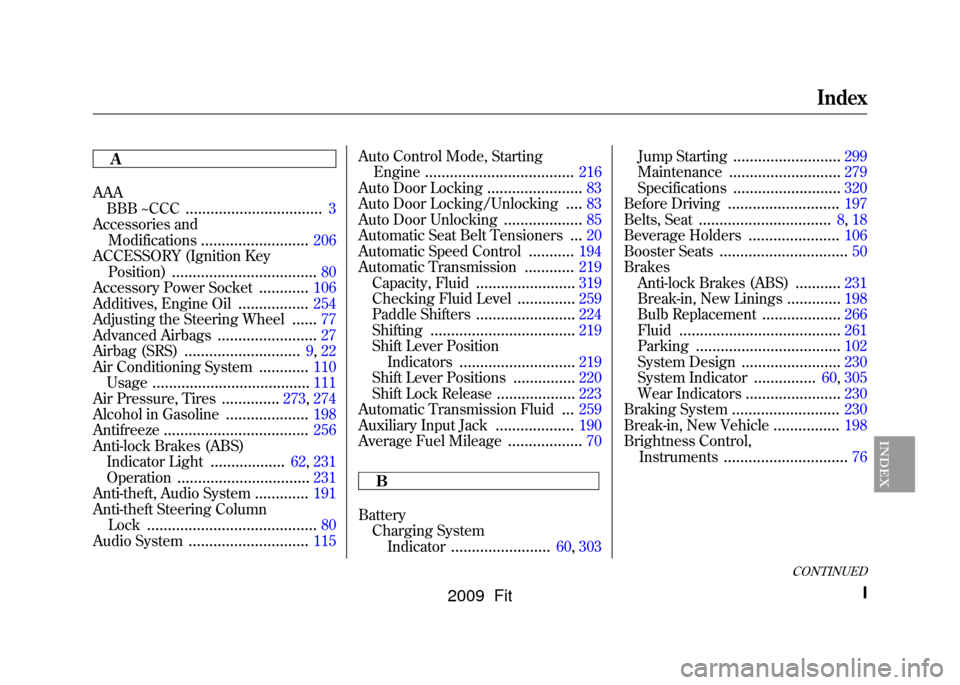
A
AAABBB ~CCC
.................................
3
Accessories and Modifications
..........................
206
ACCESSORY (Ignition Key Position)
...................................
80
Accessory Power Socket
............
106
Additives, Engine Oil
.................
254
Adjusting the Steering Wheel
......
77
Advanced Airbags
........................
27
Airbag (SRS)
............................
9, 22
Air Conditioning System
............
110
Usage
......................................
111
Air Pressure, Tires
..............
273, 274
Alcohol in Gasoline
....................
198
Antifreeze
...................................
256
Anti-lock Brakes (ABS) Indicator Light
..................
62, 231
Operation
................................
231
Anti-theft, Audio System
.............
191
Anti-theft Steering Column Lock
.........................................
80
Audio System
.............................
115 Auto Control Mode, Starting
Engine
....................................
216
Auto Door Locking
.......................
83
Auto Door Locking/Unlocking
....
83
Auto Door Unlocking
...................
85
Automatic Seat Belt Tensioners
...
20
Automatic Speed Control
...........
194
Automatic Transmission
............
219
Capacity, Fluid
........................
319
Checking Fluid Level
..............
259
Paddle Shifters
........................
224
Shifting
...................................
219
Shift Lever Position Indicators
............................
219
Shift Lever Positions
...............
220
Shift Lock Release
...................
223
Automatic Transmission Fluid
...
259
Auxiliary Input Jack
...................
190
Average Fuel Mileage
..................
70
B
Battery Charging System Indicator
........................
60, 303 Jump Starting
..........................
299
Maintenance
...........................
279
Specifications
..........................
320
Before Driving
...........................
197
Belts, Seat
................................
8, 18
Beverage Holders
......................
106
Booster Seats
...............................
50
Brakes Anti-lock Brakes (ABS)
...........
231
Break-in, New Linings
.............
198
Bulb Replacement
...................
266
Fluid
.......................................
261
Parking
...................................
102
System Design
........................
230
System Indicator
...............
60, 305
Wear Indicators
.......................
230
Braking System
..........................
230
Break-in, New Vehicle
................
198
Brightness Control, Instruments
..............................
76
CONTINUED
Index
I
INDEX
2009 Fit
Page 342 of 352
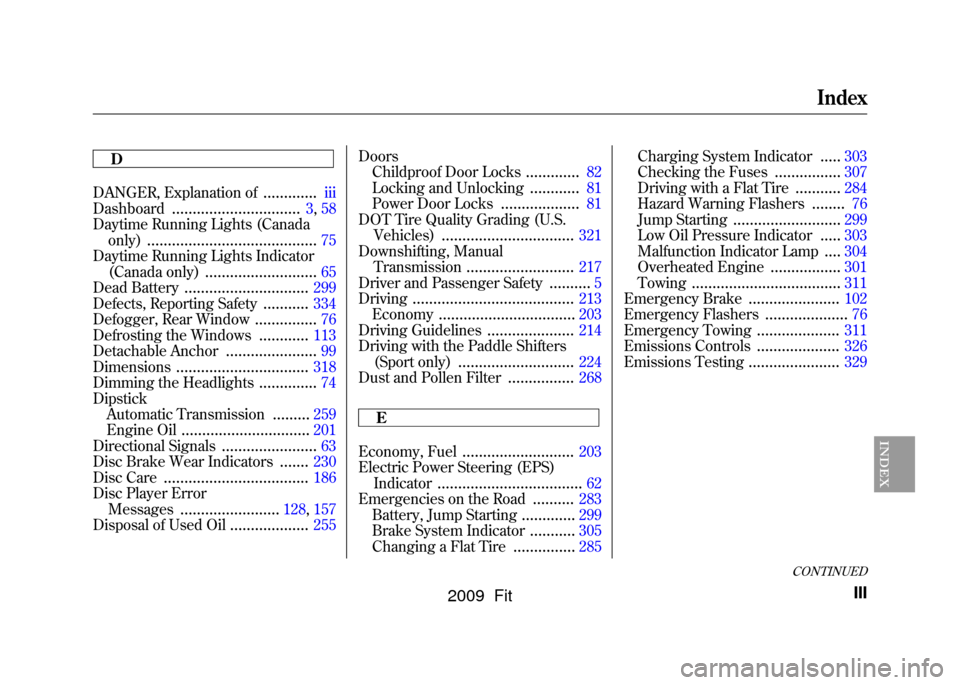
D
DANGER, Explanation of
.............
iii
Dashboard
...............................
3, 58
Daytime Running Lights (Canada only)
.........................................
75
Daytime Running Lights Indicator (Canada only)
...........................
65
Dead Battery
..............................
299
Defects, Reporting Safety
...........
334
Defogger, Rear Window
...............
76
Defrosting the Windows
............
113
Detachable Anchor
......................
99
Dimensions
................................
318
Dimming the Headlights
..............
74
Dipstick Automatic Transmission
.........
259
Engine Oil
...............................
201
Directional Signals
.......................
63
Disc Brake Wear Indicators
.......
230
Disc Care
...................................
186
Disc Player Error Messages
........................
128, 157
Disposal of Used Oil
...................
255 Doors
Childproof Door Locks
.............
82
Locking and Unlocking
............
81
Power Door Locks
...................
81
DOT Tire Quality Grading (U.S. Vehicles)
................................
321
Downshifting, Manual Transmission
..........................
217
Driver and Passenger Safety
..........
5
Driving
.......................................
213
Economy
.................................
203
Driving Guidelines
.....................
214
Driving with the Paddle Shifters (Sport only)
............................
224
Dust and Pollen Filter
................
268
E
Economy, Fuel
...........................
203
Electric Power Steering (EPS) Indicator
...................................
62
Emergencies on the Road
..........
283
Battery, Jump Starting
.............
299
Brake System Indicator
...........
305
Changing a Flat Tire
...............
285 Charging System Indicator
.....
303
Checking the Fuses
................
307
Driving with a Flat Tire
...........
284
Hazard Warning Flashers
........
76
Jump Starting
..........................
299
Low Oil Pressure Indicator
.....
303
Malfunction Indicator Lamp
....
304
Overheated Engine
.................
301
Towing
....................................
311
Emergency Brake
......................
102
Emergency Flashers
....................
76
Emergency Towing
....................
311
Emissions Controls
....................
326
Emissions Testing
......................
329
CONTINUED
Index
III
INDEX
2009 Fit