belt HONDA FIT 2009 2.G Service Manual
[x] Cancel search | Manufacturer: HONDA, Model Year: 2009, Model line: FIT, Model: HONDA FIT 2009 2.GPages: 352, PDF Size: 17.67 MB
Page 55 of 352

If you decide that a child can safely
ride up front, be sure to:●Carefully read the owner's manual,
and make sure you understand all
seat belt instructions and all safety
information.●Move the vehicle seat to the rear-
most position.●Have the child sit up straight, back
against the seat, and feet on or
near the floor.●Check that the child's seat belt is
properly and securely positioned.●Supervise the child. Even mature
children sometimes need to be
reminded to fasten the seat belts
or sit properly.Additional Safety Precautions
●Do not let a child wear a seat belt
across the neck.
This could result
in serious neck injuries during a
crash.
●Do not let a child put the shoulder part of a seat belt behind the back
or under the arm.
This could cause
very serious injuries during a
crash. It also increases the chance
that the child will slide under the
belt in a crash and be injured.
●Two children should never use the
same seat belt.
If they do, they
could be very seriously injured in a
crash.
●Do not put any accessories on a
seat belt.
Devices intended to
improve a child's comfort or
reposition the shoulder part of a
seat belt can make the belt less
effective and increase the chance
of serious injury in a crash.
Protecting Larger Children52
2009 Fit
Page 62 of 352
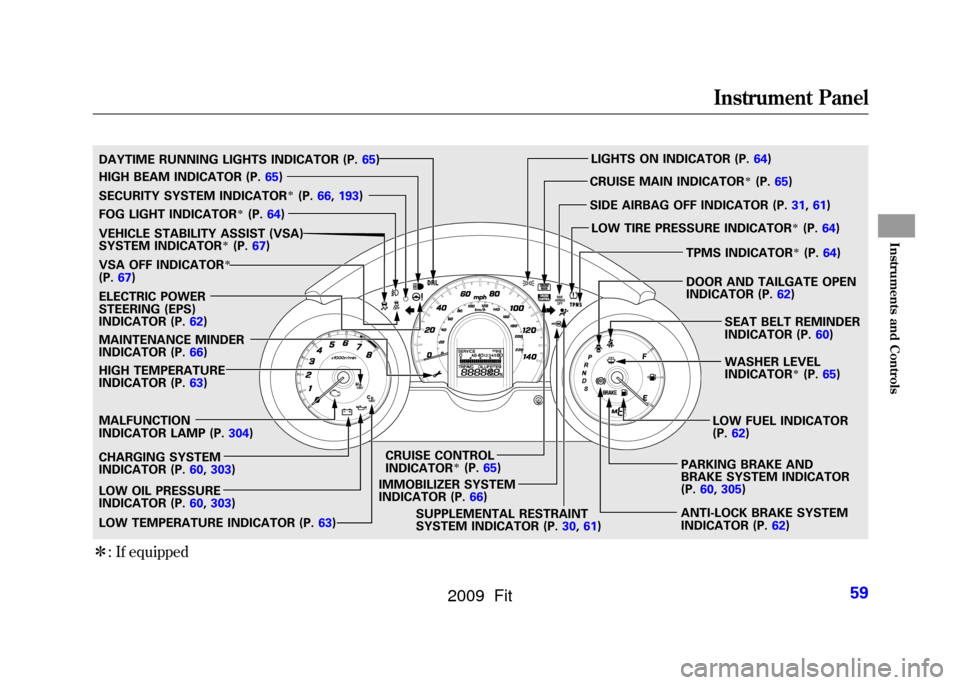
ꭧ: If equippedSECURITY SYSTEM INDICATOR
ꭧ(P. 66, 193)
WASHER LEVEL
INDICATOR
ꭧ(P.65)
MALFUNCTION
INDICATOR LAMP (P. 304)
CHARGING SYSTEM
INDICATOR (P. 60,303)
LOW OIL PRESSURE
INDICATOR (P. 60,303) IMMOBILIZER SYSTEM
INDICATOR (P.
66)
FOG LIGHT INDICATOR
ꭧ(P.
64) LIGHTS ON INDICATOR (P.
64)
SUPPLEMENTAL RESTRAINT
SYSTEM INDICATOR (P. 30,61)
MAINTENANCE MINDER
INDICATOR (P.
66) CRUISE MAIN INDICATOR
ꭧ(P.
65)
CRUISE CONTROL
INDICATOR
ꭧ(P. 65)
LOW TEMPERATURE INDICATOR (P. 63)
ELECTRIC POWER
STEERING (EPS)
INDICATOR (P.
62)
HIGH BEAM INDICATOR (P.
65)
LOW FUEL INDICATOR
(P.62)
TPMS INDICATOR
ꭧ(P.
64)
SEAT BELT REMINDER
INDICATOR (P. 60)
PARKING BRAKE AND
BRAKE SYSTEM INDICATOR
(P. 60, 305)
DAYTIME RUNNING LIGHTS INDICATOR (P.
65)
HIGH TEMPERATURE
INDICATOR (P. 63)
VEHICLE STABILITY ASSIST (VSA)
SYSTEM INDICATOR
ꭧ(P.
67)
VSA OFF INDICATORꭧ
(P. 67) SIDE AIRBAG OFF INDICATOR (P.
31,61)
LOW TIRE PRESSURE INDICATOR
ꭧ(P. 64)
ANTI-LOCK BRAKE SYSTEM
INDICATOR (P. 62)
DOOR AND TAILGATE OPEN
INDICATOR (P.
62)
Instrument Panel
59
Instruments and Controls
2009 Fit
Page 63 of 352
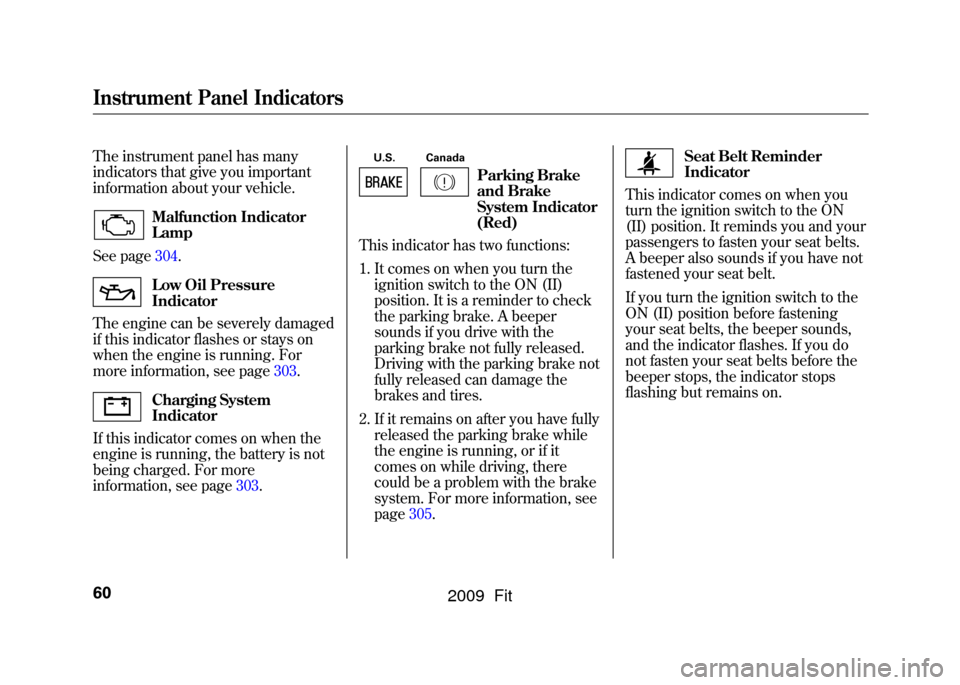
The instrument panel has many
indicators that give you important
information about your vehicle.
Malfunction Indicator
Lamp
See page304.Low Oil Pressure
Indicator
The engine can be severely damaged
if this indicator flashes or stays on
when the engine is running. For
more information, see page303.Charging System
Indicator
If this indicator comes on when the
engine is running, the battery is not
being charged. For more
information, see page303.
U.S. Canada
Parking Brake
and Brake
System Indicator
(Red)
This indicator has two functions:
1. It comes on when you turn the ignition switch to the ON (II)
position. It is a reminder to check
the parking brake. A beeper
sounds if you drive with the
parking brake not fully released.
Driving with the parking brake not
fully released can damage the
brakes and tires.
2. If it remains on after you have fully released the parking brake while
the engine is running, or if it
comes on while driving, there
could be a problem with the brake
system. For more information, see
page305.
Seat Belt Reminder
Indicator
This indicator comes on when you
turn the ignition switch to the ON
(II) position. It reminds you and your
passengers to fasten your seat belts.
A beeper also sounds if you have not
fastened your seat belt.
If you turn the ignition switch to the
ON (II) position before fastening
your seat belts, the beeper sounds,
and the indicator flashes. If you do
not fasten your seat belts before the
beeper stops, the indicator stops
flashing but remains on.
Instrument Panel Indicators60
2009 Fit
Page 64 of 352

If your front passenger does not
fasten their seat belt, the indicator
comes on about 6 seconds after the
ignition switch is turned to the ON
(II) position.
If either of you do not fasten your
seat belt while driving, the beeper
will sound and the indicator will flash
again at regular intervals. For more
information, see page18.
Supplemental Restraint
System Indicator
This indicator comes on briefly when
you turn the ignition switch to the
ON (II) position. If it comes on at any
other time, it indicates a potential
problem with your front airbags. This
indicator will also alert you to a
potential problem with your side
airbags, passenger's side airbag
cutoff system, side curtain airbags,
automatic seat belt tensioners,
driver's seat position sensor, or the
front passenger's weight sensors.
For more information, see page30.
U.S. Canada
Side Airbag Off
Indicator
This indicator comes on briefly when
you turn the ignition switch to the
ON (II) position. If it comes on at any
other time, it indicates that the
passenger's side airbag has
automatically shut off. For more
information, see page31.
CONTINUED
Instrument Panel Indicators
61
Instruments and Controls
2009 Fit
Page 99 of 352
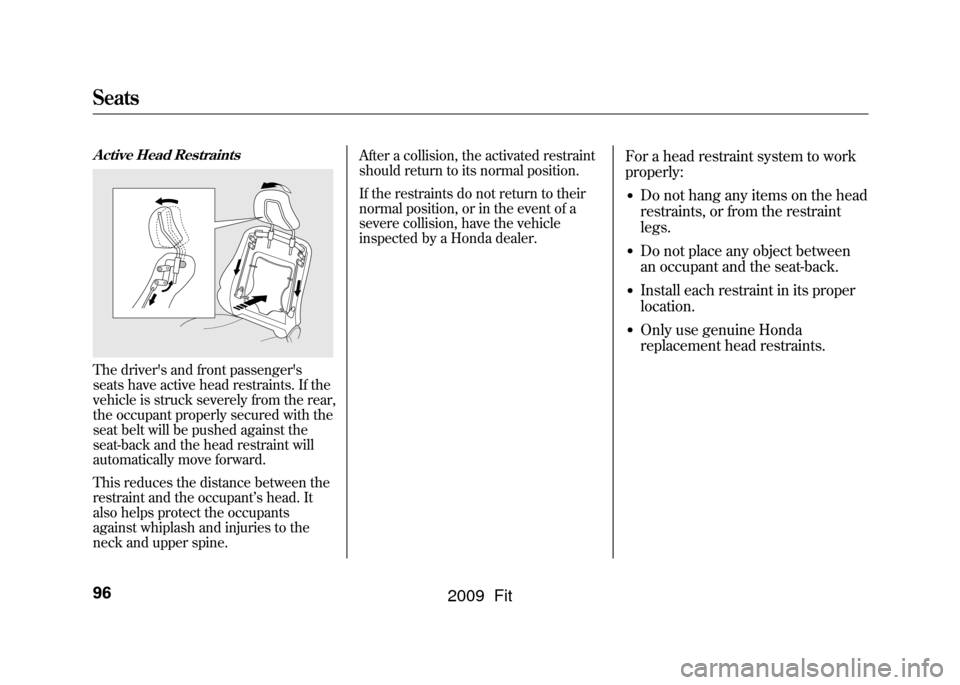
Active Head RestraintsThe driver's and front passenger's
seats have active head restraints. If the
vehicle is struck severely from the rear,
the occupant properly secured with the
seat belt will be pushed against the
seat-back and the head restraint will
automatically move forward.
This reduces the distance between the
restraint and the occupant’s head. It
also helps protect the occupants
against whiplash and injuries to the
neck and upper spine. After a collision, the activated restraint
should return to its normal position.
If the restraints do not return to their
normal position, or in the event of a
severe collision, have the vehicle
inspected by a Honda dealer.
For a head restraint system to work
properly:●Do not hang any items on the head
restraints, or from the restraint
legs.●Do not place any object between
an occupant and the seat-back.●Install each restraint in its proper
location.●Only use genuine Honda
replacement head restraints.
Seats96
2009 Fit
Page 101 of 352
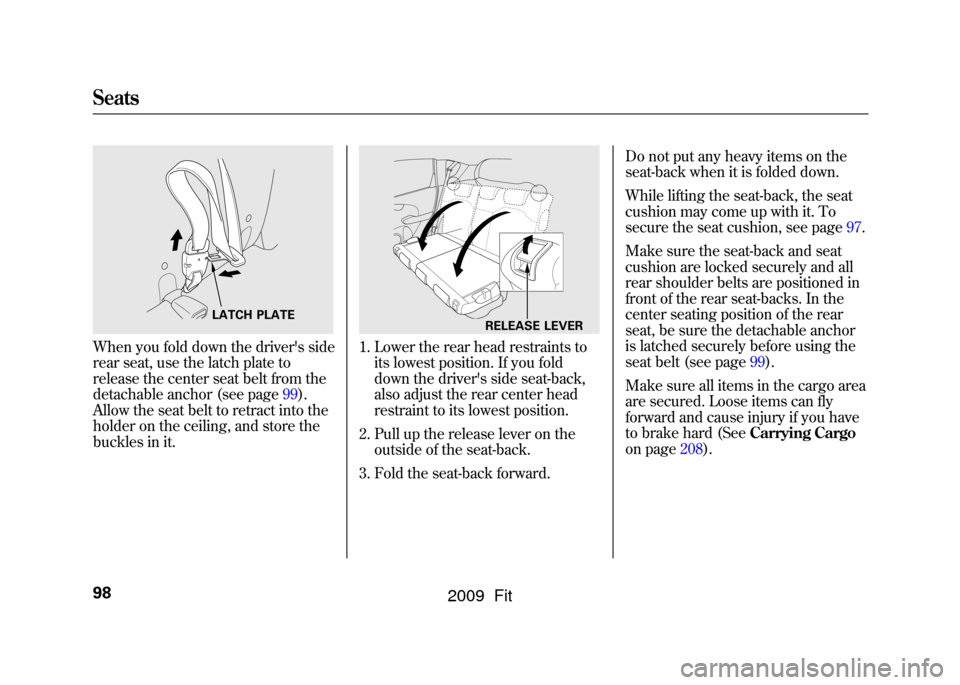
When you fold down the driver's side
rear seat, use the latch plate to
release the center seat belt from the
detachable anchor (see page99).
Allow the seat belt to retract into the
holder on the ceiling, and store the
buckles in it.
1. Lower the rear head restraints toits lowest position. If you fold
down the driver's side seat-back,
also adjust the rear center head
restraint to its lowest position.
2. Pull up the release lever on the outside of the seat-back.
3. Fold the seat-back forward. Do not put any heavy items on the
seat-back when it is folded down.
While lifting the seat-back, the seat
cushion may come up with it. To
secure the seat cushion, see page97.
Make sure the seat-back and seat
cushion are locked securely and all
rear shoulder belts are positioned in
front of the rear seat-backs. In the
center seating position of the rear
seat, be sure the detachable anchor
is latched securely before using the
seat belt (see page99).
Make sure all items in the cargo area
are secured. Loose items can fly
forward and cause injury if you have
to brake hard (See
Carrying Cargo
on page208).
LATCH PLATE
RELEASE LEVER
Seats98
2009 Fit
Page 102 of 352
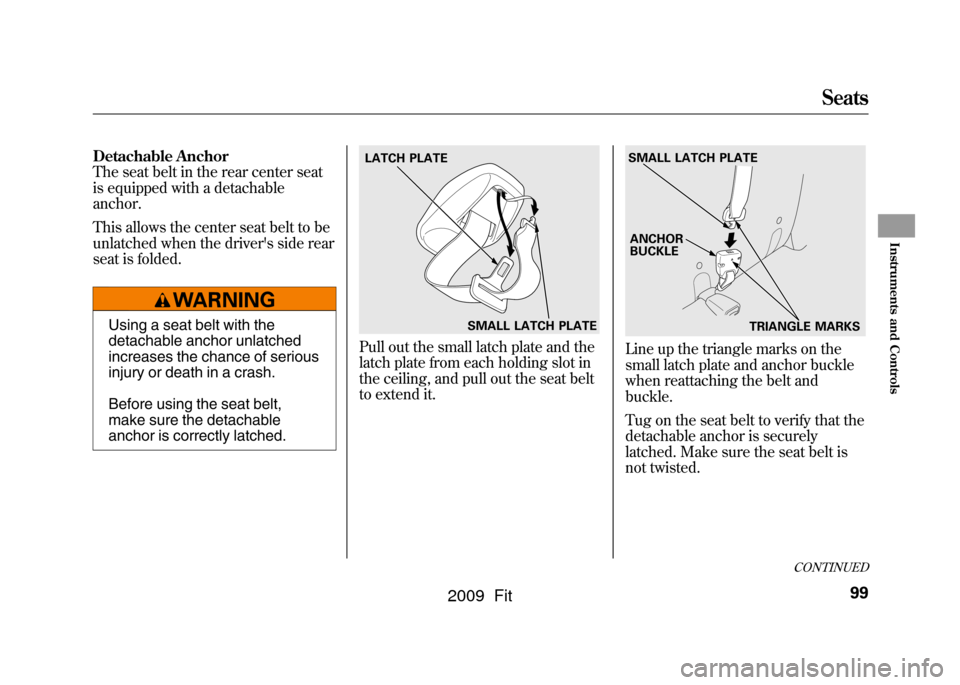
Detachable Anchor
The seat belt in the rear center seat
is equipped with a detachable
anchor.
This allows the center seat belt to be
unlatched when the driver's side rear
seat is folded.
Using a seat belt with the
detachable anchor unlatched
increases the chance of serious
injury or death in a crash.
Before using the seat belt,
make sure the detachable
anchor is correctly latched.
Pull out the small latch plate and the
latch plate from each holding slot in
the ceiling, and pull out the seat belt
to extend it.
Line up the triangle marks on the
small latch plate and anchor buckle
when reattaching the belt and
buckle.
Tug on the seat belt to verify that the
detachable anchor is securely
latched. Make sure the seat belt is
not twisted.
SMALL LATCH PLATE
LATCH PLATE
SMALL LATCH PLATE
TRIANGLE MARKS
ANCHOR
BUCKLE
CONTINUED
Seats
99
Instruments and Controls
2009 Fit
Page 103 of 352
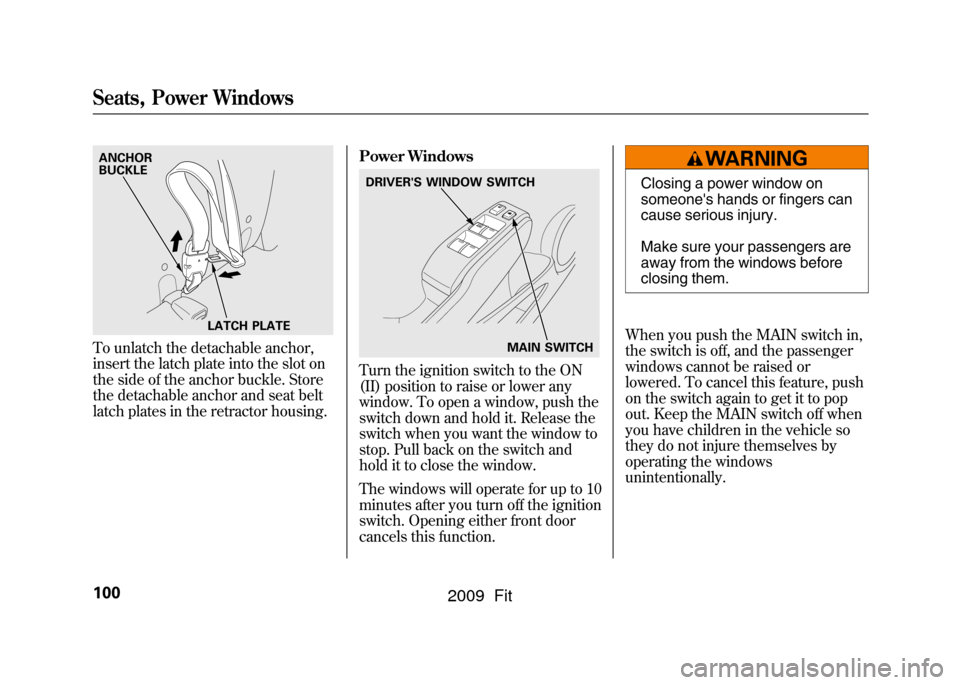
To unlatch the detachable anchor,
insert the latch plate into the slot on
the side of the anchor buckle. Store
the detachable anchor and seat belt
latch plates in the retractor housing.Power Windows
Turn the ignition switch to the ON
(II) position to raise or lower any
window. To open a window, push the
switch down and hold it. Release the
switch when you want the window to
stop. Pull back on the switch and
hold it to close the window.
The windows will operate for up to 10
minutes after you turn off the ignition
switch. Opening either front door
cancels this function.
Closing a power window on
someone's hands or fingers can
cause serious injury.
Make sure your passengers are
away from the windows before
closing them.
When you push the MAIN switch in,
the switch is off, and the passenger
windows cannot be raised or
lowered. To cancel this feature, push
on the switch again to get it to pop
out. Keep the MAIN switch off when
you have children in the vehicle so
they do not injure themselves by
operating the windows
unintentionally.
LATCH PLATE
ANCHOR
BUCKLE
DRIVER'S WINDOW SWITCH
MAIN SWITCH
Seats, Power Windows100
2009 Fit
Page 108 of 352
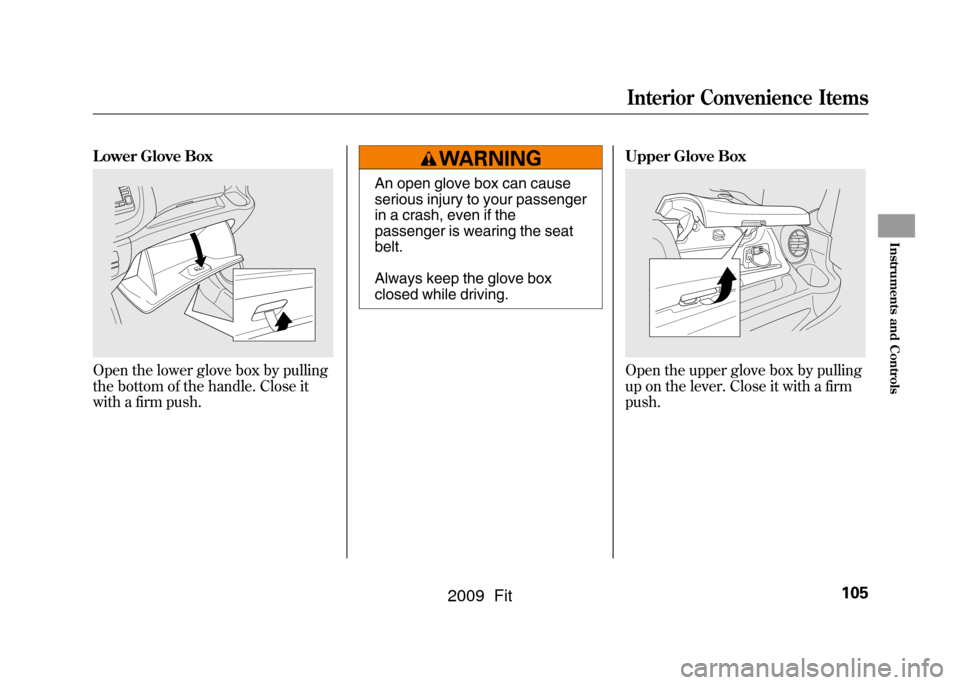
Lower Glove BoxOpen the lower glove box by pulling
the bottom of the handle. Close it
with a firm push.
An open glove box can cause
serious injury to your passenger
in a crash, even if the
passenger is wearing the seat
belt.
Always keep the glove box
closed while driving.Upper Glove Box
Open the upper glove box by pulling
up on the lever. Close it with a firm
push.Interior Convenience Items
105
Instruments and Controls
2009 Fit
Page 218 of 352

You should do the following checks
and adjustments before you drive
your vehicle.
1. Make sure all windows, mirrors,and outside lights are clean and
unobstructed. Remove frost, snow,
or ice.
2. Check that the hood is fully closed.
3. Visually check the tires. If a tire looks low, use a gauge to check its
pressure (see page273).
4. Check that any items you may be carrying are stored properly or
fastened down securely. 5. Check the seat adjustment (see
page 93).
6. Check the adjustment of the inside and outside mirrors (see page
101).
7. Check the steering wheel adjustment (see page 77).
8. Make sure the doors and the tailgate are securely closed and
locked.
9. Fasten your seat belt. Check that your passengers have fastened
their seat belts (see page 14).
10. When you start the engine, check the gauges and indicators in the
instrument panel (see page 59).
Preparing to Drive
215
Driving
2009 Fit