ESP HONDA FIT 2009 2.G Owners Manual
[x] Cancel search | Manufacturer: HONDA, Model Year: 2009, Model line: FIT, Model: HONDA FIT 2009 2.GPages: 352, PDF Size: 17.67 MB
Page 1 of 352

Congratulations! Your selection of a 2009 Honda Fit was a wise investment. It
will give you years of driving pleasure.
One of the best ways to enhance the enjoyment of your new vehicle is to read
this manual. In it, you will learn how to operate its driving controls and
convenience items. Afterwards, keep this owner's manual in your vehicle so
you can refer to it at any time.
Several warranties protect your new vehicle. Read the warranty booklet
thoroughly so you understand the coverages and are aware of your rights
and responsibilities.
Maintaining your vehicle according to the maintenance minder shown in the
instrument panel helps to keep your driving trouble-free while it preserves
your investment. When your vehicle needs maintenance, keep in mind that
your dealer's staff is specially trained in servicing the many systems unique
to your vehicle. Your dealer is dedicated to your satisfaction and will be
pleased to answer any questions and concerns.As you read this manual, you will find
information that is preceded by a
symbol. This information is
intended to help you avoid damage to
your vehicle, other property, or the
environment.
Introduction
i
2009 Fit
Page 3 of 352
Your safety, and the safety of others,
is very important. And operating this
vehicle safely is an important
responsibility.
To help you make informed
decisions about safety, we have
provided operating procedures and
other information on labels and in
this manual. This information alerts
you to potential hazards that could
hurt you or others.
Of course, it is not practical or
possible to warn you about all the
hazards associated with operating or
maintaining your vehicle. You must
use your own good judgement.You will find this important safety information in a variety of forms, including:
●Safety Labels
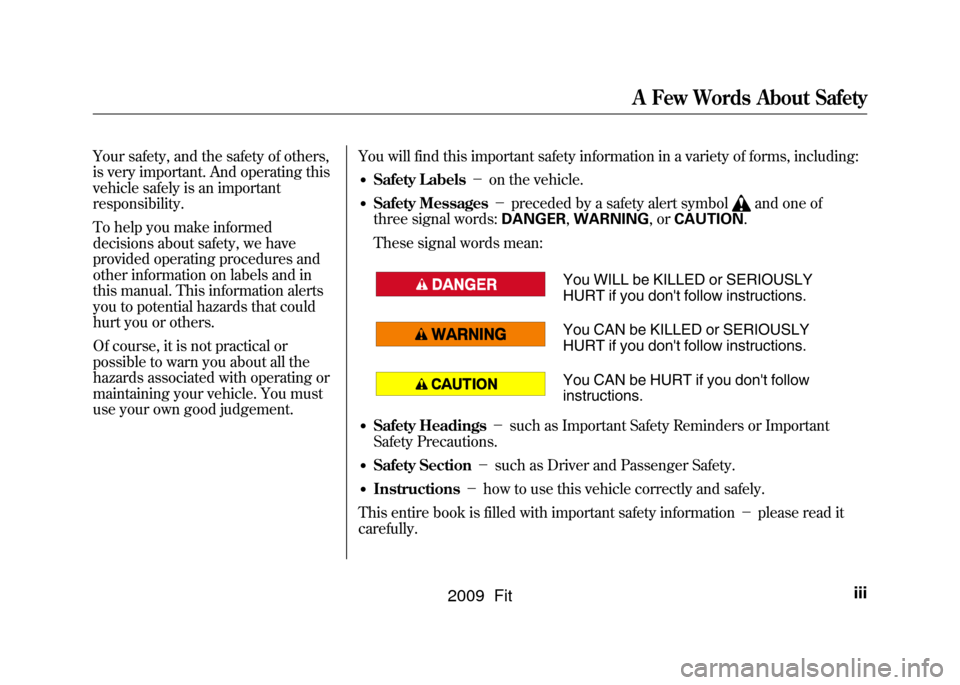
-on the vehicle.●Safety Messages -preceded by a safety alert symbol
and one of
three signal words: DANGER,WARNING ,orCAUTION.
These signal words mean:
You WILL be KILLED or SERIOUSLY
HURT if you don't follow instructions.You CAN be KILLED or SERIOUSLY
HURT if you don't follow instructions.You CAN be HURT if you don't follow
instructions.
●Safety Headings -such as Important Safety Reminders or Important
Safety Precautions.●Safety Section -such as Driver and Passenger Safety.●Instructions -how to use this vehicle correctly and safely.
This entire book is filled with important safety information -please read it
carefully.
A Few Words About Safety
iii
2009 Fit
Page 9 of 352

You'll find many safety
recommendations throughout this
section, and throughout this manual.
The recommendations on this page
are the ones we consider to be the
most important.
Always Wear Your Seat Belt
A seat belt is your best protection in
all types of collisions. Airbags are
designed to supplement seat belts,
not replace them. So even though
your vehicle is equipped with
airbags, make sure you and your
passengers always wear your seat
belts, and wear them properly (see
page14).Restrain All Children
Children age 12 and under should
ride properly restrained in a back
seat, not the front seat. Infants and
small children should be restrained
in a child seat. Larger children
should use a booster seat and a lap/
shoulder belt until they can use the
belt properly without a booster seat
(see pages34
-52).
Be Aware of Airbag Hazards
While airbags can save lives, they
can cause serious or fatal injuries to
occupants who sit too close to them,
or are not properly restrained.
Infants, young children, and short
adults are at the greatest risk. Be
sure to follow all instructions and
warnings in this manual.
Don't Drink and DriveAlcohol and driving don't mix. Even
one drink can reduce your ability to
respond to changing conditions, and
your reaction time gets worse with
every additional drink. So don't drink
and drive, and don't let your friends
drink and drive, either.Control Your SpeedExcessive speed is a major factor in
crash injuries and deaths. Generally,
the higher the speed, the greater the
risk, but serious injuries can also occur
at lower speeds. Never drive faster
than is safe for current conditions,
regardless of the maximum speed
posted.Keep Your Vehicle in Safe ConditionHaving a tire blowout or a mechanical
failure can be extremely hazardous. To
reduce the possibility of such
problems, check your tire pressures
and condition frequently, and perform
all regularly scheduled maintenance
(see page245).
Important Safety Precautions6
2009 Fit
Page 29 of 352

After a crash, you may see what
looks like smoke. This is actually
powder from the airbag's surface.
Although the powder is not harmful,
people with respiratory problems
may experience some temporary
discomfort. If this occurs, get out of
the vehicle as soon as it is safe to do
so.
Dual-Stage AirbagsYour front airbags are dual-stage
airbags. This means they have two
inflation stages that can be ignited
sequentially or simultaneously,
depending on crash severity.
In a
more severe
crash, both stages
will ignite simultaneously to provide
the quickest and greatest protection.
In a
less severe
crash, one stage will
ignite first, then the second stage will
ignite a split second later. This
provides longer airbag inflation time
with a little less force.
Dual-Threshold AirbagsYour front airbags are also dual-
threshold airbags. Airbags with this
feature have two deployment
thresholds that depend on whether
sensors detect the occupant is
wearing a seat belt or not.
If the occupant's belt is
not latched,
the airbag will deploy at a slightly
lower threshold, because the
occupant would need extra
protection.
If the occupant's belt is
latched,
the
airbag will deploy at a slightly higher
threshold, when the airbag would be
needed to supplement the protection
provided by the seat belt.
Additional Information About Your Airbags26
2009 Fit
Page 37 of 352
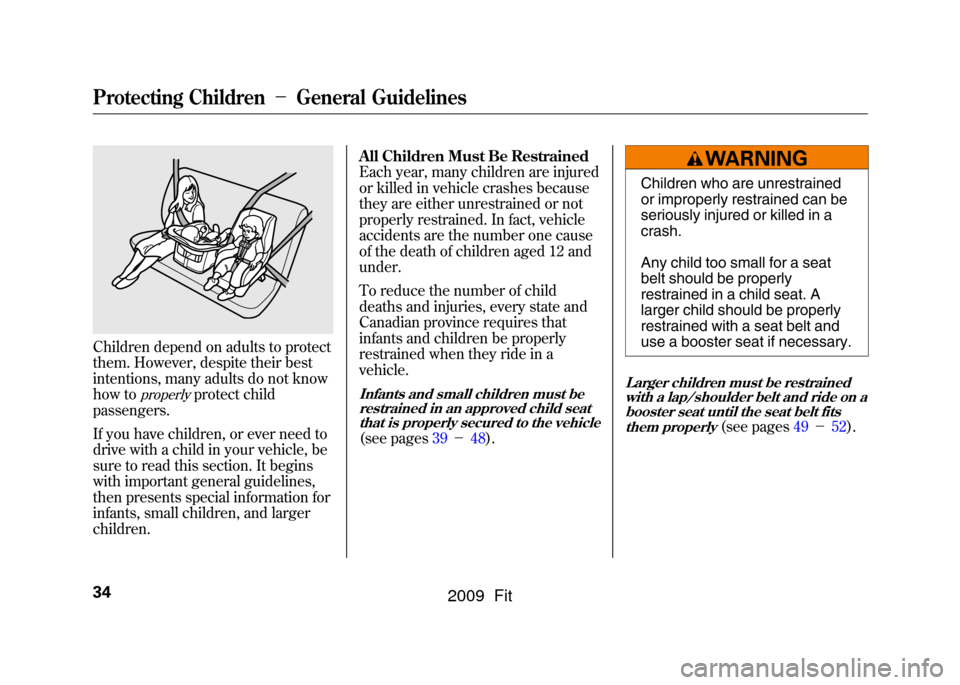
Children depend on adults to protect
them. However, despite their best
intentions, many adults do not know
how to
properly
protect child
passengers.
If you have children, or ever need to
drive with a child in your vehicle, be
sure to read this section. It begins
with important general guidelines,
then presents special information for
infants, small children, and larger
children. All Children Must Be Restrained
Each year, many children are injured
or killed in vehicle crashes because
they are either unrestrained or not
properly restrained. In fact, vehicle
accidents are the number one cause
of the death of children aged 12 and
under.
To reduce the number of child
deaths and injuries, every state and
Canadian province requires that
infants and children be properly
restrained when they ride in a
vehicle.
Infants and small children must be
restrained in an approved child seatthat is properly secured to the vehicle(see pages 39- 48).
Children who are unrestrained
or improperly restrained can be
seriously injured or killed in a
crash.
Any child too small for a seat
belt should be properly
restrained in a child seat. A
larger child should be properly
restrained with a seat belt and
use a booster seat if necessary.
Larger children must be restrained
with a lap/shoulder belt and ride on abooster seat until the seat belt fits
them properly
(see pages 49-52).
Protecting Children -General Guidelines34
2009 Fit
Page 82 of 352

The immobilizer system protects
your vehicle from theft. If an
improperly coded key (or other
device) is used, the engine's fuel
system is disabled.
When you turn the ignition switch to
the ON (II) position, the immobilizer
system indicator should come on
briefly, then go off. If the indicator
starts to blink, it means the system
does not recognize the coding of the
key. Turn the ignition switch to the
LOCK (0) position, remove the key,
reinsert it, and turn the ignition
switch to the ON (II) position again.
The system may not recognize your
key's coding if another immobilizer
key or other metal object (i.e. key
fob) is near the ignition switch when
you insert the key.If the system repeatedly does not
recognize the coding of your key,
contact your dealer.
Do not attempt to alter this system or
add other devices to it. Electrical
problems could result that may make
your vehicle inoperable.
If you have lost your key and cannot
start the engine, contact your dealer.
Always take the ignition key with you
whenever you leave the vehicle alone.
As required by the FCC:
This device complies with Part 15 of the
FCC rules. Operation is subject to thefollowing two conditions: (1) This devicemay not cause harmful interference, and(2) this device must accept any
interference received, includinginterference that may cause undesiredoperation.
Changes or modifications not expresslyapproved by the party responsible forcompliance could void the user's
authority to operate the equipment.
This device complies with IndustryCanada Standard RSS-210. Operation issubject to the following two conditions:(1) this device may not cause
interference, and (2) this device mustaccept any interference that may causeundesired operation of the device.
Immobilizer System
79
Instruments and Controls
2009 Fit
Page 95 of 352
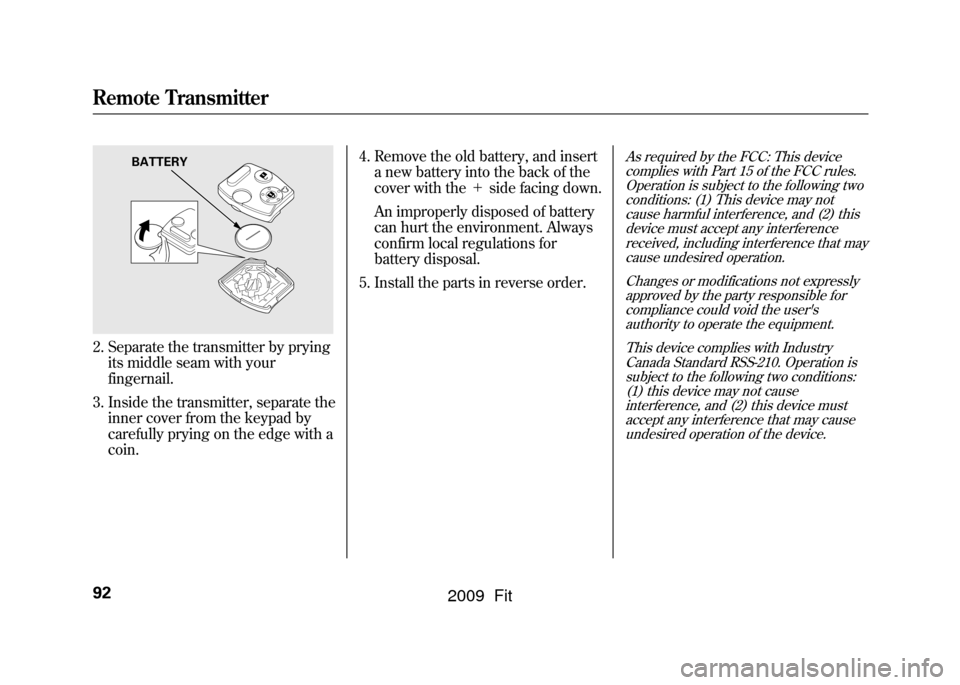
2. Separate the transmitter by pryingits middle seam with your
fingernail.
3. Inside the transmitter, separate the inner cover from the keypad by
carefully prying on the edge with a
coin. 4. Remove the old battery, and insert
a new battery into the back of the
cover with the +side facing down.
An improperly disposed of battery
can hurt the environment. Always
confirm local regulations for
battery disposal.
5. Install the parts in reverse order.
As required by the FCC: This device complies with Part 15 of the FCC rules.
Operation is subject to the following twoconditions: (1) This device may notcause harmful interference, and (2) thisdevice must accept any interference
received, including interference that maycause undesired operation.
Changes or modifications not expresslyapproved by the party responsible forcompliance could void the user'sauthority to operate the equipment.
This device complies with IndustryCanada Standard RSS-210. Operation issubject to the following two conditions:(1) this device may not causeinterference, and (2) this device must
accept any interference that may causeundesired operation of the device.
BATTERY
Remote Transmitter92
2009 Fit
Page 188 of 352
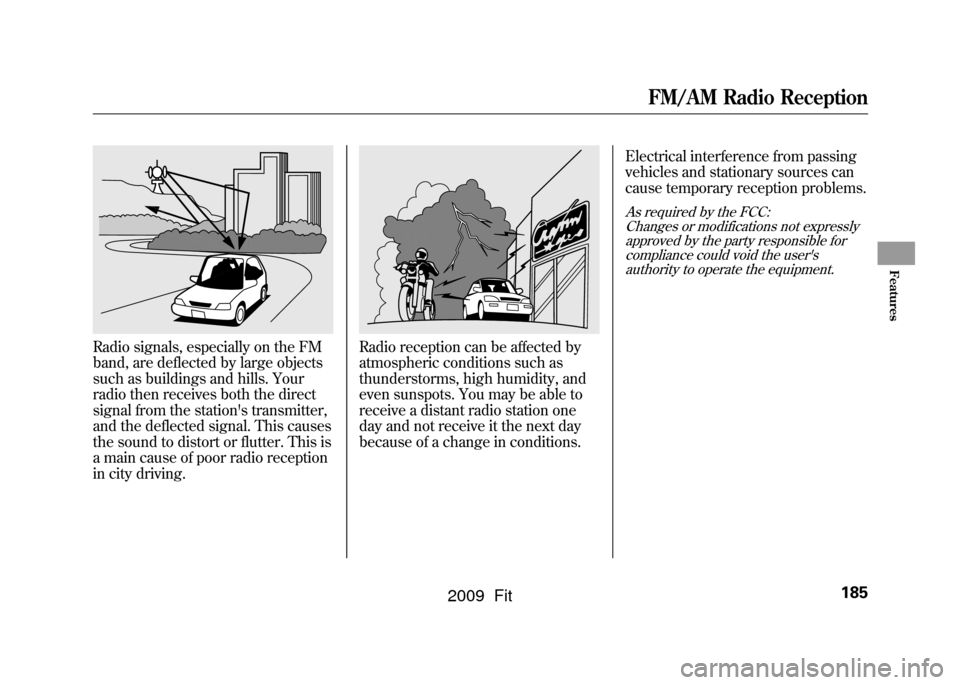
Radio signals, especially on the FM
band, are deflected by large objects
such as buildings and hills. Your
radio then receives both the direct
signal from the station's transmitter,
and the deflected signal. This causes
the sound to distort or flutter. This is
a main cause of poor radio reception
in city driving.
Radio reception can be affected by
atmospheric conditions such as
thunderstorms, high humidity, and
even sunspots. You may be able to
receive a distant radio station one
day and not receive it the next day
because of a change in conditions.Electrical interference from passing
vehicles and stationary sources can
cause temporary reception problems.
As required by the FCC:
Changes or modifications not expresslyapproved by the party responsible for
compliance could void the user'sauthority to operate the equipment.
FM/AM Radio Reception
185
Features
2009 Fit
Page 236 of 352
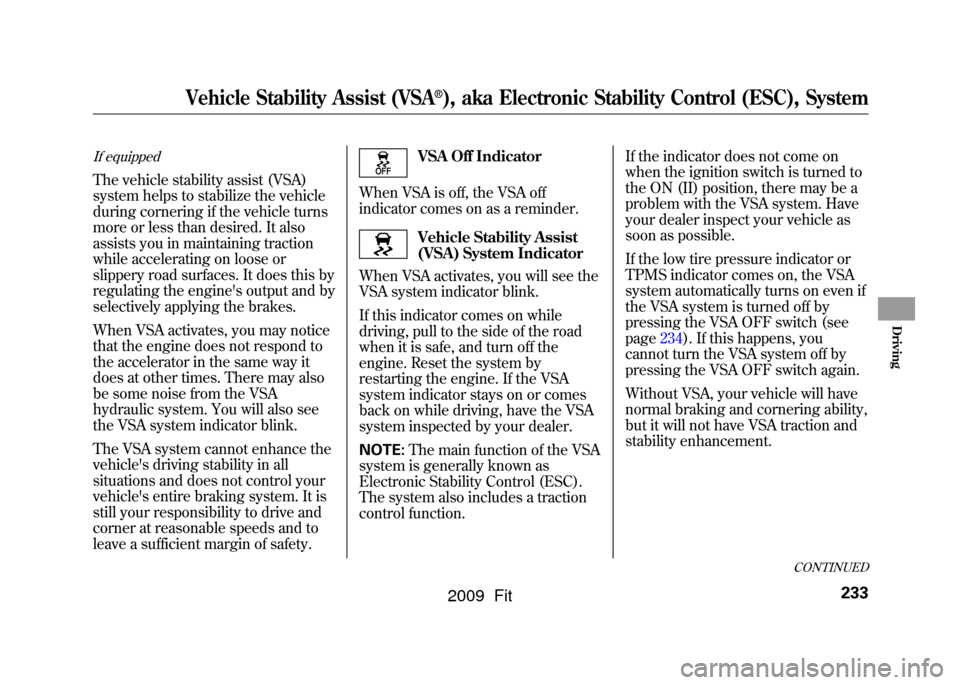
If equippedThe vehicle stability assist (VSA)
system helps to stabilize the vehicle
during cornering if the vehicle turns
more or less than desired. It also
assists you in maintaining traction
while accelerating on loose or
slippery road surfaces. It does this by
regulating the engine's output and by
selectively applying the brakes.
When VSA activates, you may notice
that the engine does not respond to
the accelerator in the same way it
does at other times. There may also
be some noise from the VSA
hydraulic system. You will also see
the VSA system indicator blink.
The VSA system cannot enhance the
vehicle's driving stability in all
situations and does not control your
vehicle's entire braking system. It is
still your responsibility to drive and
corner at reasonable speeds and to
leave a sufficient margin of safety.
VSA Off Indicator
When VSA is off, the VSA off
indicator comes on as a reminder.Vehicle Stability Assist
(VSA) System Indicator
When VSA activates, you will see the
VSA system indicator blink.
If this indicator comes on while
driving, pull to the side of the road
when it is safe, and turn off the
engine. Reset the system by
restarting the engine. If the VSA
system indicator stays on or comes
back on while driving, have the VSA
system inspected by your dealer.
NOTE: The main function of the VSA
system is generally known as
Electronic Stability Control (ESC).
The system also includes a traction
control function. If the indicator does not come on
when the ignition switch is turned to
the ON (II) position, there may be a
problem with the VSA system. Have
your dealer inspect your vehicle as
soon as possible.
If the low tire pressure indicator or
TPMS indicator comes on, the VSA
system automatically turns on even if
the VSA system is turned off by
pressing the VSA OFF switch (see
page234).If this happens, you
cannot turn the VSA system off by
pressing the VSA OFF switch again.
Without VSA, your vehicle will have
normal braking and cornering ability,
but it will not have VSA traction and
stability enhancement.
CONTINUED
Vehicle Stability Assist (VSA
®), aka Electronic Stability Control (ESC), System
233
Driving
2009 Fit
Page 240 of 352

Changing a Tire with TPMS
If you have a flat tire, the low tire
pressure indicator will come on.
Replace the flat tire with the compact
spare tire (see page284).
Each wheel (except the compact
spare tire wheel) is equipped with a
tire pressure sensor mounted inside
the tire behind the valve stem. You
must use TPMS specific wheels. It is
recommended that you always have
your tires serviced by your dealer or
qualified technician.
After you replace the flat tire with the
compact spare tire, the low tire
pressure indicator stays on. This is
normal; the system is not monitoring
the spare tire pressure. Manually
check the spare tire pressure to be
sure it is correct. After several miles
(kilometers) driving with the
compact spare tire, the TPMS
indicator comes on and the low tire
pressure indicator goes off.The low tire pressure indicator or the
TPMS indicator will go off, after
several miles (kilometers) driving,
when you replace the spare tire with
the specified regular tire equipped
with the tire pressure monitor
sensor.
Never use a puncture-repairing agent
in a flat tire. If used, you will have to
replace the tire pressure sensor.
Have the flat tire repaired by your
dealer as soon as possible.
As required by the FCC: This device
complies with Part 15 of the FCC rules.
Operation is subject to the following twoconditions: (1) This device may notcause harmful interference, and (2) thisdevice must accept any interference
received, including interference that maycause undesired operation.
Changes or modifications not expresslyapproved by the party responsible forcompliance could void the user'sauthority to operate the equipment.
This device complies with IndustryCanada Standard RSS-210. Operation issubject to the following two conditions:(1) this device may not causeinterference, and (2) this device must
accept any interference that may causeundesired operation of the device.
Tire Pressure Monitoring System (TPMS)
237
Driving
2009 Fit