Battery HONDA FIT 2012 2.G Owner's Manual
[x] Cancel search | Manufacturer: HONDA, Model Year: 2012, Model line: FIT, Model: HONDA FIT 2012 2.GPages: 286, PDF Size: 9.92 MB
Page 233 of 286
232Maintenance
Remote Transmitter Care
*
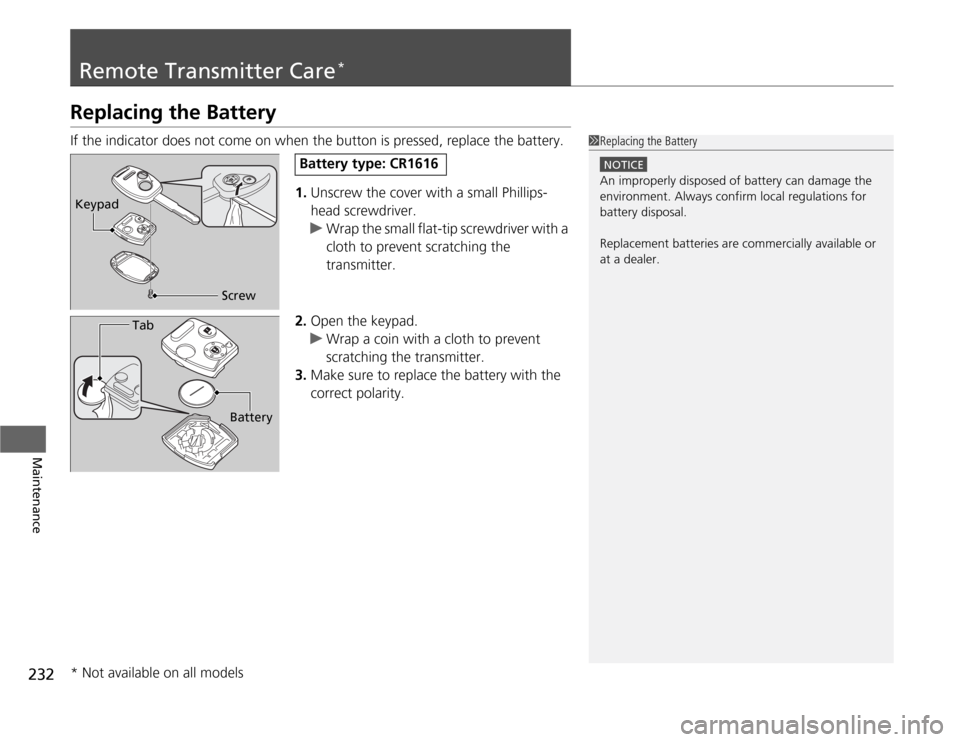
Replacing the BatteryIf the indicator does not come on when the button is pressed, replace the battery.
1.Unscrew the cover with a small Phillips-
head screwdriver.
uWrap the small flat-tip screwdriver with a
cloth to prevent scratching the
transmitter.
2.Open the keypad.
uWrap a coin with a cloth to prevent
scratching the transmitter.
3.Make sure to replace the battery with the
correct polarity.
1Replacing the Battery
NOTICEAn improperly disposed of battery can damage the
environment. Always confirm local regulations for
battery disposal.
Replacement batteries are commercially available or
at a dealer.
Keypad
Screw
Battery type: CR1616
Battery Tab
* Not available on all models
Page 237 of 286
uuCleaninguExterior Care
236Maintenance
A good coat of automotive body wax helps protect your vehicle’s paint from the
elements. Wax will wear off over time and expose your vehicle’s paint to the
elements, so reapply as necessary.
If you get gasoline, oil, engine coolant, or battery fluid on resin coated parts, they
may be stained or the coating may peel. Promptly wipe it away using a soft cloth and
clean water.
Wipe using a glass cleaner.
Aluminum is susceptible to deterioration caused by salt and other road
contaminants. Use a sponge and mild detergent to wipe away promptly.
Be careful not to use harsh chemicals (including some commercial wheel cleaners) or
a stiff brush. They can damage the clear coat of the aluminum alloy wheels that
helps keep the aluminum from corroding and tarnishing.■
Applying Wax
■
Maintaining the Bumpers and Other Resin Coated Parts
■
Cleaning the Window
■
Maintaining Aluminum Wheels
*
1Applying Wax
NOTICEChemical solvents and strong cleaners can damage
the paint, metal, and plastic on your vehicle. Wipe up
spills immediately.1Maintaining the Bumpers and Other Resin Coated Parts
Ask a dealer about the correct coating material when
you want to repair the painted surface of the parts
made of resin.1Cleaning the Window
Wires are mounted to the inside of the rear window.
Wipe along the same direction as the wires with a
soft cloth so as not to damage them.
* Not available on all models
Page 251 of 286
250Handling the Unexpected
Engine Does Not StartChecking the EngineIf the engine does not start, turn the ignition switch to START
(e
and check the
starter.
Starter condition
Checklist
Starter doesn’t turn or turns
over slowly.
The battery may be dead. Check
each of the items on the right and
respond accordingly.
Check brightness of the interior light.
Turn on interior lights and check brightness.●
If the interior lights are dim or do not come on at all
2Battery P. 231
●
If the interior lights come on normally
2 Inspecting and Changing Fuses P. 263
The starter turns over normally
but the engine doesn’t start.
There may be a problem with the
fuse. Check each of the items on
the right and respond accordingly.
Review the engine start procedure.
Follow its instructions, and try to start the engine again.
2 Starting the Engine P. 161
Check the immobilizer system indicator.
When the immobilizer system indicator is blinking, the engine cannot be started.
2Immobilizer System P. 90
Check the fuel level.
There should be enough fuel in the tank.
2 Fuel Gauge P. 72
Check the fuse.
Check all fuses, or have the vehicle checked by a dealer.
2Inspecting and Changing Fuses P. 263
If the problem continues:
2Emergency Towing P. 264
1Checking the Engine
If you must start the vehicle immediately, use an
assisting vehicle to jump start it.
2Jump Starting P. 251
Page 252 of 286
251
Continued
Handling the Unexpected
Jump StartingTurn off the power to electric devices, such as audio and lights. Turn off the engine,
then open the hood.
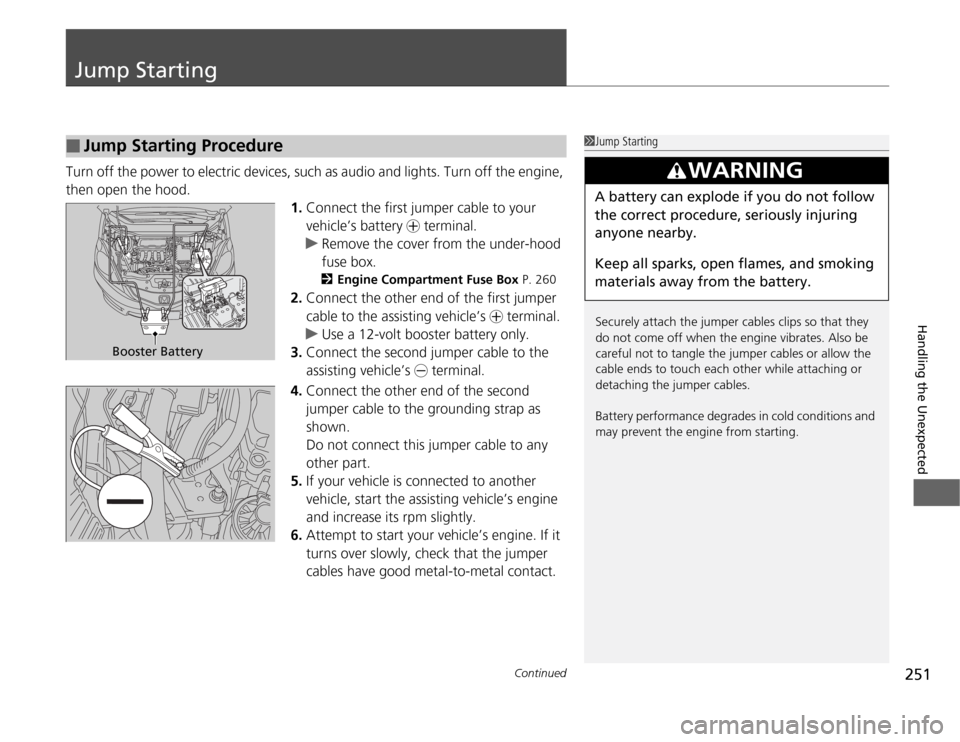
1.Connect the first jumper cable to your
vehicle’s battery + terminal.
uRemove the cover from the under-hood
fuse box.
2Engine Compartment Fuse Box P. 260
2.Connect the other end of the first jumper
cable to the assisting vehicle’s + terminal.
uUse a 12-volt booster battery only.
3.Connect the second jumper cable to the
assisting vehicle’s - terminal.
4.Connect the other end of the second
jumper cable to the grounding strap as
shown.
Do not connect this jumper cable to any
other part.
5.If your vehicle is connected to another
vehicle, start the assisting vehicle’s engine
and increase its rpm slightly.
6.Attempt to start your vehicle’s engine. If it
turns over slowly, check that the jumper
cables have good metal-to-metal contact.
■
Jump Starting Procedure
1Jump Starting
Securely attach the jumper cables clips so that they
do not come off when the engine vibrates. Also be
careful not to tangle the jumper cables or allow the
cable ends to touch each other while attaching or
detaching the jumper cables.
Battery performance degrades in cold conditions and
may prevent the engine from starting.
3
WARNING
A battery can explode if you do not follow
the correct procedure, seriously injuring
anyone nearby.
Keep all sparks, open flames, and smoking
materials away from the battery.
Booster Battery
Page 253 of 286
252
uuJump Startingu
Handling the Unexpected
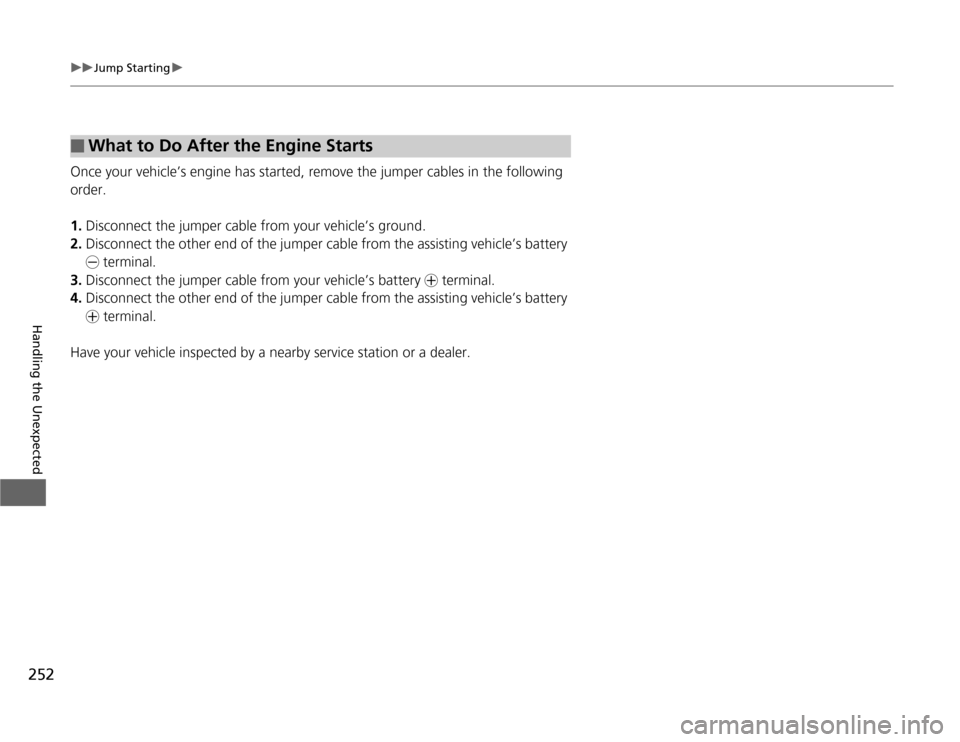
Once your vehicle’s engine has started, remove the jumper cables in the following
order.
1.Disconnect the jumper cable from your vehicle’s ground.
2.Disconnect the other end of the jumper cable from the assisting vehicle’s battery
- terminal.
3.Disconnect the jumper cable from your vehicle’s battery + terminal.
4.Disconnect the other end of the jumper cable from the assisting vehicle’s battery
+ terminal.
Have your vehicle inspected by a nearby service station or a dealer.■
What to Do After the Engine Starts
Page 257 of 286
256Handling the Unexpected
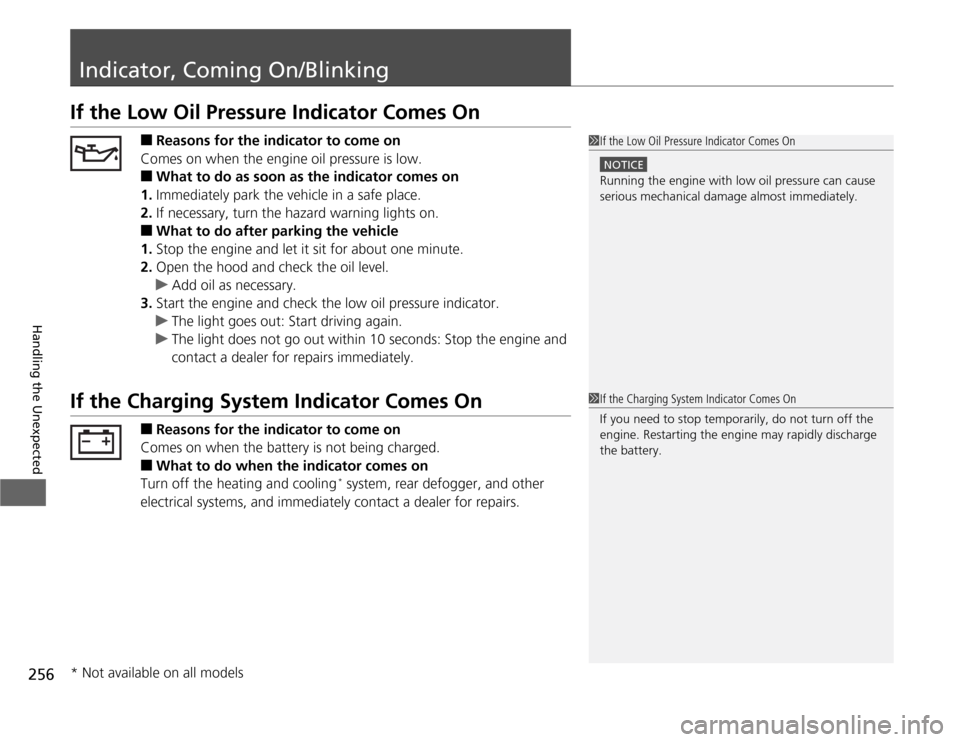
Indicator, Coming On/BlinkingIf the Low Oil Pressure Indicator Comes On
■
Reasons for the indicator to come on
Comes on when the engine oil pressure is low.
■
What to do as soon as the indicator comes on
1.Immediately park the vehicle in a safe place.
2.If necessary, turn the hazard warning lights on.
■
What to do after parking the vehicle
1.Stop the engine and let it sit for about one minute.
2.Open the hood and check the oil level.
uAdd oil as necessary.
3.Start the engine and check the low oil pressure indicator.
uThe light goes out: Start driving again.
uThe light does not go out within 10 seconds: Stop the engine and
contact a dealer for repairs immediately.
If the Charging System Indicator Comes On
■
Reasons for the indicator to come on
Comes on when the battery is not being charged.
■
What to do when the indicator comes on
Turn off the heating and cooling
* system, rear defogger, and other
electrical systems, and immediately contact a dealer for repairs.
1If the Low Oil Pressure Indicator Comes On
NOTICERunning the engine with low oil pressure can cause
serious mechanical damage almost immediately.1If the Charging System Indicator Comes On
If you need to stop temporarily, do not turn off the
engine. Restarting the engine may rapidly discharge
the battery.
* Not available on all models
Page 261 of 286
260Handling the Unexpected
FusesFuse LocationsIf any electrical devices are not working, turn the ignition switch to LOCK
(0
and
check to see if any applicable fuse is blown.
Fuse locations are shown on the fuse box cover. Locate the fuse in question by the
fuse number and box cover number.
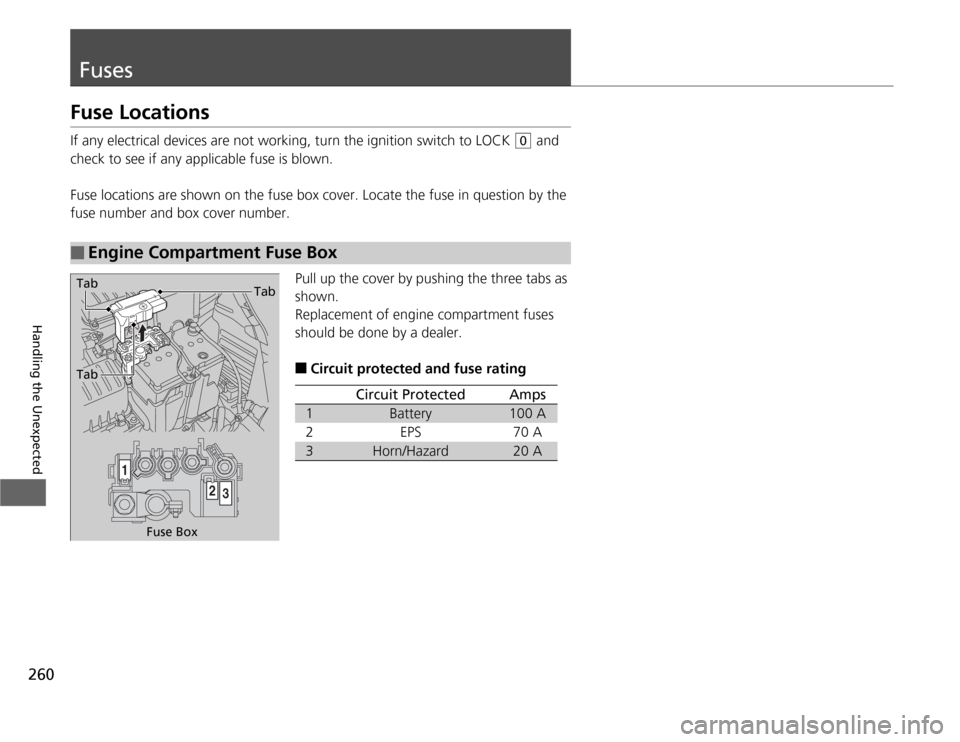
Pull up the cover by pushing the three tabs as
shown.
Replacement of engine compartment fuses
should be done by a dealer.
■
Circuit protected and fuse rating
■
Engine Compartment Fuse Box
Fuse BoxTab
TabTab
Circuit Protected
Amps
1
Battery
100 A
2
EPS
70 A
3
Horn/Hazard
20 A
Page 269 of 286
268Information
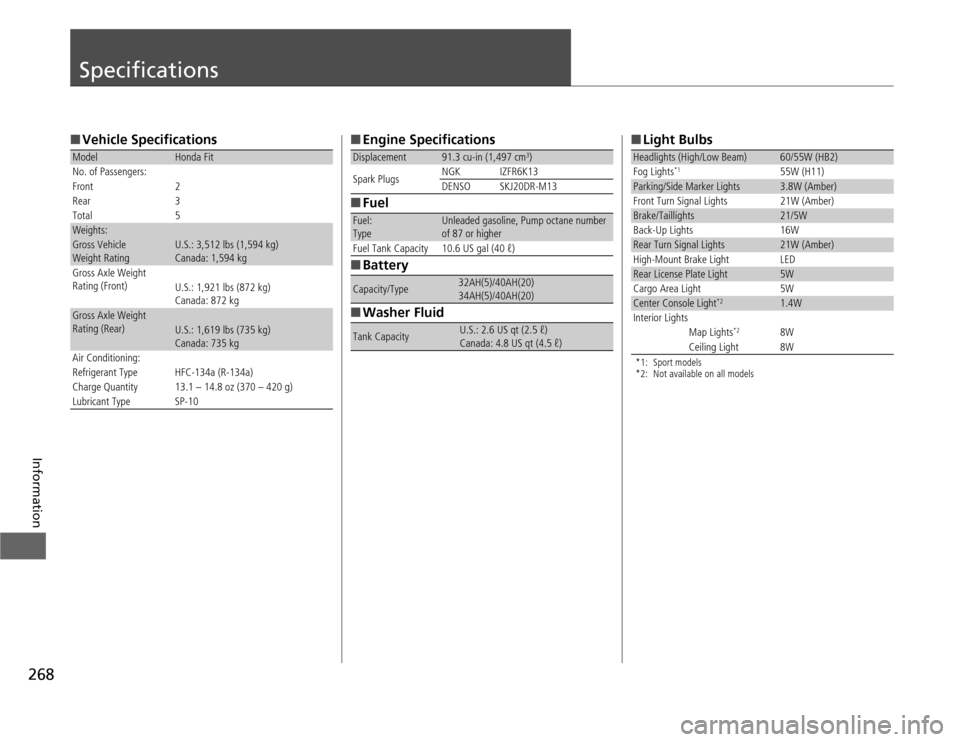
Specifications■Vehicle SpecificationsModel
Honda Fit
No. of Passengers:
Front 2
Rear 3
Total 5
Weights:Gross Vehicle
Weight Rating
U.S.: 3,512 lbs (1,594 kg)
Canada: 1,594 kg
Gross Axle Weight
Rating (Front)
U.S.: 1,921 lbs (872 kg)
Canada: 872 kg
Gross Axle Weight
Rating (Rear)
U.S.: 1,619 lbs (735 kg)
Canada: 735 kg
Air Conditioning:
Refrigerant Type HFC-134a (R-134a)
Charge Quantity 13.1 – 14.8 oz (370 – 420 g)
Lubricant Type SP-10
■Engine Specifications
■Fuel
■Battery
■Washer FluidDisplacement
91.3 cu-in (1,497 cm
3)
Spark PlugsNGK IZFR6K13
DENSO
SKJ20DR-M13
Fuel:
Type
Unleaded gasoline, Pump octane number
of 87 or higher
Fuel Tank Capacity 10.6 US gal (40 ℓ)
Capacity/Type
32AH(5)/40AH(20)
34AH(5)/40AH(20)
Tank Capacity
U.S.: 2.6 US qt (2.5 ℓ)
Canada: 4.8 US qt (4.5 ℓ)
■Light Bulbs*1: Sport models
*2: Not available on all modelsHeadlights (High/Low Beam)
60/55W (HB2)
Fog Lights
*1
55W (H11)
Parking/Side Marker Lights
3.8W (Amber)
Front Turn Signal Lights 21W (Amber)
Brake/Taillights
21/5W
Back-Up Lights 16W
Rear Turn Signal Lights
21W (Amber)
High-Mount Brake Light LED
Rear License Plate Light
5W
Cargo Area Light 5W
Center Console Light
*2
1.4W
Interior Lights
Map Lights
*2
8W
Ceiling Light 8W
Page 274 of 286
273
Continued
Information
Emissions TestingTesting of Readiness CodesYour vehicle uses “readiness codes,” as part of its onboard self diagnostic system.
Some states refer to these codes during testing to see if your vehicle’s emissions
components are working properly.
The codes may not be read if you go through the testing just after the battery has
gone dead or been disconnected.
To check if they are set, turn the ignition switch to ON
(w
, without starting the
engine. The malfunction indicator lamp will come on for several seconds. If it then
goes off, the readiness codes are set. If it blinks five times, the readiness codes are
not set.
If you are required to have your vehicle tested before the readiness codes are ready,
prepare the vehicle for retesting by doing the following:
1.Fill the gas tank to approximately 3/4 full.
2.Park the vehicle and leave the engine off for 6 hours or more.
3.Make sure the ambient temperature is between 40°F and 95°F (4°C and 35°C).
4.Start the engine without touching the accelerator pedal, and let it idle for 20
seconds.
5.Keep the vehicle in
(P
(automatic transmission) or
(N
(manual transmission).
Increase the engine speed to 2,000 rpm, and hold it there for about 3 minutes.
6.Let the engine idle with your foot off the accelerator for 20 seconds.
1Testing of Readiness Codes
The readiness codes are erased when the battery is
disconnected, and set again only after several days of
driving under a variety of conditions.
If a testing facility determines that the readiness
codes are not set, you may be requested to return at
a later date to complete the test.
If the testing facility determines the readiness codes
are still not set, see a dealer.
Page 277 of 286

276
uuWarranty Coveragesu
Information
Replacement Battery Limited Warranty – provides prorated coverage for a
replacement battery purchased from a dealer.
Replacement Muffler Lifetime Limited Warranty – provides coverage for as
long as the purchaser of the muffler owns the vehicle.
Restrictions and exclusions apply to all these warranties. Please read the 2012 Honda
warranty information booklet that came with your vehicle for precise information on
warranty coverages. Your vehicle’s original tires are covered by their manufacturer.
Tire warranty information is in a separate booklet.■
Canadian Owners
Please refer to the 2012 warranty manual that came with your vehicle.