fuel HONDA FIT 2012 2.G Owner's Manual
[x] Cancel search | Manufacturer: HONDA, Model Year: 2012, Model line: FIT, Model: HONDA FIT 2012 2.GPages: 286, PDF Size: 9.92 MB
Page 194 of 286
193
uuBefore Performing MaintenanceuSafety When Performing Maintenance
Maintenance
Safety When Performing MaintenanceSome of the most important safety precautions are given here.
However, we cannot warn you of every conceivable hazard that can arise in
performing maintenance. Only you can decide whether or not you should perform
a given task.
•To reduce the possibility of fire or explosion, keep cigarettes, sparks, and flames
away from the battery and all fuel related parts.
•To clean parts, use a commercially available degreaser or parts cleaner, not
gasoline.
•Wear eye protection and protective clothing when working with the battery or
compressed air.
•Engine exhaust contains carbon monoxide, which is poisonous and can kill you.
uOnly operate the engine if there is sufficient ventilation.
•The vehicle must be in a stationary condition.
uMake sure your vehicle is parked on level ground, the parking brake is set, and
the engine is off.
•Be aware that hot parts can burn you.
uMake sure to let the engine and exhaust system cool thoroughly before
touching vehicle parts.
•Be aware that moving parts can injure you.
uDo not start the engine unless instructed, and keep your hands and limbs away
from moving parts.■
Maintenance Safety
■
Vehicle Safety
1Safety When Performing Maintenance
3
WARNING
Improperly maintaining this vehicle or
failing to correct a problem before driving
can cause a crash in which you can be
seriously hurt or killed.
Always follow the inspection and
maintenance recommendations according
to the schedules in this owner’s manual.
3
WARNING
Failure to properly follow maintenance
instructions and precautions can cause you
to be seriously hurt or killed.
Always follow the procedures and
precautions in this owner’s manual.
Page 198 of 286
197
uuMaintenance Minder
TMuTo Use Maintenance Minder
TM
Continued
Maintenance
■
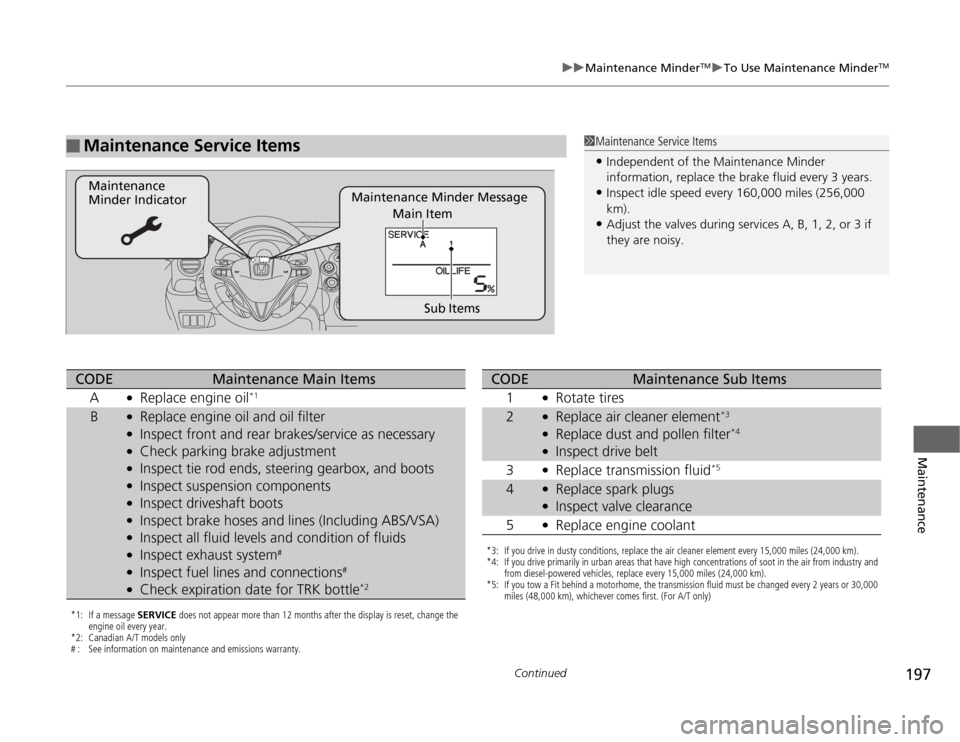
Maintenance Service Items
1Maintenance Service Items•Independent of the Maintenance Minder
information, replace the brake fluid every 3 years.•Inspect idle speed every 160,000 miles (256,000
km).•Adjust the valves during services A, B, 1, 2, or 3 if
they are noisy.
Maintenance Minder Message Maintenance
Minder Indicator
Sub Items Main Item
*1: If a message SERVICE does not appear more than 12 months after the display is reset, change the
engine oil every year.
*2: Canadian A/T models only
# : See information on maintenance and emissions warranty.CODE
Maintenance Main Items
A
●
Replace engine oil
*1
B
●
Replace engine oil and oil filter
●
Inspect front and rear brakes/service as necessary
●
Check parking brake adjustment
●
Inspect tie rod ends, steering gearbox, and boots
●
Inspect suspension components
●
Inspect driveshaft boots
●
Inspect brake hoses and lines (Including ABS/VSA)
●
Inspect all fluid levels and condition of fluids
●
Inspect exhaust system
#
●
Inspect fuel lines and connections
#
●
Check expiration date for TRK bottle
*2
*3: If you drive in dusty conditions, replace the air cleaner element every 15,000 miles (24,000 km).
*4: If you drive primarily in urban areas that have high concentrations of soot in the air from industry and
from diesel-powered vehicles, replace every 15,000 miles (24,000 km).
*5: If you tow a Fit behind a motorhome, the transmission fluid must be changed every 2 years or 30,000
miles (48,000 km), whichever comes first. (For A/T only)CODE
Maintenance Sub Items
1
●
Rotate tires
2
●
Replace air cleaner element
*3
●
Replace dust and pollen filter
*4
●
Inspect drive belt
3
●
Replace transmission fluid
*5
4
●
Replace spark plugs
●
Inspect valve clearance
5
●
Replace engine coolant
Page 203 of 286
202
uuMaintenance Under the HooduOil Check
Maintenance
Oil CheckWe recommend that you check the engine oil level every time you refuel.
Park the vehicle on level ground.
Wait approximately three minutes after turning the engine off before you check the
oil.
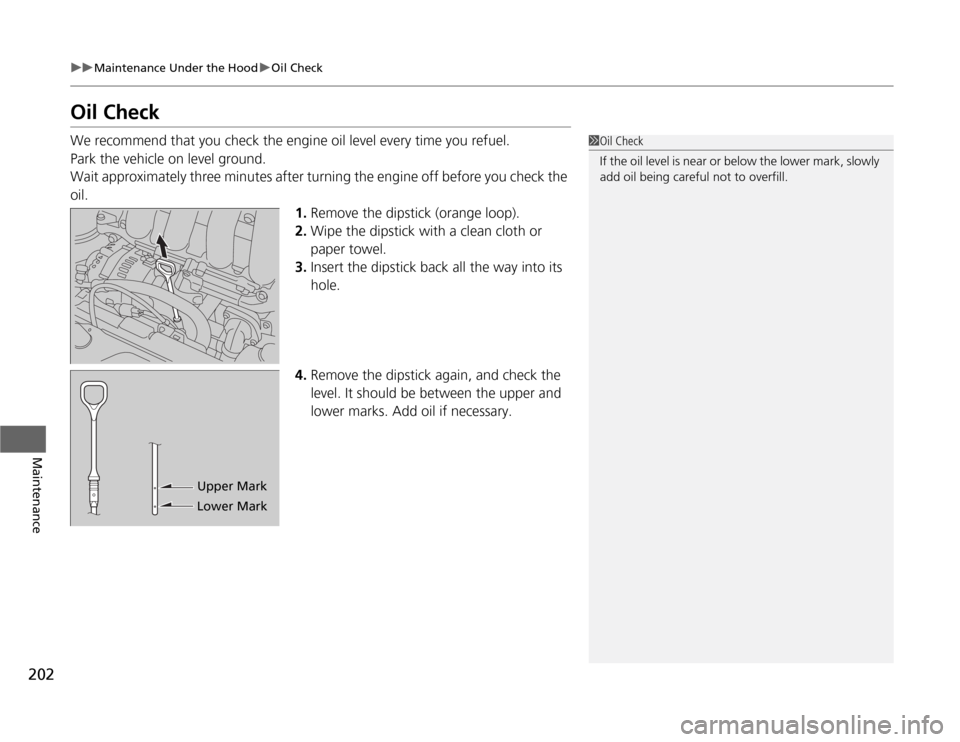
1.Remove the dipstick (orange loop).
2.Wipe the dipstick with a clean cloth or
paper towel.
3.Insert the dipstick back all the way into its
hole.
4.Remove the dipstick again, and check the
level. It should be between the upper and
lower marks. Add oil if necessary.
1Oil Check
If the oil level is near or below the lower mark, slowly
add oil being careful not to overfill.
Upper Mark
Lower Mark
Page 207 of 286
206
uuMaintenance Under the HooduEngine Coolant
Maintenance
Engine CoolantThis coolant is premixed with 50% antifreeze and 50% water. Do not add any
straight antifreeze or water.
We recommend you check the engine coolant level every time you refuel. Check the
reserve tank first. If it is completely empty, also check the coolant level in the
radiator. Add the engine coolant accordingly.
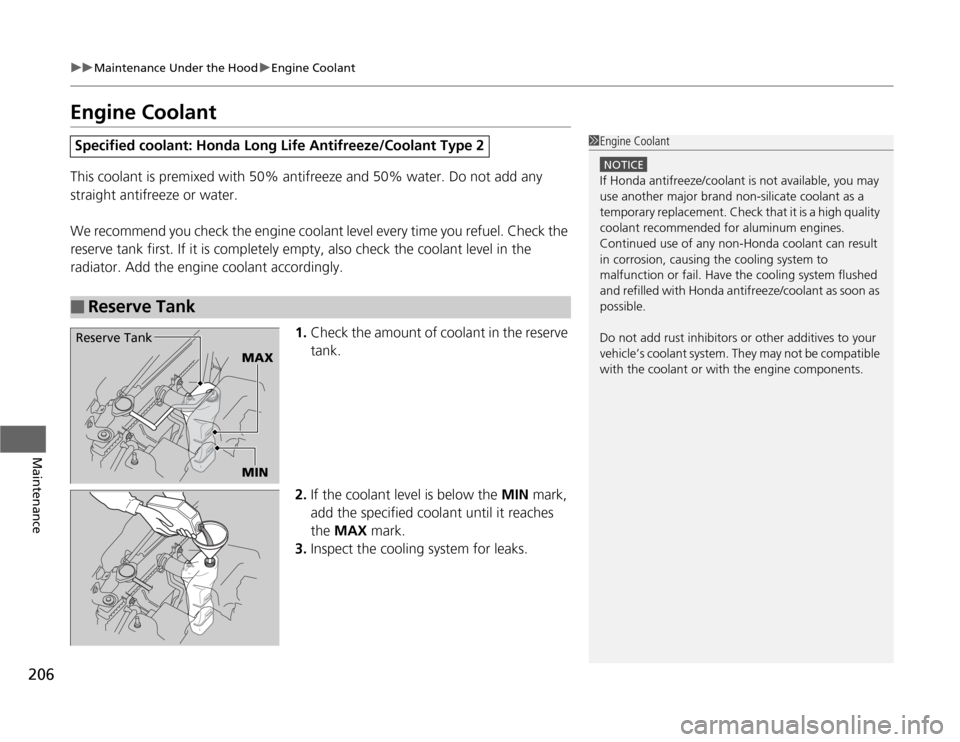
1.Check the amount of coolant in the reserve
tank.
2.If the coolant level is below the MIN mark,
add the specified coolant until it reaches
the MAX mark.
3.Inspect the cooling system for leaks.Specified coolant: Honda Long Life Antifreeze/Coolant Type 2■
Reserve Tank
1Engine Coolant
NOTICEIf Honda antifreeze/coolant is not available, you may
use another major brand non-silicate coolant as a
temporary replacement. Check that it is a high quality
coolant recommended for aluminum engines.
Continued use of any non-Honda coolant can result
in corrosion, causing the cooling system to
malfunction or fail. Have the cooling system flushed
and refilled with Honda antifreeze/coolant as soon as
possible.
Do not add rust inhibitors or other additives to your
vehicle’s coolant system. They may not be compatible
with the coolant or with the engine components.
Reserve Tank
MAX
MIN
Page 223 of 286
222Maintenance
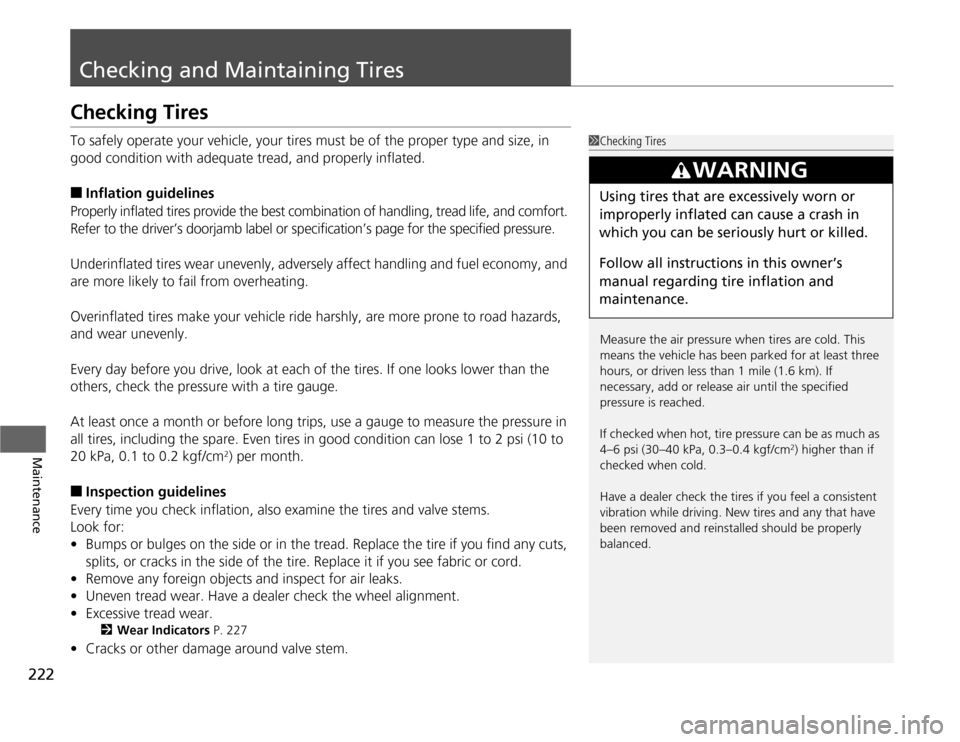
Checking and Maintaining TiresChecking TiresTo safely operate your vehicle, your tires must be of the proper type and size, in
good condition with adequate tread, and properly inflated.■
Inflation guidelines
Properly inflated tires provide the best combination of handling, tread life, and comfort.
Refer to the driver’s doorjamb label or specification’s page for the specified pressure.
Underinflated tires wear unevenly, adversely affect handling and fuel economy, and
are more likely to fail from overheating.
Overinflated tires make your vehicle ride harshly, are more prone to road hazards,
and wear unevenly.
Every day before you drive, look at each of the tires. If one looks lower than the
others, check the pressure with a tire gauge.
At least once a month or before long trips, use a gauge to measure the pressure in
all tires, including the spare. Even tires in good condition can lose 1 to 2 psi (10 to
20 kPa, 0.1 to 0.2 kgf/cm
2) per month.
■
Inspection guidelines
Every time you check inflation, also examine the tires and valve stems.
Look for:
•Bumps or bulges on the side or in the tread. Replace the tire if you find any cuts,
splits, or cracks in the side of the tire. Replace it if you see fabric or cord.
•Remove any foreign objects and inspect for air leaks.
•Uneven tread wear. Have a dealer check the wheel alignment.
•Excessive tread wear.
2Wear Indicators P. 227
•Cracks or other damage around valve stem.
1Checking Tires
Measure the air pressure when tires are cold. This
means the vehicle has been parked for at least three
hours, or driven less than 1 mile (1.6 km). If
necessary, add or release air until the specified
pressure is reached.
If checked when hot, tire pressure can be as much as
4–6 psi (30–40 kPa, 0.3–0.4 kgf/cm
2) higher than if
checked when cold.
Have a dealer check the tires if you feel a consistent
vibration while driving. New tires and any that have
been removed and reinstalled should be properly
balanced.
3
WARNING
Using tires that are excessively worn or
improperly inflated can cause a crash in
which you can be seriously hurt or killed.
Follow all instructions in this owner’s
manual regarding tire inflation and
maintenance.
Page 251 of 286
250Handling the Unexpected
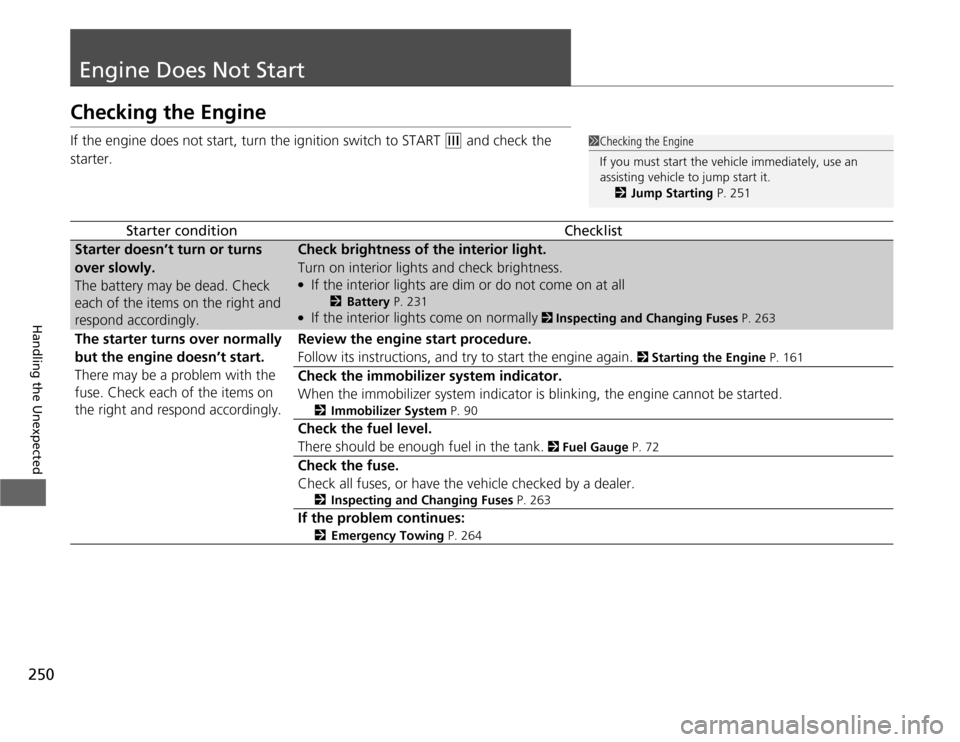
Engine Does Not StartChecking the EngineIf the engine does not start, turn the ignition switch to START
(e
and check the
starter.
Starter condition
Checklist
Starter doesn’t turn or turns
over slowly.
The battery may be dead. Check
each of the items on the right and
respond accordingly.
Check brightness of the interior light.
Turn on interior lights and check brightness.●
If the interior lights are dim or do not come on at all
2Battery P. 231
●
If the interior lights come on normally
2 Inspecting and Changing Fuses P. 263
The starter turns over normally
but the engine doesn’t start.
There may be a problem with the
fuse. Check each of the items on
the right and respond accordingly.
Review the engine start procedure.
Follow its instructions, and try to start the engine again.
2 Starting the Engine P. 161
Check the immobilizer system indicator.
When the immobilizer system indicator is blinking, the engine cannot be started.
2Immobilizer System P. 90
Check the fuel level.
There should be enough fuel in the tank.
2 Fuel Gauge P. 72
Check the fuse.
Check all fuses, or have the vehicle checked by a dealer.
2Inspecting and Changing Fuses P. 263
If the problem continues:
2Emergency Towing P. 264
1Checking the Engine
If you must start the vehicle immediately, use an
assisting vehicle to jump start it.
2Jump Starting P. 251
Page 258 of 286
257
uuIndicator, Coming On/BlinkinguIf the Malfunction Indicator Lamp Comes On or Blinks
Handling the Unexpected
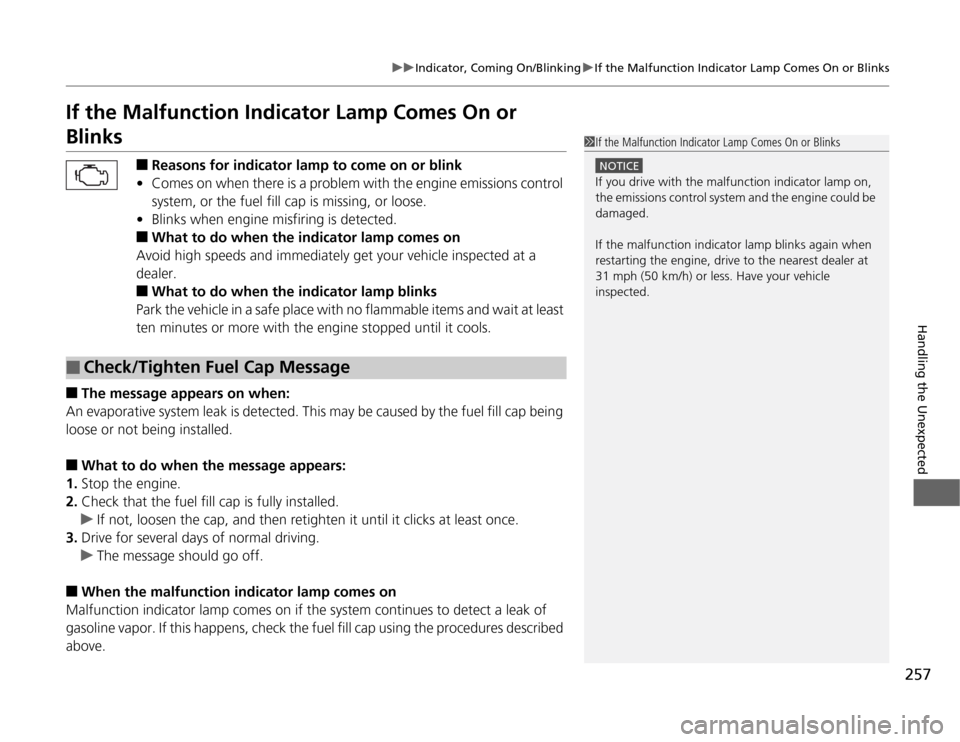
If the Malfunction Indicator Lamp Comes On or Blinks
■
Reasons for indicator lamp to come on or blink
•Comes on when there is a problem with the engine emissions control
system, or the fuel fill cap is missing, or loose.
•Blinks when engine misfiring is detected.
■
What to do when the indicator lamp comes on
Avoid high speeds and immediately get your vehicle inspected at a
dealer.
■
What to do when the indicator lamp blinks
Park the vehicle in a safe place with no flammable items and wait at least
ten minutes or more with the engine stopped until it cools.
■
The message appears on when:
An evaporative system leak is detected. This may be caused by the fuel fill cap being
loose or not being installed.
■
What to do when the message appears:
1.Stop the engine.
2.Check that the fuel fill cap is fully installed.
uIf not, loosen the cap, and then retighten it until it clicks at least once.
3.Drive for several days of normal driving.
uThe message should go off.
■
When the malfunction indicator lamp comes on
Malfunction indicator lamp comes on if the system continues to detect a leak of
gasoline vapor. If this happens, check the fuel fill cap using the procedures described
above.
■
Check/Tighten Fuel Cap Message
1If the Malfunction Indicator Lamp Comes On or Blinks
NOTICEIf you drive with the malfunction indicator lamp on,
the emissions control system and the engine could be
damaged.
If the malfunction indicator lamp blinks again when
restarting the engine, drive to the nearest dealer at
31 mph (50 km/h) or less. Have your vehicle
inspected.
Page 262 of 286
261
uuFusesuFuse Locations
Handling the Unexpected
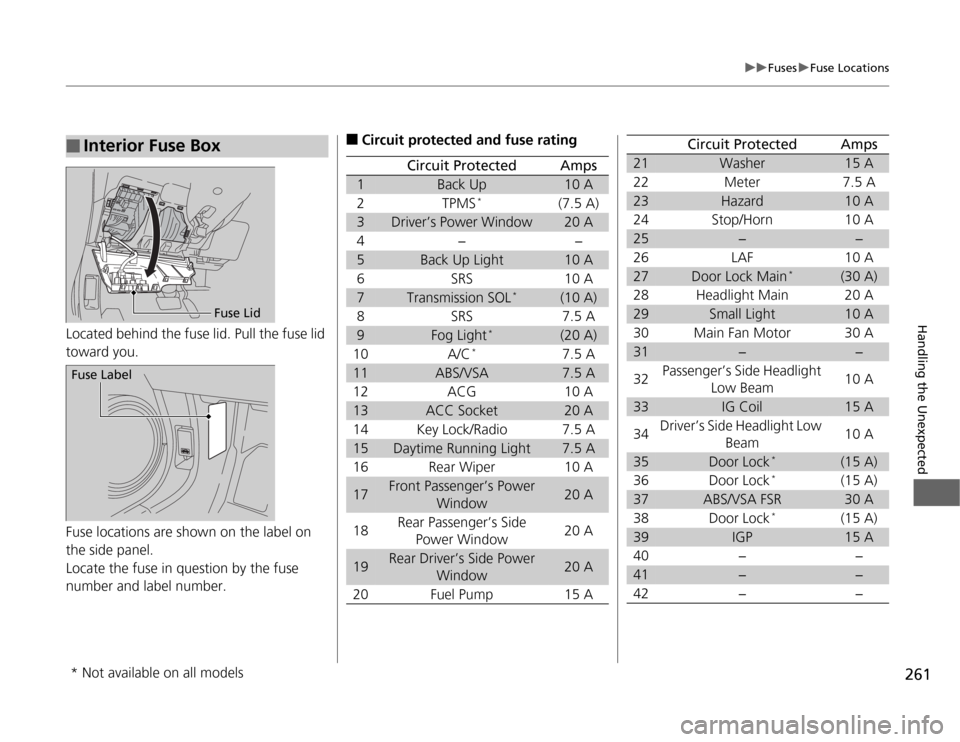
Located behind the fuse lid. Pull the fuse lid
toward you.
Fuse locations are shown on the label on
the side panel.
Locate the fuse in question by the fuse
number and label number.■
Interior Fuse Box
Fuse Lid
Fuse Label
■
Circuit protected and fuse rating
Circuit Protected
Amps
1
Back Up
10 A
2
TPMS
*
(7.5 A)
3
Driver’s Power Window
20 A
4
−
−
5
Back Up Light
10 A
6
SRS
10 A
7
Transmission SOL
*
(10 A)
8
SRS
7.5 A
9
Fog Light
*
(20 A)
10
A/C
*
7.5 A
11
ABS/VSA
7.5 A
12
ACG
10 A
13
ACC Socket
20 A
14
Key Lock/Radio
7.5 A
15
Daytime Running Light
7.5 A
16
Rear Wiper
10 A
17
Front Passenger’s Power
Window
20 A
18
Rear Passenger’s Side
Power Window
20 A
19
Rear Driver’s Side Power
Window
20 A
20
Fuel Pump
15 A
21
Washer
15 A
22
Meter
7.5 A
23
Hazard
10 A
24
Stop/Horn
10 A
25
−
−
26
LAF
10 A
27
Door Lock Main
*
(30 A)
28
Headlight Main
20 A
29
Small Light
10 A
30
Main Fan Motor
30 A
31
−
−
32
Passenger’s Side Headlight
Low Beam
10 A
33
IG Coil
15 A
34
Driver’s Side Headlight Low
Beam
10 A
35
Door Lock
*
(15 A)
36
Door Lock
*
(15 A)
37
ABS/VSA FSR
30 A
38
Door Lock
*
(15 A)
39
IGP
15 A
40
−
−
41
−
−
42
−
−
Circuit Protected
Amps
* Not available on all models
Page 269 of 286
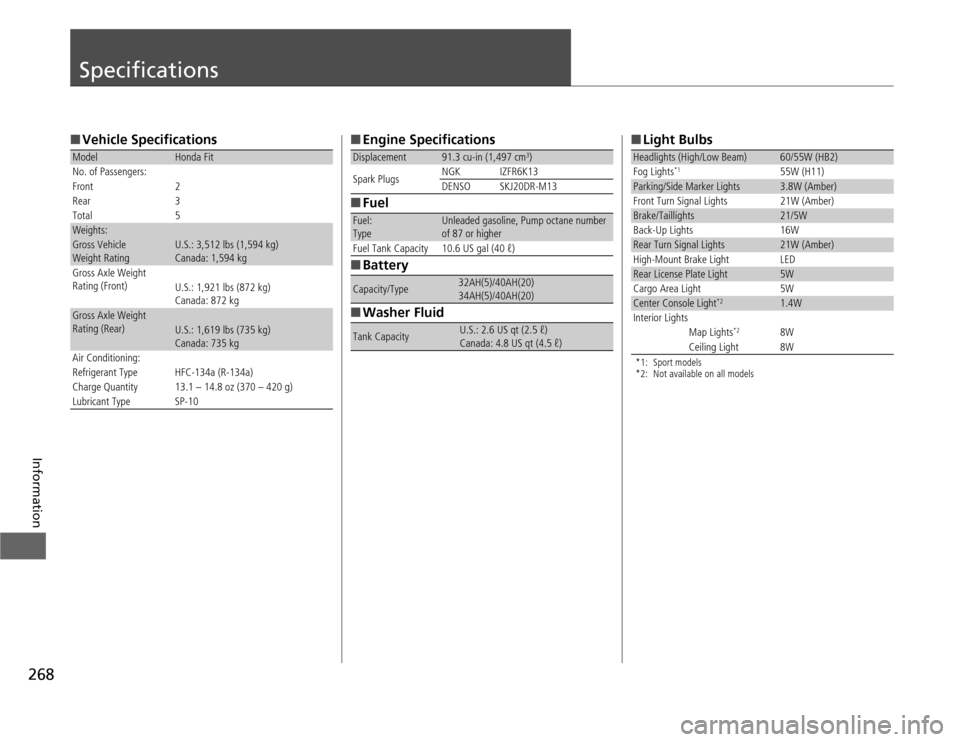
268Information
Specifications■Vehicle SpecificationsModel
Honda Fit
No. of Passengers:
Front 2
Rear 3
Total 5
Weights:Gross Vehicle
Weight Rating
U.S.: 3,512 lbs (1,594 kg)
Canada: 1,594 kg
Gross Axle Weight
Rating (Front)
U.S.: 1,921 lbs (872 kg)
Canada: 872 kg
Gross Axle Weight
Rating (Rear)
U.S.: 1,619 lbs (735 kg)
Canada: 735 kg
Air Conditioning:
Refrigerant Type HFC-134a (R-134a)
Charge Quantity 13.1 – 14.8 oz (370 – 420 g)
Lubricant Type SP-10
■Engine Specifications
■Fuel
■Battery
■Washer FluidDisplacement
91.3 cu-in (1,497 cm
3)
Spark PlugsNGK IZFR6K13
DENSO
SKJ20DR-M13
Fuel:
Type
Unleaded gasoline, Pump octane number
of 87 or higher
Fuel Tank Capacity 10.6 US gal (40 ℓ)
Capacity/Type
32AH(5)/40AH(20)
34AH(5)/40AH(20)
Tank Capacity
U.S.: 2.6 US qt (2.5 ℓ)
Canada: 4.8 US qt (4.5 ℓ)
■Light Bulbs*1: Sport models
*2: Not available on all modelsHeadlights (High/Low Beam)
60/55W (HB2)
Fog Lights
*1
55W (H11)
Parking/Side Marker Lights
3.8W (Amber)
Front Turn Signal Lights 21W (Amber)
Brake/Taillights
21/5W
Back-Up Lights 16W
Rear Turn Signal Lights
21W (Amber)
High-Mount Brake Light LED
Rear License Plate Light
5W
Cargo Area Light 5W
Center Console Light
*2
1.4W
Interior Lights
Map Lights
*2
8W
Ceiling Light 8W
Page 280 of 286
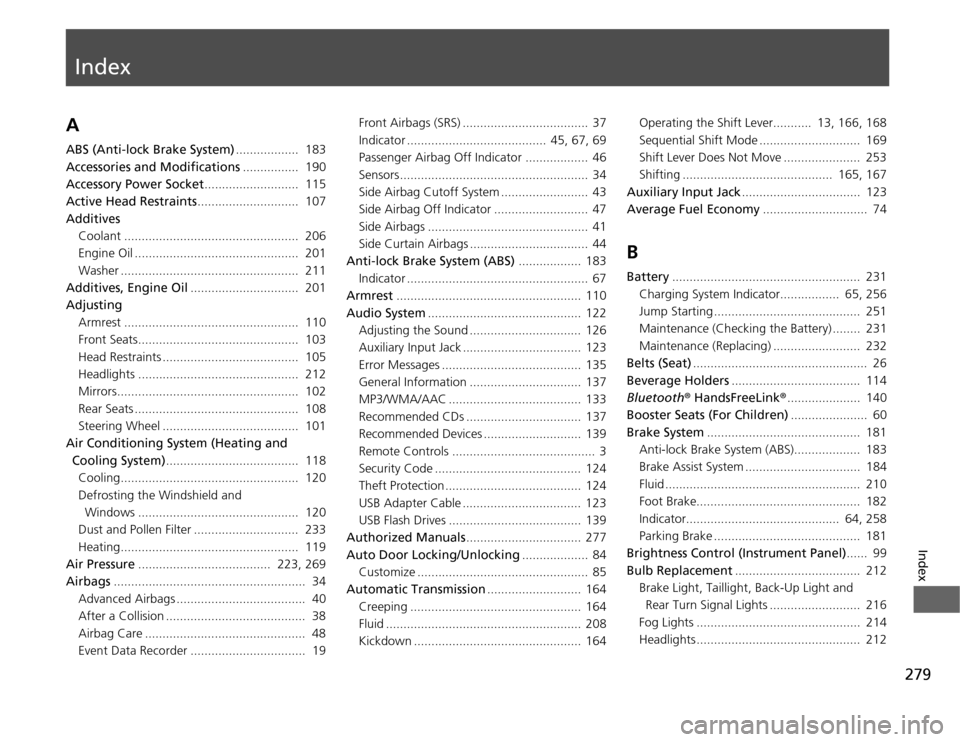
Index
279
Index
Index
AABS (Anti-lock Brake System).................. 183
Accessories and Modifications................ 190
Accessory Power Socket........................... 115
Active Head Restraints............................. 107
Additives
Coolant .................................................. 206
Engine Oil ............................................... 201
Washer ................................................... 211
Additives, Engine Oil............................... 201
Adjusting
Armrest .................................................. 110
Front Seats.............................................. 103
Head Restraints ....................................... 105
Headlights .............................................. 212
Mirrors.................................................... 102
Rear Seats ............................................... 108
Steering Wheel ....................................... 101
Air Conditioning System (Heating and
Cooling System)...................................... 118
Cooling................................................... 120
Defrosting the Windshield and
Windows .............................................. 120
Dust and Pollen Filter .............................. 233
Heating................................................... 119
Air Pressure...................................... 223, 269
Airbags....................................................... 34
Advanced Airbags ..................................... 40
After a Collision ........................................ 38
Airbag Care .............................................. 48
Event Data Recorder ................................. 19Front Airbags (SRS) .................................... 37
Indicator ........................................ 45, 67, 69
Passenger Airbag Off Indicator .................. 46
Sensors ...................................................... 34
Side Airbag Cutoff System ......................... 43
Side Airbag Off Indicator ........................... 47
Side Airbags .............................................. 41
Side Curtain Airbags .................................. 44
Anti-lock Brake System (ABS).................. 183
Indicator .................................................... 67
Armrest..................................................... 110
Audio System............................................ 122
Adjusting the Sound ................................ 126
Auxiliary Input Jack .................................. 123
Error Messages ........................................ 135
General Information ................................ 137
MP3/WMA/AAC ...................................... 133
Recommended CDs ................................. 137
Recommended Devices ............................ 139
Remote Controls ......................................... 3
Security Code .......................................... 124
Theft Protection ....................................... 124
USB Adapter Cable .................................. 123
USB Flash Drives ...................................... 139
Authorized Manuals................................. 277
Auto Door Locking/Unlocking................... 84
Customize ................................................. 85
Automatic Transmission........................... 164
Creeping ................................................. 164
Fluid ........................................................ 208
Kickdown ................................................ 164Operating the Shift Lever........... 13, 166, 168
Sequential Shift Mode ............................. 169
Shift Lever Does Not Move ...................... 253
Shifting ........................................... 165, 167
Auxiliary Input Jack.................................. 123
Average Fuel Economy.............................. 74
BBattery...................................................... 231
Charging System Indicator................. 65, 256
Jump Starting .......................................... 251
Maintenance (Checking the Battery) ........ 231
Maintenance (Replacing) ......................... 232
Belts (Seat).................................................. 26
Beverage Holders..................................... 114
Bluetooth® HandsFreeLink®..................... 140
Booster Seats (For Children)...................... 60
Brake System............................................ 181
Anti-lock Brake System (ABS)................... 183
Brake Assist System ................................. 184
Fluid ........................................................ 210
Foot Brake............................................... 182
Indicator............................................ 64, 258
Parking Brake .......................................... 181
Brightness Control (Instrument Panel)...... 99
Bulb Replacement.................................... 212
Brake Light, Taillight, Back-Up Light and
Rear Turn Signal Lights .......................... 216
Fog Lights ............................................... 214
Headlights ............................................... 212