Door HONDA FIT 2015 3.G Repair Manual
[x] Cancel search | Manufacturer: HONDA, Model Year: 2015, Model line: FIT, Model: HONDA FIT 2015 3.GPages: 453, PDF Size: 21.19 MB
Page 350 of 453
349
uuRefueling uHow to Refuel
Driving
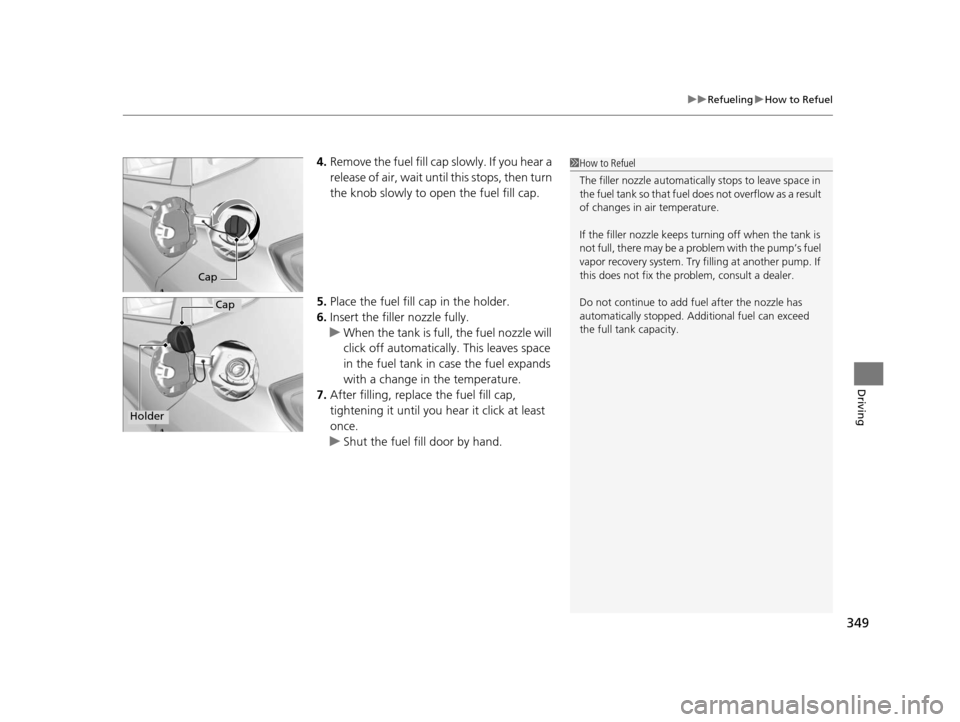
4. Remove the fuel fill cap slowly. If you hear a
release of air, wait unti l this stops, then turn
the knob slowly to open the fuel fill cap.
5. Place the fuel fill cap in the holder.
6. Insert the filler nozzle fully.
u When the tank is full, the fuel nozzle will
click off automatically. This leaves space
in the fuel tank in case the fuel expands
with a change in the temperature.
7. After filling, replace the fuel fill cap,
tightening it until you hear it click at least
once.
u Shut the fuel fill door by hand.1How to Refuel
The filler nozzle automatically stops to leave space in
the fuel tank so that fuel does not overflow as a result
of changes in air temperature.
If the filler nozzle keeps tu rning off when the tank is
not full, there may be a problem with the pump’s fuel
vapor recovery system. Try fi lling at another pump. If
this does not fix the problem, consult a dealer.
Do not continue to add fuel after the nozzle has
automatically stopped. Addi tional fuel can exceed
the full tank capacity.
Cap
Cap
Holder
15 US FIT-31T5A6000.book 349 ページ 2014年3月6日 木曜日 午後7時5分
Page 377 of 453
376
uuReplacing Light Bulbs uSide Turn Signal/Emergency Indicator Light Bulbs*
Maintenance
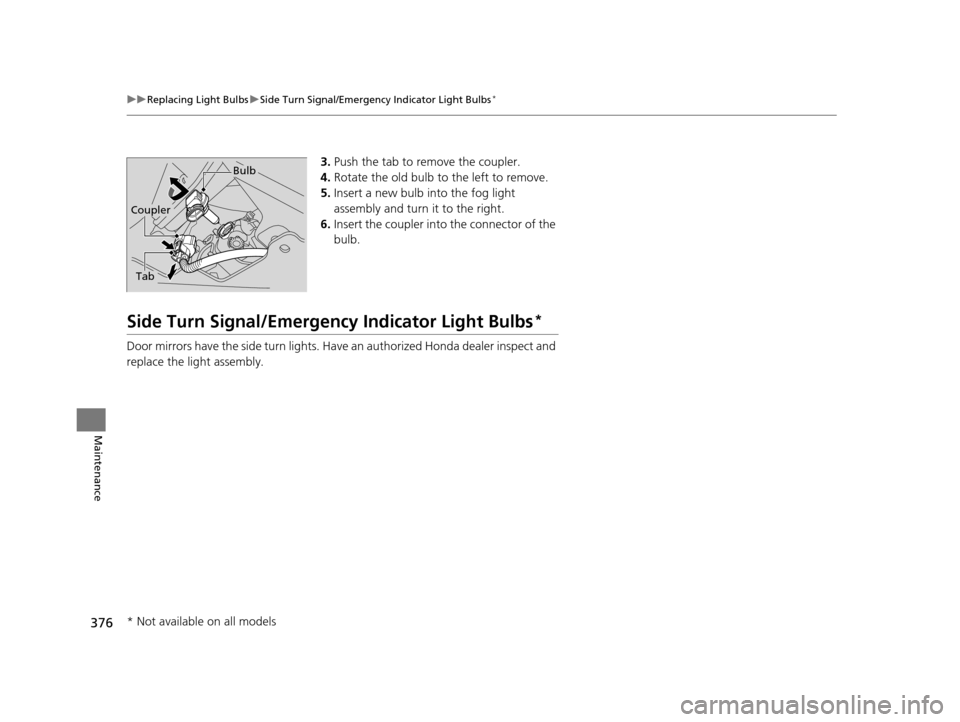
3. Push the tab to remove the coupler.
4. Rotate the old bulb to the left to remove.
5. Insert a new bulb into the fog light
assembly and turn it to the right.
6. Insert the coupler into the connector of the
bulb.
Side Turn Signal/Emergency Indicator Light Bulbs*
Door mirrors have the side turn lights. Ha ve an authorized Honda dealer inspect and
replace the light assembly.
Tab
Bulb
Coupler
* Not available on all models
15 US FIT-31T5A6000.book 376 ページ 2014年3月6日 木曜日 午後7時5分
Page 385 of 453
384
Maintenance
Checking and Maintaining Tires
Checking Tires
To safely operate your vehicle, your tires must be of the proper type and size, in
good condition with adequate tread, and properly inflated.
■Inflation guidelines
Properly inflated tires provide the best combination of handlin g, tread life, and comfort.
Refer to the driver’s doorjamb label or spec ification’s page for the specified pressure.
Underinflated tires wear unevenly, adversely affect handling and fuel economy, and
are more likely to fail from overheating.
Overinflated tires make your vehicle ride harshly, are more prone to road hazards,
and wear unevenly.
Every day before you drive, look at each of the tires. If one looks lower than the
others, check the pressure with a tire gauge.
At least once a month or before long trips, use a gauge to measure the pressure in
all tires, including the spare. Even tires in good condition can lose 1 to 2 psi (10 to
20 kPa, 0.1 to 0.2 kgf/cm
2) per month.
■Inspection guidelines
Every time you check inflation, also examine the tires and valve stems.
Look for:
• Bumps or bulges on the side or in the tread . Replace the tire if you find any cuts,
splits, or cracks in the si de of the tire. Replace it if you see fabric or cord.
• Remove any foreign objects and inspect for air leaks.
• Uneven tread wear. Have a deal er check the wheel alignment.
• Excessive tread wear.
2 Wear Indicators P. 389
•Cracks or other damage around valve stem.
1Checking Tires
Measure the air pressure when tires are cold. This
means the vehicle has been parked for at least three
hours, or driven less than 1 mile (1.6 km). If
necessary, add or releas e air until the specified
pressure is reached.
If checked when hot, tire pressure can be as much as
4–6 psi (30–40 kPa, 0.3–0.4 kgf/cm
2) higher than if
checked when cold.
Have a dealer check the tires if you feel a consistent
vibration while driving. Ne w tires and any that have
been removed and reinst alled should be properly
balanced.
Whenever tire pressure is adjusted, you must
calibrate the TPMS.
2 TPMS Calibration P. 336
3WARNING
Using tires that are excessively worn or
improperly inflated can cause a crash in
which you can be seriously hurt or killed.
Follow all instruction s in this owner’s
manual regarding ti re inflation and
maintenance.
U.S. models
15 US FIT-31T5A6000.book 384 ページ 2014年3月6日 木曜日 午後7時5分
Page 386 of 453
385
uuChecking and Maintaining Tires uTire and Loading Information Label
Continued
Maintenance
Tire and Loading Information Label
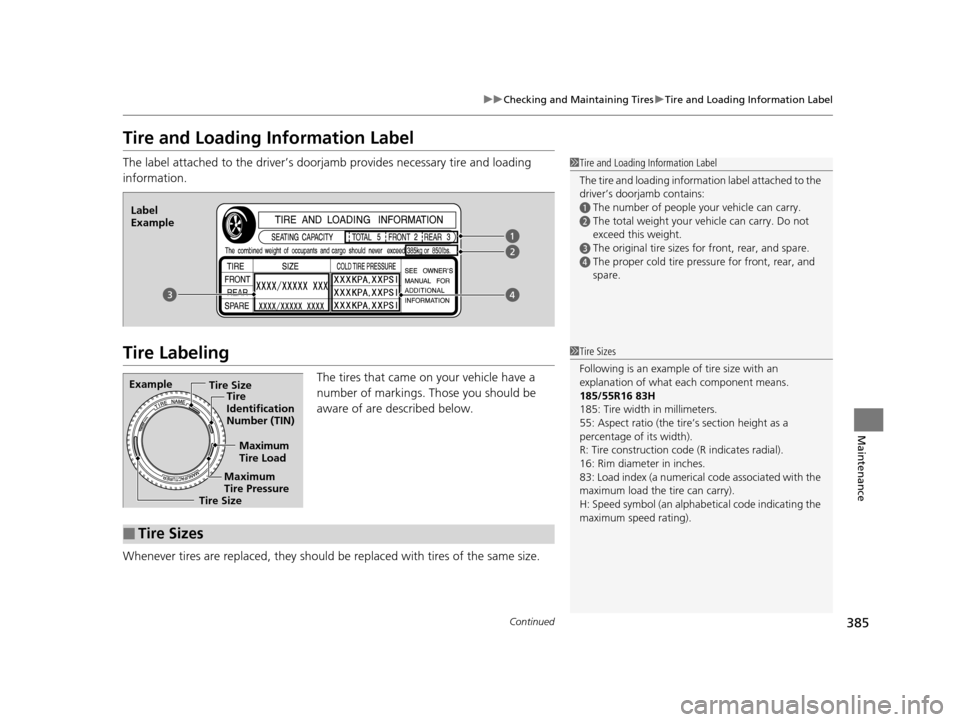
The label attached to the dr iver’s doorjamb provides necessary tire and loading
information.
Tire Labeling
The tires that came on your vehicle have a
number of markings. Those you should be
aware of are described below.
Whenever tires are replaced, they should be replaced with tires of the same size.
1Tire and Loading Information Label
The tire and loading informat ion label attached to the
driver’s doorjamb contains:
aThe number of people your vehicle can carry.
bThe total weight your vehicle can carry. Do not
exceed this weight.
cThe original tire sizes for front, rear, and spare.
dThe proper cold tire pre ssure for front, rear, and
spare.
Label
Example
Example Tire Size
Tire
Identification
Number (TIN)
Maximum
Tire Load
Maximum
Tire Pressure
Tire Size
■Tire Sizes
1 Tire Sizes
Following is an example of tire size with an
explanation of what each component means.
185/55R16 83H
185: Tire width in millimeters.
55: Aspect ratio (the tire’s section height as a
percentage of its width).
R: Tire construction code (R indicates radial).
16: Rim diameter in inches.
83: Load index (a numerical code associated with the
maximum load the tire can carry).
H: Speed symbol (an alphabe tical code indicating the
maximum speed rating).
15 US FIT-31T5A6000.book 385 ページ 2014年3月6日 木曜日 午後7時5分
Page 389 of 453
uuChecking and Maintaining Tires uDOT Tire Quality Grading (U.S. Vehicles)
388
Maintenance
The traction grades, from highest to lowest, are AA, A, B, and C.
Those grades represent the tire’s ability to stop on wet pavement
as measured under controlled conditions on specified
government test surfaces of asphalt and concrete. A tire marked
C may have poor traction performance.
The temperature grades are A (the highest), B, and C,
representing the tire’s resistance to the generation of heat and its
ability to dissipate h eat when tested under controlled conditions
on a specified indoor laboratory test wheel. Sustained high
temperature can cause the material of the tire to degenerate and
reduce tire life, and excessive temp erature can lead to sudden tire
failure. The grade C corresponds to a level of performance which
all passenger car tires must meet under the Federal Motor Vehicle
Safety Standard No. 109. Grades B and A represent higher levels
of performance on the laboratory test wheel than the minimum
required by law.
■Traction
■Temperature
1 Traction
Warning: The traction grade
assigned to this tire is based on
straight-ahead braking traction tests,
and does not include acceleration,
cornering, hydroplaning, or peak
traction characteristics.
1Temperature
Warning: The temperature grade for
this tire is establishe d for a tire that is
properly inflated and not
overloaded. Excessive speed,
underinflation, or excessive loading,
either separately or in combination,
can cause heat buildup and possible
tire failure.
15 US FIT-31T5A6000.book 388 ページ 2014年3月6日 木曜日 午後7時5分
Page 401 of 453
400
uuCleaning uExterior Care
Maintenance
Exterior Care
Dust off the vehicle body after you drive.
Regularly inspect your vehi cle for scratches on painted surfaces. A scratch on a
painted surface can result in body rust. If you find a scratch, promptly repair it.
Wash the vehicle regularly. Wash more frequently when driving in the following
conditions:
• If driving on roads with road salt.
• If driving in coastal areas.
• If tar, soot, bird droppings, insects, or tree sap are stuck to painted surfaces.
• Remove the audio antenna.
2 Audio Antenna P. 166
•Fold in the door mirrors.
Make sure to follow the instructions indicated on the automated car wash.
• Keep sufficient distance between the cleaning nozzl e and the vehicle body.
• Take particular care around the windows. Standing too close may cause water to
enter the vehicle interior.
• Do not spray high pressure water directly into the engine compartment. Instead,
use low pressure water and a mild detergent.
■Washing the Vehicle
■Using an Automated Car Wash
■Using High Pressure Cleaners
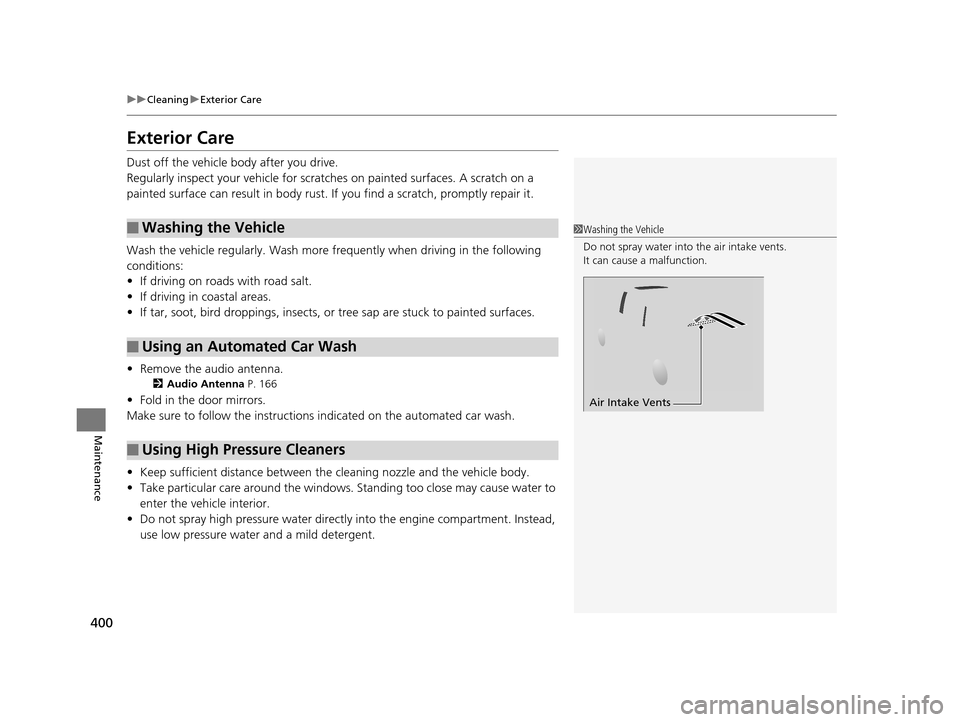
1 Washing the Vehicle
Do not spray water into the air intake vents.
It can cause a malfunction.
Air Intake Vents
15 US FIT-31T5A6000.book 400 ページ 2014年3月6日 木曜日 午後7時5分
Page 423 of 453
422
uuIndicator, Coming On/Blinking uIf the Low Tire Pressure/TPMS Indicator Comes On or Blinks
Handling the Unexpected
If the Low Tire Pressure/TPMS Indicator Comes On or
Blinks
■Reasons for the indicator to come on or blink
A tire pressure is signifi cantly low, or the TPMS has not been calibrated.
If there is a problem with the TPMS or the compact spare tire is installed,
the indicator blinks for about one minute, and then stays on
■What to do when the indicator comes on
Drive carefully and avoid abrupt cornering and hard braking.
Stop your vehicle in a safe place. Ch eck the tire pressure and adjust the
pressure to the specified level. The sp ecified tire pressure is on a label on
the driver side doorjamb. u Calibrate the TPMS after the tire pressure is adjusted.
■What to do when the indicator blinks, then remains on
Have the tire inspected by a dealer as soon as possible. If the compact
spare tire causes the indicator to blink, change the tire to a full-size tire.
The indicator goes off after driv ing for a few miles (kilometers).
u Calibrate the TPMS after a full-size tire is reinstalled.
U.S. models
1If the Low Tire Pressure/TPMS Indicator Comes On or Blinks
NOTICE
Driving on an extremely unde rinflated tire can cause
it to overheat. An overheated tire can fail. Always
inflate your tires to the prescribed level.
15 US FIT-31T5A6000.book 422 ページ 2014年3月6日 木曜日 午後7時5分
Page 426 of 453
425
uuFuses uFuse Locations
Continued
Handling the Unexpected
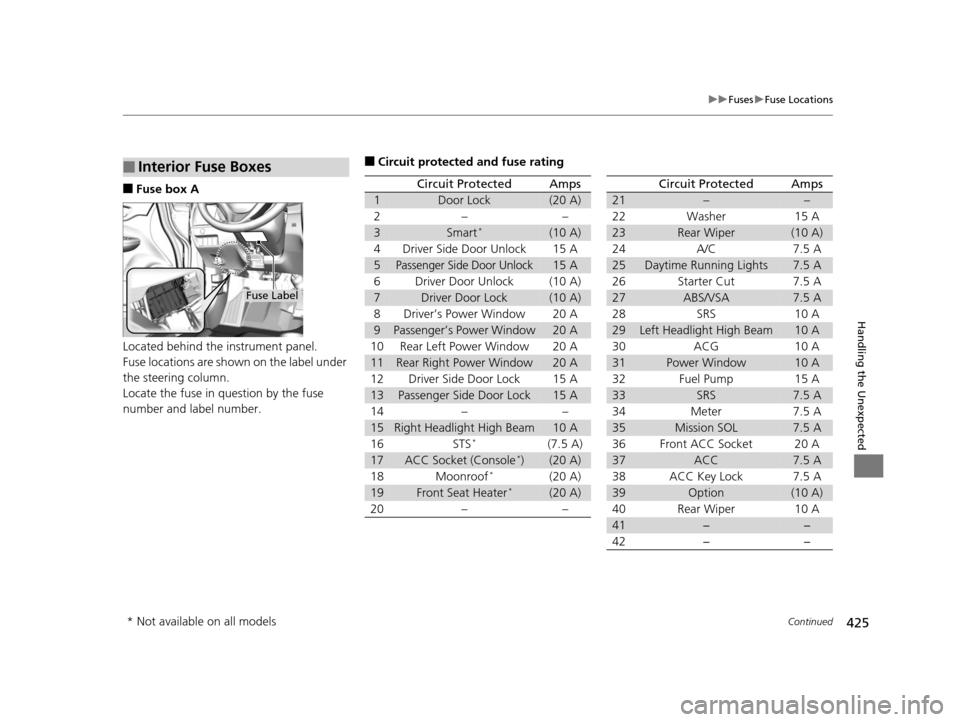
■Fuse box A
Located behind the instrument panel.
Fuse locations are shown on the label under
the steering column.
Locate the fuse in question by the fuse
number and label number.
■Interior Fuse Boxes
Fuse Label
■Circuit protected and fuse rating
Circuit ProtectedAmps
1Door Lock(20 A)
2––
3Smart*(10 A)
4Driver Side Door Unlock15 A
5Passenger Side Door Unlock15 A
6Driver Door Unlock(10 A)
7Driver Door Lock(10 A)
8Driver’s Power Window20 A
9Passenger’s Power Window20 A
10Rear Left Power Window20 A
11Rear Right Power Window20 A
12Driver Side Door Lock15 A
13Passenger Side Door Lock15 A
14––
15Right Headlight High Beam10 A
16STS*(7.5 A)
17ACC Socket (Console*)(20 A)
18Moonroof*(20 A)
19Front Seat Heater*(20 A)
20––
Circuit ProtectedAmps
21––
22Washer15 A
23Rear Wiper(10 A)
24A/C7.5 A
25Daytime Running Lights7.5 A
26Starter Cut7.5 A
27ABS/VSA7.5 A
28SRS10 A
29Left Headlight High Beam10 A
30ACG10 A
31Power Window10 A
32Fuel Pump15 A
33SRS7.5 A
34Meter7.5 A
35Mission SOL7.5 A
36Front ACC Socket20 A
37ACC7.5 A
38ACC Key Lock7.5 A
39Option(10 A)
40Rear Wiper10 A
41−−
42−−
* Not available on all models
15 US FIT-31T5A6000.book 425 ページ 2014年3月6日 木曜日 午後7時5分
Page 427 of 453
426
uuFuses uFuse Locations
Handling the Unexpected
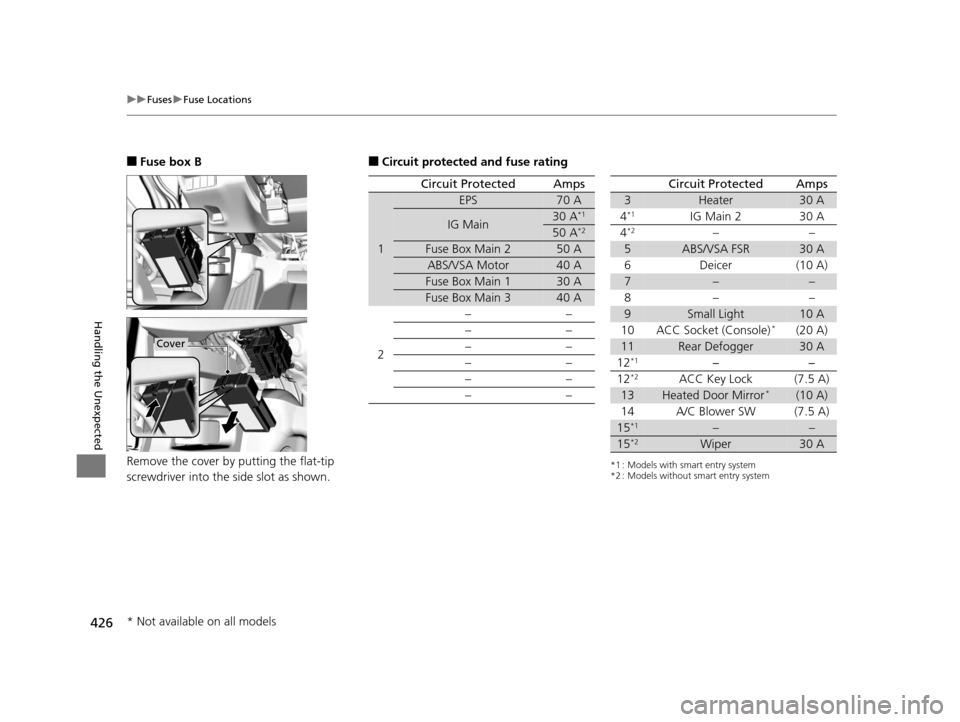
■Fuse box B
Remove the cover by putting the flat-tip
screwdriver into the side slot as shown.
Cover
■Circuit protected and fuse rating
Circuit ProtectedAmps
1
EPS70 A
IG Main30 A*1
50 A*2
Fuse Box Main 250 A
ABS/VSA Motor40 A
Fuse Box Main 130 A
Fuse Box Main 340 A
2 ––
––
––
––
––
––
*1 : Models with smart entry system
*2 : Models without smart entry system
Circuit ProtectedAmps
3Heater30 A
4*1IG Main 230 A
4*2––
5ABS/VSA FSR30 A
6Deicer(10 A)
7––
8– –
9Small Light10 A
10 ACC Socket (Console)*(20 A)
11Rear Defogger30 A
12*1−−
12*2ACC Key Lock (7.5 A)
13Heated Door Mirror*(10 A)
14 A/C Blower SW (7.5 A)
15*1––
15*2Wiper30 A
* Not available on all models
15 US FIT-31T5A6000.book 426 ページ 2014年3月6日 木曜日 午後7時5分
Page 433 of 453
432
Information
Specifications
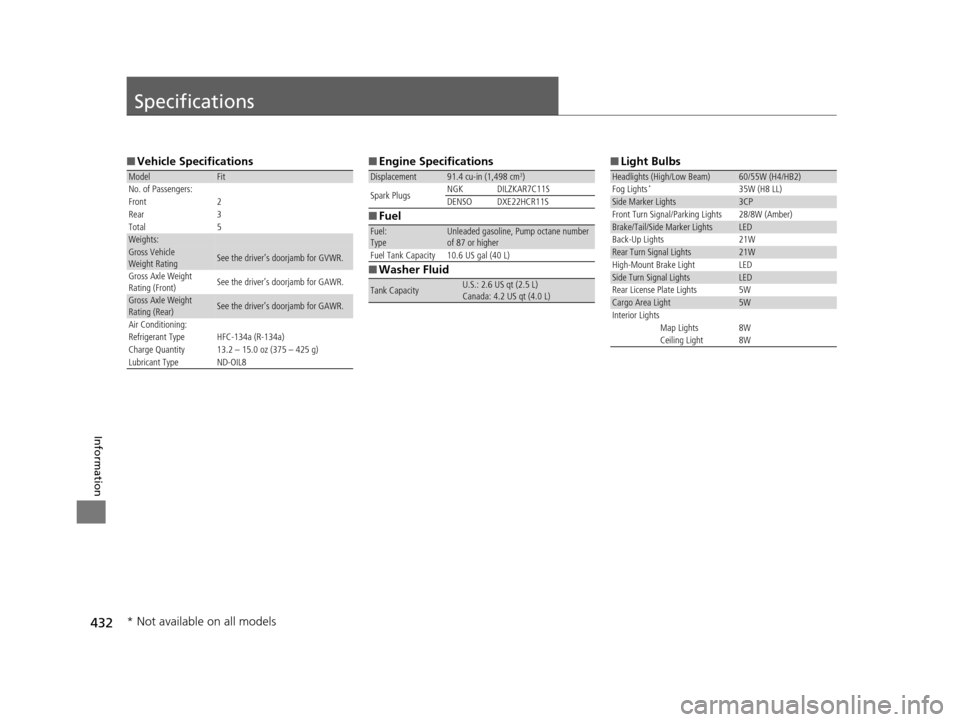
■Vehicle Specifications
ModelFit
No. of Passengers:
Front 2
Rear 3
Total 5
Weights:Gross Vehicle
Weight Rating See the driver’s doorjamb for GVWR.
Gross Axle Weight
Rating (Front)See the driver’s doorjamb for GAWR.
Gross Axle Weight
Rating (Rear)See the driver’s doorjamb for GAWR.
Air Conditioning:
Refrigerant Type HFC-134a (R-134a)
Charge Quantity 13.2 – 15.0 oz (375 – 425 g)
Lubricant Type ND-OIL8
■ Engine Specifications
■ Fuel
■ Washer Fluid
Displacement91.4 cu-in (1,498 cm3)
Spark Plugs NGK DILZKAR7C11S
DENSODXE22HCR11S
Fuel:
TypeUnleaded gasoline, Pump octane number
of 87 or higher
Fuel Tank Capacity 10.6 US gal (40 L)
Tank CapacityU.S.: 2.6 US qt (2.5 L)
Canada: 4.2 US qt (4.0 L)
■ Light Bulbs
Headlights (High/Low Beam)60/55W (H4/HB2)
Fog Lights*35W (H8 LL)Side Marker Lights3CP
Front Turn Signal/Parking Lights 28/8W (Amber)
Brake/Tail/Side Marker LightsLED
Back-Up Lights 21W
Rear Turn Signal Lights21W
High-Mount Brake Light LED
Side Turn Signal LightsLED
Rear License Plate Lights 5W
Cargo Area Light5W
Interior Lights
Map Lights8W
Ceiling Light 8W
* Not available on all models
15 US FIT-31T5A6000.book 432 ページ 2014年3月6日 木曜日 午後7時5分