tire pressure HONDA HR-V 2018 Owner's Manual (in English)
[x] Cancel search | Manufacturer: HONDA, Model Year: 2018, Model line: HR-V, Model: HONDA HR-V 2018Pages: 503, PDF Size: 32.79 MB
Page 6 of 503
4
Quick Reference Guide
Quick Reference Guide
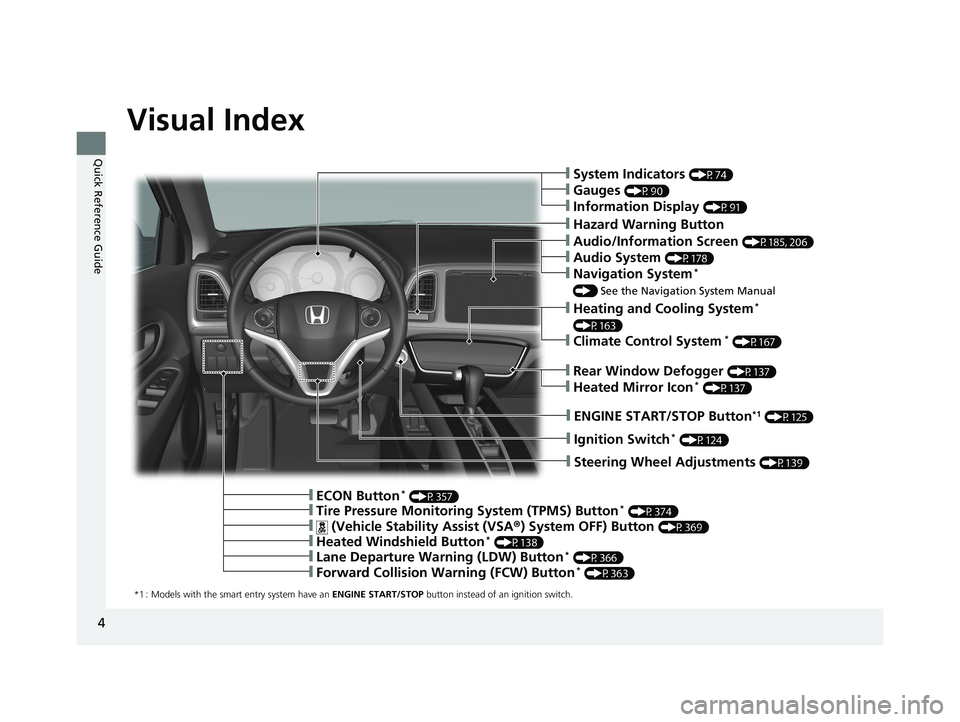
Visual Index
*1 : Models with the smart entry system have an ENGINE START/STOP button instead of an ignition switch.
❙ENGINE START/STOP Button*1 (P125)
❙Steering Wheel Adjustments (P139)
❙Hazard Warning Button
❙Ignition Switch* (P124)
❙Tire Pressure Monitoring System (TPMS) Button* (P374)
❙ (Vehicle Stability Assist (VSA ®) System OFF) Button (P369)
❙Heated Windshield Button* (P138)
❙Lane Departure Warning (LDW) Button* (P366)
❙Forward Collision Warning (FCW) Button* (P363)
❙ECON Button* (P357)
❙System Indicators (P74)
❙Gauges (P90)
❙Information Display (P91)
❙Audio/Information Screen (P185, 206)
❙Audio System (P178)
❙Navigation System*
() See the Navigation System Manual
❙Heating and Cooling System*
(P163)
❙Climate Control System* (P167)
❙Rear Window Defogger (P137)
❙Heated Mirror Icon* (P137)
18 HR-V-31T7A6200.book 4 ページ 2017年6月30日 金曜日 午後1時23分
Page 13 of 503
11
Quick Reference Guide
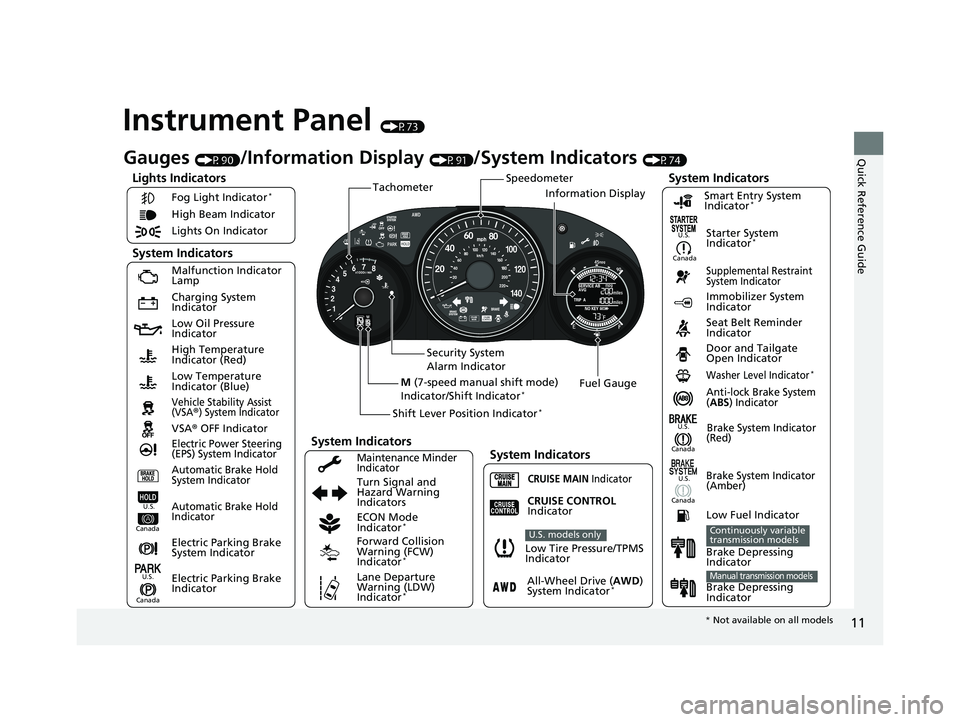
Instrument Panel (P73)
Lights Indicators
Malfunction Indicator
Lamp
Low Oil Pressure
Indicator
Anti-lock Brake System
(ABS) IndicatorVehicle Stability Assist
(VSA®) System Indicator
VSA® OFF Indicator
Electric Power Steering
(EPS) System Indicator
Lights On Indicator High Beam Indicator
Immobilizer System
Indicator
Seat Belt Reminder
Indicator
System Indicators
CRUISE MAIN IndicatorSupplemental Restraint
System Indicator
Starter System
Indicator*
Door and Tailgate
Open Indicator
Tachometer
Speedometer
Fuel Gauge
Security System
Alarm Indicator
Shift Lever Position Indicator
*
Low Fuel Indicator
Gauges (P90)/Information Display (P91)/System Indicators (P74)
Turn Signal and
Hazard Warning
Indicators
High Temperature
Indicator (Red)
Low Temperature
Indicator (Blue)
System Indicators
System Indicators
Low Tire Pressure/TPMS
Indicator
U.S. models only
Brake System Indicator
(Red)
CRUISE CONTROL
Indicator
System Indicators
Charging System
Indicator
U.S. U.S.
Canada
Smart Entry System
Indicator*
Washer Level Indicator*
ECON Mode
Indicator*
Maintenance Minder
Indicator
Fog Light Indicator*
Canada
Brake System Indicator
(Amber)
Canada U.S.
M
(7-speed manual shift mode)
Indicator/Shift Indicator*
Information Display
Automatic Brake Hold
System Indicator
Automatic Brake Hold
IndicatorU.S.
Canada
Electric Parking Brake
System Indicator
Electric Parking Brake
IndicatorU.S.
Canada
All-Wheel Drive ( AWD)
System Indicator*
Forward Collision
Warning (FCW)
Indicator
*
Lane Departure
Warning (LDW)
Indicator
*
Brake Depressing
Indicator
Continuously variable
transmission models
Brake Depressing
IndicatorManual transmission models
* Not available on all models
18 HR-V-31T7A6200.book 11 ページ 2017年6月30日 金曜日 午後1時23分
Page 24 of 503
22
Quick Reference Guide
VSA® On and Off (P369)
● The vehicle stability assist (VSA® ) system
helps stabilize the vehicle during
cornering, and helps maintain traction
while accelerating on loose or slippery
road surfaces.
● VSA ® comes on automatically every time
you start the engine.
● To partially disable or fully restore VSA ®
function, press and ho ld the button until
you hear a beep.
Cruise Control (P358)
● Cruise control allows you to maintain a
set speed without keeping your foot on
the accelerator pedal.
● To use cruise control, press the CRUISE
button, then press the -/SET button once
you have achieved the desired speed
(above 25 mph or 40 km/h).
Tire Pressure Monitoring
System (TPMS)
(P373)
● Detects a change in tire conditions and
overall dimensions due to decrease in tire
pressures.
● TPMS is turned on automatically every
time you start the engine.
● A calibration procedure must be
performed when certain conditions arise.
U.S. models only
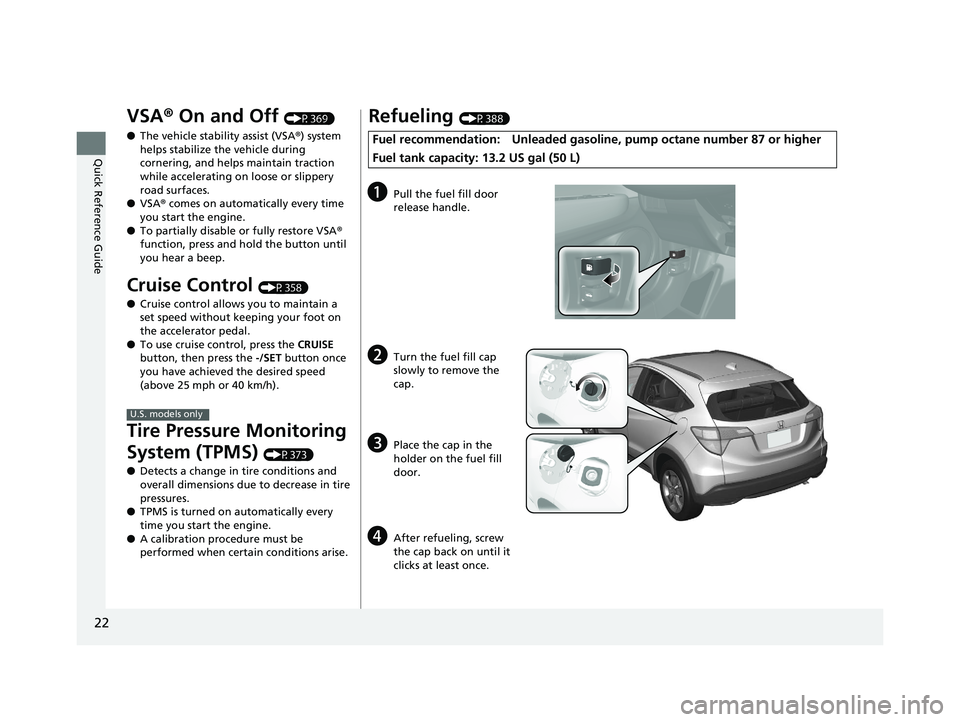
Refueling (P388)
Fuel recommendation: Unleaded gasoline , pump octane number 87 or higher
Fuel tank capacity: 13.2 US gal (50 L)
aPull the fuel fill door
release handle.
bTurn the fuel fill cap
slowly to remove the
cap.
cPlace the cap in the
holder on the fuel fill
door.
dAfter refueling, screw
the cap back on until it
clicks at least once.
18 HR-V-31T7A6200.book 22 ページ 2017年6月30日 金曜日 午後1時23分
Page 25 of 503
23
Quick Reference Guide
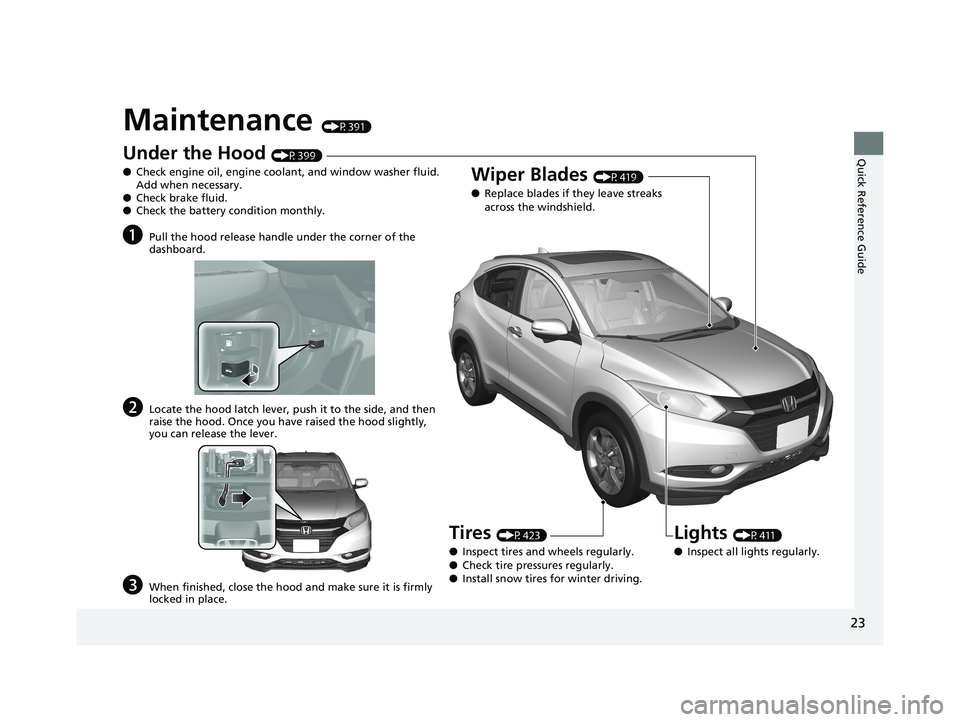
Maintenance (P391)
Under the Hood (P399)
● Check engine oil, engine coolant, and window washer fluid.
Add when necessary.
● Check brake fluid.
● Check the battery condition monthly.
aPull the hood release handle under the corner of the
dashboard.
bLocate the hood latch lever, push it to the side, and then
raise the hood. Once you have raised the hood slightly,
you can release the lever.
cWhen finished, close the hood and make sure it is firmly
locked in place.
Lights (P411)
● Inspect all lights regularly.
Wiper Blades (P419)
● Replace blades if they leave streaks
across the windshield.
Tires (P423)
● Inspect tires and wheels regularly.
● Check tire pressures regularly.
● Install snow tires for winter driving.
18 HR-V-31T7A6200.book 23 ページ 2017年6月30日 金曜日 午後1時23分
Page 29 of 503
27
Quick Reference Guide
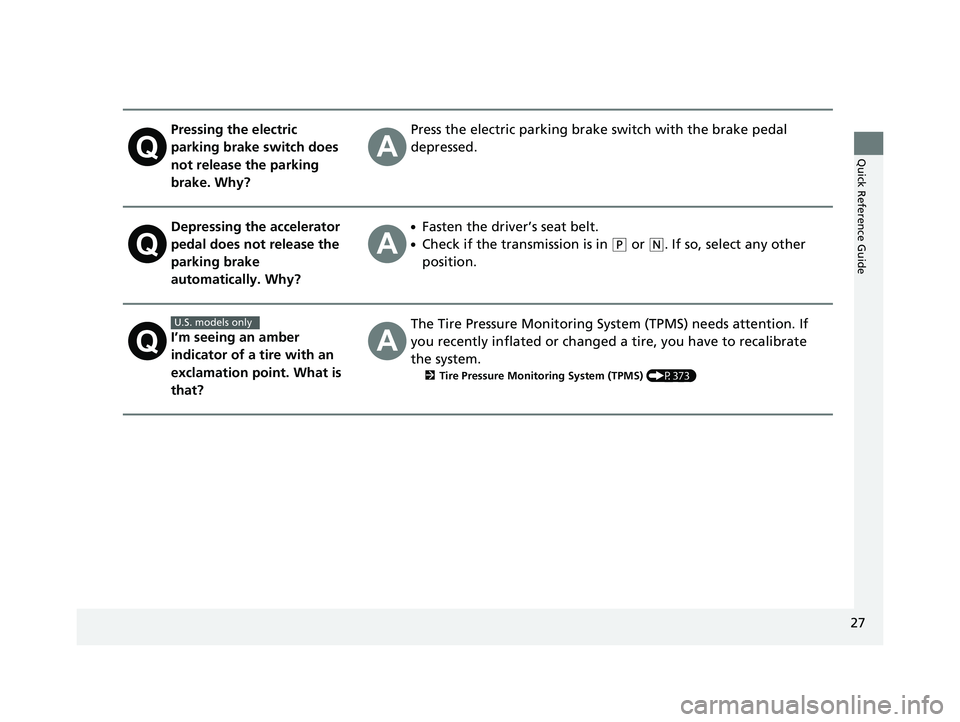
Pressing the electric
parking brake switch does
not release the parking
brake. Why?Press the electric parking brake switch with the brake pedal
depressed.
Depressing the accelerator
pedal does not release the
parking brake
automatically. Why?●Fasten the driver’s seat belt.
●Check if the transmission is in (P or (N. If so, select any other
position.
I’m seeing an amber
indicator of a tire with an
exclamation point. What is
that?The Tire Pressure Monitoring Syst em (TPMS) needs attention. If
you recently inflated or changed a tire, you have to recalibrate
the system.
2 Tire Pressure Monitoring System (TPMS) (P373)
U.S. models only
18 HR-V-31T7A6200.book 27 ページ 2017年6月30日 金曜日 午後1時23分
Page 33 of 503
31
uuFor Safe Driving uImportant Safety Precautions
Safe Driving
■Pay appropriate attention to the task of driving safely
Engaging in cell phone conversation or other activities that keep you from paying
close attention to the road, other vehicles, and pedestrians could lead to a crash.
Remember, situations can change quickly, and only you can decide when it is safe to
divert some attention away from driving.
■Control your speed
Excessive speed is a major factor in crash injuries and deaths. Generally, the higher
the speed, the greater the risk, but serious injuries can also occur at lower speeds.
Never drive faster than is safe for current conditions, regardless of the maximum
speed posted.
■Keep your vehicle in safe condition
Having a tire blowout or a mechanical failure can be extremely hazardous.
To reduce the possibility of such problems, check your tire pressures and condition
frequently, and perform all regul arly scheduled maintenance.
■Do not leave children unattended in the vehicle
Children left unattended in the vehicle may be injured if they activate one or more
of the vehicle controls. They may also cause the vehicle to move, resulting in a crash
in which the children and/or another pers on(s) can be injured or killed. Also,
depending on the ambient temperature, th e temperature of the interior may reach
extreme levels, which can result in injury or death. Even if the climate control system
is on, never leave children in the vehicle unattended as the climate control system
can shut off at any time.
18 HR-V-31T7A6200.book 31 ページ 2017年6月30日 金曜日 午後1時23分
Page 83 of 503
81
uuIndicators u
Continued
Instrument Panel
*1:Models with the smart entry system have an ENGINE START/STOP button instead of an ignition switch.
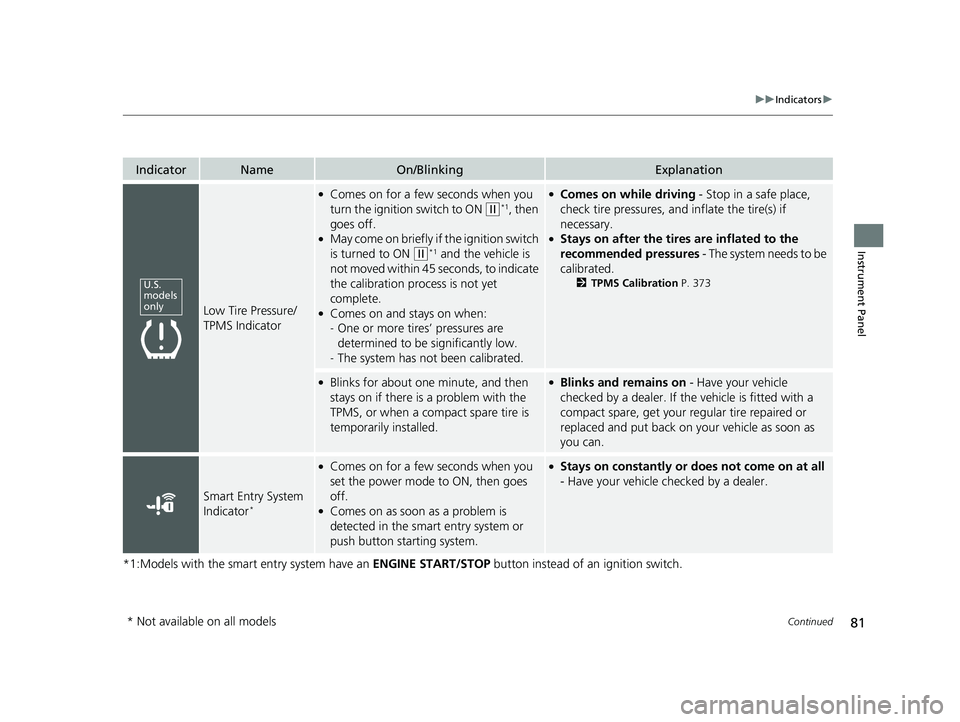
IndicatorNameOn/BlinkingExplanation
Low Tire Pressure/
TPMS Indicator
●Comes on for a few seconds when you
turn the ignition switch to ON
(w*1, then
goes off.
●May come on briefly if the ignition switch
is turned to ON
(w*1 and the vehicle is
not moved within 45 seconds, to indicate
the calibration process is not yet
complete.
●Comes on and stays on when:
- One or more tires’ pressures are
determined to be significantly low.
- The system has not been calibrated.
●Comes on while driving - Stop in a safe place,
check tire pressures, and inflate the tire(s) if
necessary.
●Stays on after the tires are inflated to the
recommended pressures - The system needs to be
calibrated.
2 TPMS Calibration P. 373
●Blinks for about one minute, and then
stays on if there is a problem with the
TPMS, or when a compact spare tire is
temporarily installed.●Blinks and remains on - Have your vehicle
checked by a dealer. If th e vehicle is fitted with a
compact spare, get your regular tire repaired or
replaced and put back on your vehicle as soon as
you can.
Smart Entry System
Indicator*
●Comes on for a few seconds when you
set the power mode to ON, then goes
off.
●Comes on as soon as a problem is
detected in the smart entry system or
push button starting system.
●Stays on constantly or does not come on at all
- Have your vehicle checked by a dealer.
U.S.
models
only
* Not available on all models
18 HR-V-31T7A6200.book 81 ページ 2017年6月30日 金曜日 午後1時23分
Page 329 of 503
327
Driving
This chapter discusses driving and refueling.
Before DrivingDriving Preparation ................................... 328
Maximum Load Limit ................................ 331
Towing a Trailer Towing Your Vehicle ................................. 334
Off-Highway Driving Guidelines ............... 337
When Driving
Starting the Engine ................................... 339
Starting the Engine ................................... 342
Precautions While Driving ......................... 346
Continuously Variable Transmission
*......... 347
Shifting ..................................................... 348
Models without smart entry system
Models with smart entry system
Continuously variable transmission models
without paddle shifters
Shifting .......................................................... 350
Shifting .......................................................... 354
ECON Button
*................................................ 357
Cruise Control ................................................ 358
Forward Collision Warning (FCW)
*................. 361
Lane Departure Warning (LDW)*.................... 365
Vehicle Stability Assist (VSA ®), aka Electronic Stability
Control (ESC), System .................................. 368
LaneWatch
TM*................................................ 370Real Time AWD with Intelligent Control SystemTM*.... 372Tire Pressure Monitoring System (TPMS) ......... 373
Tire Pressure Monitoring System (TPMS) - Required Federal Explanation ...................................... 375
Continuously variable transmission models
with paddle shifters
Manual transmission models
Braking
Brake System ................................... 377
Anti-lock Brake System (ABS) ........... 383
Brake Assist System ......................... 384
Parking Your Vehicle When Stopped ................................ 385
Multi-View Rear Camera .................. 386
Refueling Fuel Information .............................. 388
How to Refuel ................................. 389
Fuel Economy and CO
2 Emissions
Improving Fuel Economy and Reducing CO
2 Emissions ................................ 390
* Not available on all models
18 HR-V-31T7A6200.book 327 ページ 2017年6月30日 金曜日 午後1時23分
Page 330 of 503
328
Driving
Before Driving
Driving Preparation
Check the following items before you start driving.
• Make sure there are no obstructions on the windows, door mirrors, exterior
lights, or other parts of the vehicle.
u Remove any frost, snow, or ice.
u Remove any snow on the roof, as this can slip down and obstruct your field of
vision while driving. If frozen solid , remove ice once it has softened.
u When removing ice from around the wheels, be sure not to damage the wheel
or wheel components.
• Make sure the hood is securely closed.
u If the hood opens while driving, your front view will be blocked.
• Make sure the tires are in good condition.
u Check air pressure, and check for damage and excessive wear.
2 Checking and Maintaining Tires P. 423
•Make sure there are no people or ob jects behind or around the vehicle.
u There are blind spots from the inside.
■Exterior Checks1Exterior Checks
NOTICE
When doors are frozen s hut, use warm water around
the door edges to melt any ice. Do not try to force
them open, as this can damage the rubber trim
around the doors. When done, wipe dry to avoid
further freezing.
Do not pour warm water into the key cylinder.
You will be unable to insert the key if the water
freezes in the hole.
Heat from the engine and exhaust can ignite
flammable material s left under the hood, causing a
fire. If you've parked y our vehicle for an extended
period, inspect and remove any debris that may have
collected, such as dried grass and leaves that have
fallen or have been carried in for use as a nest by a
small animal. Also check under the hood for leftover
flammable materials after you or someone else has
performed maintenance on your vehicle.
18 HR-V-31T7A6200.book 328 ページ 2017年6月30日 金曜日 午後1時23分
Page 340 of 503
338
uuOff-Highway Driving Guidelines uAvoiding Trouble
Driving
Avoiding Trouble
• Check Out Yo ur Vehicle before you leave the pavement and make sure that all
scheduled maintenance has been comple ted. Pay special attention to the
condition of the tires, an d check the tire pressures.
• Remember the route you choose presents limits (too steep or bumpy), you have
limits (driving skill and comfort), and your vehicle has limits (traction, stability, and
power). Failing to recognize these limits will likely put you and your passengers in
a hazardous situation.
• Accelerating and Braking should be done slowly and gradually. Trying to start
or stop too fast can cause a loss of traction and you could lose control.
• Avoiding Obstacles and Debris in the road reduces the likelihood of a rollover
or damage to your suspension or other components.
• Driving on Slopes increases your risk of a rollover, particularly if you attempt to
drive across a slope that is too steep. Going straight up or down a slope is usually
the safest. If you can’t clearly see all cond itions or obstacles on a slope, walk it
before you drive it. If there is any doubt whether you can safely pass, don’t try it.
Find another route. If you get stuck when climbing, do not try to turn around.
Back down slowly following the same route you took up the hill.
• Crossing a Stream - Avoid driving through deep water. If you encounter water
in your route (a small stream or large pu ddle, for example), evaluate it carefully
before going ahead. Make sure it is shallow, flowing slowly, and has firm ground
underneath. If you are not sure of the depth or the ground, turn around and find
another route. Driving through deep water can also damage your vehicle. The
water can get into the transmission and differential, diluting the lubricant and
causing an eventual failure. It can also wash the grease out of the wheel bearings.
• If You Get Stuck, carefully go in the direction that you think will get you
unstuck. Do not spin the tires as this will only make things worse and could
damage the transmission. If you are unable to free yourself, your vehicle will need
to be towed. Front and rear tow hooks are provided for this purpose.
18 HR-V-31T7A6200.book 338 ページ 2017年6月30日 金曜日 午後1時23分