ECU HONDA INSIGHT 2001 1.G User Guide
[x] Cancel search | Manufacturer: HONDA, Model Year: 2001, Model line: INSIGHT, Model: HONDA INSIGHT 2001 1.GPages: 269, PDF Size: 4.52 MB
Page 73 of 269
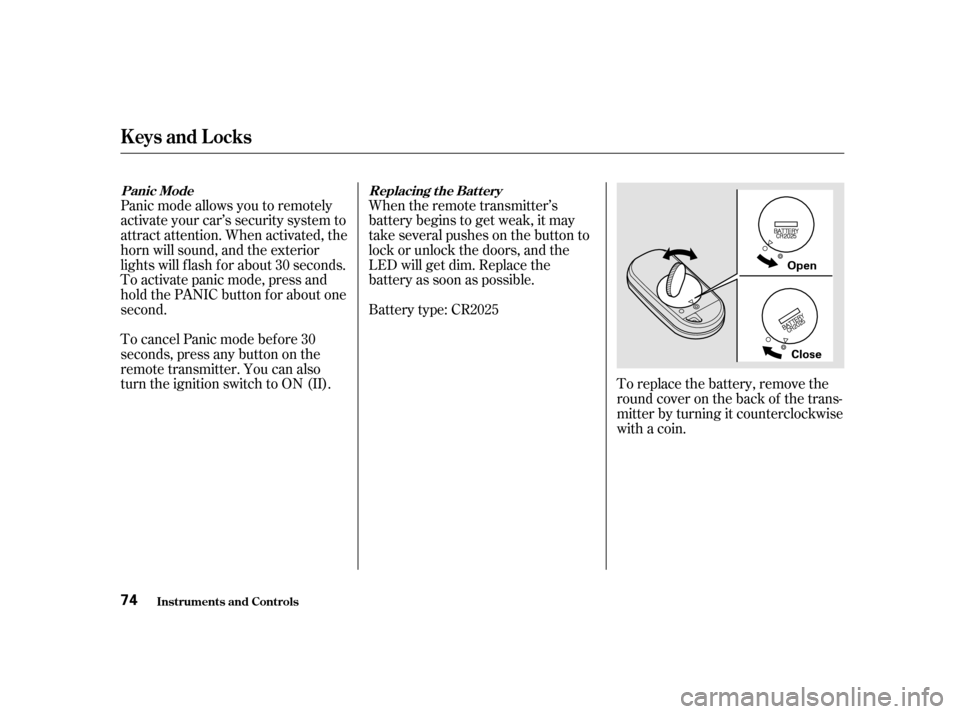
When the remote transmitter’s
battery begins to get weak, it may
take several pushes on the button to
lock or unlock the doors, and the
LED will get dim. Replace the
battery as soon as possible.
Battery type: CR2025To replace the battery, remove the
round cover on the back of the trans-
mitter by turning it counterclockwise
with a coin.
Panic mode allows you to remotely
activate your car’s security system to
attract attention. When activated, the
horn will sound, and the exterior
lights will f lash f or about 30 seconds.
To activate panic mode, press and
hold the PANIC button for about one
second.
To cancel Panic mode bef ore 30
seconds, press any button on the
remote transmitter. You can also
turn the ignition switch to ON (II).
Panic Mode Replacing t he Bat t ery
Keys and Locks
Inst rument s and Cont rols
74
OOppeenn
CClloossee
Page 122 of 269
If you can open the hood without
lifting the hood latch handle, or the
hood latch handle moves stif f ly or
does not spring back as bef ore, the
mechanism should be cleaned and
lubricated (see page ).Afterclosingthehood,makesureit
is securely latched.
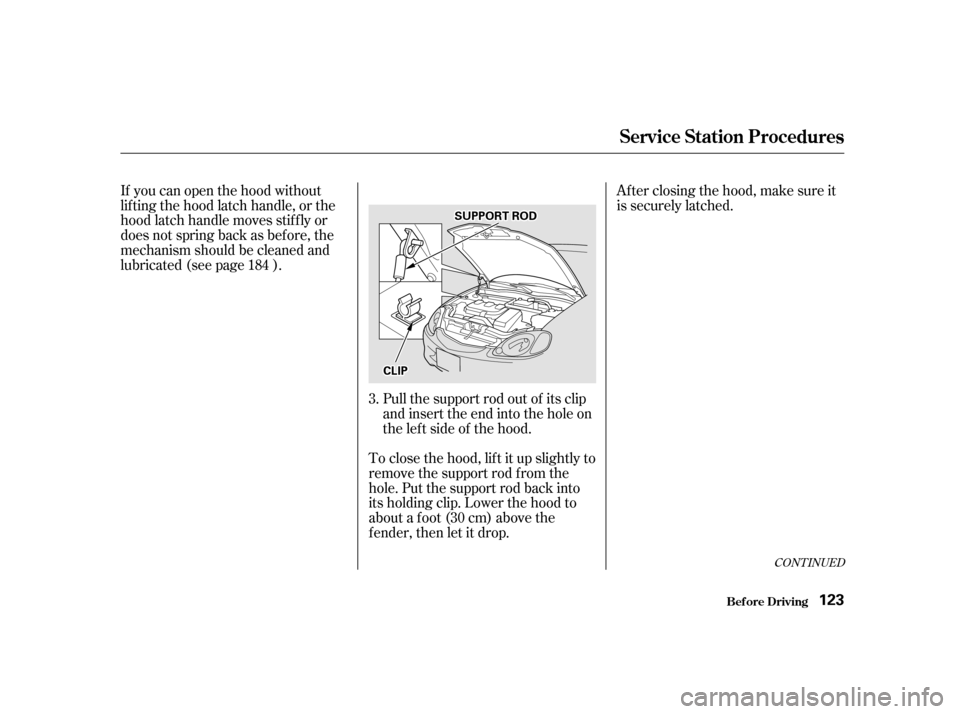
Pull the support rod out of its clip
and insert the end into the hole on
theleftsideof thehood.
To close the hood, lif t it up slightly to
remove the support rod f rom the
hole. Put the support rod back into
its holding clip. Lower the hood to
about a f oot (30 cm) above the
fender,thenletitdrop.
3.
184
CONT INUED
Service Station Procedures
Bef ore Driving
123
CCLLIIPP
SSUUPPPPOORRTTRROODD
Page 130 of 269

This f igure includes the total weight
of all occupants, cargo, and
accessories.
To f igure out how much cargo you
can carry:Add up the weight of all occupants.
The f inal number is the total weight
of cargo you can carry. Store or secure all items that could
be thrown around and hurt
someone during a crash.
Be sure items placed on the f loor
behind the f ront seats cannot roll
under the seats and interf ere with
the driver’s ability to operate the
pedals, or with the proper
operation of the seats.Keep the glove box closed while
driving. If the lid is open, a
passenger could injure their knees
during a crash or sudden stop.
Do not stack objects higher than
the tops of the seat-backs. They
could block your view and be
thrown about the vehicle during a
crash or sudden stop.
Distribute cargo evenly on the
f loor of the cargo area, placing the
heaviest items on the bottom and
as far forward as possible.
Tie down items that could be
thrown about the car during a
crash or sudden stop.
The maximum load f or your vehicle
is 400 lbs (185 kg).
Subtract the total f rom 400 lbs
(185 kg).
CONT INUED
Load Limit
Carrying Items in the Passenger
CompartmentCarrying Cargo in the Cargo A rea
Carrying Cargo
Bef ore Driving
131
Overloading or improper
loading can affect handling and
stability and cause a crash in
which you can be hurt or killed.
Follow all load limits and other
loading guidelines in thismanual.
Page 131 of 269
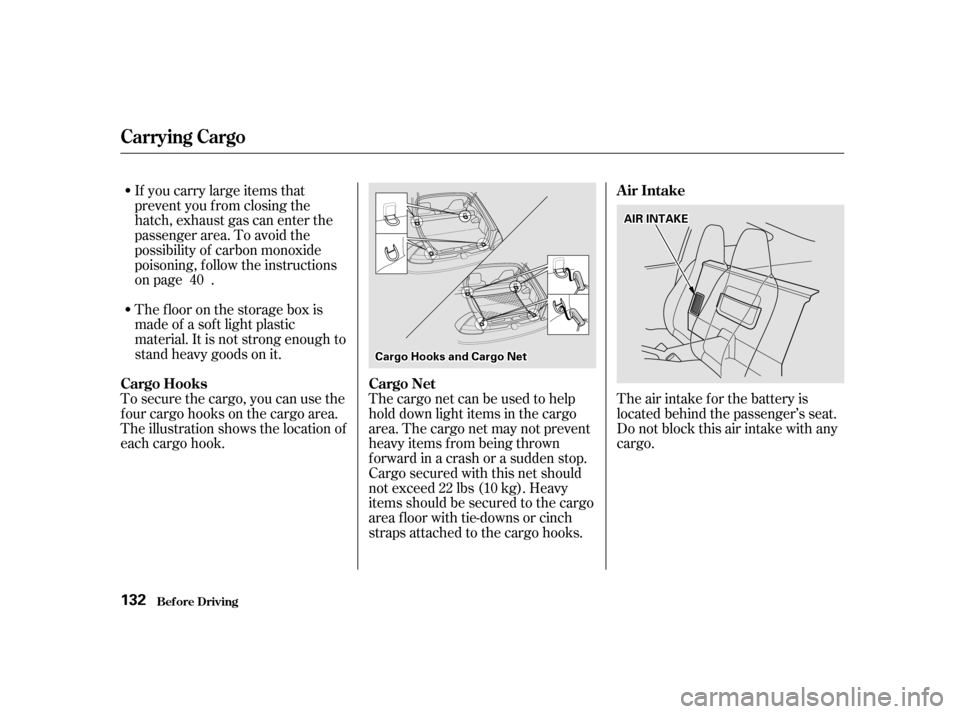
The air intake f or the battery is
located behind the passenger’s seat.
Do not block this air intake with any
cargo.
If you carry large items that
prevent you f rom closing the
hatch, exhaust gas can enter the
passenger area. To avoid the
possibility of carbon monoxide
poisoning, f ollow the instructions
on page .
The f loor on the storage box is
made of a sof t light plastic
material. It is not strong enough to
stand heavy goods on it.
To secure the cargo, you can use the
f our cargo hooks on the cargo area.
The illustration shows the location of
each cargo hook. The cargo net can be used to help
hold down light items in the cargo
area. The cargo net may not prevent
heavy items f rom being thrown
forwardinacrashorasuddenstop.
Cargo secured with this net should
not exceed 22 lbs (10 kg). Heavy
items should be secured to the cargo
area floor with tie-downs or cinch
straps attached to the cargo hooks.
40
Carrying Cargo
Bef ore Driving Air Intake
Cargo Hooks Cargo Net
132
AAIIRRIINNTTAAKKEE
CCaarrggooHHooookkssaannddCCaarrggooNNeett
Page 133 of 269

Make sure all windows, mirrors,
and outside lights are clean and
unobstructed. Remove f rost, snow,
or ice.Check the adjustment of the seat
(see page ).
Check the adjustment of the
inside and outside mirrors (see
page ).
Turn the ignition switch ON (II).
Check the indicator lights in the
instrument panel.
Start the engine (see page ).
Check the gauges and indicator
lights in the instrument panel (see
page ).
Check that any items you may be
carrying with you inside are stored
properly or f astened down
securely.
Visually check the tires. If a tire
looks low, use a gauge to check its
pressure.
Check that the hood and hatch are
f ully closed.
Youshoulddothefollowingchecks
and adjustments every day bef ore
you drive your car.
Make sure the doors are securely
closed and locked.
Fasten your seat belt. Check that
your passenger has f astened his
seat belt (see page ).
1. 2. 3. 4. 5. 6. 7. 8.
9.
10. 11.
15 45
76
78 135
Preparing to Drive
Driving
134
Page 166 of 269
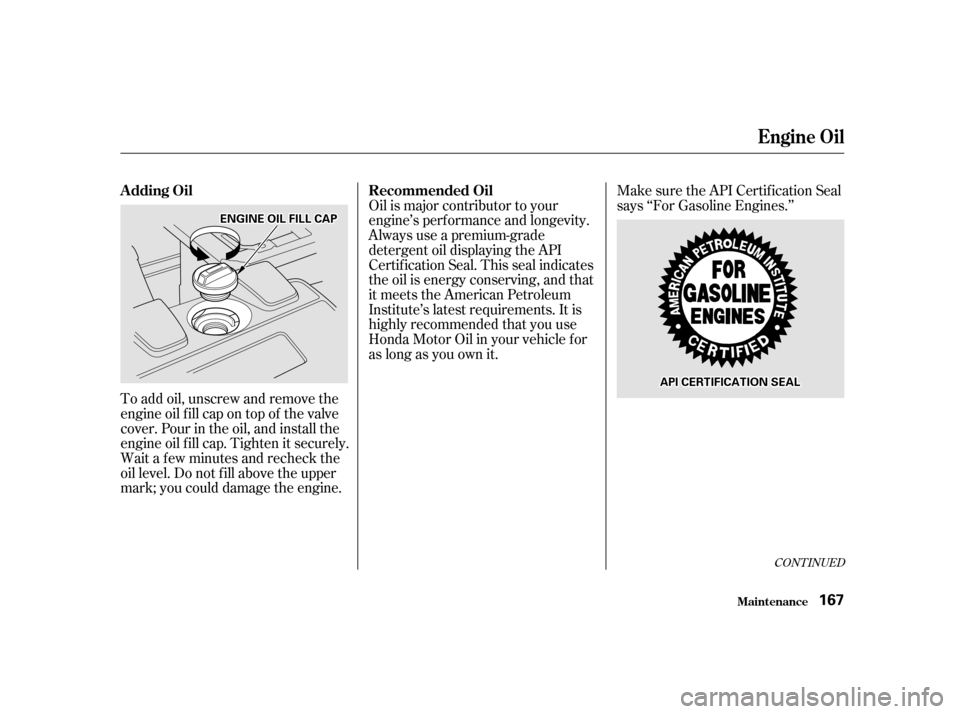
To add oil, unscrew and remove the
engine oil f ill cap on top of the valve
cover. Pour in the oil, and install the
engine oil f ill cap. Tighten it securely.
Wait a f ew minutes and recheck the
oil level. Do not f ill above the upper
mark; you could damage the engine.Oil is major contributor to your
engine’s perf ormance and longevity.
Always use a premium-grade
detergent oil displaying the API
Certif ication Seal. This seal indicates
the oil is energy conserving, and that
it meets the American Petroleum
Institute’s latest requirements. It is
highly recommended that you use
Honda Motor Oil in your vehicle f or
as long as you own it.
Make sure the API Certif ication Seal
says ‘‘For Gasoline Engines.’’
CONT INUED
A dding Oil Recommended Oil
Engine Oil
Maint enance
167
EENNGGIINNEEOOIILLFFIILLLLCCAAPP
AAPPIICCEERRTTIIFFIICCAATTIIOONNSSEEAALL
Page 174 of 269
CONT INUED
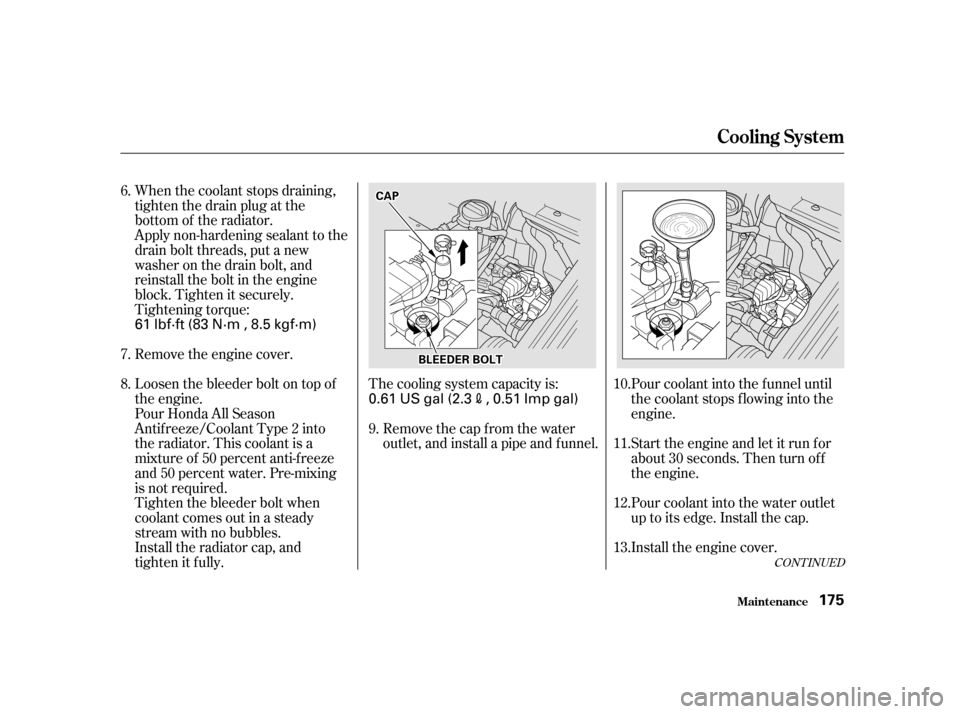
When the coolant stops draining,
tightenthedrainplugatthe
bottom of the radiator.
Apply non-hardening sealant to the
drain bolt threads, put a new
washer on the drain bolt, and
reinstall the bolt in the engine
block. Tighten it securely.
Tightening torque:Pour coolant into the f unnel until
the coolant stops f lowing into the
engine.
Install the engine cover.
Pour coolant into the water outlet
up to its edge. Install the cap.
Start the engine and let it run f or
about 30 seconds. Then turn of f
the engine.
Remove the engine cover.
Loosen the bleeder bolt on top of
the engine.
Pour Honda All Season
Antif reeze/Coolant Type 2 into
the radiator. This coolant is a
mixture of 50 percent anti-f reeze
and 50 percent water. Pre-mixing
is not required.
Tighten the bleeder bolt when
coolant comes out in a steady
stream with no bubbles.
Install the radiator cap, and
tighten it fully. The cooling system capacity is:
Remove the cap from the water
outlet, and install a pipe and f unnel.
6. 7. 8.
9.10. 11.12. 13.
Cooling Syst em
Maint enance
175
BBLLEEEEDDEERRBBOOLLTT
CCAAPP
61 lbf·ft (83 N·m , 8.5 kgf·m) 0.61 US gal (2.3
, 0.51 Imp gal)
Page 177 of 269
Check the f luid level with the engine
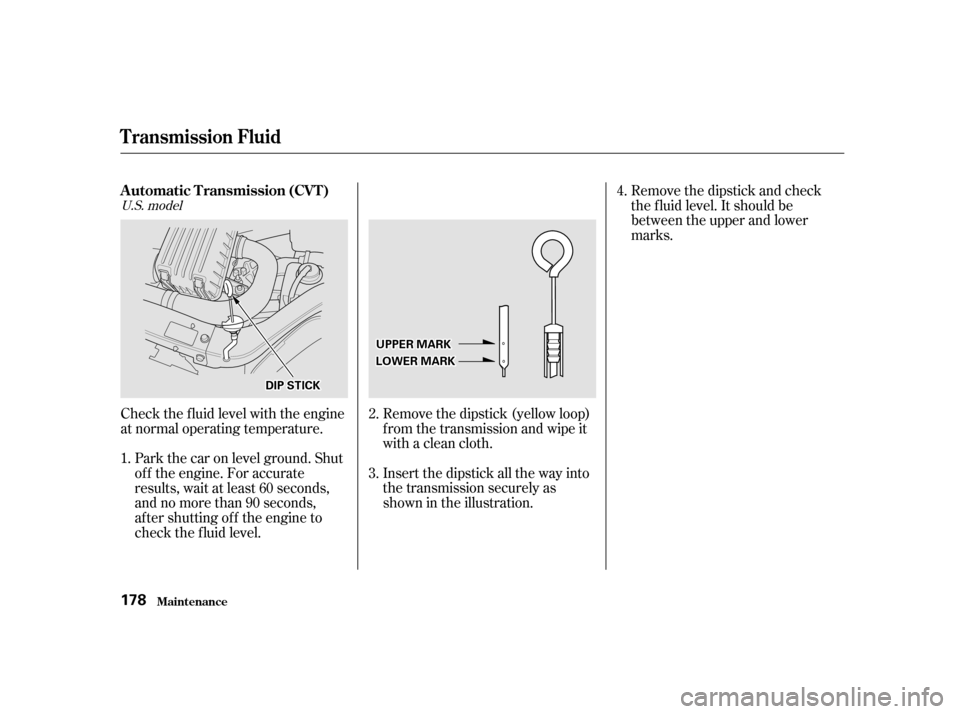
at normal operating temperature.Insert the dipstick all the way into
the transmission securely as
shown in the illustration.
Remove the dipstick (yellow loop)
f rom the transmission and wipe it
with a clean cloth. Remove the dipstick and check
the f luid level. It should be
between the upper and lower
marks.
Park the car on level ground. Shut
of f the engine. For accurate
results, wait at least 60 seconds,
andnomorethan90seconds,
af ter shutting of f the engine to
check the f luid level.
1.
2. 3.4.
U.S. model
Maint enance
T ransmission Fluid
Automatic Transmission (CVT) 178
UUPPPPEERRMMAARRKK
LLOOWWEERRMMAARRKK
DDIIPPSSTTIICCKK
Page 178 of 269

If the level is below the lower
mark, add f luid into the f iller hole
to bring it to the upper mark.
Always use Honda ATF-Z1
(Automatic Transmission Fluid). If
it is not available, you may use a
DEXRON
III automatic
transmission f luid as a temporary
replacement. However, continued
use can affect shift quality. Have
the transmission f lushed and
ref illed with Honda ATF-Z1 as
soon as it is convenient. Insert the dipstick all the way back
into the transmission securely as
shown in the illustration.
The transmission should be drained
and ref illed with new f luid according
to the time and distance recommen-
dations in the maintenance schedule.
To thoroughly f lush the transmission,
the technician should drain and ref ill
it with Honda ATF-Z1 (Automatic
Transmission Fluid), then drive the
vehicle a short distance. Do this
three times. Then drain and ref ill the
transmission a f inal time.
5.
6.
T ransmission Fluid
Maint enance179
Page 179 of 269
If Honda MTF is not available, you
may use an API service SG, SH or SJ
grade motor oil with a viscosity of
SAE 10W-30 or 10W-40 as a
temporary replacement. An SG
grade is pref erred, but an SH or SJ
grade may be used if SG is not
available. However, motor oil does
not contain the proper additives and
continued use can cause stif f er
shif ting. Replace as soon as it is
convenient.
The transmission should be drained
and ref illed with new f luid according
to the time and distance recommen-
dations in the maintenance schedule.
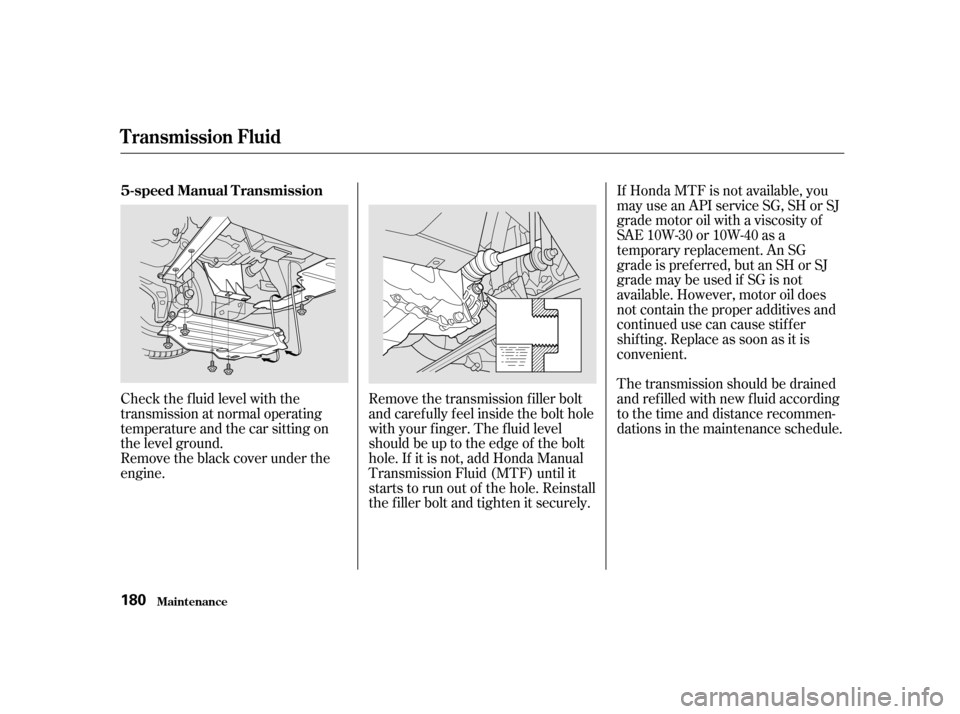
Check the f luid level with the
transmission at normal operating
temperature and the car sitting on
the level ground.
Remove the black cover under the
engine. Remove the transmission f iller bolt
and caref ully f eel inside the bolt hole
with your f inger. The f luid level
should be up to the edge of the bolt
hole. If it is not, add Honda Manual
Transmission Fluid (MTF) until it
starts to run out of the hole. Reinstall
the f iller bolt and tighten it securely.
Maint enance
T ransmission Fluid
5-speed Manual Transmission 180