brakes HONDA ODYSSEY 1995 User Guide
[x] Cancel search | Manufacturer: HONDA, Model Year: 1995, Model line: ODYSSEY, Model: HONDA ODYSSEY 1995Pages: 240, PDF Size: 2.44 MB
Page 143 of 240
Periodic Checks
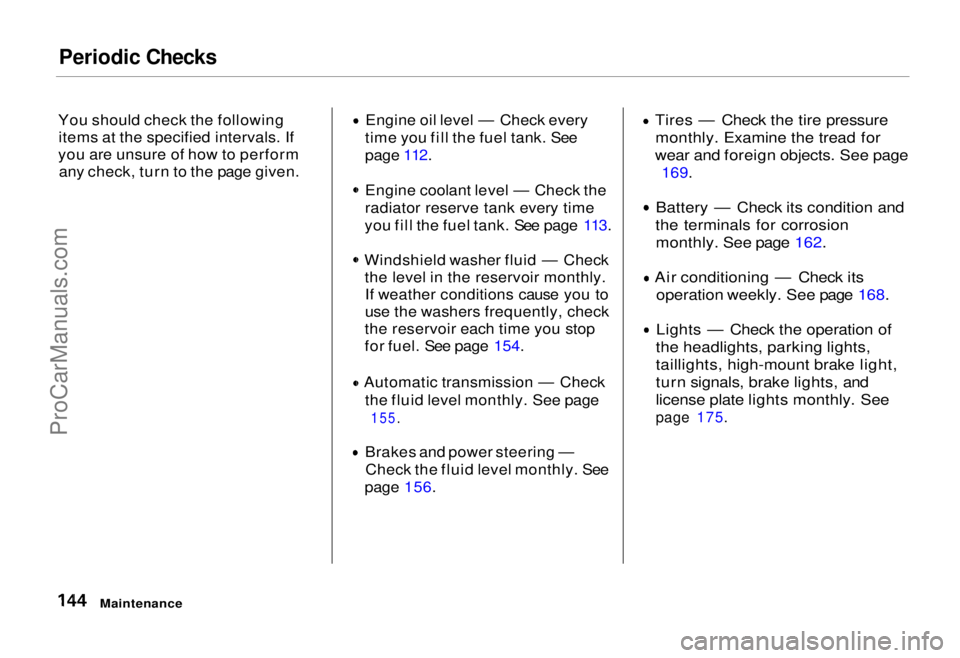
You should check the following items at the specified intervals. If
you are unsure of how to perform any check, turn to the page given. Engine oil level — Check every
time you fill the fuel tank. See
page 112.
Engine coolant level — Check the
radiator reserve tank every time
you fill the fuel tank. See page 113.
Windshield washer fluid — Check the level in the reservoir monthly.If weather conditions cause you to
use the washers frequently, check
the reservoir each time you stop
for fuel. See page 154. Automatic transmission — Check
the fluid level monthly. See page
155.
Brakes and power steering —
Check the fluid level monthly. See
page 156.
Tires — Check the tire pressure
monthly. Examine the tread for
wear and foreign objects. See page
169.
Battery — Check its condition and
the terminals for corrosion monthly. See page 162. Air conditioning — Check its
operation weekly. See page 168. Lights — Check the operation of
the headlights, parking lights,
taillights, high-mount brake light,
turn signals, brake lights, and
license plate lights monthly. See
page 175.
Maintenance
ProCarManuals.comMain Menu Table of Contents s t
Page 218 of 240
Anti-lock Brake System
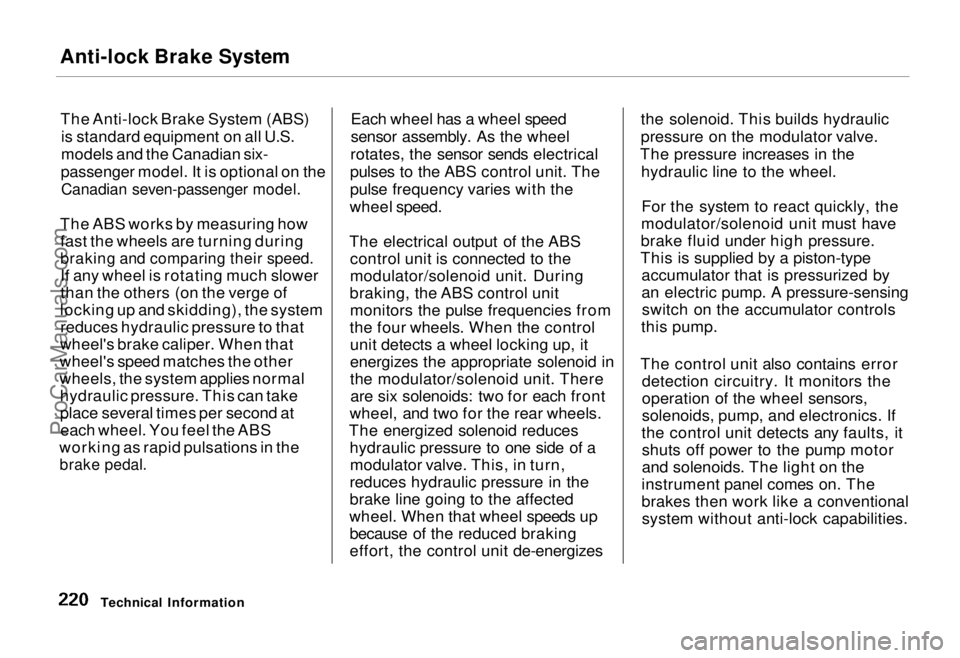
The Anti-lock Brake System (ABS) is standard equipment on all U.S.
models and the Canadian six-
passenger model. It is optional on the
Canadian seven-passenger model.
The ABS works by measuring how fast the wheels are turning during
braking and comparing their speed.
If any wheel is rotating much slower
than the others (on the verge of
locking up and skidding), the system reduces hydraulic pressure to that
wheel's brake caliper. When that
wheel's speed matches the other
wheels, the system applies normal hydraulic pressure. This can take
place several times per second ateach wheel. You feel the ABS
working as rapid pulsations in the
brake pedal.
Each wheel has a wheel speed
sensor assembly. As the wheel
rotates, the sensor sends electrical
pulses to the ABS control unit. The
pulse frequency varies with the
wheel speed.
The electrical output of the ABS control unit is connected to the
modulator/solenoid unit. During
braking, the ABS control unit monitors the pulse frequencies from
the four wheels. When the control unit detects a wheel locking up, it
energizes the appropriate solenoid in
the modulator/solenoid unit. Thereare six solenoids: two for each front
wheel, and two for the rear wheels.
The energized solenoid reduces hydraulic pressure to one side of amodulator valve. This, in turn,
reduces hydraulic pressure in the
brake line going to the affected
wheel. When that wheel speeds up because of the reduced braking
effort, the control unit de-energizes the solenoid. This builds hydraulic
pressure on the modulator valve.
The pressure increases in the hydraulic line to the wheel.
For the system to react quickly, the
modulator/solenoid unit must have
brake fluid under high pressure.
This is supplied by a piston-type accumulator that is pressurized by
an electric pump. A pressure-sensingswitch on the accumulator controls
this pump.
The control unit also contains error detection circuitry. It monitors the
operation of the wheel sensors,
solenoids, pump, and electronics. If
the control unit detects any faults, it shuts off power to the pump motor
and solenoids. The light on the
instrument panel comes on. The
brakes then work like a conventional system without anti-lock capabilities.
Technical InformationProCarManuals.comMain Menu Table of Contents s t
Page 232 of 240
Index
Accessories
Installation.................................. 115
ACCESSORY (Ignition Key
Position)....................................... 52
Adding Automatic Transmission
Fluid........................................ 155
Brake Fluid................................. 156
Engine Coolant........................... 150
Engine Oil................................... 146
Power Steering Fluid................. 157
Windshield Washer Fluid......... 154
Additional Safety Information........ 18 Door Locks................................... 19
Driving with Pets......................... 19
Head Restraint Position.............. 18
Seat-back Position........................ 18
Storing Cargo Safely................... 19
Additives, Engine Oil..................... 148
Adjustments
Mirrors.......................................... 67
Head Restraints........................... 58
Seats.............................................. 56
Steering Wheel............................ 46
Airbag (SRS) .................................... 12
Air Cleaner..................................... 157
Air Conditioning............................... 76
Maintenance............................... 168
Usage............................................. 78
Air Outlets (Vents).......................... 76
Air Pressure, Tires........................ 170
Alcohol and Drugs........................... 28
Alcohol in Gasoline........................ 109
Antifreeze....................................... 150
Anti-lock Brakes (ABS)
Description................................. 220
Indicator Light..................... 37, 125
Operation.................................... 125
Anti-theft Steering Column Lock .. 52
Appearance Care........................... 183
Ashtray.............................................. 72
Audio System................................... 84
Automatic Speed Control................ 48
Automatic Transmission............... 120
Capacity, Fluid........................... 218
Checking Fluid Level................ 155
Shifting........................................ 120
Shift Lever Positions................. 120
Shift Lock Release..................... 123
Battery
Charging System Light............... 36
Jump Starting............................. 200 Maintenance............................... 162
Specifications............................. 219
Before Driving............................... 107
Belts, Seat........................................... 5
Beverage Holder.............................. 69
Body Repair.................................... 190
Brakes
Anti-lock System (ABS)............ 125Break-in, New Linings .............. 108
Fluid............................................ 156
Light, Burned-out...................... 179
Parking.......................................... 68
System Indicator.......................... 36
Wear Indicators......................... 124
Brakes, ABS Description................................. 220
Operation.................................... 125
System Indicator................. 37, 125
Braking System.............................. 124
CONTINUEDProCarManuals.comMain Menu s t Main Menu s t