brake HONDA ODYSSEY 1995 Owner's Manual
[x] Cancel search | Manufacturer: HONDA, Model Year: 1995, Model line: ODYSSEY, Model: HONDA ODYSSEY 1995Pages: 240, PDF Size: 2.44 MB
Page 126 of 240
The Braking System, Driving in Bad Weather
A car with ABS may require a longer
distance to stop on loose or uneven
surfaces than an equivalent car with-
out Anti-lock. The ABS cannot make
up for road conditions or bad judg-
ment. It is still your responsibility to
drive at reasonable speeds for
weather and traffic conditions, and to leave a margin of safety.
For a technical description of the
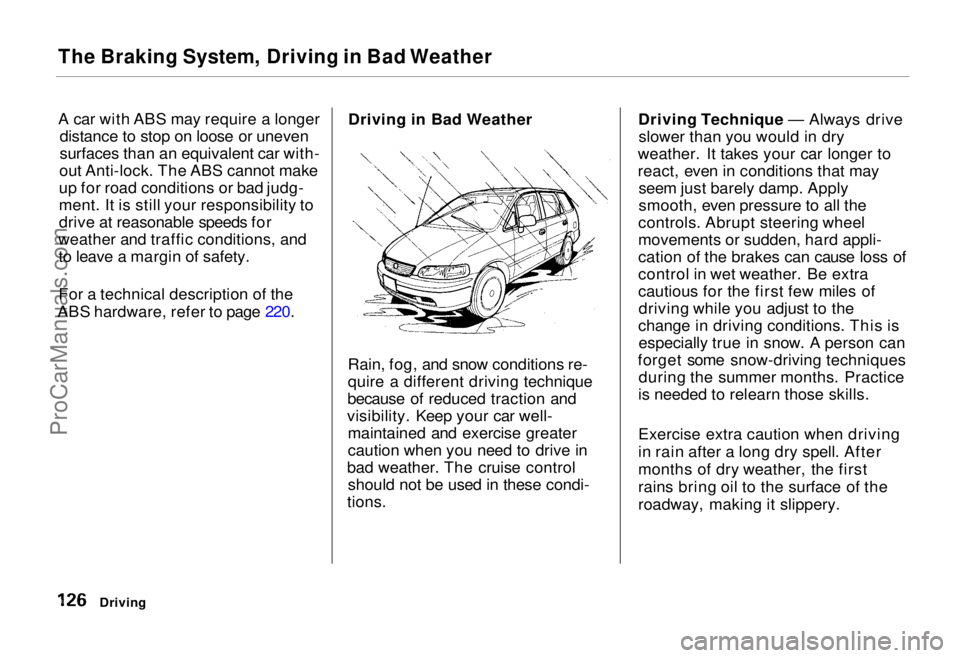
ABS hardware, refer to page 220. Driving in Bad Weather
Rain, fog, and snow conditions re-
quire a different driving technique
because of reduced traction and
visibility. Keep your car well- maintained and exercise greater
caution when you need to drive in
bad weather. The cruise control should not be used in these condi-
tions. Driving Technique — Always drive
slower than you would in dry
weather. It takes your car longer to
react, even in conditions that may seem just barely damp. Apply
smooth, even pressure to all the
controls. Abrupt steering wheel
movements or sudden, hard appli-
cation of the brakes can cause loss of
control in wet weather. Be extra
cautious for the first few miles of driving while you adjust to the
change in driving conditions. This is especially true in snow. A person can
forget some snow-driving techniques during the summer months. Practice
is needed to relearn those skills.
Exercise extra caution when driving
in rain after a long dry spell. After
months of dry weather, the first
rains bring oil to the surface of the
roadway, making it slippery.
DrivingProCarManuals.comMain Menu Table of Contents s t
Page 130 of 240
Towing a Trailer
MirrorsMany states and provinces have laws
requiring special outside mirrors
when you are towing a trailer. Check
the laws in your area. You may want
to install mirrors, even if they are not required. Hook up the trailer and see
how much it obscures your ability to see behind you with the standard
mirrors. If you cannot see directly
behind you, or have a large blind spot next to the trailer or the car,
you should install mirrors intended for towing.
Connecting the Trailer
Most trailers that have a gross
weight of 450 kg (1,000 Ibs) do not have their own braking system. If
you are thinking of getting a trailer that does have brakes, make sure
they are electrically-operated. There
are no provisions in your car to tap
into its hydraulic braking system.
Any attempt to attach the trailer's brakes to your car's hydraulicsystem, no matter how successful it
may seem, will lower braking effectiveness and create a potential
hazard.
Always use a safety chain when
towing a trailer. Connect the safetychain securely at both ends. Makesure the chain crosses under the
tongue so it will catch the trailer if it
becomes unhitched. Leave enough slack in the chain so it can't bind in asharp turn. Do not let it drag on the
ground.
DrivingProCarManuals.comMain Menu Table of Contents s t
Page 131 of 240
Towing a Trailer
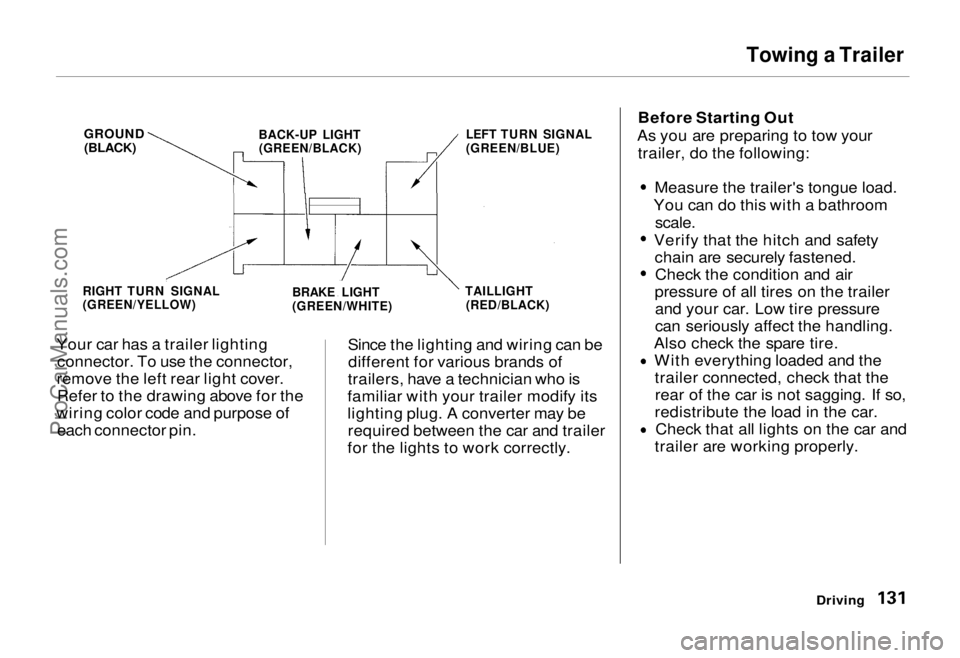
Your car has a trailer lighting connector. To use the connector,
remove the left rear light cover. Refer to the drawing above for the
wiring color code and purpose of each connector pin. Since the lighting and wiring can be
different for various brands of
trailers, have a technician who is
familiar with your trailer modify its
lighting plug. A converter may be required between the car and trailer
for the lights to work correctly. Before Starting Out
As you are preparing to tow your trailer, do the following:
Measure the trailer's tongue load.
You can do this with a bathroom
scale.
Verify that the hitch and safety chain are securely fastened.Check the condition and air
pressure of all tires on the trailer and your car. Low tire pressure
can seriously affect the handling.
Also check the spare tire. With everything loaded and thetrailer connected, check that therear of the car is not sagging. If so,
redistribute the load in the car. Check that all lights on the car and
trailer are working properly.
Driving
RIGHT TURN SIGNAL
(GREEN/YELLOW)
BRAKE LIGHT
(GREEN/WHITE)TAILLIGHT
(RED/BLACK) LEFT TURN SIGNAL
(GREEN/BLUE)
BACK-UP LIGHT
(GREEN/BLACK)
GROUND
(BLACK)ProCarManuals.comMain Menu Table of Contents s t
Page 132 of 240
Towing a Trailer
Towing Safety
Your car will not stop as quickly witha trailer in tow. Leave extra distance
between your car and other vehicles.
Avoid braking or turning suddenly.
This could cause the trailer to
jackknife or possibly turn over.
Keep in mind that your total vehicle
is now much longer. Leave more
room when making turns. The trailer
tracks a smaller arc than the car and can hit or run over something that
the car misses. When passing another vehicle, make sure the
trailer is clear before changing lanes. The car/trailer combination is more
affected by crosswinds and buffeting.
When being passed by a large
vehicle, keep a constant speed and steer straight ahead. If there is too
much wind buffeting, slow down to
get out of the other vehicle's air
turbulence.
Towing a trailer puts an extra load on your car. You should have your
car serviced according to the "Maintenance schedule under severe
driving conditions" on page 141. This extra load is magnified when
you are driving in hilly terrain.
Watch the temperature gauge closely when climbing hills. If it gets
near the hot area, turn off the air
conditioning (if it is on). If this does
not reduce the heat, it may be
necessary to pull to the side of the
road and wait for the engine to cool.If the automatic transmission shifts
frequently between 3rd and 4th gears, put it in D3. This will help
prevent the transmission from overheating. Help keep the brakes
from overheating by shifting to a lower gear when going downhill.
DrivingProCarManuals.comMain Menu Table of Contents s t
Page 133 of 240
Towing a Trailer
If you have to stop while going uphill, do not hold the car in place by
pressing on the accelerator. This can cause the automatic transmission to
overheat. Use the parking brake or
footbrake.
When parking your car and trailer, especially on a hill, be sure to follow
all the normal precautions. Turn
your front wheels into the curb, set the parking brake firmly, and put thetransmission in Park. In addition,
place wheel chocks at each of the
trailer's tires. Backing up with a trailer is difficult
and takes practice. Drive slowly,
make small movements with the
steering wheel, and have someone
stand outside to guide you. Grip the
steering wheel on the bottom (rather
than the usual position near the top). Move your hand to the left to get the
trailer to move to the left, and right
to move the trailer right.
DrivingProCarManuals.comMain Menu Table of Contents s t
Page 134 of 240
Maintenance
This section explains why it is important to keep your car well
maintained and to follow basic
maintenance safety precautions.
This section also includes Maintenance Schedules for normal
driving and severe driving conditions,
a Maintenance Record, and
instructions for simple maintenance
tasks you may want to take care of
yourself.
If you have the skills and tools
required to perform more complex
maintenance tasks on your Honda,
you may want to purchase the Service Manual. See page 233 for
information on how to obtain a copy, or see your Honda dealer.
Maintenance Safety....................... 136
Maintenance Schedule.................. 138
Maintenance Record..................... 142
Periodic Checks............................. 144
Fluid Locations............................... 145
Engine Oil....................................... 146
Checking Engine Oil................. 146
Adding......................................... 146
Recommended Oil..................... 147
Additives..................................... 148
Oil and Filter Changes.............. 148
Cooling System.............................. 150
Checking the Engine Coolant
Level........................................ 150
Adding Engine Coolant............. 151
Replacing Engine Coolant........ 152
Windshield Washers..................... 154
Automatic Transmission Fluid..... 155
Brake Fluid..................................... 156
Brake System............................. 156
Anti-lock Brake System............ 157
Power Steering............................... 157
Air Cleaner..................................... 158
Spark Plugs..................................... 160
Replacement............................... 160
Specification............................... 161
Battery............................................ 162
Windshield Wipers........................ 165
Air Conditioning............................. 168 Drive Belts...................................... 169
Tires................................................ 169 Inflation....................................... 170
Inspection................................... 171
Maintenance............................... 171
Tire Rotation.............................. 172 Replacing Tires and Wheels .... 172
Wheels and Tires....................... 173
Winter Driving........................... 173 Snow Tires.............................. 174
Tire Chains............................. 174
Lights.............................................. 175 Headlight Aiming...................... 175
Replacing Bulbs......................... 177
Storing Your Car............................ 182
MaintenanceProCarManuals.comMain Menu s t
Page 136 of 240
Maintenance Safety
Important Safety Precautions Before you begin any maintenance,
make sure your car is parked on
level ground and that the parking
brake is on. Also, be sure the engine is off. This will help to eliminateseveral potential hazards:
Carbon monoxide poisoning
from engine exhaust. Be sure there is adequate ventilation
whenever you operate the engine.
Burns from hot parts. Let the
engine and exhaust system cool
before touching any parts.
Injury from moving parts. Do
not run the engine unless in- structed to do so. Read the instructions before you
begin, and make sure you have the
tools and skills required.
To reduce the possibility of fire or explosion, be careful when workingaround gasoline or batteries. Use a
nonflammable solvent, not gasoline,
to clean parts. Keep cigarettes, sparks, and flames away from the
battery and all fuel-related parts.
You should wear eye protection and protective clothing when working
near the battery or when usingcompressed air.
MaintenanceProCarManuals.comMain Menu Table of Contents s t
Page 137 of 240
Maintenance Schedule
The Maintenance Schedule specifies how often you should have your carserviced and what things need
attention. It is essential that you have
your car serviced as scheduled to retain its high level of safety,dependability, and emission control
performance. The services and time or distance
intervals shown in the maintenanceschedule assume you will use your
car as normal transportation. You
should:
Avoid exceeding your car's loadlimit. This puts excess stress on
the engine, brakes, and manyother parts of your car. The load
limit is shown on the label on the driver's doorjamb.
Operate your car on reasonable
roads within the legal speed limit. Drive your car regularly over a
distance of several kilometers
(miles).
Always use unleaded gasoline with
the proper octane (see page 108). Which Schedule to Follow:
Service your car according to the
time and mileage periods on one of
the Maintenance Schedules on pages 140 and 141. Select the schedule for
"Severe Conditions" if most of your
driving is done under one or more of
the conditions listed on that page. Otherwise, follow the schedule for
"Normal Conditions."
MaintenanceProCarManuals.comMain Menu Table of Contents s t
Page 143 of 240
Periodic Checks
You should check the following items at the specified intervals. If
you are unsure of how to perform any check, turn to the page given. Engine oil level — Check every
time you fill the fuel tank. See
page 112.
Engine coolant level — Check the
radiator reserve tank every time
you fill the fuel tank. See page 113.
Windshield washer fluid — Check the level in the reservoir monthly.If weather conditions cause you to
use the washers frequently, check
the reservoir each time you stop
for fuel. See page 154. Automatic transmission — Check
the fluid level monthly. See page
155.
Brakes and power steering —
Check the fluid level monthly. See
page 156.
Tires — Check the tire pressure
monthly. Examine the tread for
wear and foreign objects. See page
169.
Battery — Check its condition and
the terminals for corrosion monthly. See page 162. Air conditioning — Check its
operation weekly. See page 168. Lights — Check the operation of
the headlights, parking lights,
taillights, high-mount brake light,
turn signals, brake lights, and
license plate lights monthly. See
page 175.
Maintenance
ProCarManuals.comMain Menu Table of Contents s t
Page 144 of 240
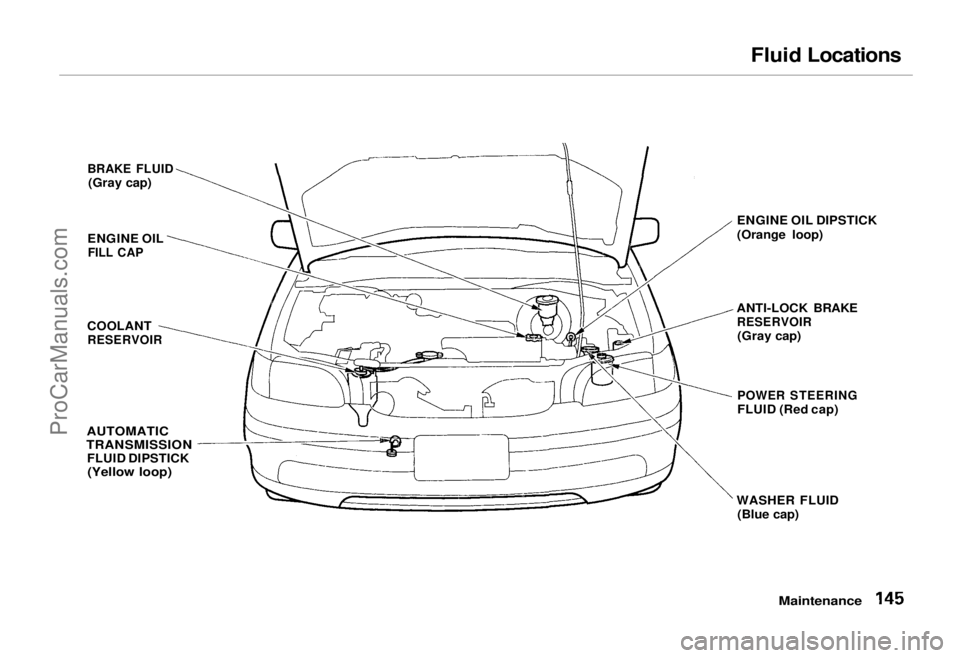
Fluid Locations
BRAKE FLUID
(Gray cap)
ENGINE OIL
FILL CAP
COOLANT
RESERVOIR
AUTOMATIC
TRANSMISSION
FLUID DIPSTICK
(Yellow loop)
ENGINE OIL DIPSTICK
(Orange loop)
ANTI-LOCK BRAKE
RESERVOIR
(Gray cap)
POWER STEERING
FLUID (Red cap)
WASHER FLUID (Blue cap)
MaintenanceProCarManuals.comMain Menu Table of Contents s t