service HONDA ODYSSEY 1995 Owner's Manual
[x] Cancel search | Manufacturer: HONDA, Model Year: 1995, Model line: ODYSSEY, Model: HONDA ODYSSEY 1995Pages: 240, PDF Size: 2.44 MB
Page 157 of 240
Air Cleaner
The air cleaner element should be replaced every 2 years or 48,000 km (30,000 miles), whichever comes
first. Under severe driving condi-
tions, it should also be cleaned every 12 months or 24,000 km (15,000
miles), whichever comes first. Cleaning (Severe Conditions)
Clean the air cleaner element by
blowing compressed air through it in the opposite direction to normal air
flow. If you do not have access to compressed air (such as a gas
station), ask your Honda dealer to do
this service.
Follow the replacement procedure
for removal and reinstallation.
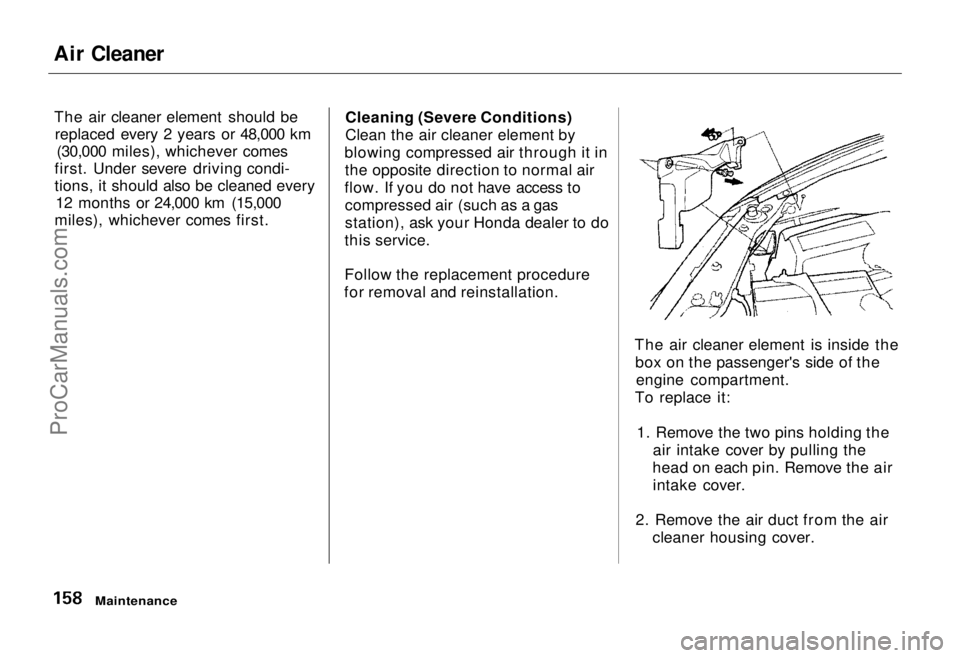
The air cleaner element is inside thebox on the passenger's side of theengine compartment.
To replace it:
1. Remove the two pins holding the air intake cover by pulling the
head on each pin. Remove the air intake cover.
2. Remove the air duct from the air cleaner housing cover.
MaintenanceProCarManuals.comMain Menu Table of Contents s t
Page 167 of 240
Air Conditioning
Your car's air conditioning is a sealed system. Any major maintenance,
such as recharging, should be done
by
a qualified technician. There are a
couple of things you can do to make sure the air conditioning works
efficiently.
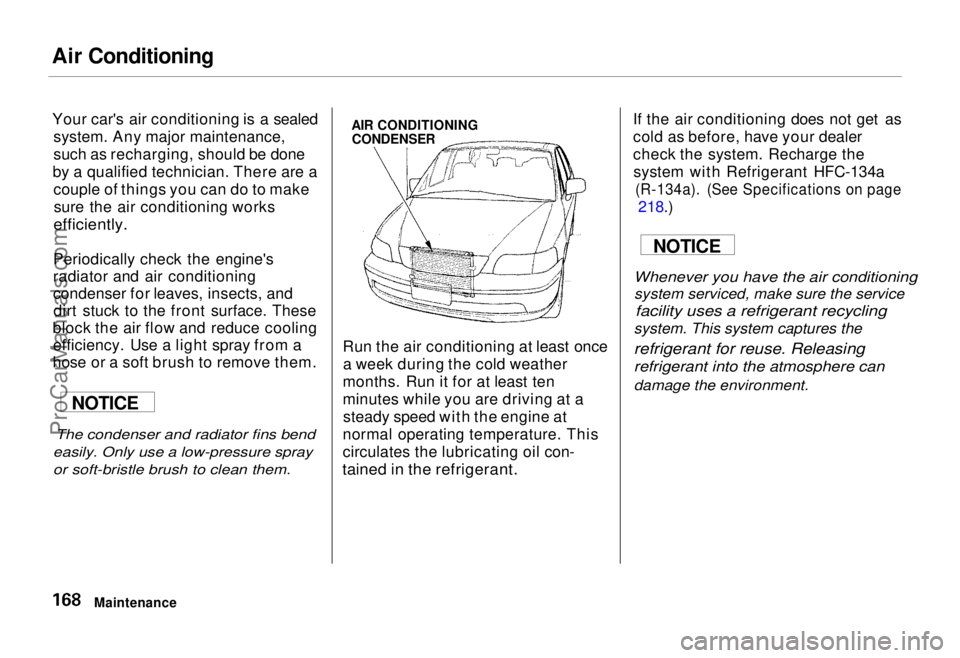
Periodically check the engine's
radiator and air conditioning
condenser for leaves, insects
, and
dirt stuck to the front surface.
These
block the air flow and reduce cooling efficiency. Use a light spray from a
hose or
a soft brush to remove them. Run the air conditioning at least once
a week during the cold weather
months
. Run it for at least ten
minutes while you are driving at a steady speed with the engin
e at
normal operating temperature. This
circulates
the lubricating oil con-
tained in the refrigerant.
If th
e air conditioning does not get as
cold
as before, have your dealer
chec
k the system. Recharge the
syste
m with Refrigerant HFC-134a
(R-134a). (See Specifications on page
218.)
Whenever you have the air conditioning
system. This system captures the
refrigerant for reuse. Releasing
refrigerant into the atmosphere can
damage the environment.
Maintenance
AIR CONDITIONING
CONDENSER
The condenser and radiator fins bend
easily. Only use a low-pressure spray
or soft-bristle brush to clean them.
NOTICE NOTICE
system serviced, make sure the service
facility uses a refrigerant recycling
ProCarManuals.comMain Menu Table of Contents s t
Page 196 of 240
Changing a Flat Tire
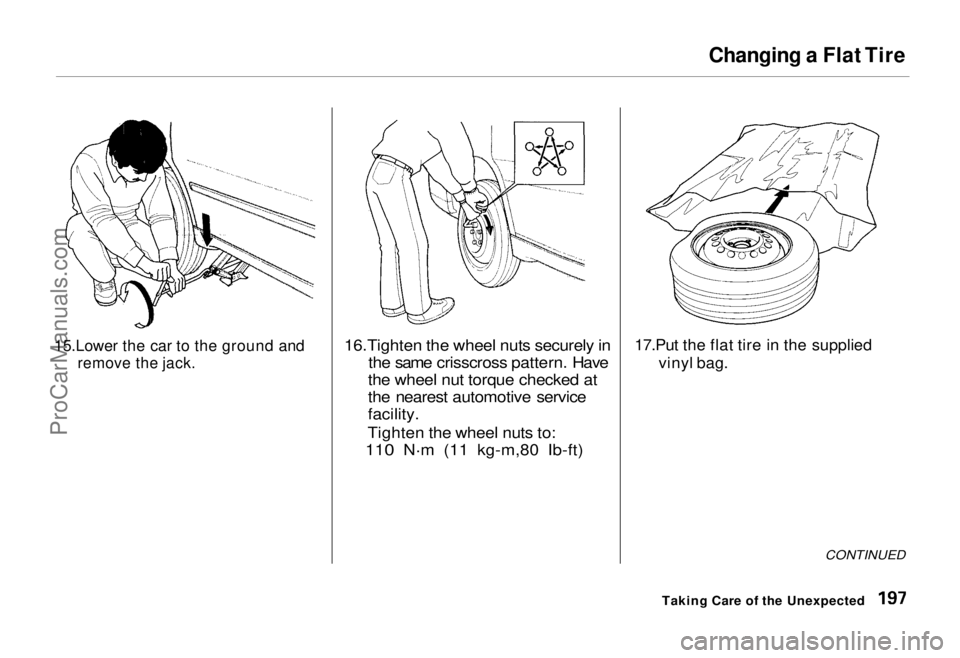
15.Lower the car to the ground and
remove the jack.
16.Tighten the wheel nuts securely in
the same crisscross pattern. Have
the wheel nut torque checked at
the nearest automotive service
facility.
Tighten the wheel nuts to:
110 N .
m (11 kg-m,80 Ib-ft)
17.Put the
flat tire in the supplied
vinyl bag.
CONTINUED
Taking Care of the UnexpectedProCarManuals.comMain Menu Table of Contents s t
Page 204 of 240
Charging System Indication
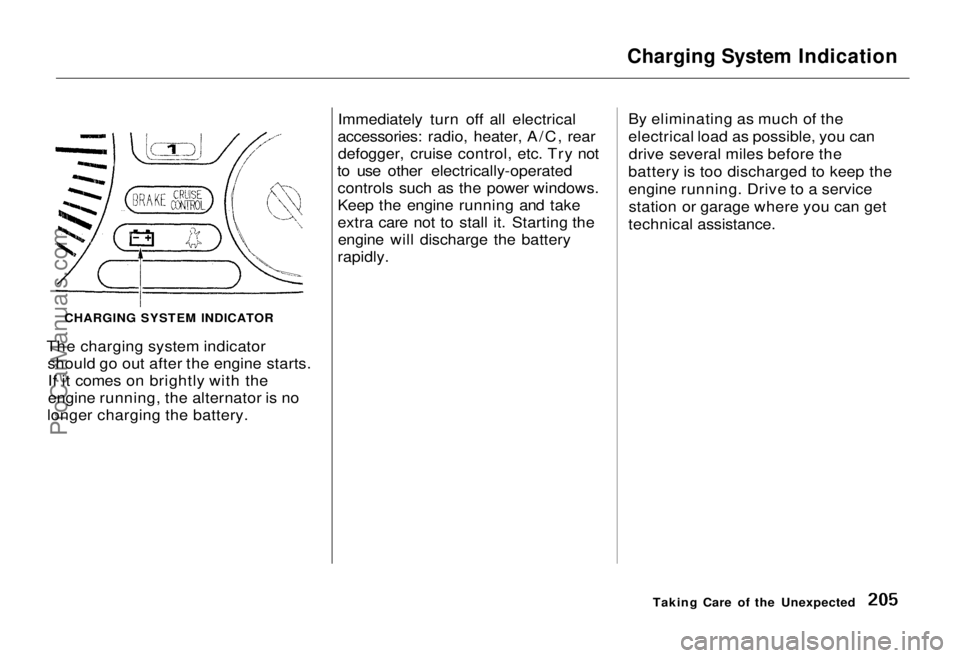
The charging system indicator should go out after the engine starts.If it comes on brightly with the
engine running, the alternator is no
longer charging the battery. Immediately turn off all electrical
accessories: radio, heater, A/C, rear defogger, cruise control, etc. Try not
to use other electrically-operated controls such as the power windows.
Keep the engine running and take
extra care not to stall it. Starting theengine will discharge the battery
rapidly. By eliminating as much of the
electrical load as possible, you can
drive several miles before the
battery is too discharged to keep the
engine running. Drive to a service station or garage where you can get
technical assistance.
Taking Care of the Unexpected
CHARGING SYSTEM INDICATORProCarManuals.comMain Menu Table of Contents s t
Page 212 of 240
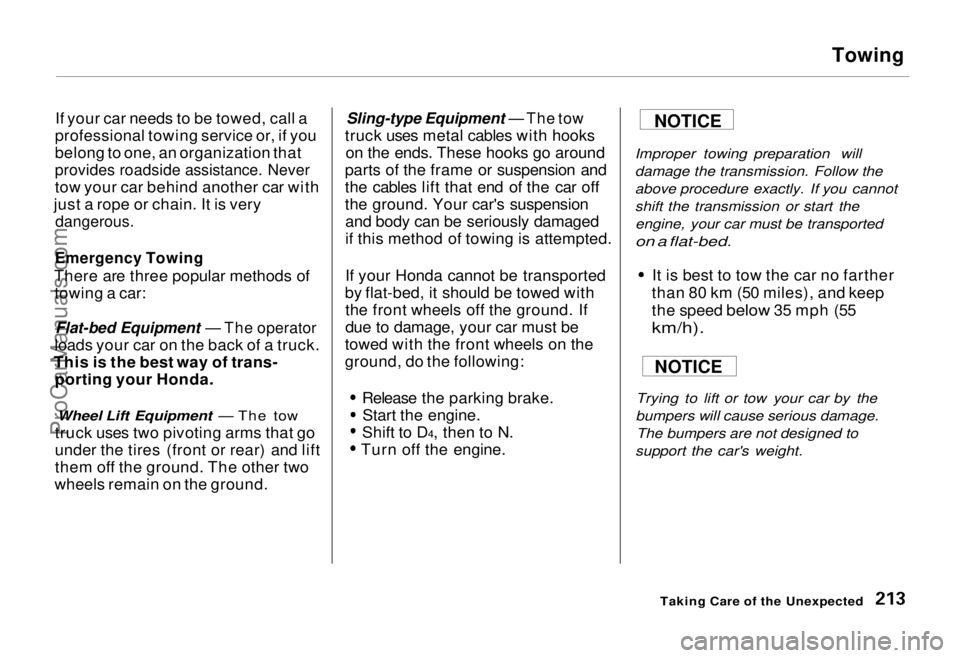
Towing
If your car needs to be towed, call a
professional towing service or, if you
belong to one, an organization that
provides roadside assistance. Never
tow your car behind another car with
just a rope or chain. It is very
dangerous.
Emergency Towing
There are three popular methods of towing a car:
Flat-bed Equipment — The operator
loads your car on the back of a truck.
This is the best way of trans- porting your Honda.
Wheel Lift Equipment — The tow
truck uses two pivoting arms that go
under the tires (front or rear) and lift
them off the ground. The other two
wheels remain on the ground.
Sling-type Equipment — The tow
truck uses metal cables with hooks on the ends. These hooks go around
parts of the frame or suspension and
the cables lift that end of the car off
the ground. Your car's suspension and body can be seriously damaged
if this method of towing is attempted.
If your Honda cannot be transported
by flat-bed, it should be towed with the front wheels off the ground. If
due to damage, your car must be
towed with the front wheels on the
ground, do the following:
Release the parking brake.Start the engine.
Shift to D4, then to N.
Turn off the engine.
Improper towing preparation will
damage the transmission. Follow the
above procedure exactly. If you cannot
shift the transmission or start the
engine, your car must be transported
on a flat-bed.
It is best to tow the car no farther
than 80 km (50 miles), and keep
the speed below 35 mph (55
km/h).
Trying to lift or
tow your car by the
bumpers will cause serious damage. The bumpers are not designed to
support the car's weight.
Taking Care of the Unexpected
NOTICE
NOTICEProCarManuals.comMain Menu Table of Contents s t
Page 220 of 240
Tire Information
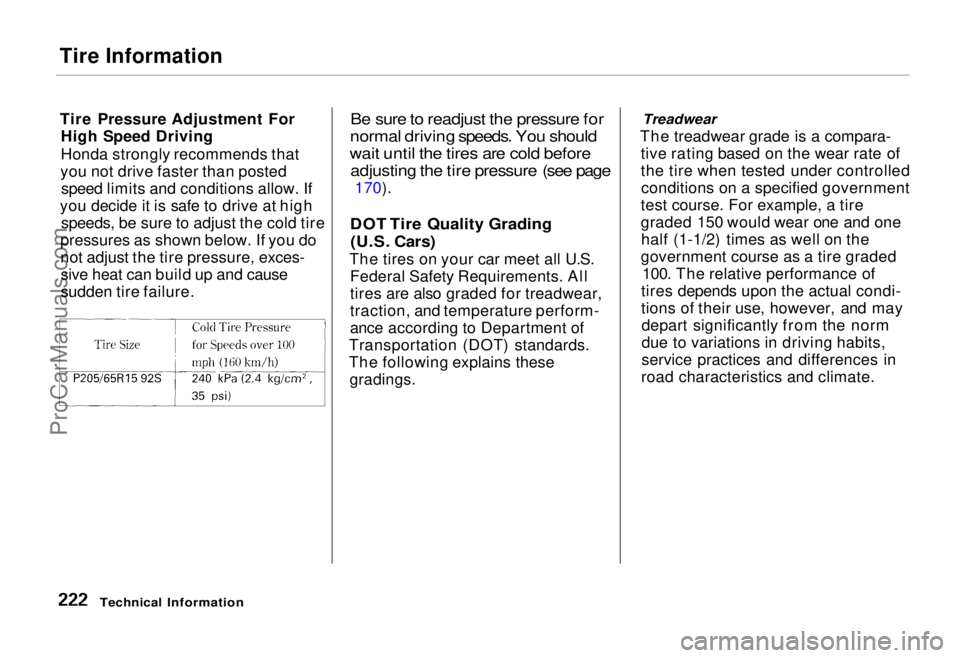
Tire Pressure Adjustment For High Speed Driving
Honda strongly recommends that
you not drive faster than posted speed limits and conditions allow. If
you decide it is safe to drive at high speeds, be sure to adjust the cold tire
pressures as shown below. If you do
not adjust the tire pressure, exces- sive heat can build up and cause
sudden tire failure.
Be sure to readjust the pressure for
normal driving speeds. You should
wait until the tires are cold before adjusting the tire pressure (see page
170).
DOT Tire Quality Grading (U.S. Cars)
The tires on your car meet all U.S. Federal Safety Requirements. All
tires are also graded for treadwear,
traction, and temperature perform-
ance according to Department of
Transportation (DOT) standards.
The following explains these
gradings.
Treadwear
The treadwear grade is a compara- tive rating based on the wear rate of
the tire when tested under controlledconditions on a specified government
test course. For example, a tire
graded 150 would wear one and one half (1-1/2) times as well on the
government course as a tire graded 100. The relative performance of
tires depends upon the actual condi-
tions of their use, however, and may depart significantly from the norm
due to variations in driving habits,
service practices and differences in
road characteristics and climate.
Technical InformationProCarManuals.comMain Menu Table of Contents s t
Page 227 of 240
Customer Relations Information
Honda dealership personnel are trained professionals. They should
be able to answer all your questions. If you encounter a problem that your
dealership does not solve to your
satisfaction, please discuss it with
the dealership's management. The
Service Manager or General
Manager can help. Almost all
problems are solved in this way. If you are dissatisfied with the
decision made by the dealership's
management, contact your HondaCustomer Relations Zone Office.
Refer to the U.S. and Canadian Zone Office maps on the following pages.
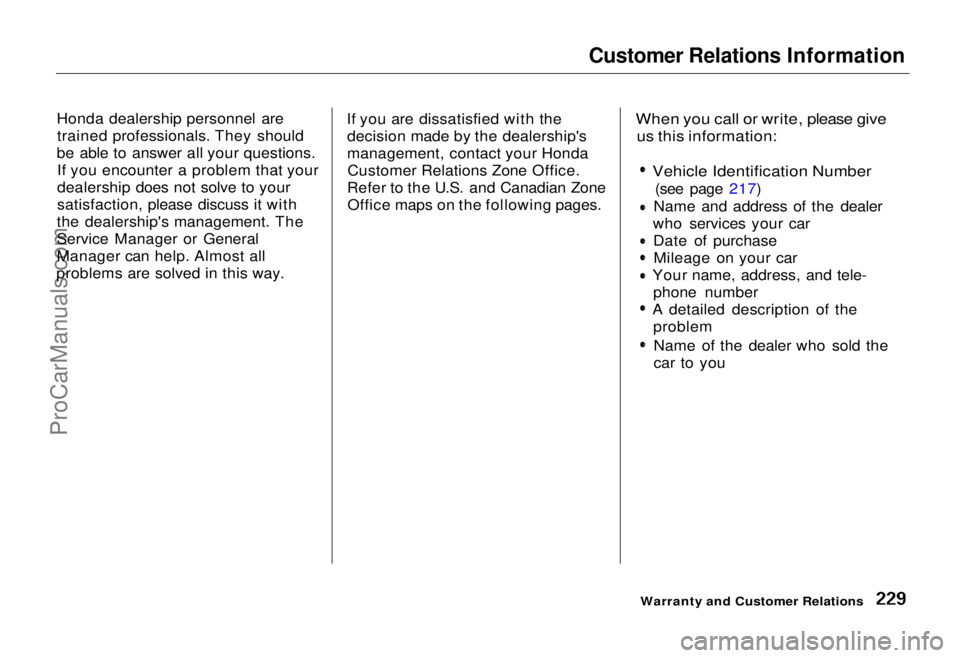
When you call or write, please give
us this information:
Vehicle Identification Number
(see page 217)
Name and address of the dealer
who services your car Date of purchaseMileage on your car
Your name, address, and tele- phone number
A detailed description of the problem
Name of the dealer who sold the
car to you
Warranty and Customer RelationsProCarManuals.comMain Menu Table of Contents s t
Page 231 of 240
Authorized Manuals
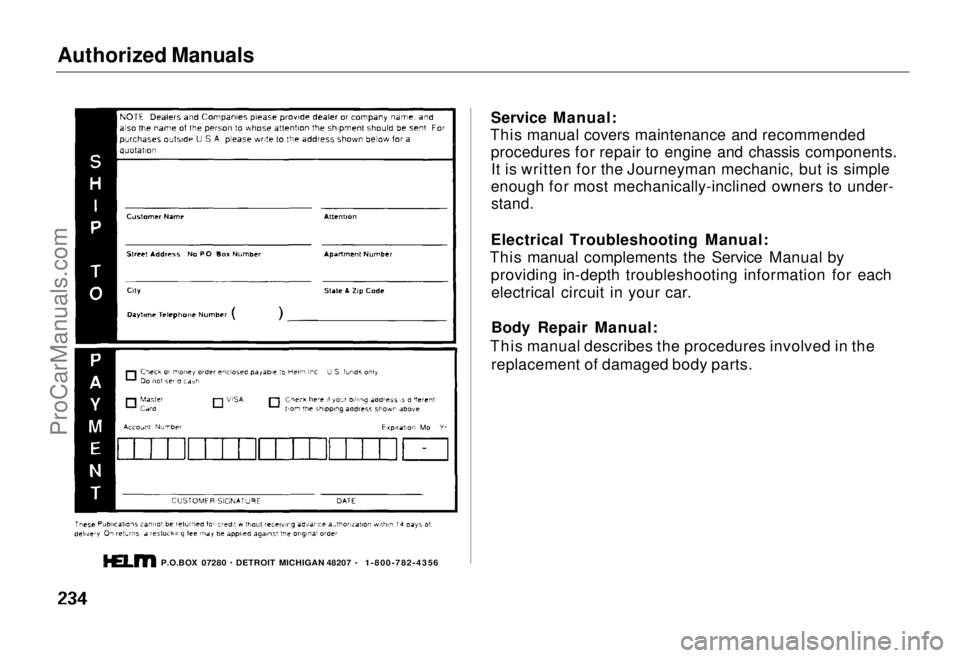
Service Manual:
This manual covers maintenance and recommended procedures for repair to engine and chassis components.It is written for the Journeyman mechanic, but is simple
enough for most mechanically-inclined owners to under-
stand.
Electrical Troubleshooting Manual:
This manual complements the Service Manual by providing in-depth troubleshooting information for eachelectrical circuit in your car.
Body Repair Manual:
This manual describes the procedures involved in the replacement of damaged body parts.
P.O.BOX 07280 DETROIT MICHIGAN 48207 1-800-782-4356
ProCarManuals.comMain Menu Table of Contents s t
Page 238 of 240
Index
Driver's Seat Power Height Adjustment.................. 57
Folding the Second Seats........... 60
Folding the Third Seats.............. 62
Head Restraints........................... 58
Passenger Seating....................... 56
Reclining the Second Seat.......... 61
Removing the Second Seats....... 59
Third Seat Access........................ 58
Serial Number................................ 216
Service Intervals............................ 140
Service Manual.............................. 233
Service Station Procedures .......... 110
Setting the Clock............................. 68
Shifting the Automatic
Transmission.............................. 120
Shift Lever Position Indicator...... 120 Side Marker Lights, Bulb
Replacement in.......................... 178
Signaling Turns................................ 43
Snow Tires...................................... 174
Solvent-type Cleaners.................... 184
Sound System................................... 84
Spare Tire
Inflating....................................... 192
Specifications............................. 219
Spark Plugs, Replacing................. 160
Specifications Charts..................... 218
Speed Control...................................
49
Speedometer......................................
39
SRS Indicator...............................
16,
37
START (Ignition
Key Position)..... 52
Starting the Engine........................ 119 In Cold Weather at HighAltitude................................... 119
With a Dead Battery ................. 200
Steam Coming from Engine......... 202 Steering Wheel Adjustment................................... 46
Anti-theft Column Lock.............. 52
Stereo Sound System...................... 84
Storing Your Car............................ 182
Sunroof.............................................. 65
Closing Manually....................... 207
Operation...................................... 65
Supplemental Restraint System Service Precautions..................... 17
Servicing....................................... 16
SRS Indicator.......................... 16, 37
System Components.................... 12 Tailgate............................................. 55
Taillights, Changing Bulbs in....... 179
Taking Care of the Unexpected .. 191 Tape Player................................. 89, 98
Technical Descriptions Anti-lock Brake System............ 220
Emission Control Systems........ 224
Three Way Catalytic
Converter................................ 226
Tire Information........................ 221
Temperature Gauge........................ 40
Tether Attachment Points.............. 26 Three Way Catalytic Converter... 226Time, Setting the............................. 68
Tire Chains..................................... 174
Tire, How to Change a Flat.......... 193
Tires................................................ 169 Air Pressure............................... 170
Checking Wear.......................... 171
Compact Spare........................... 192
DOT Tire Quality Grading....... 222
Inflation....................................... 169
CONTINUEDProCarManuals.comMain Menu s t